
The twentieth century was a turning point in the history of the cello. For the first time, cellists could be widely heard through recordings, radio broadcasts, and international touring, allowing their playing styles to be preserved, compared, and debated across generations.
As a result, the idea of the “greatest cellist” in this period is inseparable from influence – on technique, repertoire, pedagogy, and the public imagination.
Today, we’re taking a decade-by-decade approach, identifying the cellist who best represented what the cello meant in each moment of the twentieth century.
Together, these ten cellists trace the evolution of the instrument from its late-Romantic roots to its modern role as one of classical music’s most expressive voices.
1901–1909: Julius Klengel
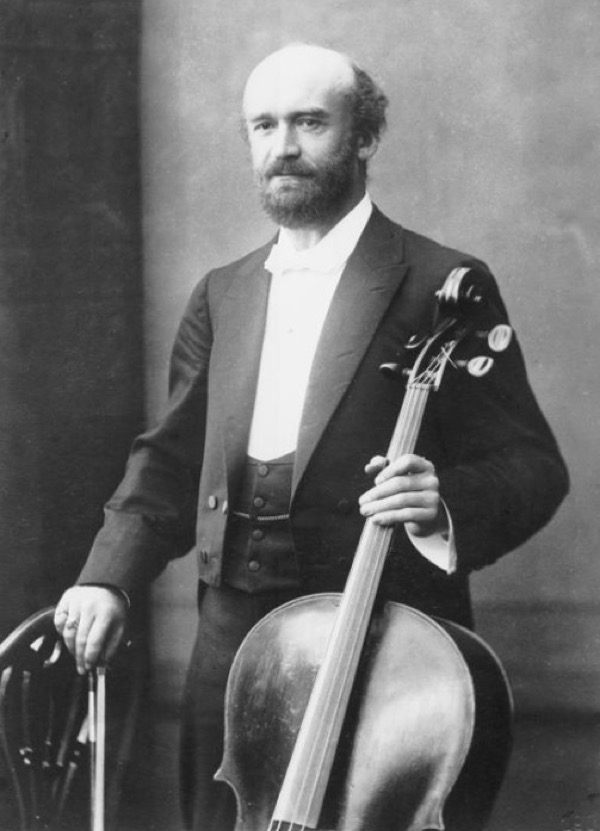
Julius Klengel
Klengel’s Hymnus für 12 Celli
Born in 1859 in Leipzig, Julius Klengel was already a central figure in German musical life by the turn of the century.
He served as principal cellist of the Leipzig Gewandhaus Orchestra and became one of Europe’s most influential cello pedagogues.
Klengel – as a performer, teacher, and composer of études – was an integral contributor to modern cello technique.
While later figures would revolutionize interpretation and become famous primarily as soloists rather than orchestral musicians or pedagogues, Klengel’s legacy lies more in his cementing the technical foundations on which that revolution could be built.
1910–1919: Pablo Casals
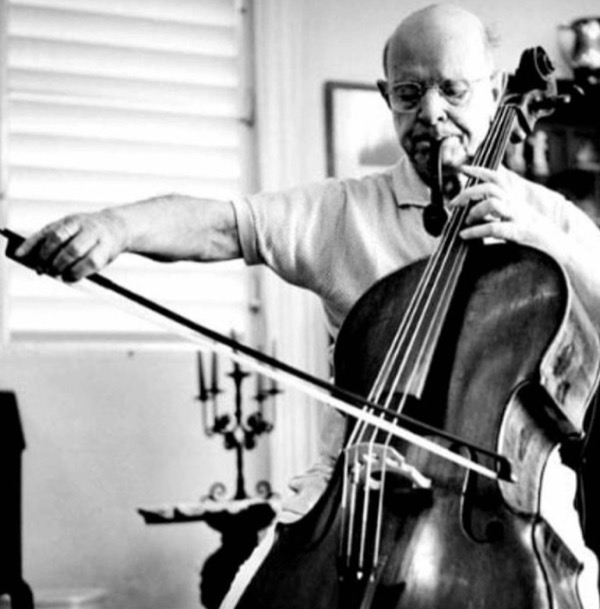
Pablo Casals
Casals playing the Bach Cello Suite No. 1
By the turn of the twentieth century, the 24-year-old Catalonian cellist Pablo Casals was already recognized as a remarkable musician – but it was during the 1910s that he began making his mark as one of the first great cello soloists.
Casals transformed cello playing through his insistence on expressive phrasing and structural awareness.
His rediscovery and lifelong advocacy of Bach’s Cello Suites was one of his most important contributions to the art. Today the suites are considered to be the heart of the cello repertoire, and they are a requirement at nearly every serious high-level audition.
Over the course of his career, Casals became an important moral voice in the music world, pushing for various humanitarian and anti-fascist causes.
1920–1929: Emanuel Feuermann
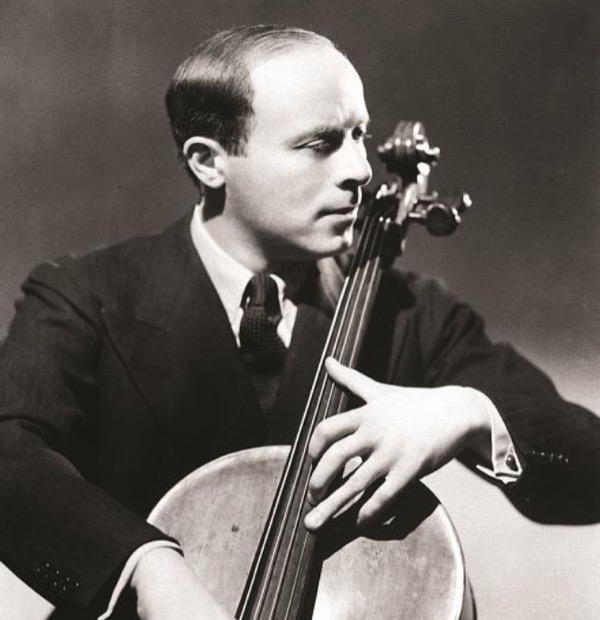
Emanuel Feuermann
Feuermann playing Dvořák’s Rondo in G minor and Popper’s Spinning Song
Emanuel Feuermann was born in 1902 in what is now Ukraine and was quickly acknowledged as one of the most impressive cello prodigies of his generation.
As a boy, he studied with Julius Klengel. Then, during the 1920s, he began an international career that astonished audiences and fellow musicians alike.
When Feuermann took the stage, cellists suddenly heard what was physically possible on the instrument in a way they never had before. His playing routinely combined flawless intonation, lightning-fast articulation, and effortless virtuosity with an unforced naturalness.
Feuermann’s career would be cut short – he died in 1942 at the age of 39 after complications from surgery – but the future of cello technique arrived with him in the 1920s.
Casals famously said after his death, “What a great artist Feuermann was! His early death was a great loss to music.”
1930–1939: Gregor Piatigorsky
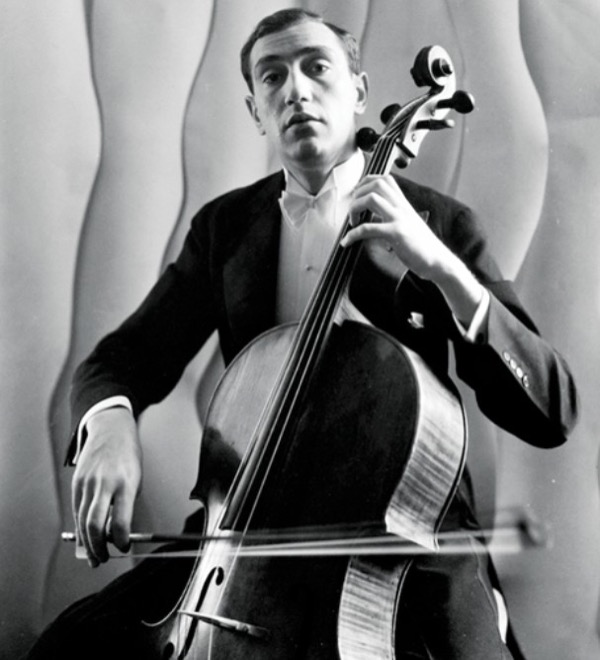
Gregor Piatigorsky
Piatigorsky playing the second movement of Chopin’s Cello Sonata
Born in 1903 in Ukraine, Gregor Piatigorsky rose to prominence in 1921 after escaping the Soviet Union by smuggling himself and his cello in a cattle car.
After that daring escape, he completed his training in Berlin and Leipzig before being appointed principal cello of the Berlin Philharmonic.
By the 1930s, thanks to his talent and his marriage to the wealthy socialite Jacqueline de Rothschild, he had become one of the most visible and glamorous cellists in the world.
Piatigorsky’s appeal lay in his elegance and communicative ease. His playing balanced technical polish with warmth, personality, and a sense of drama, lending his playing – and the cello itself – an air of both sophistication and approachability.
He also cultivated a public persona that fit the interwar era’s fascination with international virtuosos.
1940–1949: Pierre Fournier
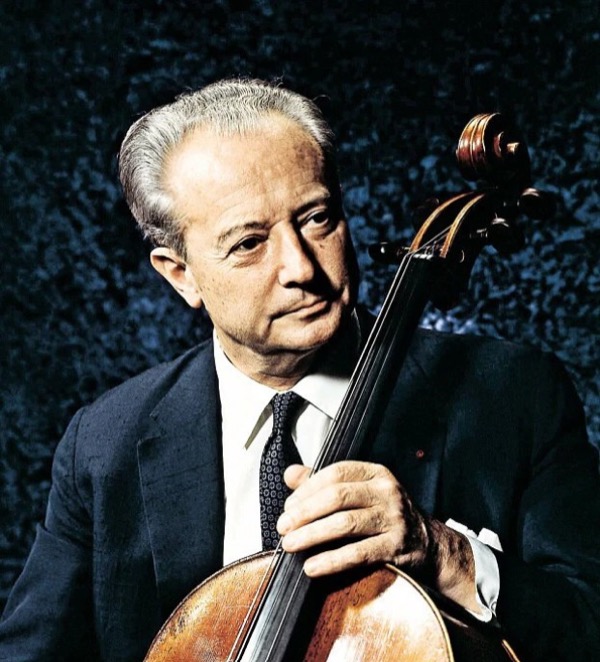
Pierre Fournier
Fournier plays Schumann’s Cello Concerto
Pierre Fournier was born in Paris in 1906 and initially trained as a pianist before turning to the cello after a case of childhood polio made it difficult for him to work piano pedals.
Nicknamed the “aristocrat of cellists,” Fournier exemplified clarity, balance, and restraint. His interpretations avoided excess, instead favouring elegance of line and tonal refinement.
In 1937, he took a position at the Paris Conservatoire, and by the 1940s, he had become a leading figure in European musical life, touring internationally.
After the war, he was criticised for earning money by playing on the German radio station Radio-Paris during the Nazi occupation of France. He was banned from playing in France for six months.
His career exemplifies one uniquely twentieth-century phenomenon: how even well-respected soloists found their professional reputations tarnished by working with the Nazi regime.
1950–1959: Mstislav Rostropovich
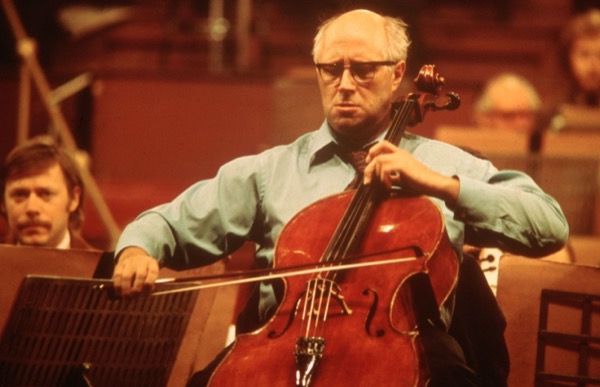
Mstislav Rostropovich
Rostropovich playing Shostakovich’s Cello Concerto No. 1
Born in 1927 in Baku in present-day Azerbaijan, Mstislav Rostropovich emerged from the Soviet musical system with extraordinary gifts as a cellist, musician-intellectual, and activist. By the 1950s, his rise was unstoppable.
Rostropovich possessed a massive, fearless sound and an unparalleled commitment to contemporary music. Composers such as Shostakovich and Prokofiev wrote major works specifically for him, permanently expanding the cello’s modern repertoire.
In 1974, after years of conflict with Soviet authorities, he and his family fled the country for the United States. He had always advocated for human rights and political and artistic freedom, and those passions only intensified after his exile.
Consequently, in this decade, Rostropovich helped the cello become a vehicle for twentieth-century expression and political advocacy.
1960–1969: Jacqueline du Pré
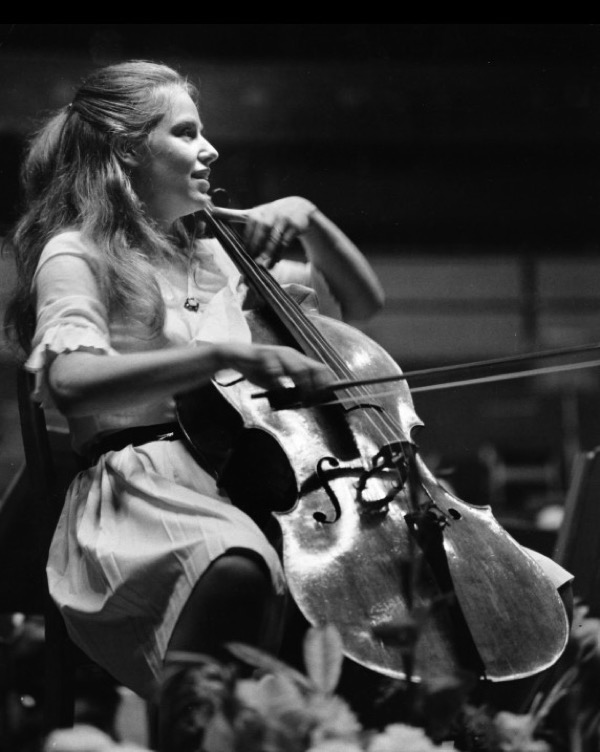
Jacqueline du Pré
du Pré playing the Elgar cello concerto with conductor Daniel Barenboim
Jacqueline du Pré was born in Oxford in 1945 and rose to international fame at a stunning pace.
Her playing was marked by emotional urgency, physical intensity, and a sense of total personal commitment. Audiences responded not just to her sound, but to the feeling that in her performances, she was holding absolutely nothing back.
Her breakthrough recording of Elgar’s Cello Concerto with Sir John Barbirolli in 1965 became an instant classic and made that concerto a pillar of the cello repertoire.
In 1967, in a development that felt like the culmination of a musical fairytale, she married her colleague, conductor and pianist Daniel Barenboim.
For a brief but truly incandescent moment, du Pré redefined what emotional truth at the cello – and what a glamorous woman cello soloist, taken as seriously as her male peers – could sound and look like.
Her career came to a devastating early end in her twenties, when she was diagnosed with multiple sclerosis.
1970–1979: János Starker
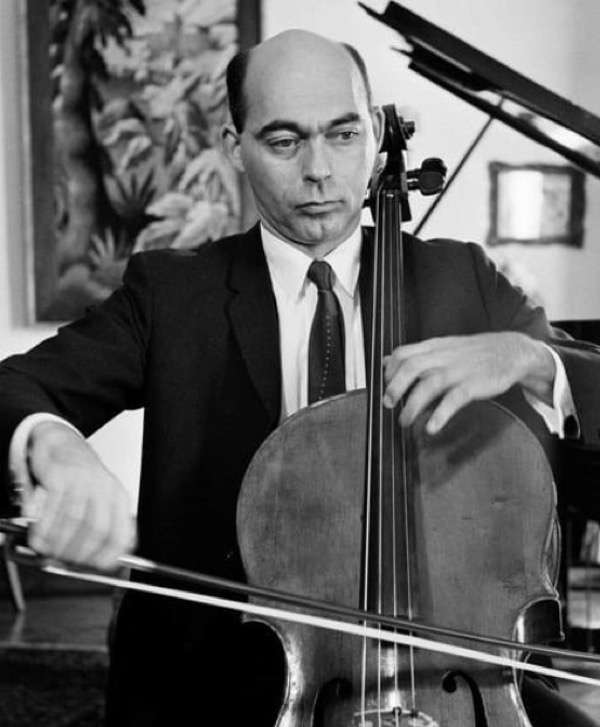
János Starker
Starker playing Beethoven’s Cello Sonata No. 3
Born in Budapest in 1924, János Starker survived the Holocaust and built a career grounded in discipline, clarity, and intellectual rigour.
By the 1970s, he had become one of the most influential cellists and teachers in the world.
Starker’s playing emphasised economy of motion, structural coherence, and technical control, particularly in Bach.
His approach offered an alternative to du Pré’s overtly emotional style, providing a bit of a corrective after the revolution of extroversion she’d ignited during the 1960s.
1980–1989: Mischa Maisky
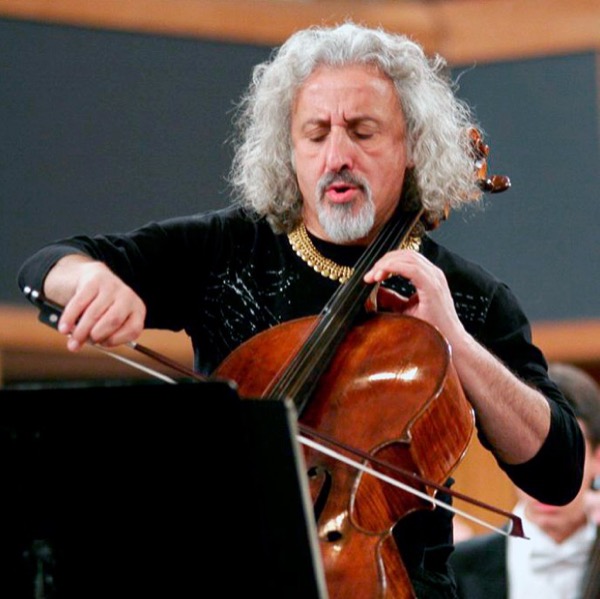
Mischa Maisky
Maisky playing Haydn’s Cello Concerto No. 1
Mischa Maisky was born in Riga in present-day Latvia in 1948 and trained in the Soviet system before emigrating to the West.
A student of both Rostropovich and Piatigorsky, he combined two powerful twentieth-century cello lineages in one player.
Maisky’s playing is unapologetically Romantic, with its wide vibrato, flexible tempos, and individualistic style.
In the pluralistic musical landscape of the 1980s, his individuality stood out, sometimes controversially so.
Maisky represents a decade in which the consensus on what a cellist should sound like began to fracture, and artists’ personal voices began to take precedence.
1990–1999: Yo-Yo Ma
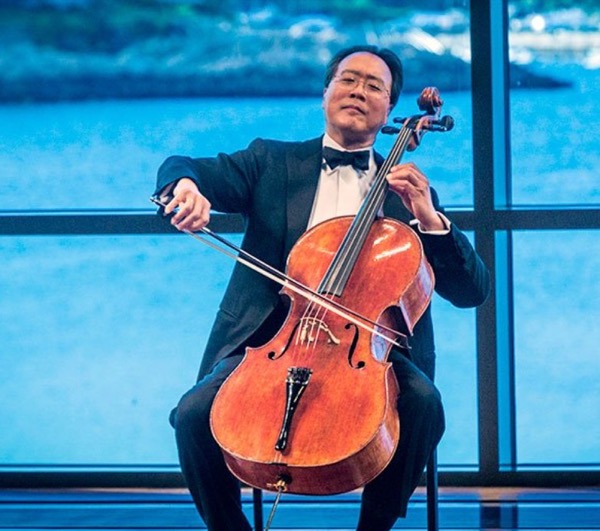
Yo-Yo Ma
Yo-Yo Ma playing Dvořák’s Cello Concerto
Born in Paris in 1955 to Chinese parents and raised in the United States, Yo-Yo Ma was a remarkable prodigy who grew into a fixture of pop culture and mass media.
By the 1990s, Ma had become a global cultural figure, equally comfortable in Bach, contemporary commissions, film scores, and cross-cultural collaboration.
Through projects like the Silk Road Ensemble, Ma ensured that the cello could serve as a bridge between traditions from around the globe, rather than a monument to a single European genre.
He has also devoted a large portion of his career to advancing humanitarian causes, having been named a United Nations Messenger of Peace.
Today, he remains one of the most popular instrumentalists on the concert circuit, and he is universally celebrated for his good nature and endless musical curiosity, as well as the warm humanity and exuberant virtuosity of his playing.
Conclusion
By the end of the twentieth century, the cello had undergone a remarkable transformation.
The century began with the establishment of the cello as a solo concerto instrument. Over the following generations, it evolved into a vehicle for moral seriousness, dazzling virtuosity, political expression, emotional candour, and ultimately global dialogue.
Each cellist on the list built on the work of the men and women who came before them. Julius Klengel built the technical grammar; Pablo Casals and Mstislav Rostropovich created the blueprint of the artist-advocate; Gregor Piatigorsky and Jacqueline du Pré made it glamorous; Emanuel Feuermann, Pierre Fournier, and János Starker all embraced discipline and restraint; Mischa Maisky championed emotional immediacy; and Yo-Yo Ma opened the cello to the wider world and created a template for international soloists to use during the new century.
Taken together, these cellists illustrate how the cello itself changed, responding to artistic movements, historical upheavals, and evolving ideas of what classical music could – and should – express.
For more of the best in classical music, sign up for our E-Newsletter





It is impossible to compare cellists. Let them speak for themselves.
Missed the point. Nobody is comparing them
Rostropovich gave a recital the proceeds of which helped my Youth Orchestra attend a festival. Sitting 30 feet away and experiencing this was fabulous for our teen minds! That moment only enhanced his legend for me. He then went on to conduct our local orchestra.
In my 2025 memoir “I Knew a Man Who Knew Brahms,” I write about Rostropovich (and Stokowski, Ormandy and others) from musical and personal perspectives. In my career as an orchestra librarian, I heard many cellists, some of them great, but Slava had a unique sound and expressiveness — unforgettable! His astonishing technique was always at the service of the music.