The Russian art song has a distinguished history. The genre’s origins are attributed to Mikhail Glinka, who made it part of his campaign to create a Russian national style distinct from European musical culture.
Anton Arensky (1861–1906) studied at the St Petersburg Conservatory with Nikolai Rimsky-Korsakov; upon graduation, he became a professor at the Moscow Conservatory. In his 12 years there, the greatest of Russian composers were his students, including Rachmaninoff, Scriabin, Glière, Grechaninov, and Medtner. After leaving the Moscow Conservatory, he returned to St Petersburg, where he was director of the Imperial Choir from 1895 until his retirement in 1901.
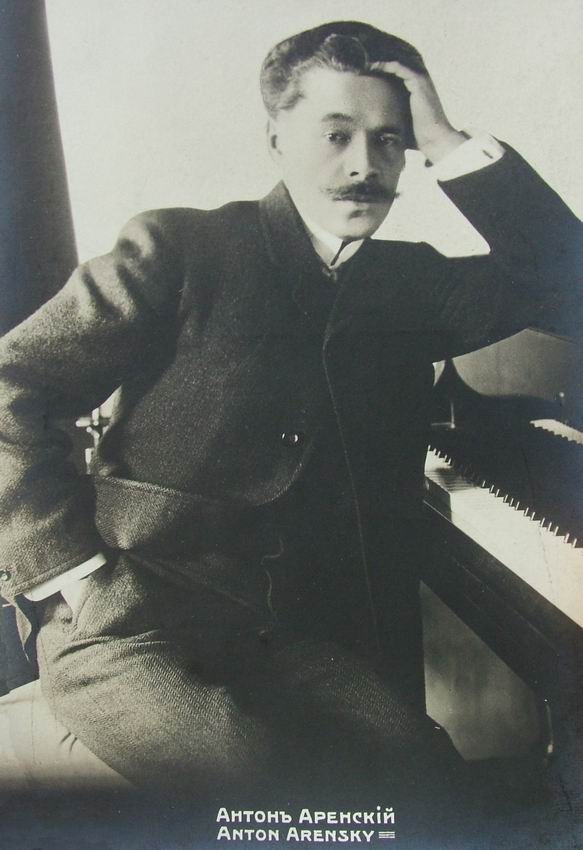
Anton Arensky, 1895
His student at the Moscow Conservatory, Sergei Rachmaninoff (1873–1943), far better known than his teacher, started studying with Arensky in 1885, when he was 12, and remained his student for the next 3 years. Rachmaninoff was aware of Arensky’s contribution to his musical education, ‘often recalled later in life how valuable those lessons had been, saying that Arensky had given him the tools to think more broadly and inventively about his own music’.
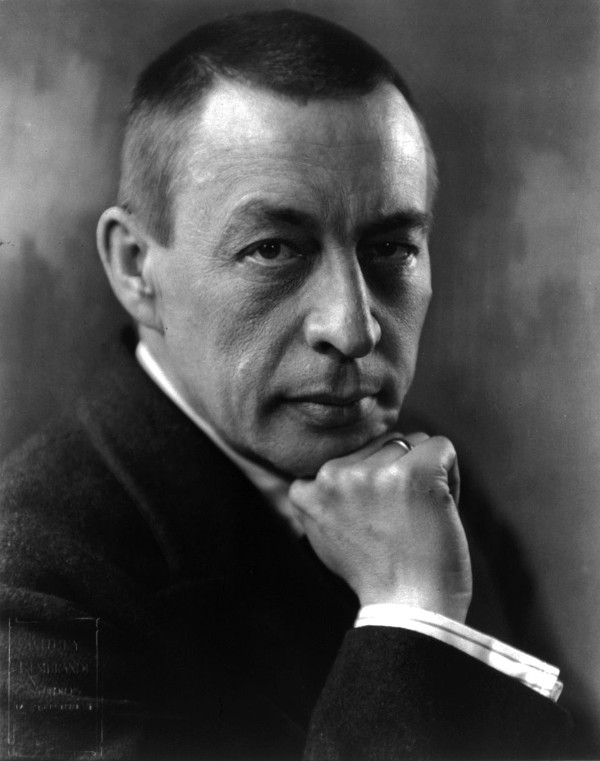
Sergei Rachmaninoff, ca. 1921 (Library of Congress, cph.3a40575)
Arensky’s teacher, Rimsky-Korsakov, thought his work was too influenced by Tchaikovsky, and, indeed, his Variations on a Theme of Tchaikovsky, Op.35a for string orchestra, of 1894, remains Arensky’s most famous work even now. Contemporary critics regarded Arensky as ‘standing…in the shadow of greater figures’ but didn’t give enough credit to his role as a teacher of the next generation of Russian composers.
A new album by soprano Anastasia Prokofieva, juxtaposing Arensky’s and Rachmaninoff’s art songs with Sergey Rybin on piano, lets us examine the teacher and his student. The album opens with Arensky’s 5 Romances, Op. 70, setting texts by Tatiana Shchepkina-Kupernik (1874–1952). Their date of composition is unknown, but the Opus number puts the work in 1904 or 1905.
Many of Arensky’s 60-some songs are undated, and he set a large number of Russian poets, from Konstantin Balmont, who wrote poetry based on Shelley’s poems, to Lermontov, Pushkin, and Aleksey Tolstoy.
The songs are beautiful and have a certain Russian sound that emphasises the melancholic side of the texts. One of the most interesting is the song ‘Poetry’ to a text by Semyon Nadson. It starts out as a description of the emergence of Poetry, crowned in roses, from the shelter of heaven. Her motto is ‘Art for Art’s Sake’ and her creed, ‘To Serve Beauty’. But her encounter with the world goes very poorly, ending with her soul in torment and her crown of roses lying in the dust.
Anton Arensky: 5 Romances, WoO, No.1 Poėziya
Rachmaninoff tends towards more dramatic settings than did Arensky. As the next generation of Russian composers, he could be more fantastical in his approach, such as No. 6 from the Romances, Op. 38 of 1916. Our lover is lured into the mountains by her laughter, but there’s no assurance he can find the woman he seeks, no matter how deep he goes into the forest.
Sergei Rachmaninoff: Romances, Op. 38, No. 6. ‘A-u!’
Anastasia Prokofieva’s voice is lower than you might expect for a soprano, and it suits the music and its feelings very sympathetically. The pianist, Sergey Rybin, plays with elegant precision.
The recording is evenly divided between the two composers and gives us an interesting view of the teacher’s work and the student who always credited his teacher with giving him the key to expanding from a beginning level to the greatness he later achieved.
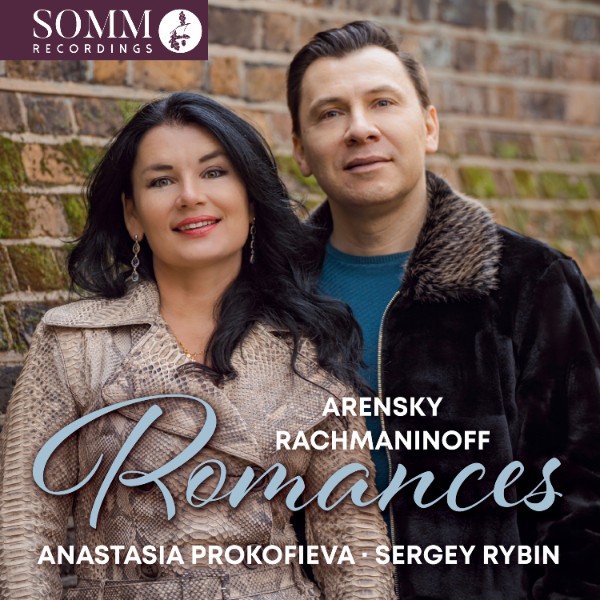
Arensky & Rachmaninoff: Romances
Anton Arensky; Sergei Rachmaninoff
Anastasia Prokofieva (soprano); Sergey Rybin (piano)
SOMM Recordings SOMMCD 0716
Official Website
For more of the best in classical music, sign up for our E-Newsletter