In the 19th century, women cellists faced a barrier that women violinists and pianists didn’t: before the rise of the endpin, playing the cello required sitting with the instrument held between the knees, which audiences considered unseemly.
However, beginning in the 1800s, a generation of women cellists chipped away at that prejudice, starting with Lisa Cristiani, who found a wardrobe workaround that helped audiences take her seriously as an artist.
Today we’re looking at the stories of six women cellists born in the 19th century. One became a professional orchestral player decades before women were widely permitted to join such ensembles; another played in a coal mine; still another became the partner of cello great Pablo Casals, while becoming one of the century’s great cellists herself.
Lisa Cristiani (c. 1827–1853)
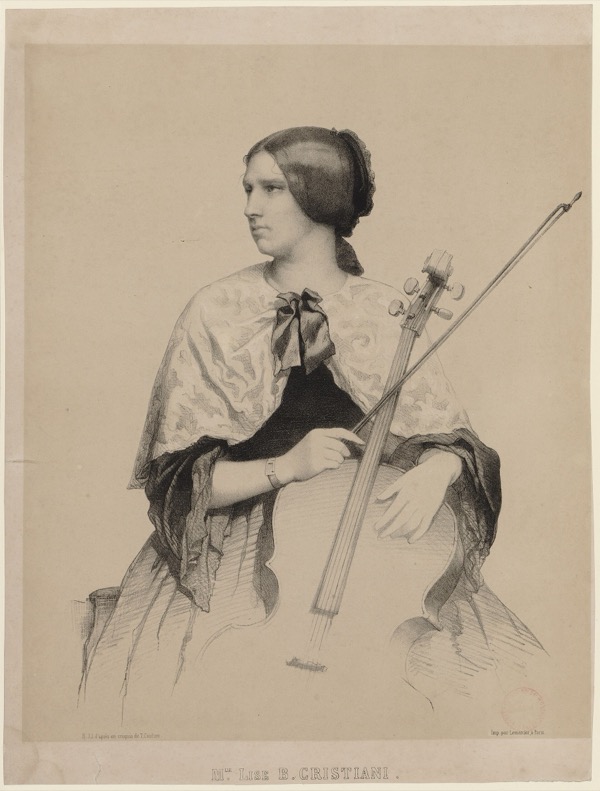
Lisa Cristiani
Lisa Cristiani was born in Paris around 1827. Her parents died when she was a child, and her grandparents raised her.
She began taking piano lessons as a young girl. Later, in her teens, she took up the cello – an extremely unusual choice for women.
She advanced rapidly, studying under Bernard Benazet, the principal cellist of the Paris Théâtre-Italien orchestra. She performed in Paris and was so successful that she toured Germany and Austria.
During her stop in Leipzig, Felix Mendelssohn – music director of the Leipzig Gewandhaus – was deeply impressed, dedicating his Song Without Words in D major, Op. 109, to her.
Mendelssohn’s Song Without Words in D major, Op. 109
Audiences of the era, nearly all of whom had never seen a woman cellist, were concerned about how she’d appear publicly while retaining her modesty.
The solution lay in her wardrobe and in the words of one 1846 review: dressed “in a loose, flowing dress that completely concealed the contours of her body,” she made it acceptable.
In the late 1840s, Cristiani embarked on a massive tour of Russia, carrying her Stradivari in a metal case wrapped in wolfskins. Tragedy struck in 1853 in the city of Novocherkassk, about a hundred miles from the present-day border of Russia and Ukraine, where she died of cholera. She was only in her mid-twenties.
Walborg Lagerwall (1851–1940)
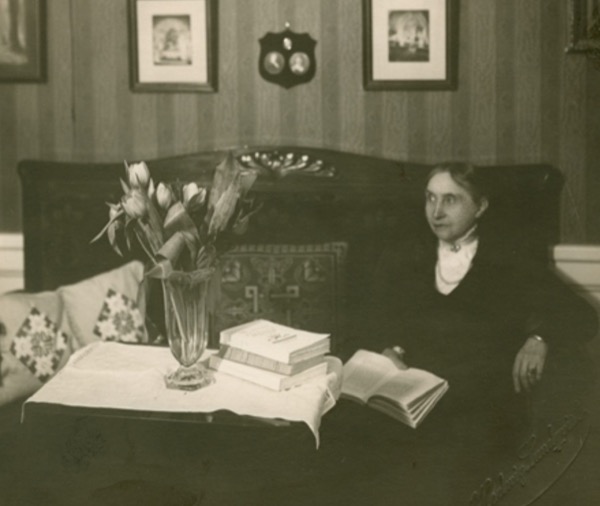
Walborg Lagerwall
Walborg Lagerwall was born in 1851 in Österhaninge, just south of Stockholm. She studied piano at Stockholm’s Royal College of Music, where she enrolled in 1872.
It is unclear exactly when she took up the cello, but sometime in the mid-1870s, she began studying it at the college.
She played chamber music during her student years, and even toured Scandinavia with an all-female piano trio in 1879.
In November 1884, she joined the Royal Theatre orchestra in Stockholm. Her annual contract was renewed for five years, making her one of the first women in Europe to join a professional orchestra of male players.
She retired from performance in 1889, moving to the south of France for health reasons.
Margarethe Quidde (1858–1940)
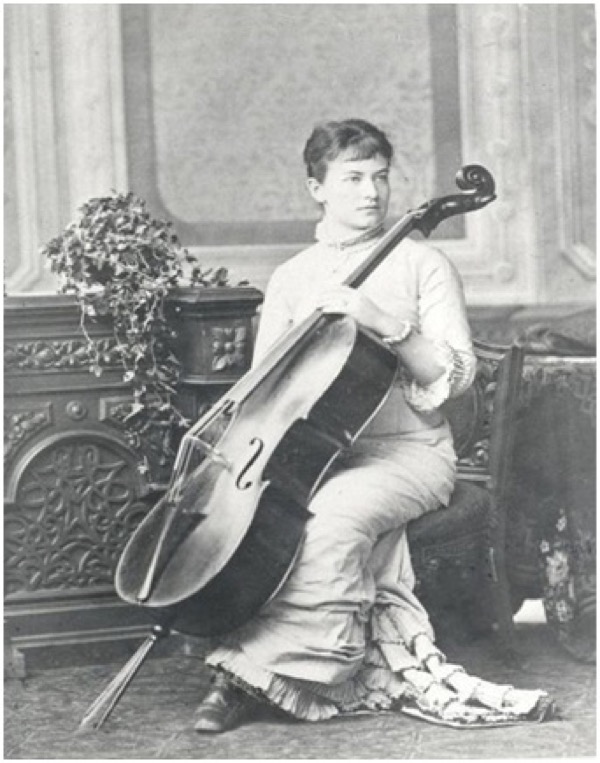
Margarethe Quidde
Cellist and pianist Margarethe Quidde was born in 1858 in Königsberg, now Kaliningrad, to a prominent ophthalmologist father and his opera-singer wife.
She started studying music as a child. In 1874, at age sixteen, she became a pupil of Clara Schumann’s half-brother, Woldemar Bargiel. She also began studying cello with Robert Hausmann, the prominent German cellist who premiered Bruch’s Kol Nidrei and Brahms’s Double Concerto. Later she studied with Hausmann’s teacher Carlo Alfredo Piatti.
In her early twenties, she appeared in Vienna and Munich. But in 1882, just as her career was getting started, she married politician and pacifist Ludwig Quidde.
Like many women of her generation, Margarethe stepped back from the stage after marriage – in her case, at her new husband’s request.
Their marriage was rocky. In the early 1890s, she left him for a period of time before reconciling. They never divorced but eventually began living in separate cities.
Starting in 1902, she returned to the stage, specialising in chamber music performances. Through it all, she stayed involved in the musical world by writing music criticism for the Munich Free Press. She also taught cello – and even made appearances as a pianist.
In 1933, her husband fled the Nazis with his lover. Despite the danger her Jewish ancestry presented, Margarethe remained in Munich to care for her sick sister.
Margarethe died in 1940 of heart failure. It is tempting to imagine what kind of career she would have had if she hadn’t married.
Flavie Van den Hende (1865–1925)
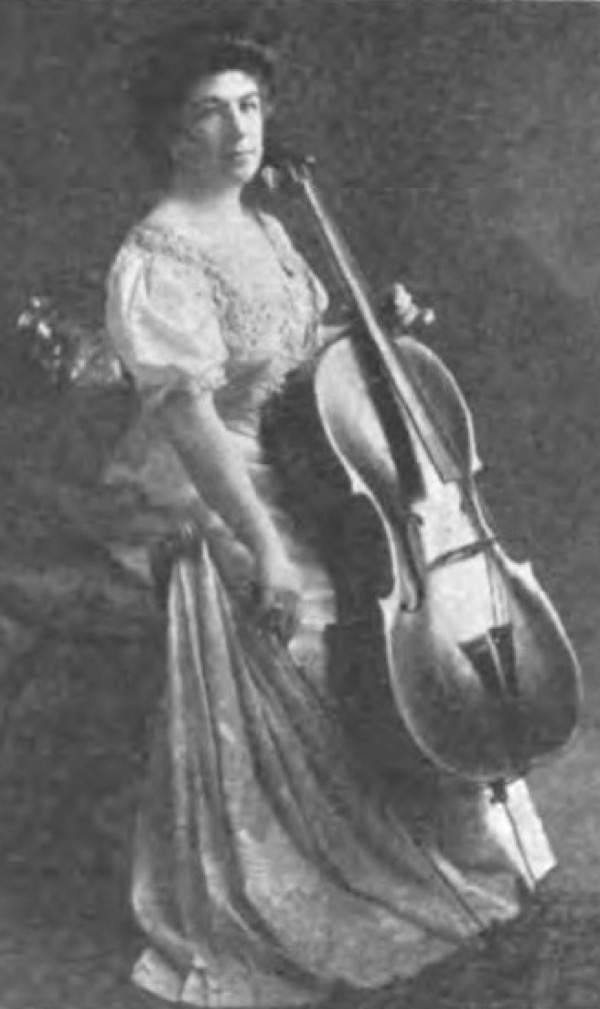
Flavie Van den Hende
Flavie van den Hende was born in Renaix, Belgium, in 1865. She began studying cello and entered the Royal Conservatory in Brussels in 1880. Five years later, she won a first prize in cello playing and chamber music.
In 1890, she moved to the United States and settled in New York in 1892.
She toured throughout the Northeast and appeared as a soloist with the Cincinnati Symphony, the Chicago Symphony, and the New York Symphony Orchestra, a predecessor to the New York Philharmonic. This made her one of the first female cello soloists to appear with major American orchestras.
In 1895, she founded the New York Ladies’ Trio, a piano trio that performed works by Beethoven, Smetana, and fellow female musical pioneer Cécile Chaminade.
She died at her home in Yonkers, New York, in 1925.
Guilhermina Suggia (1885–1950)
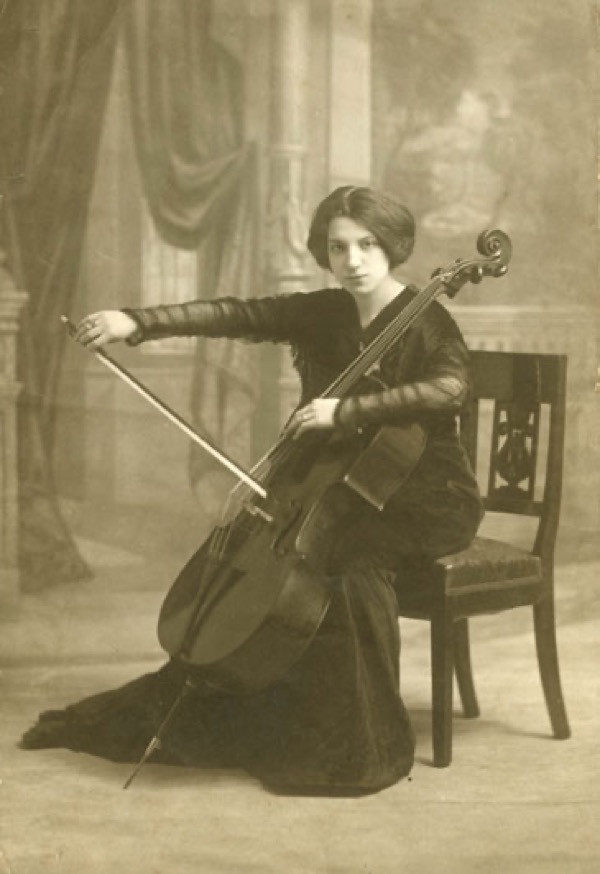
Guilhermina Suggia
Guilhermina Suggia was born in Porto, Portugal, in 1885. She began learning cello from her father and became the principal cellist of the local orchestra when she was just twelve.
In 1904, the year she turned nineteen, she began studying in Leipzig with Julius Klengel, teacher of later 20th-century greats like Feuermann and Piatigorsky. Soon after, she was asked to appear as soloist with the storied Leipzig Gewandhaus Orchestra.
Between 1906 and 1912, she began dating fellow cellist Pablo Casals and moved in with him. (Some thought they were married.) Both became internationally famous.
In 1914, she formed a piano trio with Fanny Davies, who studied under Clara Schumann, and Jelly d’Aranyi (the fiery violinist for whom Ravel wrote Tzigane).
Suggia playing Haydn’s Cello Concerto in D, from 1928
She made her home in Britain in the 1920s and 1930s, eventually marrying Jose Mena, an X-ray specialist, in 1927.
The couple returned to her home country of Portugal during World War II. There, she retired from the concert stage and focused on teaching and died in 1950.
Her glamorous life helped to bring the idea of the woman cello soloist into the 20th century.
Anna Luboshutz (1887–1975)
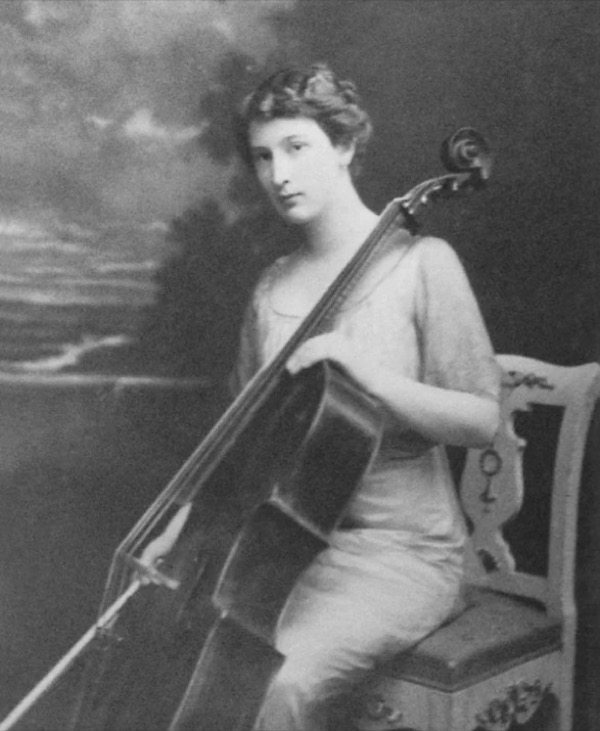
Anna Luboshutz
Anna Luboshutz was born in Odessa in 1887 to a musical family. Her first teacher was her father.
In 1904, the year she turned seventeen, she began attending the Moscow Conservatory. While there, she joined an all-female piano trio; her sister Lea was the violinist.
Later, her brother joined the ensemble, and it became a sibling trio. They performed together all across Russia, introducing the idea of a woman cellist to countless listeners.
After the Russian Revolution, her brother and sister fled to America. Anna stayed behind with her internist husband and daughter. (We wrote about the saga of her sister Lea here: https://interlude.hk/the-nightingales-sonata-the-story-of-violinist-lea-luboshutz-and-her-musical-dynasty/.)
Anna threw herself into concertizing throughout the Soviet Union, appearing in unusual venues like factories and even coal mines.
She also appeared regularly on Soviet radio and often played with the Moscow Philharmonic during the 1930s.
She became the first cellist, male or female, to earn the title “Honoured Artist of the Russian Soviet Federative Socialist Republic.”
She gave her final performance in February 1947.
Her legacy lived on: over two decades after her retirement, in 1969, cellist Mstislav Rostropovich hosted a gala event in Moscow in her honour, demonstrating her lasting influence.
Luboshutz’s career proved to Soviet audiences that women could fully succeed as cello soloists.
Conclusion
Each of these women had a career with a unique trajectory. Each found a new way to build a career on an instrument whose history, up to that moment, had included vanishingly few women players.
By the time Suggia had her triumphantly glamorous portrait painted in the 1920s, it was clear the new century would be more welcoming to women cello soloists: the fight Cristiani had begun fifty years earlier had been half-won.
Fortunately, none of the great women cellists who came after the six virtuosos above had to start their arguments from scratch.
For more of the best in classical music, sign up for our E-Newsletter