Inspirations Behind Darius Milhaud’s Le boeuf sur le toit
At the heart of Darius Milhaud‘s 15-minute ballet, Le boeuf sur le toit, was his trip to South America in 1919. Returning to Paris, he and his friends got together to create a show based around a popular song he’d heard in Brazil: O Boi no Telhado (The ox on the roof).
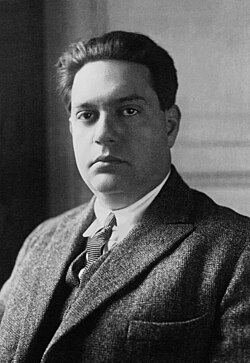
The Meurisse Agency: Darius Milhaud, 1923 (Gallica: btv1b9024401w)
The use of musical styles from other countries was very much the fashion in 1920s Paris, and it wasn’t only Milhaud’s South American music. Even more important was American music and jazz. Post-war Paris was jazz-mad and was also a place of attraction for American artists.
Cocteau saw the use of popular genres from other countries as a way of freeing French music from the impressionism of Debussy and used it as a way of creating the unique genre of ‘French music of France’ where elements of international music, including popular songs, festive fanfares, South American rhythms, fox-trot, ragtime, shimmy and jazz could appear side-by-side, stripped of their former nationalism and now became part of French music.
On the original programme for the premiere, Cocteau appended a subtitle: Le boeuf sur le toit: The Nothing-Happens Bar. Cocteau’s plot is set in a bar in the US…with music that was a collage of popular Brazilian melodies. However, the visuals ended up setting the music into the background. To Milhaud, the composer, he could see/hear the disconnect between the slowed American visuals and his quick Brazilian-style music. The audience didn’t catch the mix of nationalities. It was a contrast with the staging, but then, that’s what was expected of post-war music in France!
The circle around Cocteau had just been named Les Six by French musicologist Henry Collet, who made a comparison with The Russian Five. Collectively, Les Six worked to create unique shows, and the ‘spectacle-concert’ where Le boeuf sur le toit appeared was one of these. There were only three performances announced, and the work was joined on the program by other premieres: Trois petites pièces montées (Three little stuffed pieces) by Erik Satie, Georges Auric‘s foxtrot Adieu New-York! and Francis Poulenc‘s three songs Cocardes (Cockades) that he regarded as the most characteristic of his work as part of Les Six. Poulenc also wrote an entrance Ouverture.
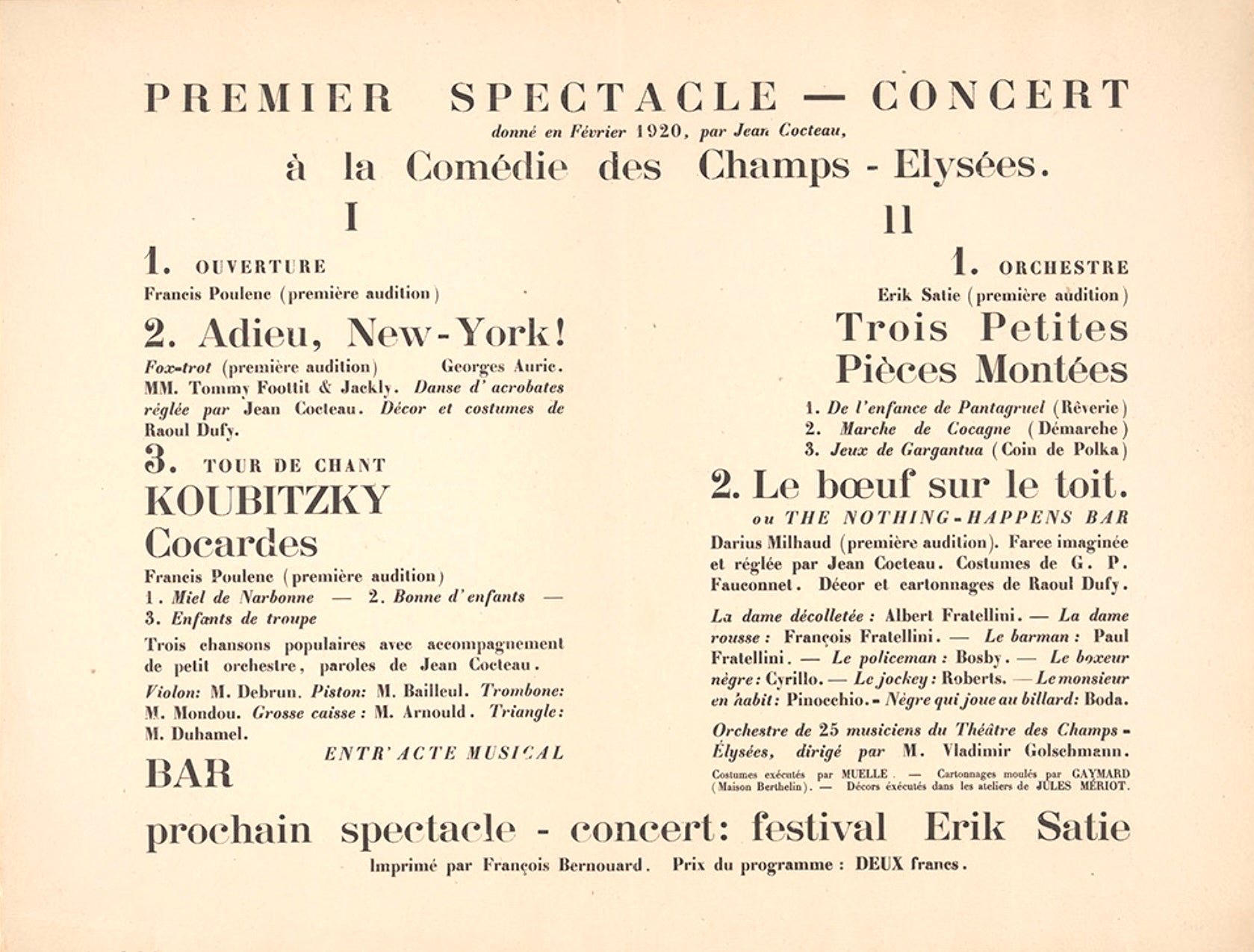
Program for the Premier Spectacle-Concert, February 1920
At the premiere, everyone was anxious. Milhaud reported that Cocteau was so nervous that he had 300 private pneumatiques (equivalent to telegrams) sent out that could be presented for a free seat. It didn’t matter – the lines were out the door, and its popularity was immediate.
Originally, Milhaud had conceived Le boeuf sur le toit as background music for an unnamed silent film by Charlie Chaplin. It was Cocteau who thought about the work as a production on its own, as a theatrical spectacle. But, because it was Cocteau, he worked in what he later called ‘accidental synchronism’ where a ‘collage of a plot’ or a choreography would be performed over inappropriate music to get an audience reaction. As a result, the ballet’s movements did not coincide with the action on stage. The stage movements were performed as if in a slow-movement film, while the music had its own life. Milhaud thought that this ‘gave the whole ensemble an unreal character’ that resembled a film more than a theatre. One writer compared this device to the simultaneity of Cubism (Cocteau had also used this technique in the ballet Parade two years earlier).
The program clearly states that the work is a ‘farce imagined and arranged by Cocteau, with costumes by G.P. Fauconnet, and with stage designs by Raoul Dufy.’ For the program book, Dufy created a lithograph that crammed as much of the chaos onstage into a single image as possible.
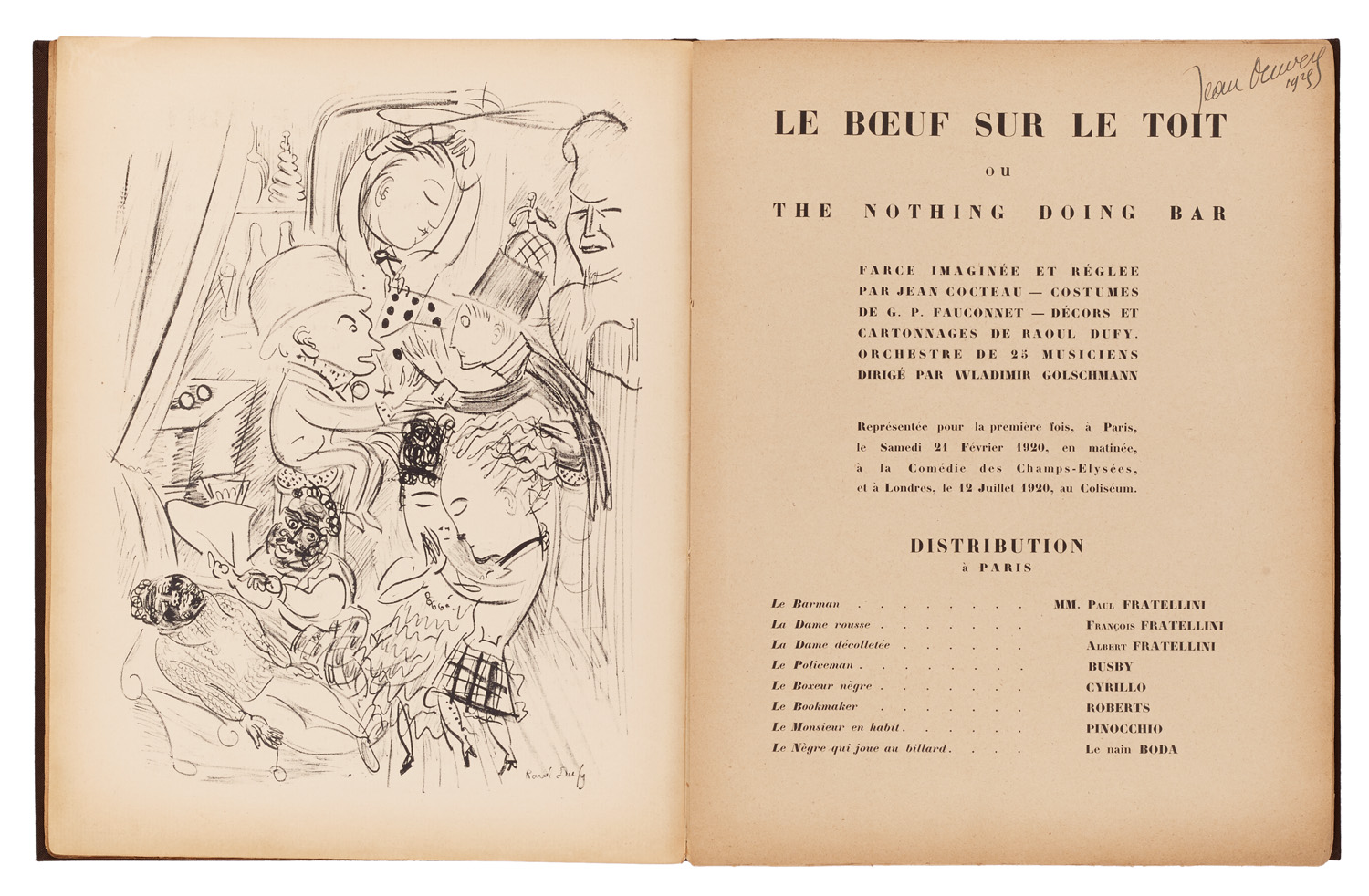
Raoul Dufy: Frontispiece with title page of programme book, 1920
The image has been summarised as ‘The stage set is that of a bar frequented by a number of characters: a boxer, a dwarf, a lady of fashion, a red-headed woman dressed as a man, a bookmaker, a gentleman in evening dress, a policeman who is decapitated by the blades of an overhead fan before being revived, and a number of others’.
The Fratellini Brothers played the roles of The Barman (Paul), The Red-haired Woman (François) and The Woman in the Low-Cut Dress (Albert).
Jean Cocteau did two drawings that captured the Fratellini Brothers, one coloured to show The Red-Haired Woman’s characteristic colour.
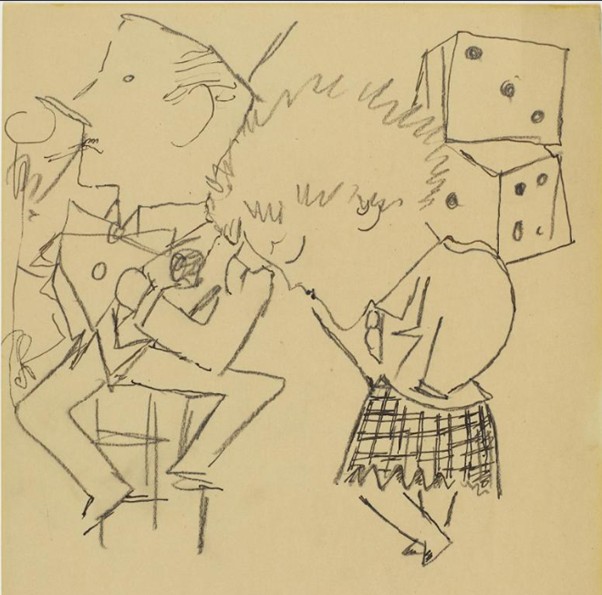
Jean Cocteau: Les Frères Fratellini dans Le Boeuf sur le toit, 1920 (Pompidou Center: AM 2019-227)
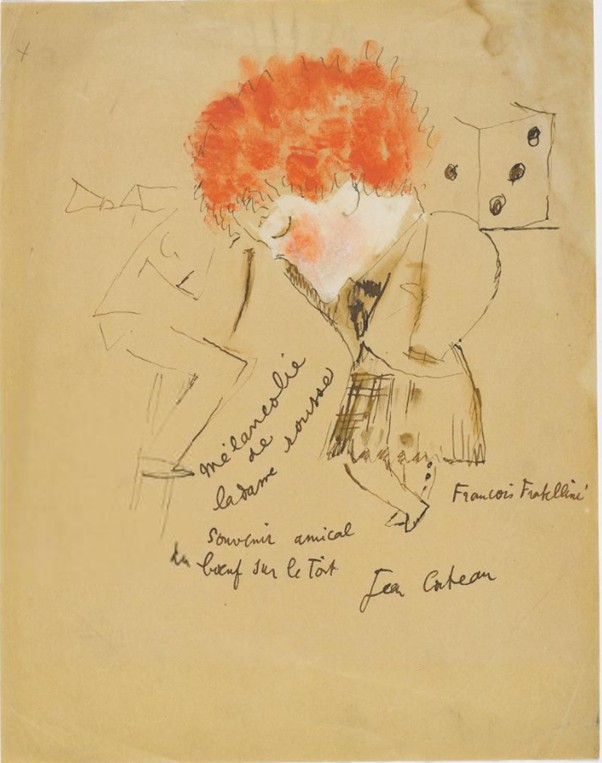
Cocteau: François Fratellini dans le rôle de la Dame rousse, dans Le Boeuf sur le toit, 1920 (Pompidou Center: AM 2019-226)
To Milhaud, who intended to be a serious composer, this side trip into comedy and humour wasn’t what he wanted. He wasn’t like Satie, who deliberately wrote works that were mocking, comic, and unserious. It would be another decade before Milhaud, the serious composer, known for his tragedies such as Les Choéphores, emerged from behind the screen where Cocteau had placed him.
Le boeuf sur le toit, despite its adoption (should one say appropriation?) of Brazilian music, was always French. One writer in 1923 said about the work: ‘Mr. Darius Milhaud recently published in Paris a series of Brazilian dances, in most of which the French naturalisation is manifested’ (Mário de Andrade).
Milhaud was fascinated by the music he heard on the streets of Rio de Janeiro. He heard ‘the rhythmic richness, the indefinitely renewed fantasy, the verve, the vivacity, the melodic invention of a prodigious imagination’, particularly in the music of Marcello Tupynambá (1889–1953) and Ernesto Nazareth (1863–1934).
In an article in the French journal Revue Musicale, Milhaud explained that he didn’t think that Brazilian composers (presumably of classical, serious music) had yet discovered the wonders that were occurring in popular music. Milhaud was using the freedom of French, Mediterranean, Latin, and South American music to counter the strictures he saw Germanic music and culture imposing on French music. Milhaud, who was from Marseille, France, wanted a style of French music that suited his southern soul.
On 10 January 1922, the cabaret Le boeuf sur le toit was opened in Paris by Louis Moysés, and it became the de facto clubhouse for Les Six. Opened at 28, rue Boissy-d’Anglas in the 8th arrondissement, it was an immediate success and dominated Parisian cabaret life through the 1920s. On opening night, the attendees included Picasso, Diaghilev, René Clair, and Maurice Chevalier. Over the next decade, the bar moved to another address on the same street and is now located at 34, rue du Colisée. The bar was primarily dedicated to music and was a source for new jazz coming from America, and one could hear ‘Eugene McCown playing jazz, Jean Wiéner playing Bach, the virtuoso pianist Clément Doucet playing Cole Porter, or Marianne Oswald performing the songs of Kurt Weill’.
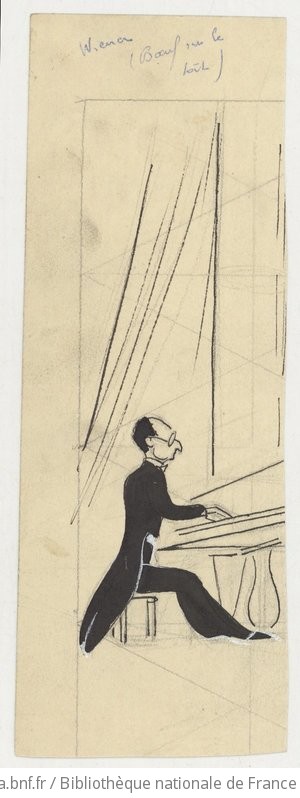
Pierre Payen: Wiener jouant au Boeuf sur le toit, ca 1922–1930 (Gallica: btv1b53180215c)
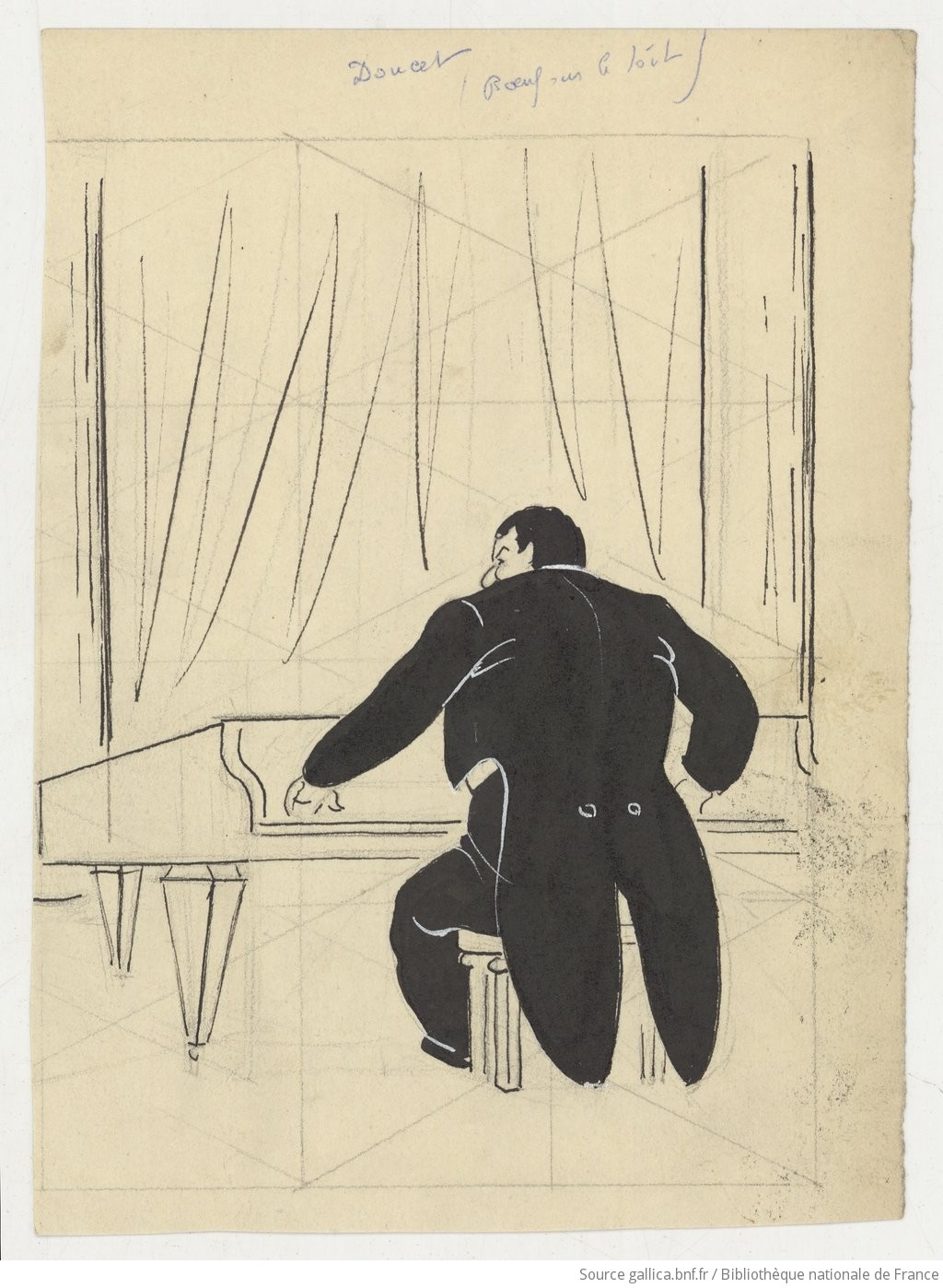
Pierre Payen: Doucet jouant au Boeuf sur le toit, ca 1922–1930 (Gallica: btv1b53180272h)
The Fratellini family came from Italy, where the father, Gustavo Fratellini, had been a compatriot of Giuseppe Garibaldi. Part of the family moved to France, and the three brothers, Paul, François and Albert, each represented a different style of French clowning.
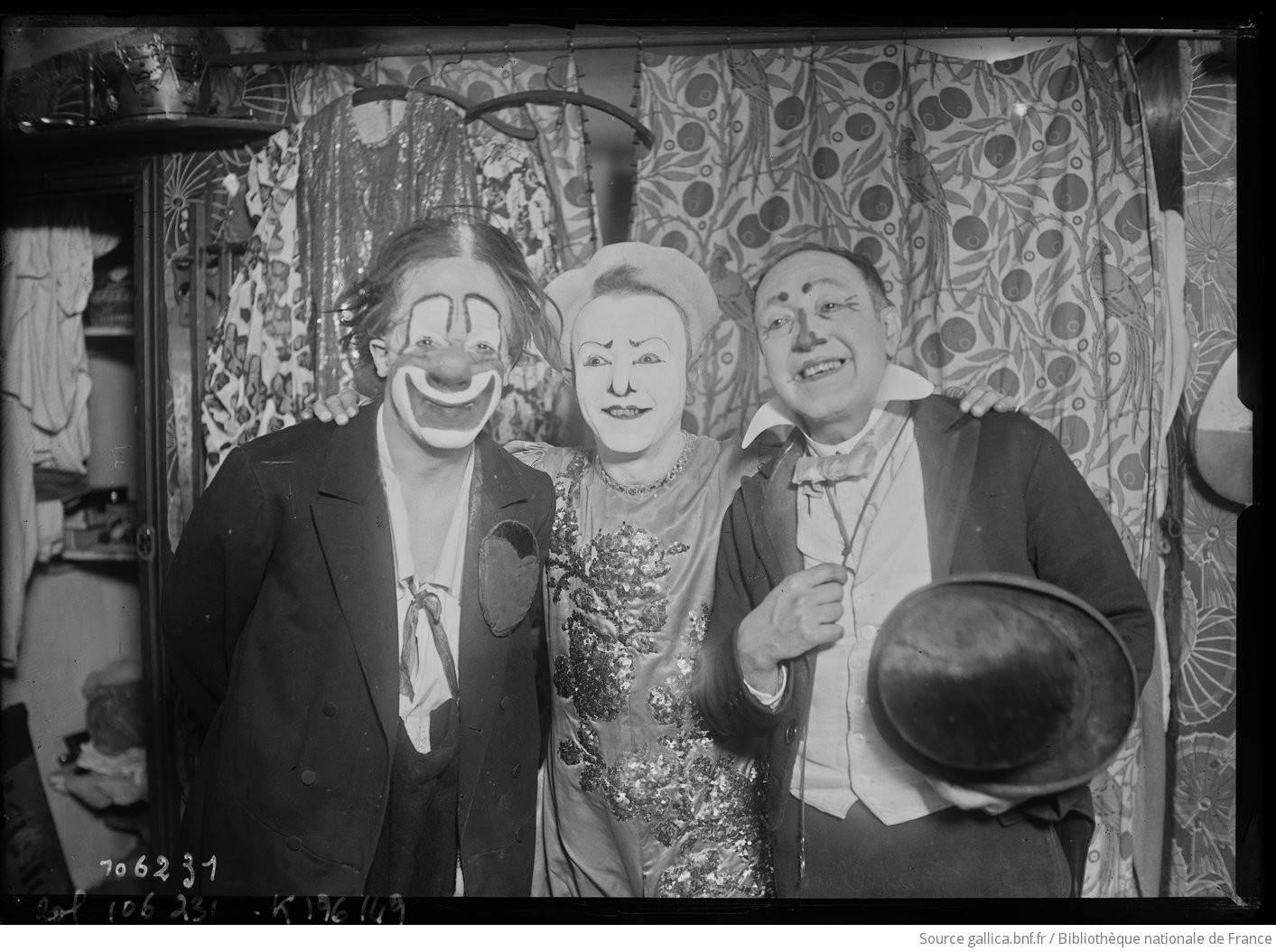
The Fratellini brothers (Albert, François, and Paul)
Albert was an example of the French Auguste clowns, with outlined eyes and mouth and a red nose. A stock figure based on a lower-class or hobo character, he was a foil for the most sophisticated whiteface clown.
François was an elegant Whiteface, in the tradition of the early 19th-century clown Joseph Grimaldi, and came from the oldest of the clown types. Costumes for whitefaces are generally more extravagant, often with the ruffled collar and pointed hat associated with French clowns.
Paul was a character clown who wore little makeup and was often in an almost convincing business suit, but note that his collar is extravagantly extended, and his lips and nose are painted. He’s not wearing a false red nose, but he does have a monocle.
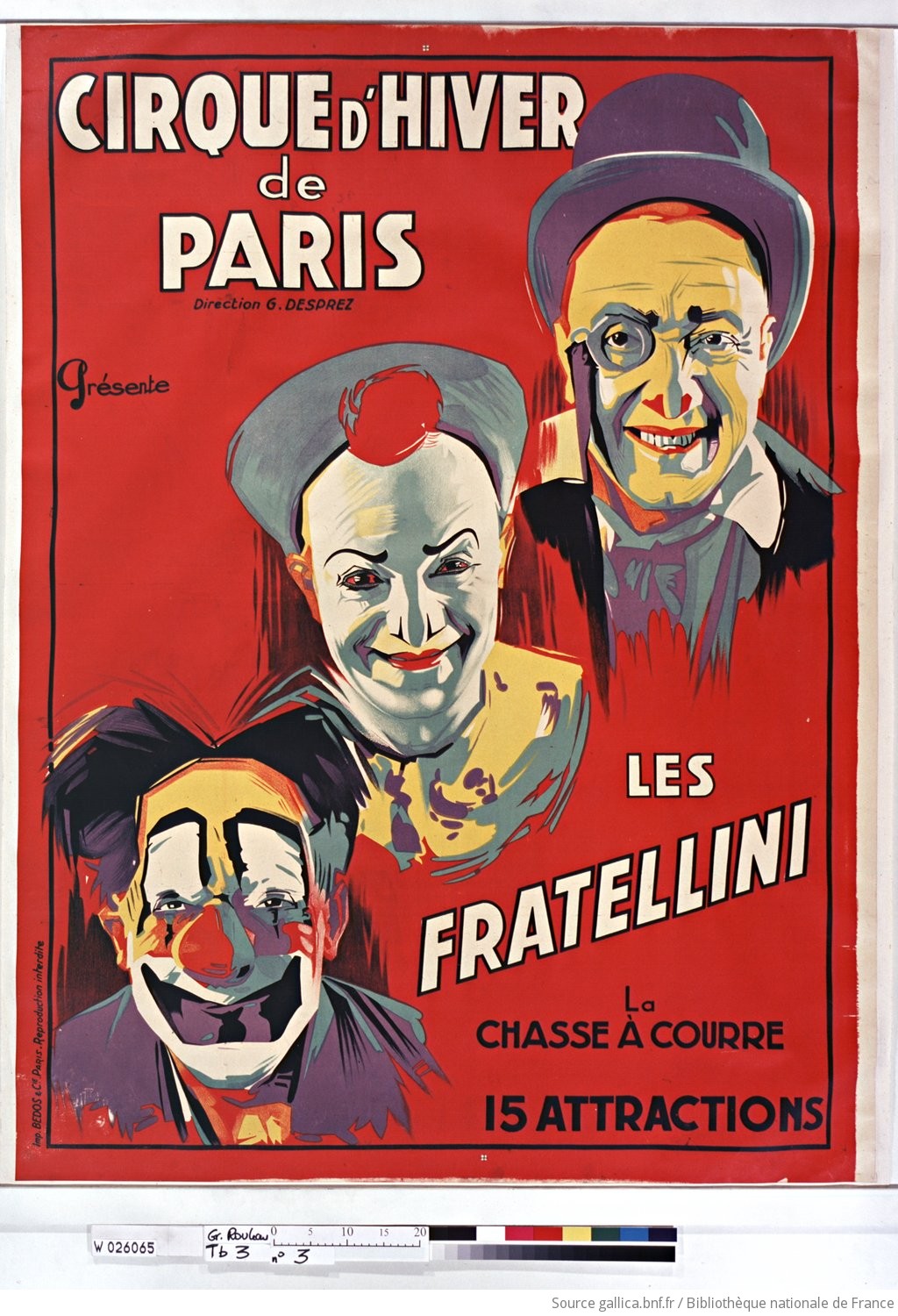
Cirque d’Hiver de Paris présente les Fratellini. La chasse à courre, 1930 (Gallica: btv1b9012056k)
In 2009, to get a sense of what might be accomplished, I Musici de Montreal staged a version of the evening with students from the Canadian National Circus School and two comedians, Vitali Makarov and Maria Monakhova. See what you think!
Le Bœuf sur le toit – Darius Milhaud (1892-1974)
Milhaud created a new model in post-war French music with Le boeuf sur le toit by combining Brazilian popular music with French melodies. It was taken up by Cocteau to become a unique spectacle-concert, and Dufy added his designs to the mix. In the end, by bringing in three famous clowns from the Cirque Médrano (the Fratellinis), Cocteau was able to create his world of ‘accidental synchronism’ that was an instant hit, but which Milhaud couldn’t escape for another decade.
For more of the best in classical music, sign up for our E-Newsletter