Beethoven boxset, BSO concertos, Curtis lectures, New York recitals, NEC masterclasses, Marlboro Festivals—Jonathan Biss is a pianist whose performances I made sure to catch during my student years on the US East Coast. His online course exploring Beethoven’s sonatas attracted hundreds of thousands of listeners worldwide. When he played Bach for four hands with Mitsuko Uchida, I knew I wasn’t the only teary-eyed member of the audience.
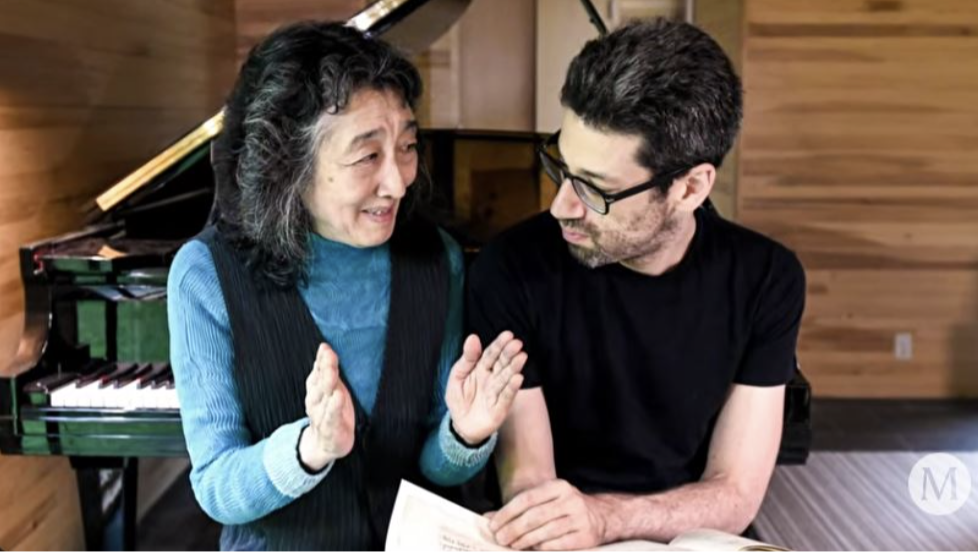
Mitsuko Uchida and Jonathan Biss, Artistic Directors of the Marlboro Music Festival
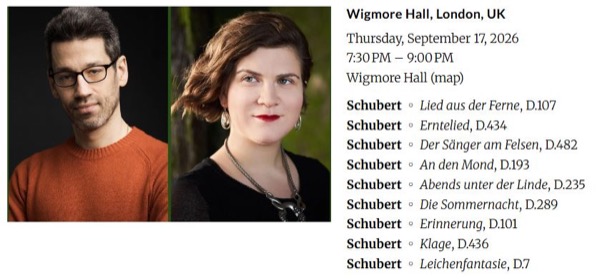
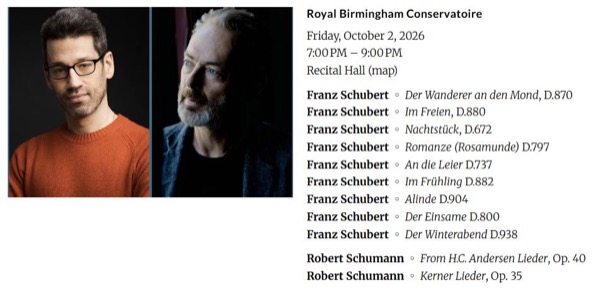
Biss’s current 2026–27 season includes several Lieder recitals: accompanying mezzo-soprano Ema Nikolovska in September at Wigmore Hall and touring with tenor Mark Padmore in October at four venues. When I asked him about Schubert and Schumann, Biss responded with the same generosity found in his detailed program notes, New York Times columns, and four published books.
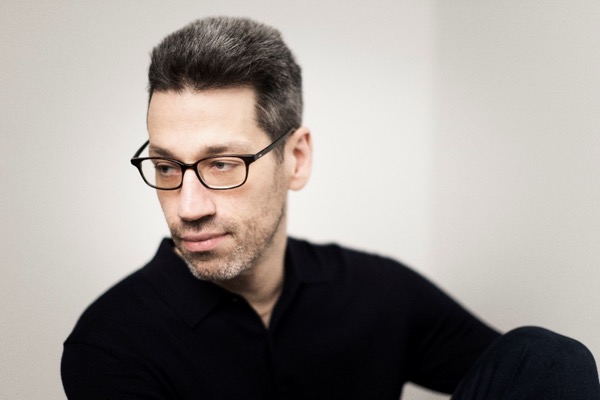
Jonathan Biss (Photo by Benjamin Ealovega)
You will perform twenty Schubert songs with Ema Nikolovska and nine more with Mark Padmore. Of Schubert’s nearly six hundred songs, are there any pieces that you discovered anew this time?
These programs have been full of fantastic discoveries for me! I hardly knew any of the early songs that Ema and I are doing on the first half. An den Mond D.193 might be the sole exception. And even some of the later ones on both programs are new to me: Nachtstück D.672, An die Leier D.737, Abschied von der Erde D.829, and perhaps a few others. After decades of listening to these songs, I’m not sure how reliable my memory is for which ones I have and haven’t heard…
For the second half of the concert, what is the thinking behind alternating Schwanengesang with Schubert’s other songs? A few years ago, you curated a series called “Late Style” featuring Schwanengesang with Mark Padmore.
While it is an amazing experience to play the fourteen songs of Schwanengesang in one go, they weren’t really conceived as a cycle. They come from three different poets, and unlike Die schöne Müllerin or Winterreise, they don’t tell any literal story. So, in assembling the second half of that program, Ema and I just used our instincts. We wanted one song to lead into the next in subtle, surprising ways, casting them in a different light and prompting the listener to approach them anew.
Mark Padmore and Jonathan Biss perform Ständchen in Boston
You once wrote that: “Schubert and Schumann are our two greatest poets of solitude.” What can you gather about the interior of Schubert and Schumann from their songs?
The intimacy in Schubert’s and Schumann’s songs is extreme. But each has a different kind of intimacy, just as each has a different experience of loneliness. In some of Schubert’s late songs—I’m thinking of Im Freien D. 880, and Der Winterabend D. 938, in particular—the piano and the vocal line move in the most beautiful tandem. It’s almost as if the treble of the piano becomes a second singer, the companion that Schubert so wished for.
Franz Schubert: Im Freien, D. 880 (Gundula Janowitz, soprano)
Franz Schubert: Der Winterabend, D. 938 (Margaret Price, soprano; Graham Johnson, piano)
Schumann is more complicated. So often in his songs, the piano offers a different—more ironic and less direct—reading of the text. It answers questions the singer cannot; it speaks in tangents, asides, and non sequiturs. Rarely are the voice and the piano in the kind of glorious accord one finds in Schubert. This is subjective, of course, but to me, this lack of accord reflects Schumann’s experience of the world: He was always slightly, or not so slightly, out of step.
Robert Schumann: Kreisleriana, Op. 16: II. Sehr innig und nicht zu rasch (Jonathan Biss, piano)
You have at least four recordings of Schumann’s works. You will soon perform his Fantasie in C Major, Op. 17, and Geistervariationen, WoO 24. What do Schumann’s songs tell you about his piano solo work, and vice versa?
Schumann might be the most poetic of all composers. I don’t just mean that he was fascinated by and sensitive to words, though he definitely was. With Schumann, the poetic detail of the music—the turn of a phrase—is central to its meaning. What he says is sometimes not as important as the precision of how he says it—how he lingers unexpectedly on a note, or delays its arrival, considering it from above and below. One finds this in all his music, but in the songs, where he has actual words to work with, it’s revelatory, giving the text new meanings. I try to take that with me when I play the solo music—to remind myself that in addition to the most obvious, evident meaning of the music, there are other, more obscure ones to search for.
Jonathan Biss plays Schumann’s Fantasiestücke, No. 2 Aufschwung
In Schumann’s Hans Christian Andersen Lieder, Op. 40, and Kerner-Lieder, Op. 35, what elements do you find most noteworthy? Is it Schumann’s word-painting, specific rhythms, tonal instability, harmonic sensitivity, piano pre-/postludes, or something else?
All of the above! Perhaps the tonal instability above all. Schumann revels in ambiguity. There are moments in these songs where one is poised between two keys, genuinely unsure of where the phrase will land. And so often, he uses suspensions and deceptive cadences to take what would otherwise be an ordinary harmonic sequence and turn it strange and so, so fragile.
Robert Schumann: 5 Gesänge der Frühe, Op. 133: No. 5. Im Anfange ruhiges, im Verlauf bewegteres Tempo (Jonathan Biss, piano)
The emotional landscape of these two cycles is very different. The Kerner songs, despite their extroverted moments, are tender and extraordinarily vulnerable: vintage Schumann. The Andersen songs are, above all, morbid. That’s the nature of the text, but Schumann knows how to twist the knife that much deeper.
As you play plenty of chamber music at the Marlboro Music Festival and beyond, how is working with a singer different from working with a string player?
Ultimately, it’s not so different. When you work with any other musician or musicians, you have to listen. Through listening, you learn when you need to lead and when you need to follow; how to join your sound to someone else’s; how to follow the music’s path. Of course, when you play with a singer, you need to be attentive to their breath and to where they place their consonants and vowels. Those are more than just practical matters—they are connected to the substance of the music. But on the deepest level, the task of making music is the same, no matter who you are making it with.
Marlboro Festival: Serving Music & Musicians
Do you have any historical Lieder recordings, singers, or accompanists that you enjoy and would recommend?
Kathleen Ferrier’s voice and artistry move me deeply: As soon as she opens her mouth, I want to cry. There are some Schubert songs with Benjamin Britten at the piano that are treasures—such beauty and understanding from them both. Also remarkable are the few recordings that Therese Behr made late in her career with her husband, the one and only Artur Schnabel! Doppelgänger and Erlkönig are genuinely frightening, in the best possible way.
Franz Schubert: Lachen und Weinen, Op. 59, No. 4, D. 777 (Kathleen Ferrier, contralto; Bruno Walter, piano)
Franz Schubert: Schwanengesang, D. 957: No. 13. Der Doppelgänger (Therese Behr-Schnabel, contralto; Artur Schnabel, piano)
Franz Schubert: Erlkönig, Op. 1, D. 328 (Therese Behr-Schnabel, contralto; Artur Schnabel, piano)
You commissioned and recorded a project pairing Beethoven’s five piano concertos with new works by composers such as Caroline Shaw. Next June, you will travel to Macao, China, and play Beethoven’s Piano Concerto No. 4. Can you tell us more about your plans for 2027, the Beethoven year?
The June trip will be my only visit to Asia. For the rest of the year, I’ll be back and forth between North America and Europe, playing a lot of Beethoven, unsurprisingly. Much of the repertoire is not new to me—though there are always discoveries! But one thing I’m very excited about is playing the Diabelli Variations for the first time in the second half of the year. I’ve always found it highly mysterious, even impenetrable. It’s still mysterious, but now I can’t wait to delve into its mystery.
For tour dates, see Jonathan Biss’s concert calendar
For more of the best in classical music, sign up for our E-Newsletter