In all my years of playing the piano, there is only one composer whose music I consider terrifying. And that composer is Alexander Scriabin. In his early sonatas, there are still gestures to hold on to, but as you move further along, all familiarity disappears.
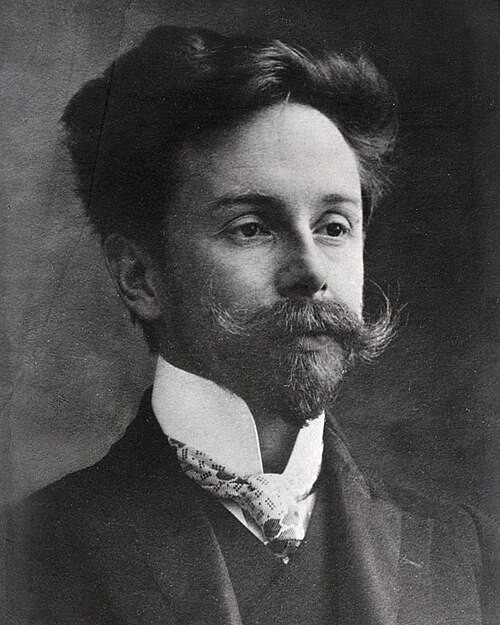
Alexander Scriabin
Chords become alien, textures are all over the place, and the music doesn’t breathe in regular phrases. It’s almost like getting seriously lost. How can you communicate something that can’t be grasped?
No Place to Hide
The harmonic language expresses colours and metaphysical visions, not really something you can handle in the practice room. And I can’t even imagine having to memorise the music. I’ve heard it said that pianists need a kind of vulnerability to perform his music, as it is impossible to hide behind structure or tradition.
I think it’s time I confront my demon. So, to commemorate Scriabin’s death on 27 April 1915, let’s have a quick guide to his 10 piano sonatas. Mind you, I’ll try to stay away from too many technical descriptions, and I am immensely grateful to Simon Nicholls for his 1996 notes accompanying Marc-André Hamelin’s interpretations.
Alexander Scriabin: Sonata No. 1 in F minor, Op. 6
Between Prayer and Despair
Scriabin’s first attempt at a piano sonata was written at the age of fourteen, while he was at the Cadet Corps in Moscow. This turned out to be his Sonata-Fantasy in G-sharp minor of 1886, a work that was never published. So let’s forget about this work and move straight to his Sonata No. 1 in F minor, Op. 6, published seven years later in 1893.
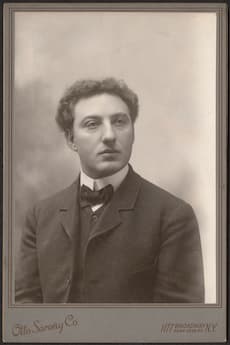
Josef Lhevinne
Scriabin had been trying to compete with the unbelievable virtuosity of his classmate Josef Lhevinne, and he injured his right arm and hand. Doctors told him that he would never recover. Thus, this first sonata, as Scriabin calls it, was a cry against fate and against God.
That cry is heard in the opening measures of the movement, which at times almost sounds like Brahms. Doubts and prayers appear in the second movement in a musical language influenced by César Franck.
The Rondo movement sounds like the finale, but that place is taken by a seriously gloomy Funeral March. It all sounds like Scriabin is trying to find his bearings in a late-Romantic language, throwing in snippets of Chopin, Schumann, and Modest Mussorgsky.
Alexander Scriabin: Sonata No. 2 in G-sharp minor, Op. 19
Nature Transformed
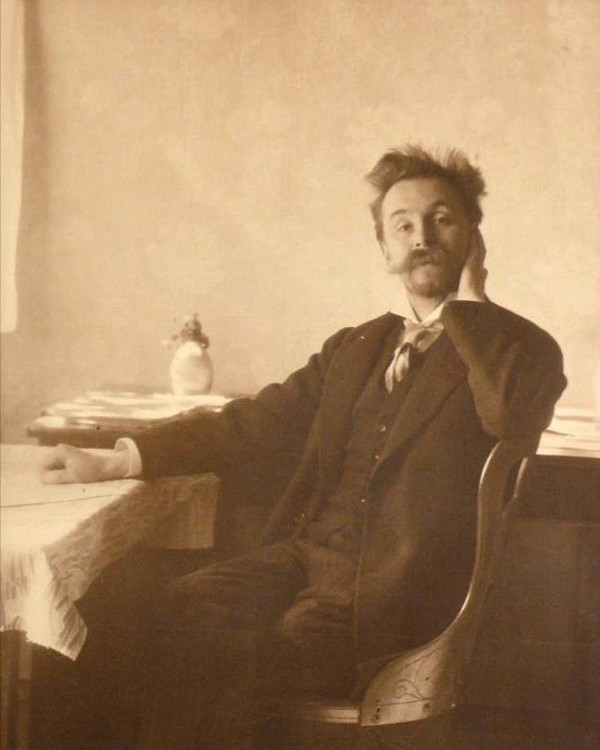
Alexander Scriabin
It took Scriabin the better part of five years to write and publish his Sonata No. 2, Op. 19. The piece unfolds in two movements, and the composer told us what to expect in a short programme note.
“The first part evokes the calm of the night by the seashore in the South; in the development we hear the sombre agitation of the depths. The section in E Major represents the tender moonlight which comes after the first dark of night. The second movement, presto, shows the stormy agitation of the vast expanse of ocean.”
This sonata is one of Scriabin’s most famous works, and it is technically approachable. It certainly helps that in the opening movement, the exposition, development, and recapitulation all start with the same music.
Scriabin’s style has changed in comparison to his first sonata, as the piano writing is much more delicate, almost in the style of Chopin. There are plenty of polyrhythms in the opening movement, while the finale features endless streams of triplets against a marching rhythm.
Alexander Scriabin: Sonata No. 3 in F-sharp minor, Op. 23
A Soul’s Journey
Scriabin’s Sonata No. 3 was composed between 1897 and 1898, around the time he married the young pianist Vera Ivanovna Isaakovich. Initially, he is said to have called the finished work “Gothic,” like the impression of a ruined castle.
Several years later, he or his second wife, Tatyana Schloezer, came up with a different description and nickname, namely “States of Being.” And in this description, all four movements represent a story of a soul’s strife, from being free and untamed to reaching the abyss of nothingness.
A clever person once said that composers who issue programmes for their music often live to regret it, and that seems pretty apt in this case. The music, however, has once again advanced in style. All movements are closely linked to each other in a cyclic treatment reminiscent of Liszt.
Hints of Wagner’s Tristan float through parts of the closing movement, which really does not have a happy ending. There is plenty of counterpoint and a seemingly symphonic conception underneath it all.
Alexander Scriabin: Sonata No. 4 in F-sharp Major, Op. 30
From Desire to Radiance
As Scriabin went through a turbulent personal period, his musical language was transforming as well. His Sonata No. 4, issued as Op. 30 in 1903, is headed by a poem describing a flight to a distant star.
Thinly veiled in transparent cloud
A star shines softly, far and lonely.
How beautiful! The azure secret
Of its radiance beckons, lulls me…
Vehement desire, sensual, insane, sweet…
Now! Joyfully I fly upward toward you,
Freely I take wing.
Mad dance, godlike play…
I draw near in my longing…
Drink you in, sea of light, you light of my own self…
In this shortest of his sonatas, Scriabin uses cyclic themes throughout the 2-movement work. We find unusual harmonies and plenty of “Tristan” references in the opening introduction.
The second movement, which follows without a break, features plenty of new sounds. The first-movement theme returns in a jubilant manner and in an explosion of overwhelming joy. Compared to the sombre finales of the first three sonatas, this one is full of light and ecstasy.
Alexander Scriabin: Sonata No. 5, Op. 53
Ecstasy Unleashed
Scriabin’s Sonata No. 5 was written shortly after his orchestral “Poem of Ecstasy” in 1907. Apparently, he wrote this sonata in only a couple of days as his musical style had evolved once more.
The “Poem of Ecstasy” features a lengthy poetic introduction, describing in rather sexual terms the release from the unconscious mind.
I call you to life, mysterious forces!
Drowned in the obscure depths
of the creative spirit, timid
Embryos of life, to you I bring audacity!
I am not sure we could call it a transitional work, but the music relates directly and clearly to the tonal system, yet many features already point to his late style. We are certainly treated to a contrast between ecstatic fast themes and languid slow ones.
We find cyclic links between sections, and this sonata might be the most difficult among this group. Some parts are downright unpianistic, but we do find some of Scriabin’s most creative harmonic writing, nevertheless.
Alexander Scriabin: Sonata No. 6, Op. 62
Fear and Shadows
After Scriabin completed “Prometheus,” he set to work on his Sonata No. 6, Op. 62.
There is no programme, and Scriabin never played it in public. He considered it frightening, dark, mysterious, and dangerous.
The music is disturbing, switching between playful and fleeting, and within this concentrated mysteriousness, tonality has almost disappeared. One might practically call this sonata atonal.
In addition, a transformation of the piano sound had taken place. We find monolithic chords, fluttering airborne impulses, and what has been called an arching theme of boundless sensuality.
There is plenty of febrile hyperactivity that exceeds the range of the keyboard, and it gives the impression of a dream. This sonata remains obscure, and you won’t see it much on concert programmes.
Alexander Scriabin: Sonata No. 7, Op. 64 “White Mass”
White Mass
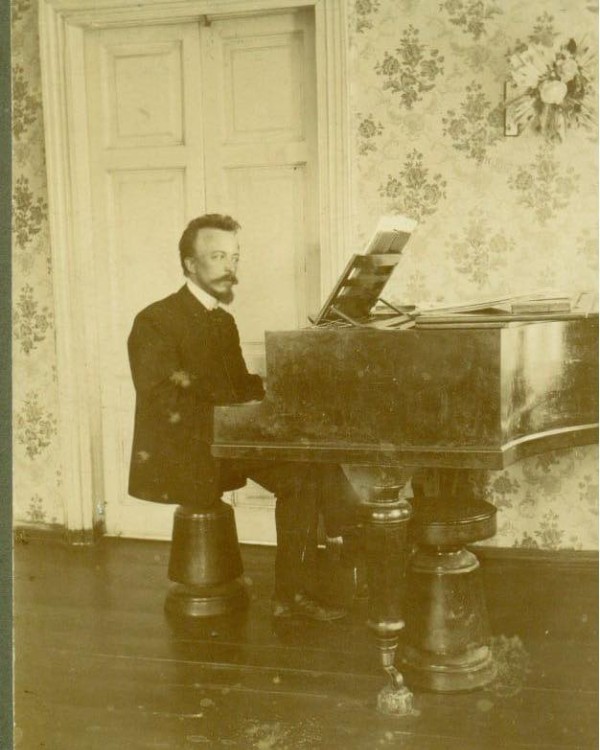
Scriabin at the piano
With the 7th Sonata of 1911, actually finished before the No. 6, we are squarely in the grasp of the composer’s Messianic pretensions. Subtitled “White Mass,” it features wondrous sonorities, extreme dissonances, and a number of themes related to heavenly exorcism.
Scriabin set out to create a prophetic atmosphere; just listen to the opening fanfares and the lightning flickering across the score. Chiming bells present a motif of invocation, and arpeggios drift like clouds of incense.
It all, predictably, ends in a mighty climax, a light flutter of trills and a polyrhythmic ascension after a chord that spans 5 octaves. Many consider this sonata Scriabin’s crowning achievement.
Scriabin loved to play this sonata in public, but the reactions were rather cold. There are just too many technical difficulties, and the harmonic structure and rhythm tend to be a great challenge to pianists.
Alexander Scriabin: Sonata No. 8, Op. 66
Quietest Storm
The Sonata No. 8 turns out to be the quietest of the set. Actually, it was the last sonata to be finished in 1913, and Scriabin spoke enthusiastically of it. But it is the longest and most complex of all Scriabin’s works.
Apparently, Scriabin thought of its form as a quasi-geometrical organisation that bridges the visible natural world with the invisible artistic realm. He also thought himself superior to Bach in terms of contrapuntal writing.
We do find plenty of counterpoint and less dissonance as the entire sonata exudes a static mood. This is possibly what Scriabin had in mind when he called parts “at perfect peace.”
Horribly difficult to perform, on par with the 5th and 7th Sonatas, but it has a much more mature personality. The material for this sonata is summed up in a final dance, and then everything just dissolves.
Alexander Scriabin: Sonata No. 9, Op. 68 “Black Mass”
Black Mass
In terms of popularity, the Sonata No. 9, subtitled “Black Mass”, is by far the most frequently performed of the set. That subtitle actually comes from an admirer, who described the atmosphere as Satanic.
The work dates from 1912, and it is one of the more approachable sonatas, both in terms of technical demand and in understanding the composer’s mystic ideals. Opening dissonances and repeated notes reach a nightmarish first climax.
The lyrical second subject appears in various seductive guises and turns into a grotesque march. The music becomes more intoxicating by the minute, and the coda evokes the cackle of the devil. Yet, it all ends in subdued quietness, or as A.E. Hull calls it “molecular vertigo.”
Into the Light
In his final sonata, Scriabin returns to the harmony of nature. Sonata No. 10 is bright and sunny, and much less dissonant. It was written on his country estate. The serene opening finishes with luminous trills in a blazing vision of light.
There are plenty of fluttering chords and joyous screams, and Scriabin thought he was on the brink of great new developments. Surprisingly, this sonata is more tonal and features more exposed tonal chords.
Scriabin died in 1915, but he was convinced that “the masses need to be shaken up, in order to purify the human organisation.” I wonder what he might have thought of World War I and the Russian Revolution.
After looking at and listening to the 10 sonatas by Scriabin, my fear of his music will probably never completely go away. It’s like stepping into quicksand, with no anchors for fingers or the mind. And maybe that’s the point; you’ll just have to let go and lunge into the music headfirst.
For more of the best in classical music, sign up for our E-Newsletter