Mozart died on 5 December 1791, at thirty-five years old. He is buried in an unmarked grave, and his Requiem was unfinished. These are the facts most people know.
What’s less often told is how much he accomplished in the year he died – and how little he seemed to know the end was coming.
In 1791 alone, Mozart completed his final piano concerto, premiered two operas, wrote the Ave Verum Corpus, and received the mysterious commission that would become his Requiem. He also became a father for the last time.
He worked at a pace that seems almost impossible in retrospect – and almost none of it showed signs of a man who sensed the end was near.
Here is Mozart’s final year, month by month.
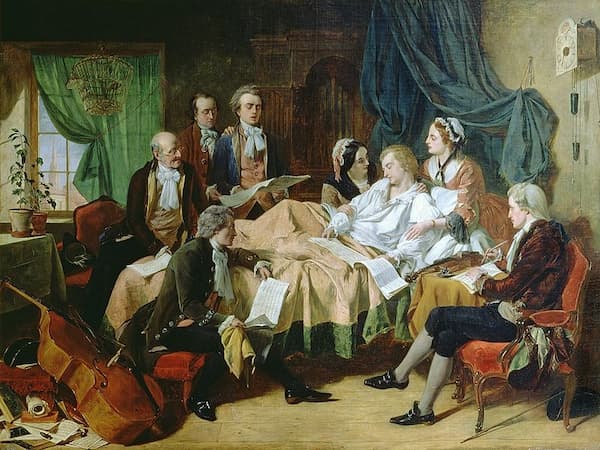
Henry Nelson O’Neil: The Last Hours of Mozart, 1860s
January 1791: Mozart’s Final Piano Concerto
The Austro-Turkish War, a conflict between the Habsburg Empire and the Ottoman Empire, raged between February 1788 and August 1791.
During this time, taxes were raised on the aristocracy to finance the war. Freelance musicians based in Vienna (like Mozart) saw a downturn in performance opportunities and, therefore, income.
Mozart had begun his final piano concerto (Piano Concerto No. 27) roughly two years earlier, around January 1789, but, understandably under the circumstances, didn’t finish it.
But he ultimately returned to it and completed it, entering it into his catalogue on 5 January 1791. Mozart’s final year of output had begun.
Mozart’s Piano Concerto No. 27
February 1791: Mozart’s Three German Dances
Mozart’s big February project was his Three German Dances.
Mozart had been appointed Imperial Chamber Composer in 1787, which meant that he was expected to provide dance music for royalty and the aristocracy.
Nowadays, we might think of dances as lesser music, but during Mozart’s lifetime, these dances were vital to his career.
They weren’t just background music for the aristocracy; they were advertisements for his services as composer, directed at the royal court and the aristocracy.
Without the income and social cachet that the approval of the elites offered, he never would have been able to make his way as a freelance composer.
Not to mention, the musicians who would be playing these dances were some of the most talented in Vienna, and obviously he wanted to make a good impression on them, too.
“Sleigh Ride” from Mozart’s Three German Dances
March 1791: Mozart’s Variations from The Stupid Gardener
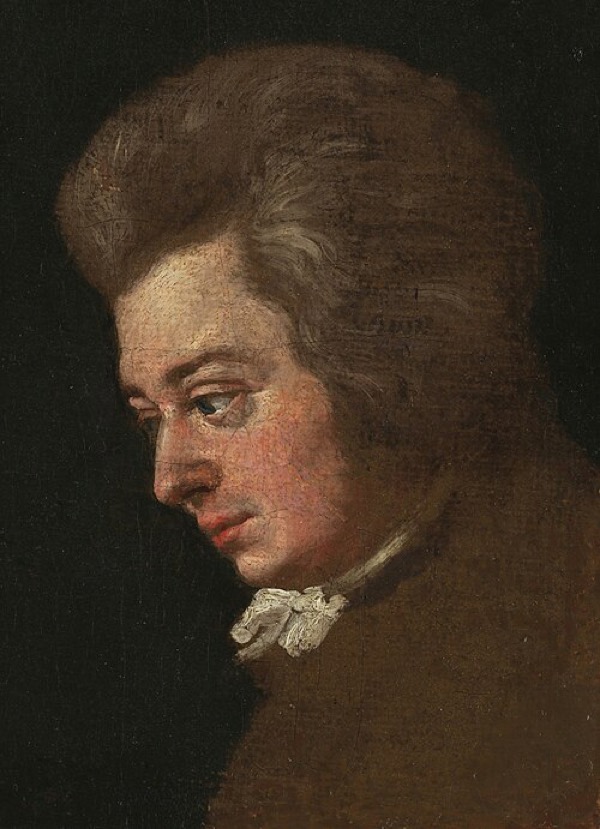
Joseph Lange: Mozart (detail), 1782
Mozart’s biggest achievement in March 1791 was his “8 Variations on an Air of Schikaneder,” K. 613.
These variations were based on an aria from the Singspiel Der dumme Gärtner (The Stupid Gardener) by composer Benedikt Schack, a friend of Mozart’s and the tenor who would originate the role of Tamino in The Magic Flute a few months later.
Operatic variations were all the rage in Vienna in Mozart’s day, and Mozart put his whole heart and soul into this work.
Wolfgang Amadeus Mozart: 8 Variations on Schack’s or Gerl’s Ein Weib ist das herrlichste Ding in F Major, K. 613 (Walter Klien, piano)
Performance-wise, on March 4, he performed his Piano Concerto No. 27 at a benefit concert organised by a clarinettist named Joseph Bähr.
April 1791: Mozart’s Triumph at St. Stephen’s Cathedral
Good – if somewhat grim – news reached the Mozart family in late April 1791. He was told that he’d been named the assistant Kapellmeister at the prestigious St. Stephen’s Cathedral, a position that would come with prestige and a good salary.
The job didn’t pay anything yet, but securing it meant that Mozart would be next in line for the job when the current Kapellmeister died. And lucky for Mozart, that Kapellmeister was elderly and perpetually ill.
It was also a triumph for more personal reasons; Mozart had married his wife Constanze in a side chapel at St. Stephen’s in 1782.
May 1791: Mozart’s Music for Glass Harmonica
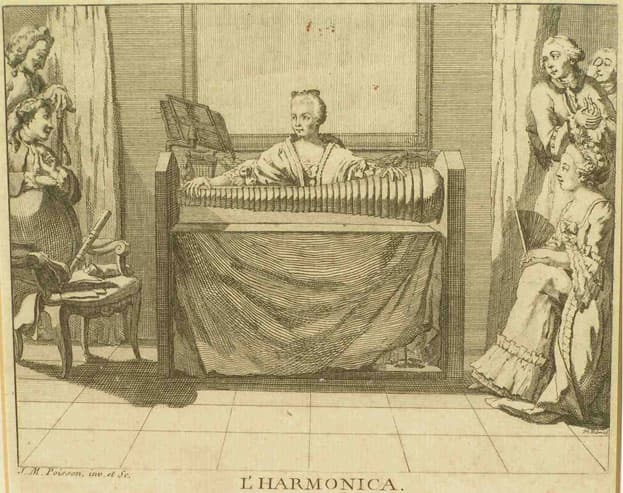
Glass harmonica
In the spring of 1791, Mozart began writing a comedic opera called Die Zauberflöte, or The Magic Flute.
He also wrote some chamber music for the Benjamin-Franklin-designed glass harmonica, a unique new instrument with a haunting, unusual timbre. He wrote a solo for the instrument (K617a), as well as an Adagio and Rondo for glass harmonica, flute, oboe, viola, and cello (K617).
He wrote these works for a well-known glass harmonica player named Marianne Kirchgessner, who, despite her blindness, toured around Europe, astonishing audiences with her virtuosity. During her stay in Vienna, Mozart appeared with her in a private performance, taking the viola part.
Mozart’s Quintet for Glass Harmonica, Flute, Oboe, Viola, and Cello, K.617
June 1791: Mozart’s Ave Verum Corpus
In June 1791, Constanze was in the last trimester of her pregnancy. She and her husband decided she needed to spend some time at the spas at Baden.
Mozart missed her deeply, and it took only a couple of weeks before he travelled to join her.
He brought his work along with him, writing what would become one of his most famous works, the Ave Verum Corpus for soprano. He signed the autograph on June 17.
Mozart’s Ave Verum Corpus
July 1791: Mozart’s Requiem Commission – And a New Son
It is believed that sometime around July 1791, a mysterious messenger arrived at the Mozarts’ home in Vienna with an important commission.
Details are murky, but the bottom line is that the messenger (or the man who sent him) wanted to buy a requiem in honour of a recently deceased wife. Mozart agreed to take on the commission.
Increasingly fascinated by Freemasonry, Mozart also wrote a Masonic cantata for voice and piano (K619).
Wolfgang Amadeus Mozart: Die ihr des unermesslichen Weltalls Schöpfer ehrt, K. 619 (Young Hoon Heo, tenor; Alberto Bertino, piano)
Then, mid-month, he was commissioned to write yet another opera to celebrate the coronation of Leopold II. This would become La clemenza di Tito, and he’d have to write it in six weeks.
It was a banner month in his personal life, too. On July 26, Constanze gave birth to their son Franz Xaver Wolfgang Mozart. He would be the couple’s final child.
August 1791: Mozart Travels to Prague
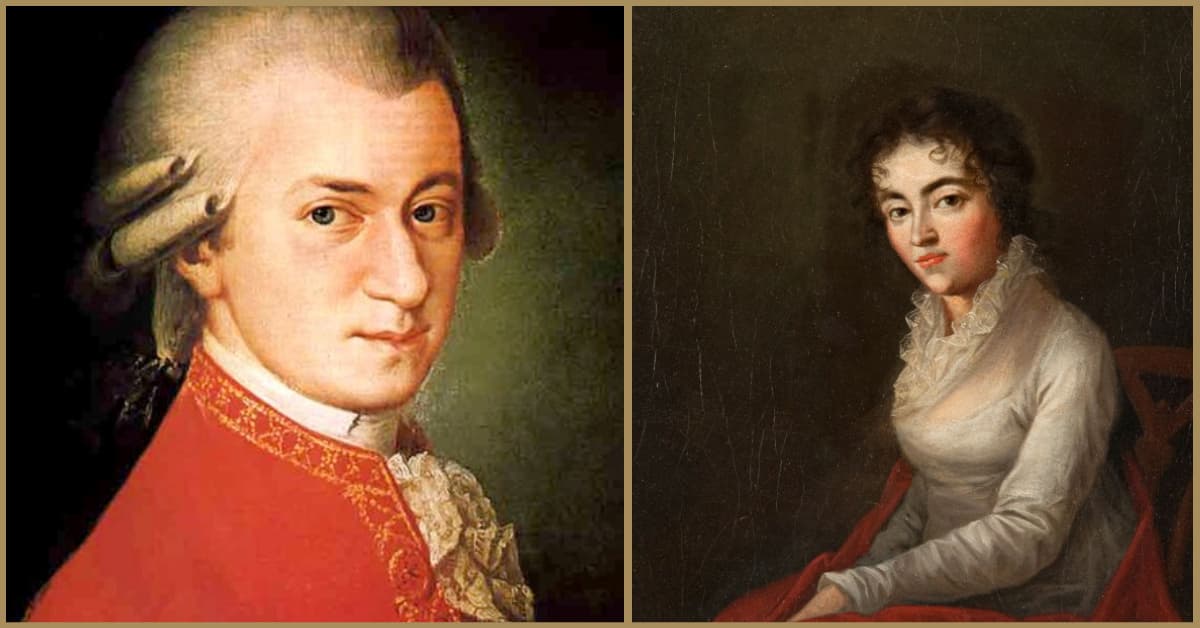
Wolfgang Amadeus Mozart and his wife Constanze
Mozart didn’t let fatherhood interrupt his career. In late August, he needed to travel to Prague for the coronation festivities of Leopold II.
Wolfgang and Constanze had missed each other desperately when they’d been separated in June, so this time Constanze came with him on his work trip. The new parents left their baby and hired a wet nurse.
They also brought along Mozart’s pupil, Franz Xaver Süssmayr, who would play an outsized role in the Requiem’s birth.
They arrived in Prague on August 28, just ahead of the emperor, who arrived on August 29.
September 1791: Mozart’s Operas La Clemenza di Tito and Die Zauberflöte
On September 4, Mozart’s music was played during the service of the emperor’s oath of allegiance at the Cathedral of St. Vitus. (Interestingly, Antonio Salieri was the conductor.)
The following day, La clemenza di Tito was premiered at the Prague National Theatre. The day after that, his Coronation Mass was played at the coronation itself.
Mozart’s Coronation Mass
Unfortunately, the royal party didn’t take to Tito, and the opera proved to be a bit of an early flop. It felt too serious in tone for a group that wanted celebratory music.
These high-profile performances and the stress of his superhuman output had taken a toll, and Mozart fell ill while in Prague.
Mozart’s Overture to La Clemenza di Tito
Nevertheless, he returned to Vienna, where he finished and rehearsed Die Zauberflöte. He conducted the premiere on September 30. Performances would continue in October: nearly two dozen of them.
As if all this wasn’t enough, he also worked on his clarinet concerto this month. The clarinet concerto would be the last concerto he’d ever write, and it’s widely considered to be one of his best.
Mozart’s Clarinet Concerto
October 1791: Mozart Begins His Requiem
In October, Constanze went to Baden again. She was no doubt exhausted and ill from her pregnancy, the birth, and the travelling.
Her absence depressed Mozart, but he was also starting to feel physical symptoms, including rheumatism and abdominal pains. The dreary weather didn’t help.
It was against this backdrop that he worked on the Requiem.
November 1791: Mozart’s Last Completed Work
In November, he took a break from the Requiem to work on another Masonic cantata (K623).
He entered it into his catalogue on November 15, and it was premiered three days later at his lodge. The positive reception cheered him greatly. It would be the last work he’d ever finish.
Wolfgang Amadeus Mozart: Laut verkünde unsre Freude, K. 623 (Young Hoon Heo, tenor; Lars-Olivier Ruehl, tenor; Jürgen Appel, baritone; Kassel State Opera Chorus, male voices; Kassel Spohr Chamber Orchestra; Roberto Paternostro, cond.)
Unfortunately, the happiness was short-lived. His health deteriorated rapidly. On November 20, he took to bed, experiencing intense pain and vomiting.
December 1791: Mozart’s Death
Constanze and her sister nursed Mozart through his illness.
Early in the month, he seemed to be showing signs of improvement. He was still bedridden, but he managed to gather a small group of friends to run over parts of the Requiem. Unfortunately, the rehearsal was too much for him, and he ended it feeling extremely weak.
He gave instructions to his pupil, Süssmayr, on how to finish, should he die and be unable to do so himself.
Mozart died on 5 December 1791 at 12:55 in the morning. He was thirty-five years old.
You can read more about his death and funeral here: https://interlude.hk/on-this-day-5-december-wolfgang-amadeus-mozart-died/
Mozart’s Requiem
Conclusion
Mozart died, leaving the Requiem unfinished, its final pages handed off to his pupil, Süssmayr. It premiered two years later and has been performed ever since.
The same is true of the Ave Verum Corpus, the Piano Concerto No. 27, The Magic Flute – works written in a single year, by a man in declining health, under financial pressure, in the middle of a war.
Thirty-five years was not enough time. But as 1791 makes clear, he used every hour of it.
For more of the best in classical music, sign up for our E-Newsletter