One of the oldest stories in opera is that of Orpheus and Eurydice. In the original story, Orpheus, the musical son of Apollo, loses his beloved wife Eurydice to a snake bite. Outraged at the loss of his bride, he decides to travel to the Underworld and confront Pluto himself to get his wife back. His music persuades Pluto to let Eurydice go, but with the proviso that Orpheus must trust that she is following him. If he turns to check her presence, Pluto will claim her forever. In the original story and in Monteverdi‘s opera of 1605, Orpheus loses Eurydice. In two pre-Monteverdi operas (Jacopo Peri’s of 1600 and Giulio Caccini’s of 1602), Orpheus and Eurydice return together and rejoice. This served many operas: a choice between a happy or a sad ending. And then we get to the 19th century.
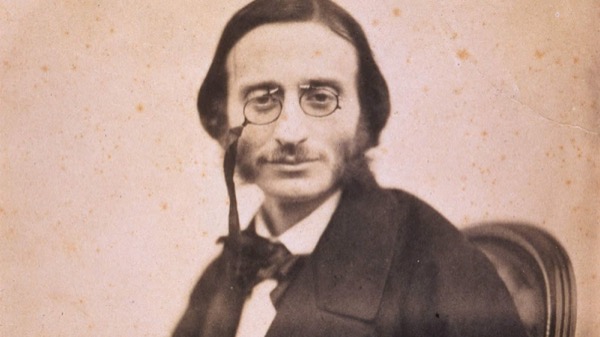
Jacques Offenbach
Jump to 1858. Jacques Offenbach set the story, written by Hector Crémieux and Ludovic Halévy, first as a two-act opéra bouffon at the Théâtre des Bouffes-Parisiens, Paris, on 21 October 1858. Over the next 12 years, Offenbach revised and expanded it to become a four-act “opéra féerie”, given at the Théâtre de la Gaîté, Paris, on 7 February 1874. In this later, very successful version, Offenbach made his name around the world.
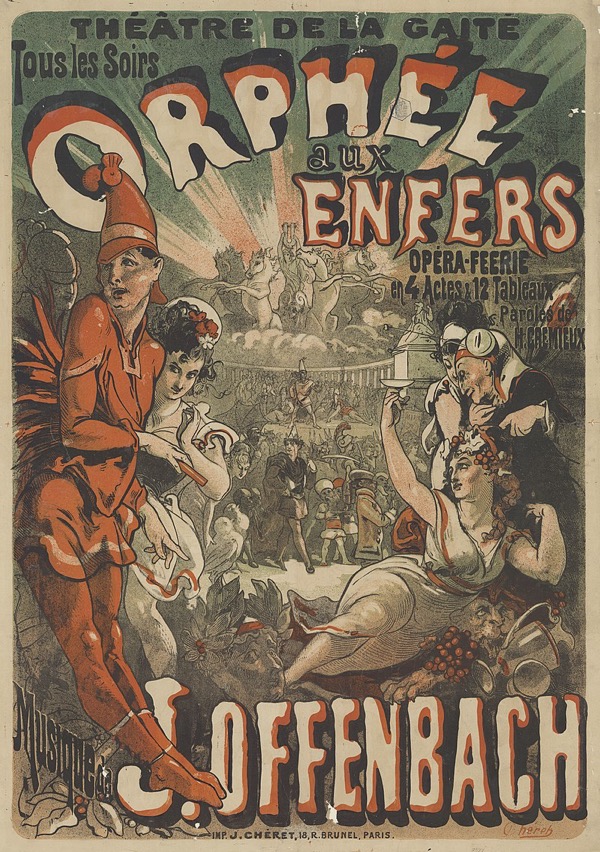
Poster for the Paris Revival of 1878
Offenbach has taken the story of Orpheus and Eurydice and set it on its head. Orpheus isn’t the son of Apollo but just a countryside violin teacher; he and his wife Eurydice mutually detest each other. When Eurydice is abducted by Pluto, Orpheus is glad she’s gone. It takes Public Opinion (who says she’s the guardian of morality). Eurydice is happy to have the God of Death as her lover. Orpheus wants to pursue the shepherdess Chloë, but is harried by Public Opinion, who will ruin his violin teaching career unless he goes to rescue his wife.
Meanwhile, up in Olympus, reports of Pluto’s beautiful new woman are getting around. Diane is lamenting the loss of Actaeon, who Jupiter has turned into a stag to protect her reputation. Cupid and Venus have returned from their own amatory adventures, and everyone’s in revolt about the tedium of Olympus and their boring diet of ambrosia and nectar. They’re not fond of Jupiter’s reign, either. When Orpheus arrives with Public Opinion, Jupiter decides to go to the Underworld to sort things out, and all the gods decide to go with him as a holiday.
Eurydice is bored in the Underworld. She’s been locked up by Pluto and only has a country bumpkin for a jailer. Jupiter finds Eurydice and, in the guise of a golden fly, sings a love duet with her (he can only buzz in his fly guise). He’s able to free her, and they go to find the other gods in the Underworld.
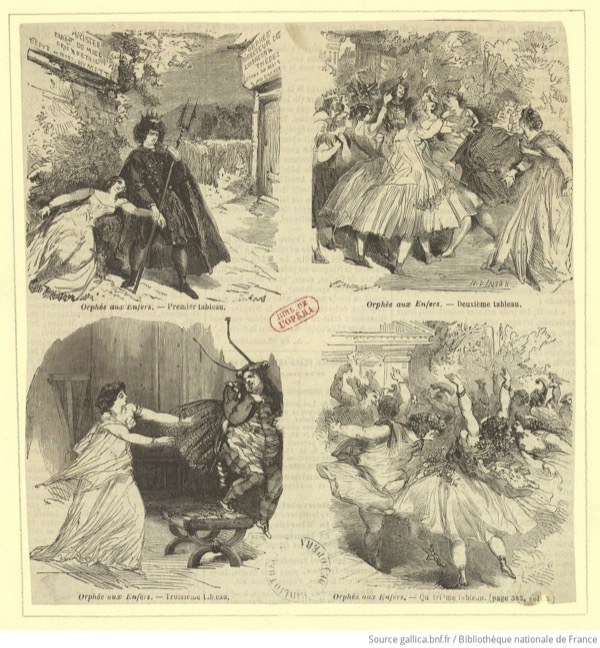
Edmond Morin: Scenes from Orphée aux enfers, ca 1850 (Gallica, btv1b53117028m)
They join the other gods who are having an enormous party, or, from the description, perhaps an orgy, where, as one writer puts it, ‘ambrosia, nectar, and propriety are nowhere to be seen’. Eurydice is in disguise as a Bacchante (a wild woman who follows Bacchus). A dance is called for, and Jupiter leads everyone in a minuet, which is boring. The gods then come up with a fast dance in honour of the Underworld, the Galop infernal.
Orpheus arrives with Public Opinion. He’s permitted to walk out with Eurydice but is forced to look back when Jupiter throws an unexpected lightning bolt, so he jumps and looks back. Eurydice vanishes. Jupiter then proclaims that she will belong to the god Bacchus and become one of his priestesses. Orpheus is free of his hated wife, Pluto doesn’t want her back, and all ends resolved, except, perhaps, for Eurydice, who is not consulted on her wishes.
This opera was a box office success but, critically, was received with mixed opinion: some hated the change to a beloved story and librettists’ disrespect for classical mythology, while others found it ‘unprecedented, splendid, outrageous, gracious, delightful, witty, amusing, successful, perfect, tuneful’. The scene in Olympus ‘was widely seen as a veiled satire of the court and government of Napoleon III, Emperor of the French’. The opera made Offenbach’s name, rescued his opera company from financial problems, and broke all box office records. It was staged widely through France and then internationally, and continues to hit the stage in the 21st century.
The Galop Infernal in the final act is, of course, what is now known more familiarly as the Can-Can. The can-can was a dance in the musical halls of Paris starting in the 1840s, developing from the quadrille, a dance for 4 or more couples. It gradually evolved into a dance that featured high kicks, splits (or jump splits) and cartwheels, all the while the dancer’s long skirts and petticoats were being vigorously shaken. Eventually, the couple-pairing of the original can-can gave way to the chorus line so familiar today.
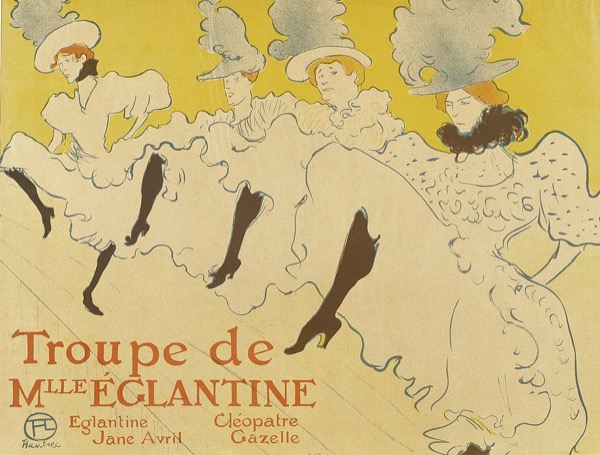
Henri de Toulouse-Lautrec: Troupe de Mlle Églantine, 1895, showing the Can-Can
By the end of the 19th century, the French cabarets such as the Moulin Rouge and Folies Bergère used the Galop infernal to accompany the dance, and the association continues today. In actuality, many different composers have written music for the dance, including Franz Lehár and Cole Porter.
Jacques Offenbach: Orphée aux enfers – Overture
This recording was made in June 1960 by René Leibowitz, leading the Orchestre de la Société des Concerts de Paris.
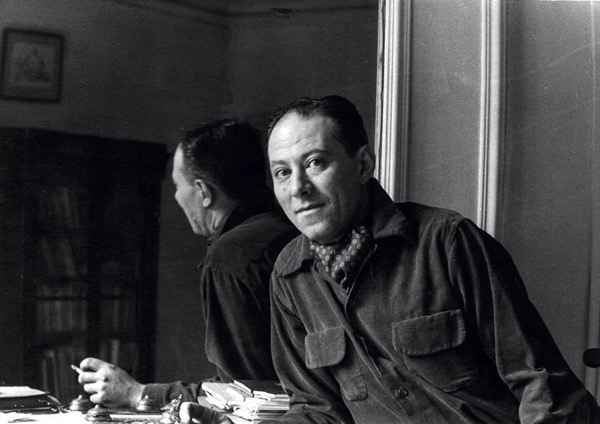
René Leibowitz
René Leibowitz (1913–1972) was a composer in the Second Viennese style and devoted follower of Arnold Schoenberg, and a conductor of a wide range of music, from Beethoven to Gershwin. Starting in the 1950s, Leibowitz conducted recordings of seven complete operas, including Orphée aux enfers, which were well received. In his later years, he recorded a set of Beethoven symphonies and was among the first to follow Beethoven’s metronome markings. Although he wasn’t the first to record this, his version was praised for its ensemble playing. As a teacher, his most important pupils were Pierre Boulez and Jacques-Louis Monod, each of whom followed a different path in 20th-century music. At his death, Leibowitz left a compositional estate of nearly 100 pieces.
The Orchestre de la Société des Concerts de Paris (or, more accurately, the Orchestre de la Société des Concerts du Conservatoire) was established in 1828 and comprised the professors of the Paris Conservatoire and their pupils. It closed in 1967 and became the basis for the Orchestre de Paris, which still plays today.
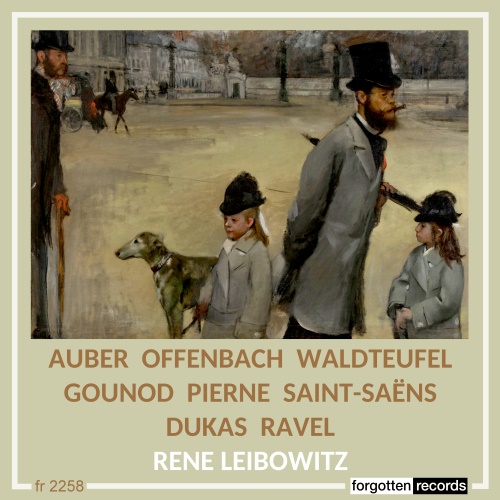
Performed by
René Leibowitz
Orchestre de la Société des Concerts de Paris
Recorded in 1960
Official Website
For more of the best in classical music, sign up for our E-Newsletter