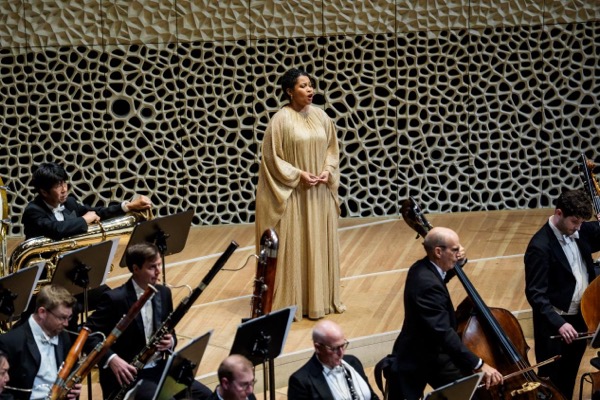
Other highlights provided by the festival:
Nocturnal Light Programs: This dialogue between shadow and illumination extends to the festival’s chamber recitals. Pianist Bernd Glemser crafts a striking twilight narrative, pairing Beethoven‘s “Moonlight” Sonata with Liszt‘s transcription of Beethoven’s Fifth Symphony. The choice is brilliant; the symphony’s legendary transition from the suspenseful dark of the Scherzo to the radiant C-major finale mirrors Haydn‘s own passage from chaos to creation. Meanwhile, the “Romantische Nacht” (Romantic Night) program pairs German moonlit poetry with chamber music, capturing the light’s romantic, twilight aspects.
In Harnoncourt’s Footsteps: Mozart‘s Requiem in the Stainz Pfarrkirche
The 2026 season’s spiritual offerings unfold southwest of Graz, guiding travellers deep into the rolling hills and historic heartland of the Harnoncourt dynasty. The pilgrimage begins the moment you board the festival shuttle, leaving the urban centre behind to cruise through Styria’s emerald, undulating landscape. Your destination is the historic Stainz Castle, where the courtyard (Schlosshof) radiates a refined summer vitality. Before the music even begins, the air is filled with lively chatter as an eager crowd—many beautifully dressed in authentic Austrian Tracht—strolls through the estate’s vibrant, blooming gardens. This outdoor elegance transitions seamlessly into the sacred, light-flooded Baroque nave of the Stainz Pfarrkirche, where conductor Michael Hofstetter, the Styriarte Festspiel-Orchester, and the Arnold Schoenberg Chor join forces in a stunning marriage of space, memory, and acoustics.
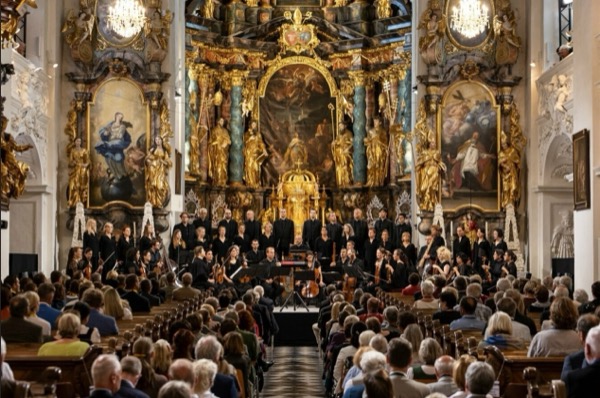
(Credit: Nikola Milatovic)
This is not a standard concert hall experience; it is designed as a profound, multi-sensory liturgical pilgrimage. To elevate the dramatic architecture of the space, Hofstetter weaves austere Gregorian chants—intoned by the five exquisite, completely invisible female voices—at the opening, the close, and right before the Offertorium. Because the singers remain entirely hidden from view, their voices seem to emanate directly from the golden stuccowork of the high altar itself, creating a haunting, disembodied wash of sound. It carves out quiet, spiritual breathing spaces between the grand, driving weight of Mozart’s orchestral movements. Attending this transcendent performance remains the quintessential Styriarte pilgrimage.
Cosmic Harmony: Schloss Eggenberg & Its Picnic Concerts
Schloss Eggenberg is not just a palace; it is a giant cosmic riddle carved into stone. Built in the 17th century, its entire architecture is governed by the laws of time and astronomy to reflect the divine order of the universe, featuring 365 exterior windows for the days of the year, 31 rooms per floor, and 24 staterooms for the hours of the day. The crown jewel inside is the Planetensaal (Planetary Room), a masterclass in Baroque geometry where breathtaking ceiling frescoes blend astrology, mythology, and imperial power.
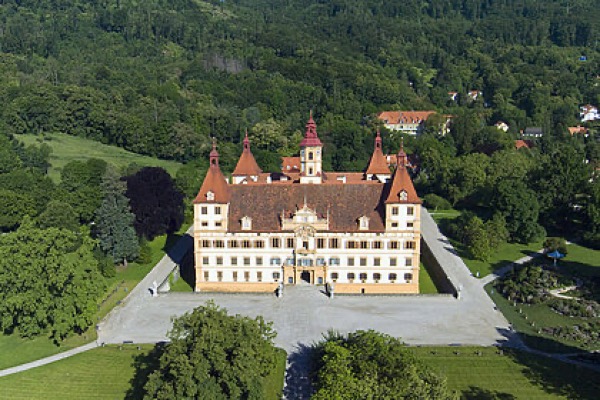
(Credit: Universalmuseum Joanneum)
During Styriarte, this cosmic monument becomes a living stage for the festival’s signature Schloss Eggenberg picnic concerts. In 2026, the evening begins under the Planetary Room’s celestial frescoes with a performance of Mozart’s The Magic Flute (Die Zauberflöte). Adapted as a wind-ensemble concert (Harmoniemusik) by the acclaimed Ensemble Zefiro, the triumph of Sarastro’s sun over the Queen of the Night’s darkness becomes a literal architectural experience in this space.
The celebration then spills out into the palace’s inner courtyard and romantic gardens. Under the fading twilight, audiences spread out their blankets to pair the sublime music with local Styrian strawberries and crisp white wines. This effortless blend of high imperial elegance and laid-back summer picnic culture captures the very heart of the festival’s open, sensory spirit.
The Crown Jewel of Old Town: Stefaniensaal
For nearly 120 years, the Stefaniensaal has served as the historic beating heart of Graz’s musical life, universally celebrated as one of the finest concert halls in the world. This legendary shoebox venue is renowned for its crystalline, warm acoustic properties—a sonic perfection that famously allowed Nikolaus Harnoncourt to capture his benchmark, award-winning recordings of Beethoven and Schubert symphonies right here in the hall.
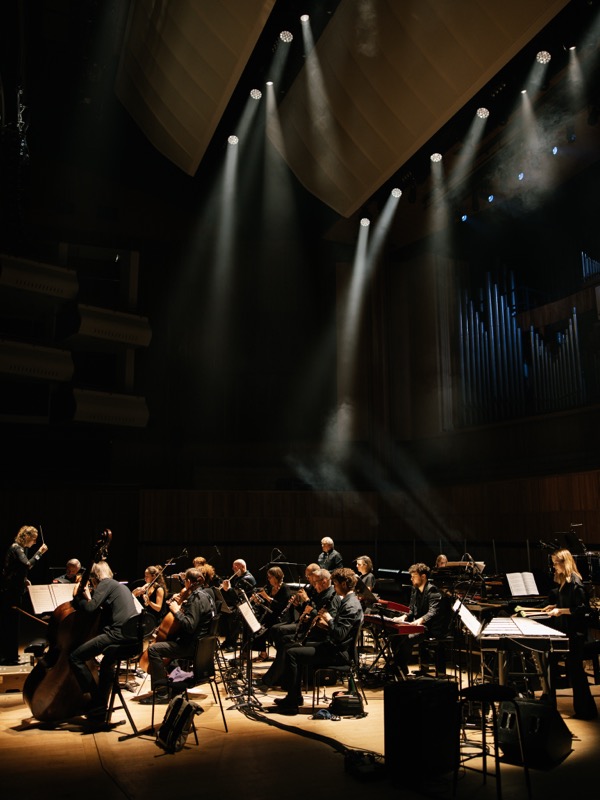
During Styriarte 2026, the hall beautifully bridges its storied past with cutting-edge visual artistry. On July 25, the venue hosts the festival’s ultimate thematic event: “Licht Spiele”. In this 65-minute spectacular, the celebrated local light-artist collective OchoReSotto will completely submerge the historic architecture into shifting, immersive waves of illumination.
A Concise Visitor’s Guide to Graz
Historic Gems
Landeszeughaus (Styrian Armoury): The world’s largest historic armoury, holding 32,000 authentic 17th-century weapons and suits of iron armour. Arranged with repetitive precision, it stands as a raw, gripping time capsule of Central Europe’s defensive history.
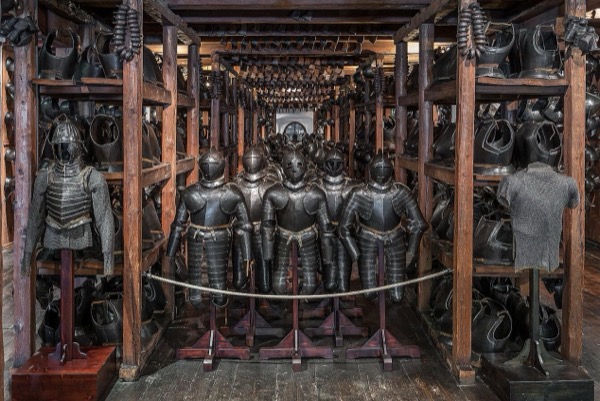
(Credit: Universalmuseum Joanneum/N. Lackner)
Ferdinand II Mausoleum: Designed by Italian masters in 1614, its green copper domes brought Baroque romance to the Alps. Inside, the Emperor’s dark red marble sarcophagus rests in a quiet, heavy crypt.
The Double Spiral Staircase: Tucked inside the Burg courtyard, this 15th-century Gothic masterpiece features two stone staircases winding in opposite directions, seamlessly merging on each floor.
Modern Architecture & Views
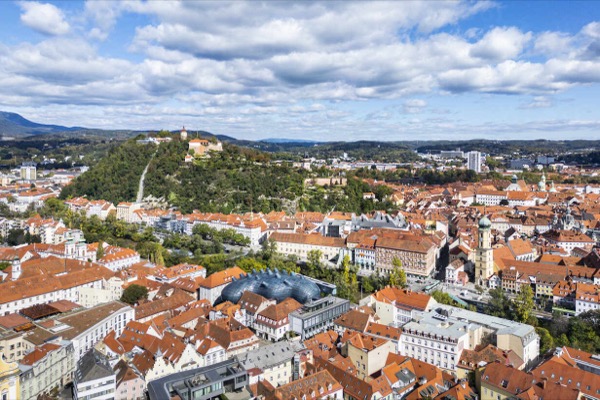
Kunsthaus & Murinsel: Graz weaves futuristic design into its medieval core via the biomorphic Kunsthaus (“Friendly Alien”) and the Murinsel, a floating steel-shell island and café anchored in the rushing Mur River.
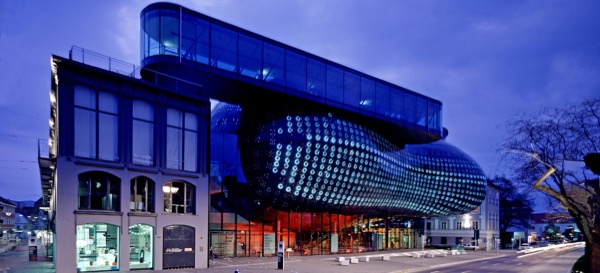
(Credit: Universalmuseum Joanneum)
Schlossberg: The city’s historic core offers a postcard-perfect 360-degree view of the UNESCO roofscape. Climb the 260 steps or take the glass mountain elevator (open until 2:00 AM on weekends).
Culinary Landmarks
As Austria’s Capital of Culinary Delights (Genushauptstadt), Graz pairs open-air shopping at the bustling Kaiser-Josef-Platz market with chic urban relaxation. Before evening events, mingle with locals over gourmet open-faced sandwiches (Brötchen) and crisp Styrian white wine at the Kastner & Öhler rooftop café.
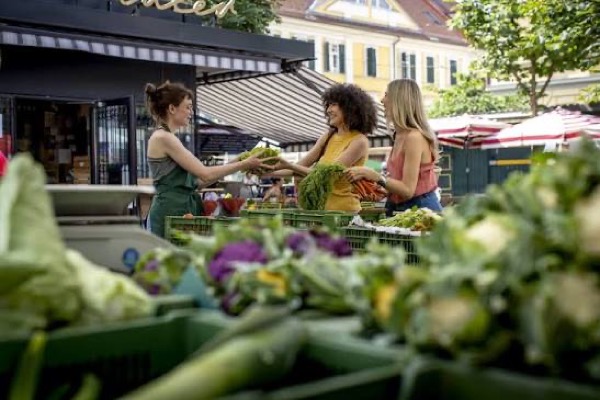
(Credit: Graz Tourismus – Tom Lamm)
As the sun sets over the red-tiled roofs and the first notes echo through the historic halls, you will find that Graz does not just host the Styriarte Festival—it lives and breathes it. Enjoy every note, every flavour, and every summer evening in Austria’s cultural gem. Viel Spaß!
https://styriarte.com/en/festivals/styriarte
For more of the best in classical music, sign up for our E-Newsletter