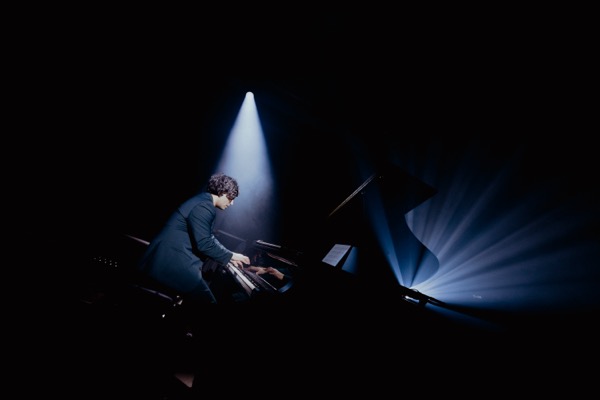
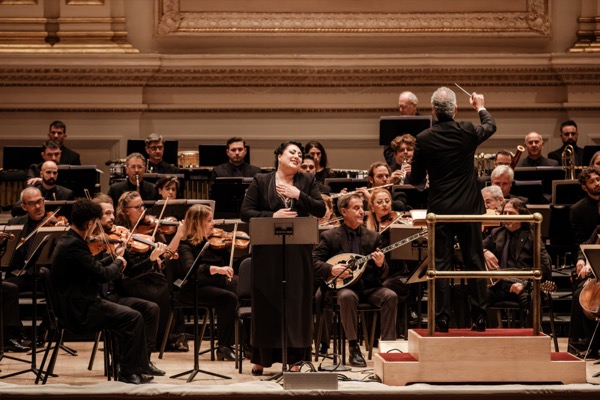
Reveries in Fracture is a multidisciplinary live work by artist Afshin Naghouni and composer Amir Konjani, combining abstract painting and film with Kraken instruments and contemporary performance. Exploring fractured memory and the instability of historical narratives, the work creates an immersive environment of abstract sound and imagery. Developed in collaboration with the London Sinfonietta and Trinity Laban, it presents a spatially expanded composition for Kraken instruments, bespoke resonators, voice and ensemble, featuring Gabriella Dall’Olio on harp, Aleksander Szram on keyboards, vocalist Eleanor Westbrook and conductor Nazanin Aghakhani. The work premiered on October 11, 2026, at Kings Place.
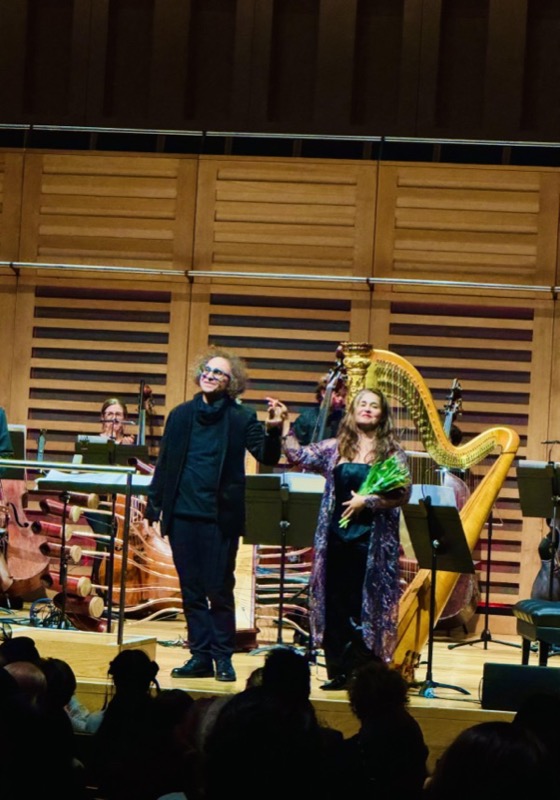
Reveries in Fracture at Kings Place
Highlights from Reveries in Fracture
The audience enters the hall to a duet of what sounds like reversed English, sung by Westbrook, alongside the first of Konjani’s prepared — or, more accurately, Kraken — instruments: the contrabass. Konjani himself welcomes us. Positioned in the upper stalls, he walks steadily from side to side, watching the audience as it settles. The experience is fascinating, slightly frightening and unsettling too. Has the performance started yet? The audience wonders… Is the audience a part of it? The eerie sounds of the contrabass, at times accompanied by Westbrook’s a cappella voice, make the introduction a highlight in its own right.
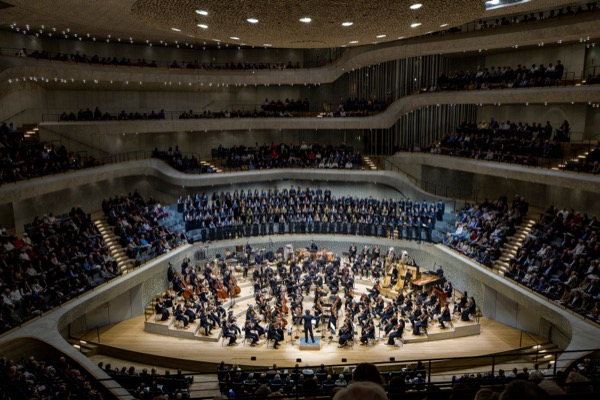
During this time, the audience gradually discovers the unusual orchestration: eight contrabasses, a piano, a harp and, of course, the Kraken instruments, including the prepared harpsichord and harp. Before the performance starts, the sight of these particular objects raises questions and sparks curiosity.
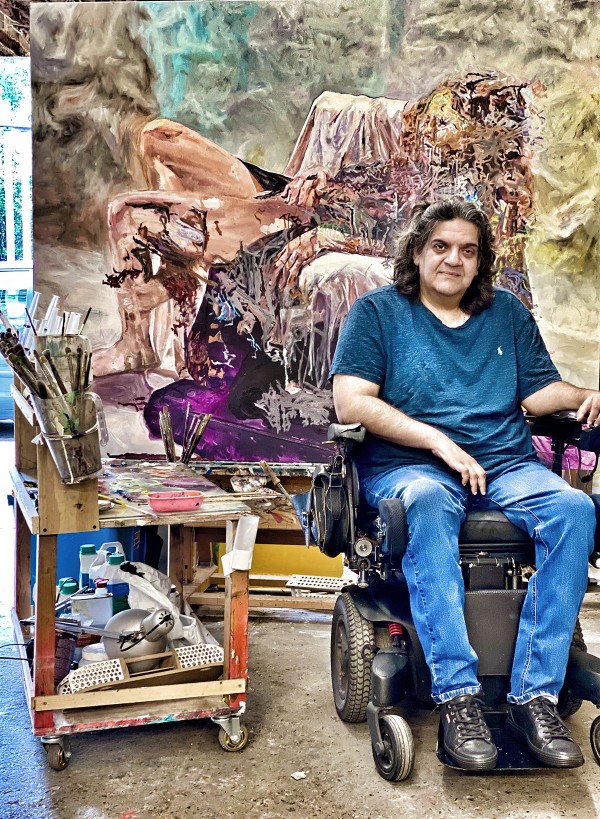
Afshin Naghouni © Lux Magazine
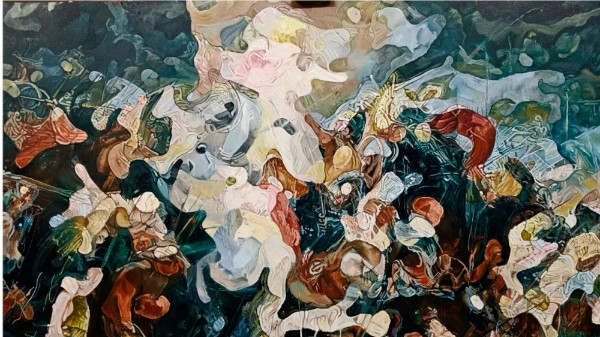
Naghouni’s abstract paintings — which are only to be seen after the performance — reconstruct Old Masters in ways that question the relationship between memory and what may never have existed. This is not a mere reproduction of the past, but a process of fracturing it, preserving its essence through abstraction while blurring the boundaries between composition, history and memory. Konjani translates this experience into fractured gestures, expressionistic forms and sharply edged sonic structures. Like Naghouni’s work, the performance creates an immersive environment of uncertainty, challenging what the listener thinks they know and what they believe they hear. There are no instruments as we know them in Reveries in Fracture. The Kraken harp and harpsichord are transformed, revealing the percussive aspects of their musical personalities, while the eight bassists become percussionists in their own right, drumming on the bodies of their instruments.
© kingsplace.co.uk
Much of Konjani’s writing focuses on rhythm, exposing the percussive nature of the instruments. Throughout the performance, a strong sense of pulse persists beneath the dominance of dissonance. This is further emphasised by Aghakhani’s unorthodox conducting gestures and manner of counting, perhaps necessary for navigating such intricate, textural music… One could describe the music as sheets of sound — though not in the Coltrane sense. Rather, it has the slightly abrasive, enveloping quality of rough linen, covering the listener in layers of dissonance and extremes of sound. At times, one can almost hear the paint being deposited on the canvas — perhaps with a knife — and the scrape of the tool against the fabric. Sound and image seem to share a physical language, both built from gestures, textures and fragments.
Much of Reveries in Fracture is theatrical; there is the scene Konjani establishes at the beginning, the prepared Kraken instruments acting as both performers and setting pieces, Aghakhani’s dramatic conducting gestures, and the fragility of Westbrook’s voice emerging from the ensemble. The real encounter with Konjani’s music takes place in the performance itself, through the interaction between the musicians and the audience. Just as in Naghouni’s paintings, these are instruments we think we know, but not as we know them.
The complementarity of the music and painting resides in how the listener and viewer understand one through the other, only by experiencing them simultaneously. A wish of the writer would be to experience both at the same time, in total immersion of sound and images…
For more of the best in classical music, sign up for our E-Newsletter