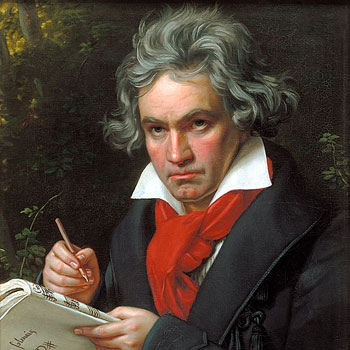
Over the course of listening to Beethoven’s early and middle period string quartets, music lovers have the privilege of hearing a brilliant young composer step into the tradition of Haydn and Mozart – then begin to innovate beyond it.
Written between 1789 and 1810, these eleven quartets chart Beethoven’s transformation from talented twentysomething phenom to a mature, confident master composer.
Here’s a beginner’s guide to each of the eleven Beethoven string quartets from his early and middle periods – what to know and what to listen for, one bullet point at a time.
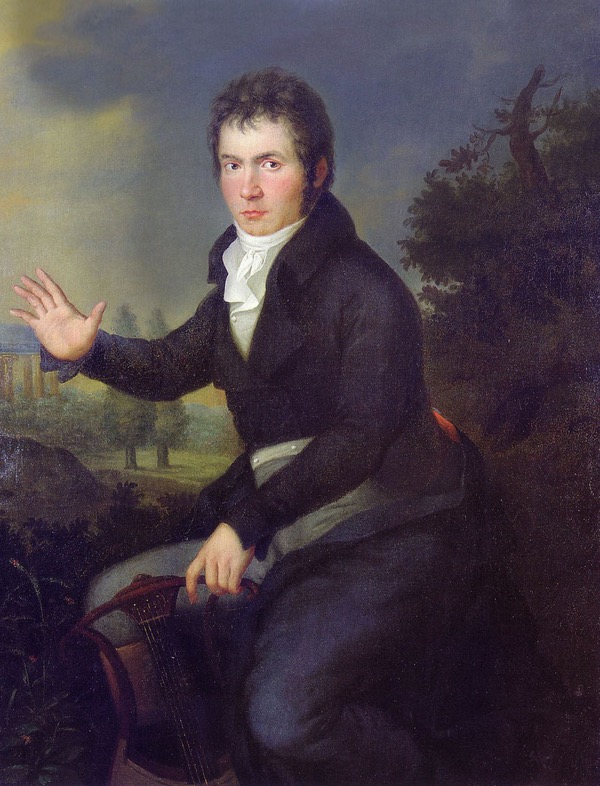
Joseph Willibrord Mähler: Beethoven, 1804 (Vienna Museum)
String Quartet No. 1 in F major, Op. 18, No. 1
Year written: 1798–1800, when Beethoven was 27–29
Dedicated to: Joseph Franz von Lobkowitz
- This quartet kicks off a set of six that Beethoven published in 1801, when he was 30.
- Although it was published as his first string quartet, it is likely the second quartet he wrote.
- Beethoven was eager to signal his debt – and connection – to Haydn and Mozart here. One way he does so is by opening the quartet with a “turn” (a flourish of quick notes around a pitch), a Classical-era gesture that recalls important works by his two predecessors.
- Beethoven told his friend Karl Ferdinand Amenda, a music teacher and pastor, that the tomb scene from Romeo and Juliet inspired the second movement.
- It was originally dedicated to Amenda, but Beethoven altered the work considerably (telling Amenda in a letter, “Be sure not to hand on to anybody your quartet” because he’d made “drastic alterations” to it). Then he included it in a set dedicated to Joseph Franz von Lobkowitz, a music-obsessed aristocrat who supported Beethoven and other composers. Hopefully Amenda understood!
String Quartet No. 2 in G major, Op. 18, No. 2, “Komplimentier-Quartett”
Year written: 1798–1800, when Beethoven was 27–29
Dedicated to: Joseph Franz von Lobkowitz
- In German-speaking countries, this quartet is known as the “Komplimentier-Quartett” – a word that can be translated as “quartet of bows and curtseys.”
- Intriguingly, Haydn wrote his own string quartet that earned the nickname of “Komplimentier”: his Op. 77, No. 1, which would have been written contemporaneously with this Beethoven quartet. Both are in G major, too!
- Beethoven was unhappy with the original second movement and wrote a replacement; that replacement movement is the version in the score today.
- That replacement movement, an adagio, features a witty contrasting allegro middle section, giving the slower moments an almost comic tinge of melodrama.

August Friedrich Oelenhainz: Joseph Franz von Lobkowitz
String Quartet No. 3 in D major, Op. 18, No. 3
Years written: 1798–1800, when Beethoven was 27–29
Dedicated to: Joseph Franz von Lobkowitz
- This is actually the first string quartet that Beethoven wrote.
- When opening it, Beethoven opted for a quiet yearning upward jump, from an A to a G – an interval that falls just short of an octave, that our inner ears want to resolve, that might be found at a transitional moment in a piece of music. In fact, it almost sounds as if we’ve joined mid-movement.
- The quartet ends like it started, quietly – this time with mischief and a wink.
String Quartet No. 4 in C minor, Op. 18, No. 4
Years written: 1798–1800, when Beethoven was 27–29
Dedicated to: Joseph Franz von Lobkowitz
- Thanks to Beethoven’s notes, we have an idea of what order the other quartets in this set were written in. However, no notes survive for this quartet, so we can only guess where it sits in the chronology.
- This is the only quartet in a minor key in this collection.
- Beethoven would go on to write several incredibly famous works in C minor, including his Pathetique piano sonata (1798), third piano concerto (1800), seventh violin sonata (1802), funeral march in his third symphony (1803), fifth symphony (1808), and so on, until his last piano sonata in 1822. This dramatic quartet precedes those works.
- This quartet doesn’t have a slow movement; instead, it has a fugal Andante scherzoso quasi Allegretto that comes across as precise and a little picky – potentially partly satirical.
- The prestissimo finale is fast and fiery.
String Quartet No. 5 in A major, Op. 18, No. 5
Years written: 1798–1800, when Beethoven was 27–29
Dedicated to: Joseph Franz von Lobkowitz
- Throughout all of these quartets, Beethoven’s debt to Haydn and Mozart is profound. This quartet was an homage to Mozart, specifically his String Quartet No. 18 in A major, K. 464. Mozart had dedicated that quartet to Haydn, so modelling his own quartet after it was a way to honour both men’s legacies.
- Beethoven was even seen copying out the Mozart quartet to take it apart and understand it before tackling his take on it.
- The traditional order of the inner movements here is swapped: the minuet is the second movement, and the andante theme and variations is the third movement…a deliberate nod to Mozart, who did the same thing in his K. 464.
String Quartet No. 6 in B-flat major, Op. 18, No. 6
Years written: 1798–1800, when Beethoven was 27–29
Dedicated to: Joseph Franz von Lobkowitz
- This is the last quartet of the six quartets of Op. 18 to be composed chronologically.
- Beethoven clearly wanted to end with a bang, and the standout moment in this quartet is its final movement, titled La Malinconia (“The Melancholy”) and marked “Questo pezzo si deve trattare colla più gran delicatezza” (“This piece is to be played with the greatest delicacy”).
- The movement switches between the sombre “melancholy” theme and a cheerful country dance, unable to settle on one. Beethoven resolves the gap by finishing with a thrilling prestissimo ending that evokes neither.
- That movement alone foreshadows Beethoven’s later ability to create works with a wider range of emotional expression than Haydn or Mozart could manage using the musical vocabulary of the Classical era.
String Quartet No. 7 in F major, Op. 59, No. 1
Year written: 1806, when Beethoven was 35
Dedicated to: Andrey Razumovsky
- Only six or seven years passed between Beethoven’s Op. 18 quartets and his Op. 59 quartets. Still, in that time, he came into his own as a composer, writing landmark heroic works like his Third Symphony, his Ninth Violin Sonata (nicknamed the Kreutzer), and his Waldstein and Appassionata piano sonatas.
- This is the first quartet from a set of three dedicated to Prince Andrey Razumovsky, a Russian diplomat who lived and worked in Vienna. The prince loved music and even established an in-house string quartet.
- With this work, Beethoven brought his huge ambitions to the string quartet genre, writing a piece that was nearly 40 minutes long.
- The finale features a jaunty, Russian-tinged theme, likely an homage to Razumovsky’s heritage.
- This quartet marks a dividing line. While you can imagine his first six quartets being written by Mozart or Haydn, every Beethoven quartet from his seventh on was clearly his.
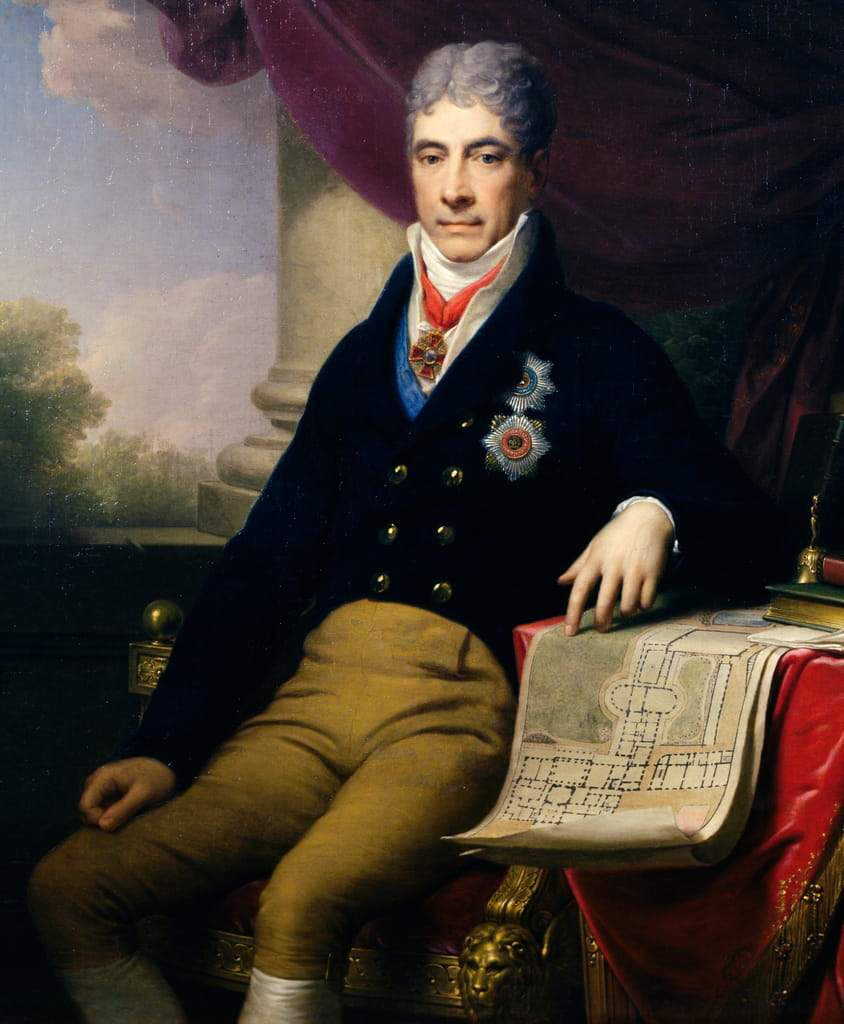
Portrait of Razumovsky from 1810 by Austrian artist Lampi the Younger
String Quartet No. 8 in E minor, Op. 59, No. 2
Year written: 1806, when Beethoven was 35
Dedicated to: Andrey Razumovsky
- This is the second in the set of three Razumovsky string quartets.
- Beethoven’s piano student Carl Czerny later reported that the majesty of the night sky inspired the awed slow movement of this quartet.
- In tribute to Razumovsky, the third movement allegretto uses an authentic Russian folk song that was also used by Russian composers like Mussorgsky, Tchaikovsky, and Rachmaninoff – foreshadowing the wave of nationalism that would strike classical music in future generations.
- The finale ends in furious E minor: an unusual choice for Beethoven, who favoured narrative arcs closer to hopelessness-to-hopefulness.
String Quartet No. 9 in C major, Op. 59, No. 3
Year written: 1806, when Beethoven was 35
Dedicated to: Andrey Razumovsky
- The mysterious, brooding opening sets the stage for the rest of the quartet, without having much to do with the rest of the quartet’s material musically. Beethoven may have drawn on Mozart’s famous “Dissonance” quartet for inspiration here; that legendary quartet pulls off a similar trick in its opening to capture listeners’ attention and provide contrast.
- The second movement features an unusual cello part that is heavy on the pizzicato (plucking the string). The resulting texture is extremely unusual for a string quartet of this era.
- The third movement is a minuet – another unusual choice, given that by this point in his career, Beethoven was embracing the idea of spiky scherzos over refined courtly dances.
- The finale features a fast fugue. Again, unusual – and incredibly technically demanding. This movement underlines how Beethoven had stopped writing string quartets for amateur players and was pushing the professional quartet that Razumovsky had assembled to its limits.
- Speaking of Razumovsky, unlike in the other two quartets in the set, Beethoven declined to include a Russian-sounding melody here. Why is anybody’s guess.
String Quartet No. 10 in E-flat major, Op. 74, “Harp”
Year written: 1809, when Beethoven was 38
Dedicated to: Joseph Franz von Lobkowitz
- Beethoven returned to quartet writing a few years after his Razumovsky quartets.
- It was written during a trying time. That year, Beethoven suffered from tinnitus while Napoleon bombarded and occupied Vienna. He channelled his suffering and stress into works like his Emperor piano concerto and his 26th piano sonata, nicknamed “Les Adieux” – interestingly, all in E-flat major.
- The quartet has the nickname of the “Harp” because of its pizzicato passages. Beethoven didn’t give it; it was bestowed later, and he never approved it.
- The slow movement, adagio, is the soul of the piece, featuring a hymn-like theme for the first violin.
- The third movement, Presto, features the short-short-short-long rhythmic pattern he’d made famous in his fifth symphony – just sped up. The symphony premiered a few months before he wrote the Harp Quartet; it is interesting to hear him return to the same idea in another genre, and it shows how his mind kept turning over the musical ideas he was drawn to.
String Quartet No. 11 in F minor, Op. 95, “Serioso”
Year written: 1810, when Beethoven was 39
Dedicated to: Nikolaus Zmeskall von Domanovetz
- This quartet is one of Beethoven’s shortest, clocking in at a little over twenty minutes.
- Its nickname comes from the inscription “Quartett Serioso” that Beethoven wrote at the top of the page. To underline the idea, his tempo marking for the third movement reads “Allegro assai vivace ma serioso.”
- He told a publisher that this quartet was meant for musical connoisseurs – not the wider public.
- To underline that, it was dedicated to one of his long-time Vienna friends, Nikolaus Zmeskall von Domanovetz, who was a cellist – not an untrained aristocrat.
- The opening theme is one of Beethoven’s most attention-grabbing, with its aggressive playing in unison.
- The quartet has a striking ending: after the seriousness of the entire work, the very end of the finale features a bright and cheerful push to the end. Is it the musical equivalent of a pasted-on smile, patched in to create a traditional happy ending? A genuine reckoning with the turbulence that has come before? The answer is unclear.
- Listen for how abrupt and terse the entire work is. Beethoven is experimenting with leanness here in a way that calls to mind some of the more austere chamber music of his late period.
Conclusion
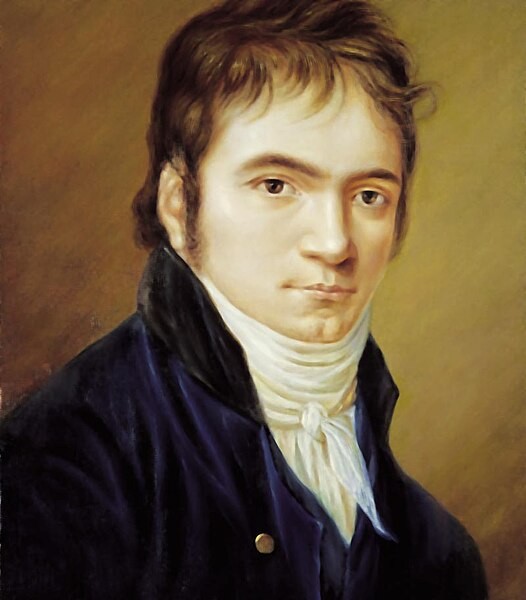
Christian Horneman: Ludwig van Beethoven, 1803 (Beethovenhaus Bonn)
Over his first eleven string quartets, Beethoven pushed the form far beyond what he’d found. In the process, he created eleven of the most intriguing pieces of chamber music ever written.
But he wasn’t done yet: his late quartets would continue to break new ground in ways that still impress and awe listeners today.
For more of the best in classical music, sign up for our E-Newsletter