When we look at the modern orchestra, we assume that those instruments have been there unchanged for centuries. Yet, like all things in the world, they’re subject to change, to alterations, and even experimentation.
In their search for new or newer sounds, instrument makers create new configurations. If you can get a composer to write for your new instrument, or if your new instrument catches the public fancy, it may live for longer than its time of popularity. Let’s look at some of these.
Baryton
In the 18th century, experimentation in string instruments led to the baryton, rather like an expanded cello. Or, because the cello wasn’t really a thing yet in the 18th century, rather like an expanded bass viol.
The normal bass viol was the lowest member of the string family. Players held the instrument, much like the later cello, vertically in front of the body. Because it didn’t have an endpin, it was balanced between the player’s legs to keep it off the ground.
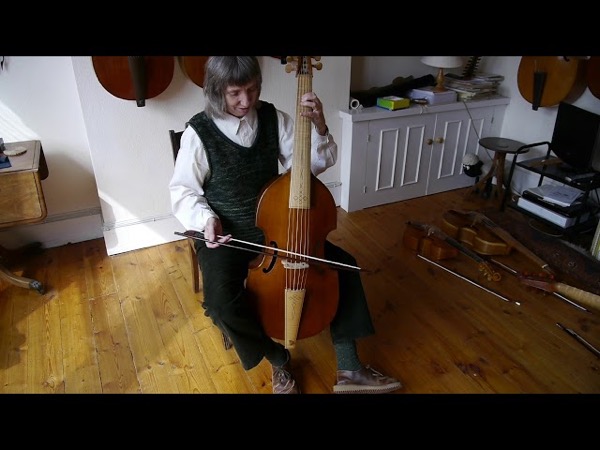
Bass violist Alison Crum holding her bass viol
It is thought that the baryton originated in England in the early 17th century and combined two instruments into one: the bowed viola da gamba and the plucked bandora (a kind of bass string instrument). It’s described in Mersenne’s treatise of 1644, and the instrument was said to be popular at the court of Saint James. It retained its popularity in court circles, finally reaching Vienna and the Esterházy family, where Joseph Haydn was the court composer. By the time the instrument reached Haydn, one major change was that the sympathetic strings were tuned an octave higher, giving the instrument a voice that made it stand out from the viola and cello.
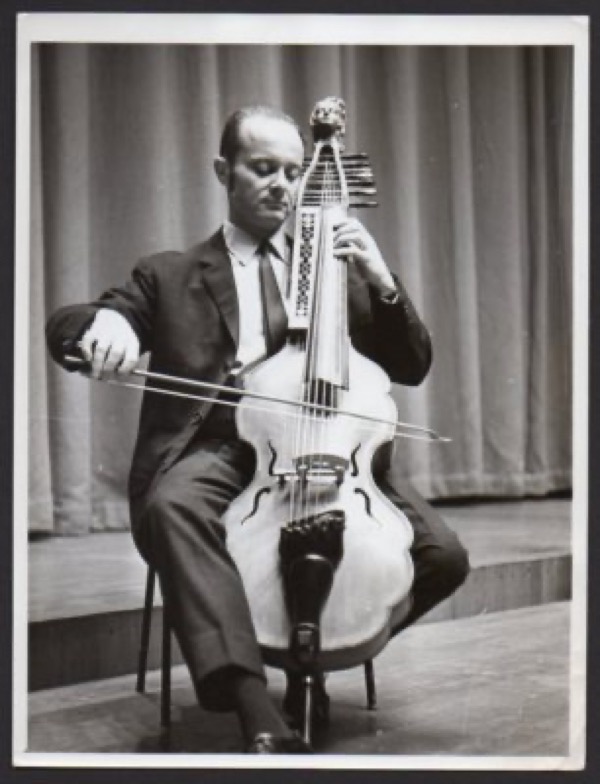
Janos Leibner playing a baryton
This combination of uses resulted in an instrument with many strings! In this copy of Prince Esterházy’s baryton at his palace, we can see pegs for 18 strings.
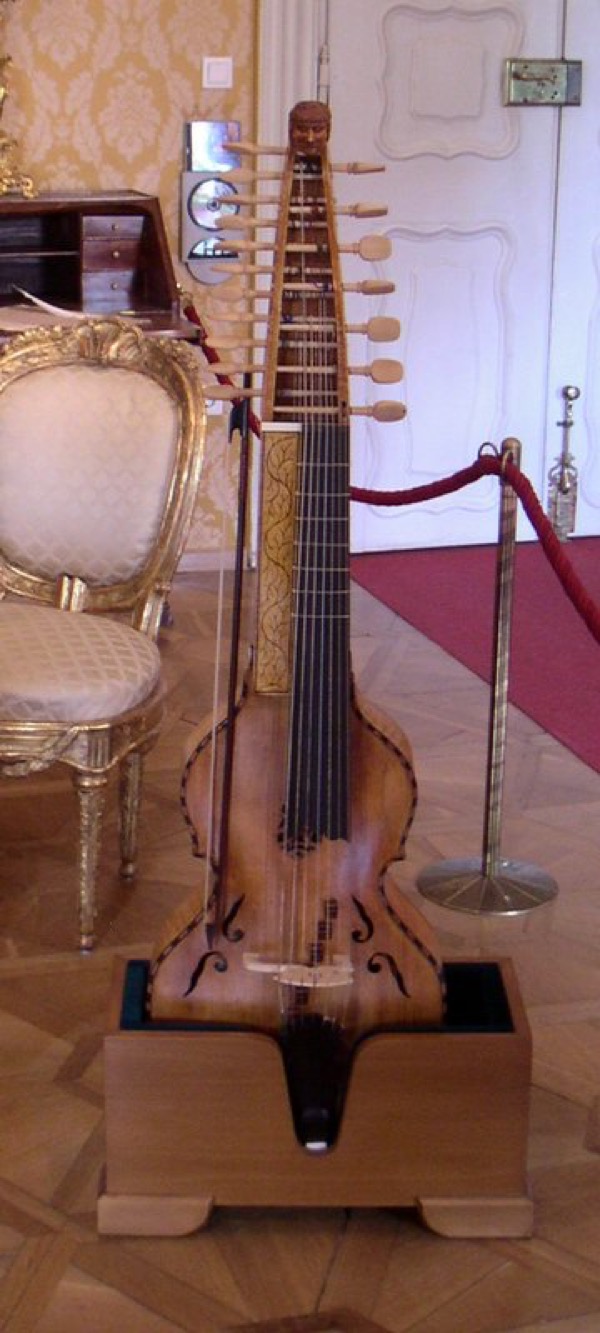
A copy of Prince Esterházy’s baryton, on display at his palace in Eisenstadt (photo by Rik86)
The instrument was fairly rare, and we only have specific information on about 50 instruments. Not all have lived their whole lives as barytons, but were later changed into a different instrument.
If you look closely at Prince Esterházy’s baryton, you’ll see an unusual bridge: instead of being a simple arch, as you might find on a regular cello, this one is an arch plus a lower side arch on the left side. The right side of the arch held the 6 strings that were to be bowed, and the left side of the arch would have been for the metal sympathetic strings that could sound alone or be plucked with the player’s thumb.
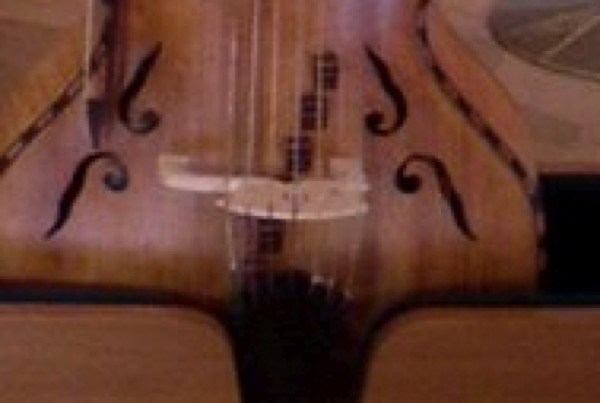
Bridge detail on a copy of Prince Esterházy’s baryton, on display at his palace in Eisenstadt (photo by Rik86)
What did this mean for a performance? In this brief excerpt of a Haydn piece, we can hear the echoes and resonance of the baryton as it plays alone.
Franz Joseph Haydn: Divertimento for Baryton Solo No. 1 in G Major, Hob.XII:20 (Michael Brussing, baryton; Esterhazy Ensemble)
Now, when you hear it as part of a baryton trio (violin, baryton, and cello), you can better listen for its distinctive sound and how it fills out the trio texture.
Franz Joseph Haydn: Baryton Trio No. 118 in D Major, Hob.XI:118: I. Allegro (Esterhazy Ensemble)
Since his patron was a baryton player, Haydn wrote for the instrument, with over 120 trios for baryton, violin/viola, and cello. He also wrote a dozen divertimentos for baryton and 2 horns, or 2 horns and strings, or just baryton and cello. It may be a measure of Prince Esterházy’s proficiency on the instrument, but all the trios and divertimentos are in major keys.
The baryton wasn’t the only art instrument with sympathetic strings. Other European instruments that include sympathetic strings include the viola d’amore and the Aliquot piano, invented in 1873.
The viola d’amore is a higher-pitched instrument than the baryton. It has both bowed strings and a second set of sympathetic strings that run under the fingerboard. In the example below, it has 14 strings: 7 bowed and 7 sympathetic strings that run under the fingerboard.
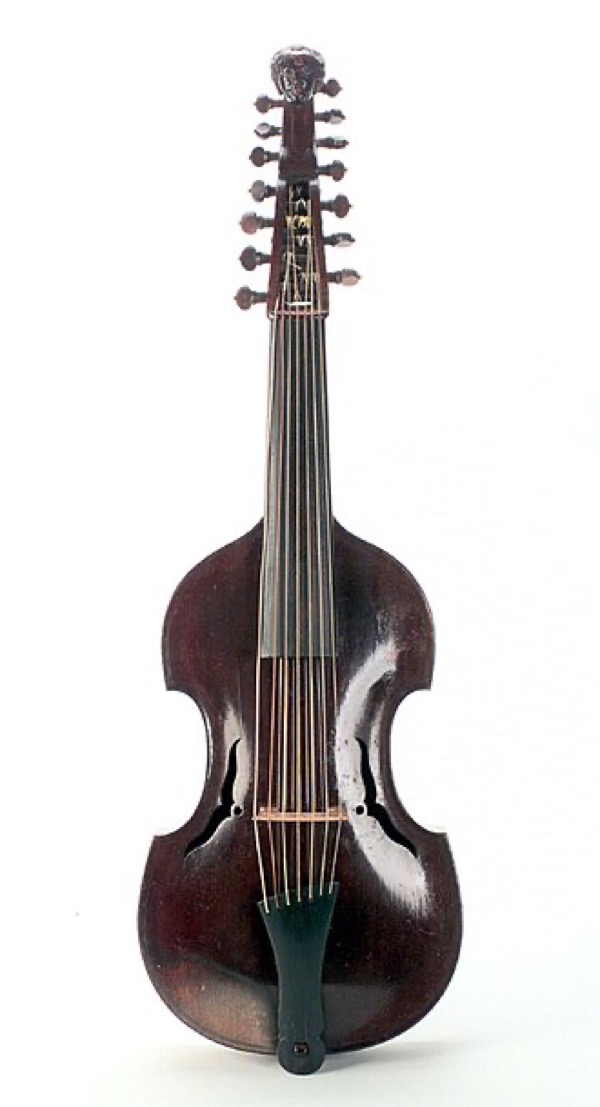
Viola d’amore, late 18th century (Auckland Museum)
In a detail of the bridge from an early 18th-century viola d’amore, we can see the additional strings running under the bridge’s arch.
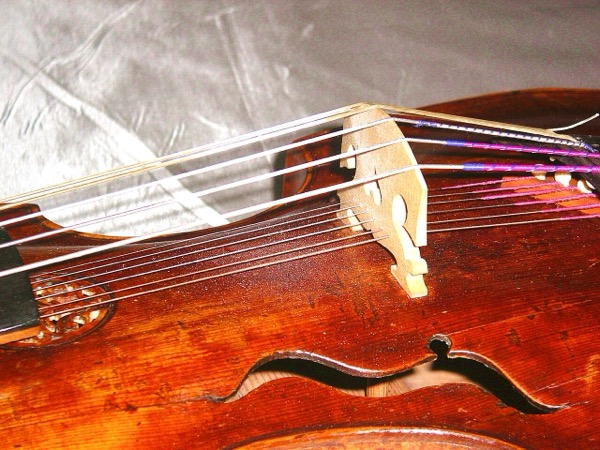
Viola d’amore bridge by Johanne Paul Schoern, between 1700 and 1715 (photo by Aviad2001) (Owned by Anton Steck)
In this viola d’amore sonata by Domenico Scarlatti, you can hear the depth brought by the sympathetic strings of the viola d’amore.
Domenico Scarlatti: Solo Sonata in D Minor, K.90/L.106/P.9: I. Grave (Valerio Losito, viola d’amore; Andrea Coen, harpsichord)
Compare it with the same work played on violin, cello and harpsichord.
Domenico Scarlatti: Sonata for Violin, Cello and Harpsichord in D Minor, K.90/L.106/P.9 (Remy Baudet, violin; Frank Wakelkamp, cello; Pieter-Jan Belder, harpsichord)
The instrument largely fell from use by the end of the 18th century. Interest returned in the 20th century when two violists/composers, Henri Casadesus and Paul Hindemith, took up the instrument. It was also used in films by composer Bernard Herrmann and in the ballet Romeo and Juliet by Sergei Prokofiev.
Paul Hindemith: Kleine Sonata, Op. 25, No. 2: I. Massig schnell, lustig (Gunter Teuffel, viola d’amore; Anthony Spiri, harpsichord)
The idea of a piano with sympathetic strings isn’t as unusual as it sounds. Since it is essentially a box with strings, the piano has always had resonance from the other strings in the box when something is played. On a modern piano, holding down the rightmost pedal releases all the dampers from all the strings. If you hold some keys down and then press the middle pedal, it will hold the dampers off the notes you’re holding down. Both methods create sustain; however, that’s not the same as sympathetic strings.
The Aliquot grand piano changed the piano stringing system.
In a piano, when you strike a key, the hammer inside the piano may strike 1 string (lowest octave), two strings (next higher octave), or three strings (rest of the piano). Look at the stringing of this grand piano, and you’ll see the heavy bass strings to the right and the doubled, then tripled strings as the pitches get higher and higher.
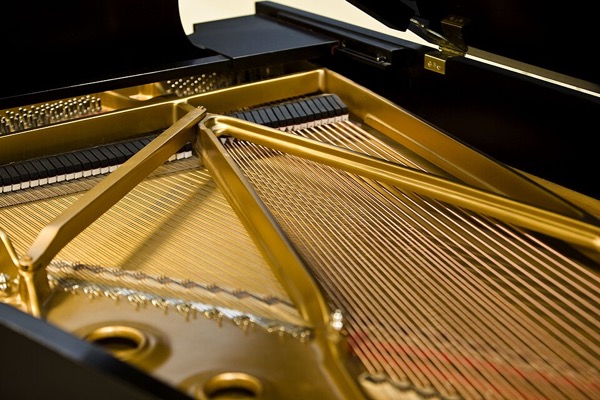
The strings of a Steinway grand piano, 2010 (photo by David Maiolo)
On an Aliquot-strung piano, however, the top three octaves are strung with four strings. The piano hammers don’t strike the fourth string; it’s strung above the regular strings and resonates in sympathy, sounding one octave higher (as with the late development of the baryton). You will note in the picture below that the extra string terminates just after the wood dampers; its short length gives it the higher sound.
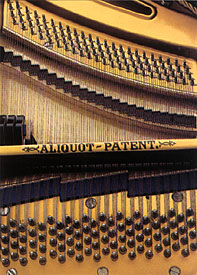
Blüthner Grand Piano made in 1874 with Aliquot strings © pianostreet.com
In this example, you can hear the high strings’ bright, singing quality.
Fully Restored Blüthner Style 4A (Aliquot System) @ The Piano Shop, Bath
Aliquot pianos are still made today by Blüthner (its inventor), Steinway, Mason & Hamlin, and Fazioli. In case you’re wondering, the word ‘aliquot’ is Latin for ‘some’ or ‘several’, but in mathematics, it means ‘an exact part or divisor’ and refers to the fact that the aliquot string is not the same length as the others in its set but is an exact division (2:1) of them, and so sounds sympathetically with them, but at a higher pitch.
Although instruments with sympathetic strings are more common in folk instruments, and the baryton has vanished from the instrument list, the viola d’amore and the Aliquot piano still have a place.
For more of the best in classical music, sign up for our E-Newsletter