French violinist Ginette Neveu was widely considered to be one of the greatest musicians of the 20th century: a prodigy who graduated from the Paris Conservatoire as a child, beat David Oistrakh in an international competition at 15, and spent the following decade redefining what a woman’s violin playing could sound like.
But her life and career ended in heartbreaking tragedy. She was just 30 years old when she and her pianist brother died in a plane crash in the Azores in 1949.
In the decades since her death, her small body of recordings has never gone out of print – and her influence on successive generations of violinists has never faded.
Today, we’re looking at the life, death, and legacy of Ginette Neveu.
Life as a Developing Child Prodigy
Ginette Neveu was born on 11 August 1919 in Paris to a stockbroker and his wife.
Music ran in the family. Her mother was a violinist who was her first violin teacher, and her brother Jean Paul Neveu, a year older than her, became a pianist.
Ginette was a child prodigy. She gave her first public concert at the age of five. By seven, she’d already learned the Bruch and Mendelssohn concertos.
As a child, she’d climb with her violin on top of the kitchen table, telling her mother, “It’s to get used to performing on stage. The other day, I had stage fright; it was probably vertigo.”
After enrolling in the Paris Conservatoire, she studied violin with Jules Boucherit and composition with Nadia Boulanger. She won the prestigious Premiere Prix while still a child.
She also took violin lessons from George Enescu, a Romanian violinist, pianist, conductor, composer, and violin teacher. (His violin students included Menuhin, Ferras, Gitlis, Grumiaux, Haendel, and other twentieth-century giants.)
Her education was capped off by studies with Carl Flesch, who was so impressed by her that he reportedly told her:
“My child, you have received a gift from heaven, and I have no wish to touch it. All I can do for you is to give you some purely technical advice.”
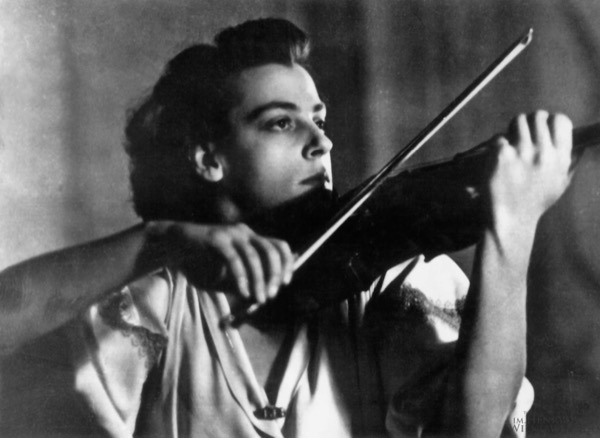
Ginette Neveu
How Neveu Triumphed at Competitions
Ginette Neveu gave some extraordinary performances as a child at international violin competitions.
When she was just twelve years old, she competed in the Vienna International Violin Competition. (This is where she met Flesch, who was on the jury and astonished by her playing.) Astonishingly, she ended up winning fourth place out of 250 players.
In 1935, when she was fifteen, she had an even more impressive showing at the very first Wieniawski Competition. Her fellow competitors included some of the greatest violinists of her generation, including David Oistrakh and Ida Haendel.
Neveu beat all of them, winning first place. One of the pieces that put her over the top was a performance of Maurice Ravel’s showpiece Tzigane. Her interpretation of Tzigane would go on to become one of her calling cards.
Maurice Ravel: Tzigane (Ginette Neveu, violin; Jean Neveu, piano)
David Oistrakh, despite being a decade older than Neveu, walked away with silver.
After she won the Wieniawski Competition, she received countless invitations to tour the world. Over the course of her career, she would travel widely, visiting Europe, North and South America, and Australia.
The Striking Musical Presence of Ginette Neveu
Neveu was a striking presence on the concert platform. Even from an early age, audiences noted her unwillingness to conform to specific gender norms, aesthetics, and playing styles.
A Viennese newspaper reported that when she was competing at the Vienna International Violin Competition:
“If you close your eyes, you think you are listening to the vigorous playing of a man and not that of a little girl in a white frock.”
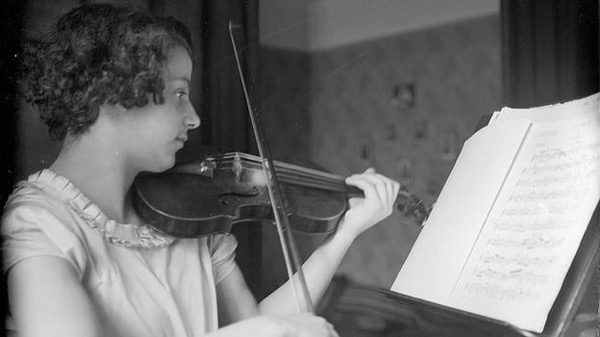
Ginette Neveu
An excerpt of Neveu playing Chausson’s Poème
Throughout her career, her playing was described in stereotypically masculine ways: strong, full-toned, muscular, etc. Fellow violinist Ida Haendel went so far as to call her playing masculine.
Some accounts suggest that Neveu was intersex. In 2009, violinist Stephanie Chase claimed that, after Arthur Grumiaux’s death in 1986, she spent time with Grumiaux’s widow, who told her about Neveu’s identity and that her parents chose to raise her as a woman and not pursue gender-affirming surgery. Chase speculated that Neveu’s struggles with her identity may have affected her impassioned playing style.
As of today, this is an open question unresolved by the historical record – but it is certainly thought-provoking to consider how such an identity might have impacted her and listeners’ perceptions of her playing.
How Ginette Neveu Pushed Back Against the Nazi Occupation
World War II began on 1 September 1939, when Nazi Germany invaded Poland. Neveu had just turned twenty.
The Nazis invaded France the following spring, and the occupation continued until August 1944.
Not surprisingly, the war had a major impact on Neveu’s career. She made a decision to stay in Paris and not concertize in Germany. She also limited her performances in France during the occupation to protest it.
During this time, she made music in another way. She partnered with French composer Francis Poulenc, and they worked together on his violin sonata.
Poulenc’s Violin Sonata
Poulenc wrote:
“To be honest, I don’t like the violin, as a solo instrument… but how could I resist a suggestion from Ginette Neveu!… The war had deprived us of Menuhin, Heifetz, and Francescatti, but we had the unexpected fortune to have their equal on our doorstep…”
It’s important to note that Neveu – who had, after all, studied composition with Nadia Boulanger, who had trained most of the great composers of the twentieth century – made important contributions to the work, per Poulenc’s testimony.
“There are some tasty details in the violin part, entirely due to Ginette Neveu, who was a great help over the instrumental writing…”
They premiered the sonata together in June 1943. Unfortunately, they never recorded it, but the sonata remains in the repertoire today.
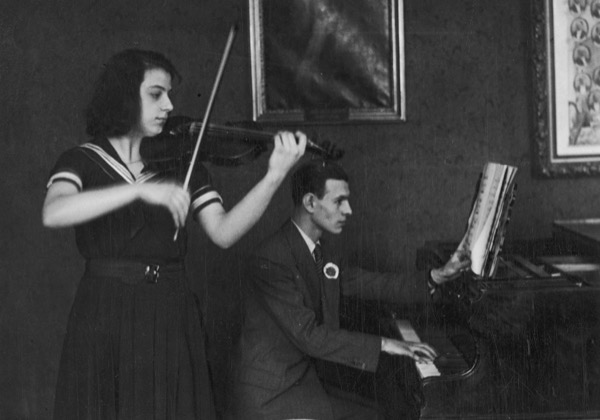
Ginette Neveu
Her Triumphant Return to the International Stage
After the war ended, Neveu continued her international career.
In November 1945, she recorded the Sibelius violin concerto with the Philharmonia Orchestra and conductor Walter Susskind.
Sibelius himself was impressed by her work, writing:
“I particularly wish to speak of my feeling of profound gratitude when I think of the inspired and extremely sensitive performance of my Violin Concerto, which Ginette Neveu rendered unforgettable.”
Jean Sibelius: Violin Concerto in D Minor, Op. 47 (Ginette Neveu, violin; Philharmonia Orchestra; Walter Susskind, cond.)
The following year, she made a follow-up recording of the Brahms concerto with the Philharmonia.
In addition to making these and a handful of other important recordings, Neveu’s postwar years were spent touring. Along with her brother, pianist Jean-Paul, she travelled the world as a touring artist.
At one Royal Albert Hall concert, Queen Elizabeth (the Queen Mother) was so impressed by the Beethoven Concerto that she invited Neveu up to the royal box for the second half of the concert.
She was scheduled to record the Beethoven concerto with conductor Herbert von Karajan in 1950.
Inside the Tragic Airplane Crash That Killed Ginette Neveu
Tragically, that recording was never made.
Neveu gave her final concert in Paris on 20 October 1949. A week later, she and Jean-Paul boarded Air France Flight 009 from Paris to the Azores, en route to New York City.
Boxer Marcel Cerdan, beloved partner of singer Edith Piaf, was a fellow passenger; he was travelling to New York to meet with Piaf. While waiting in the departure lounge together, the press took photos of Neveu, her brother Jean-Paul, and Cerdan, with Cerdan holding her violin.
Hours later, their flight crashed into a ravine upon approach. All 48 passengers and crew aboard the flight, including Ginette and Jean-Paul, died. He was 31 years old, and she was 30. It was one of the most heartbreaking losses in music history.
Although her bows were recovered in her double case after the plane crash, both of her antique violins were presumed destroyed, though her Guadagnini’s scroll later surfaced in Paris. According to legend, Neveu’s body was found in the wreckage with the crushed Stradivari clutched in her arms.
Neveu was buried in Père Lachaise Cemetery in Paris, close to the grave of Frédéric Chopin.
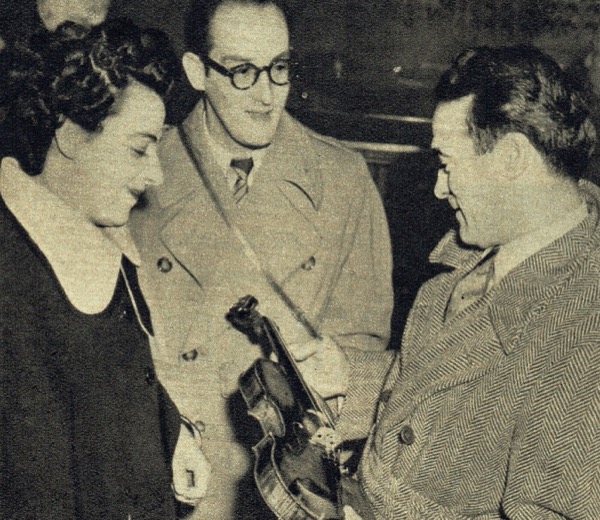
Ginette Neveu and Marcel Cerdan
Ginette Neveu’s Poignant Legacy
Composers and conductors were haunted by the loss of their colleague.
Her creative partner, Francis Poulenc wrote:
“I am haunted by the memory of Ginette Neveu. I had the greatest admiration for her, and I loved her dearly.”
That statement was representative of many others from the most respected names in the art. The loss was all the more poignant because her extraordinary promise was clearly only just starting to blossom.
Fellow French violinist Jacques Thibaud asked:
“Why was it that at the dawn of her days an unjust and relentless stroke of fate should come and cut off a life which was bringing to the world nothing but beauty and joy? But in spite of the sternness of destiny, in the hearts of her friends and of the whole world, Ginette is unforgettable. The memory of her will never die.”
Neveu was just thirty years old when she died. She had spent more than half her life playing at the highest level – and yet she had decades of professional accomplishments left. The Beethoven concerto recording with Karajan was scheduled for 1950. The repertoire she hadn’t yet recorded dwarfed what she had.
Instead, what remains is small in quantity but vast in impact: a handful of commercial recordings, a few live recordings, and, of course, the testimony of the people who heard her.
Throughout her career, critics tried to describe her playing using gendered words like masculine, virile, and powerful. But those never fully described the entirety of her artistry. She simply didn’t fit into society’s idea about what a woman violinist should be – and, always true to herself and her creative vision, she never tried.
For more of the best in classical music, sign up for our E-Newsletter