The history of classical music is filled with extraordinary lives – and, in some cases, extraordinarily unsettling deaths.
In Part 2 of our series on strange composer deaths, we move into the twentieth century – an era shaped by modern medicine, world wars, and rapidly changing artistic worlds.
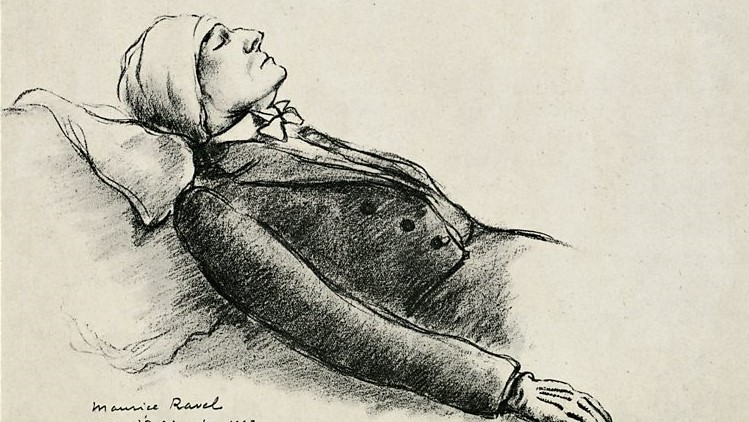
Ravel on his deathbed © Lebrecht Music & Arts
These composers did not die quietly or predictably. Instead, their final days were marked by misdiagnosed illnesses, institutionalisation, sudden accidents, wartime chaos, or shocking medical failures.
Today, we’re looking at some of the strangest deaths of famous composers.
Hugo Wolf (1903)
Hugo Wolf’s Italian Serenade
In 1897, composer Hugo Wolf was entering the final stages of a syphilis infection.
At the time, he was suffering from delusions that he was the intendant of the Vienna Opera. His friends only succeeded in sending him to an asylum by telling him it was the Emperor’s home, where he would sign the paperwork to finalise his new position.
He was in and out of institutions over the following years. At one point, he attempted suicide by jumping into a lake, but he survived – and then was committed for the rest of his life.
In early 1902, doctors determined he’d have just a few days of suffering left. But he survived for a full year more, only dying of a pulmonary infection in February 1903.
Enrique Granados (1916)
Enrique Granados’s Danza Española No. 5: Andaluza
Spanish composer Enrique Granados died a tragic hero’s death.
In 1916, in the middle of World War I, he was touring America. Toward the end of that tour, he accepted one last recital invitation and postponed his passage.
It was a fateful decision. Crossing the English Channel, his British vessel was torpedoed by a German U-boat.
In the chaos, Granados found a spot on a lifeboat…but then he saw his wife in the water and jumped into the ocean to save her. (Women of the 1910s, who usually dressed in heavy and restrictive clothing, were especially prone to drowning.)
Both died.
Alexander Scriabin (1915)
Alexander Scriabin’s Le poème de l’extase
Russian composer Alexander Scriabin had an active creative imagination.
In the 1910s, he conceived a multimedia extravaganza called Mysterium, to last seven days and be performed in the Himalayas.
While he was working on this project, a boil on his lip – possibly originating from shaving – became infected.
He began running a high fever and developed septicemia. Nine days later, he was dead, along with his dreams for Mysterium.
Here’s our story about Scriabin’s death: https://interlude.hk/dont-pop-that-zitalexander-scriabins-undoing/
Engelbert Humperdinck (1921)
Engelbert Humperdinck’s Evening Prayer from Hansel und Gretel
In September 1921, composer Engelbert Humperdinck attended a performance of the opera Der Freischütz. His son was serving as the stage director of the production.
During the performance, Engelbert suffered a heart attack. He died the following day from a second heart attack.
Wolfram would go on to make a career in opera and write a biography of his father.
Alban Berg (1935)
Alban Berg’s Violin Concerto
In 1935, composer Alban Berg set aside his demanding opera Lulu to work on a violin concerto, which he wrote quickly over the summer.
The death of Alma Mahler‘s daughter Manon at the age of 18 inspired him to subtitle the magical, melancholy work “To the memory of an angel”: a subtitle that would prove to be prophetic.
Berg returned to Lulu, hoping to finish it, but in November 1935, he was bitten by an insect. A boil developed on his back and became infected. He ended up developing sepsis and dying on Christmas Eve.
Lulu remained unfinished, although portions would be presented in the years to come.
After the death of Alban’s widow, Lulu was finished in the 1970s by composer and conductor Friedrich Cerha.
More about the Berg violin concerto: https://interlude.hk/berg-violin-concerto-premiered-today-1936/
Louis Vierne (1937)
Louis Vierne’s Messe Solennelle
On 2 June 1937, blind composer and organist Louis Vierne played a fateful organ recital at Notre-Dame Cathedral. It would be his 1,750th – and final – one.
He had finished the main body of his program and was just about to begin improvising from themes submitted to him in Braille.
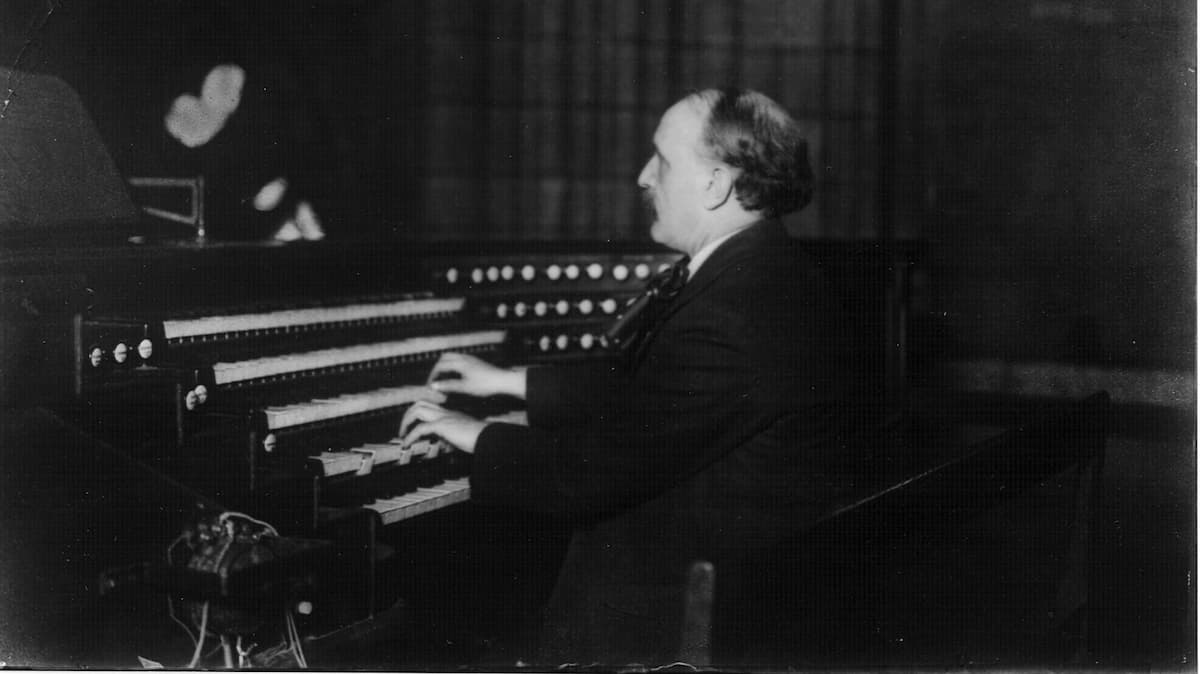
Louis Vierne at Notre Dame © Rollin Smith
He pulled out a stop, had some kind of cardiac event, and then fell off the bench. His foot was stuck on the low E-pedal note. The note resonated through the cathedral.
Amazingly, he had always expressed a wish to die while playing at the organ.
Learn more about Vierne: https://interlude.hk/louis-vierne-born-unlucky/
George Gershwin (1937)
George Gershwin’s Rhapsody in Blue
In 1937, composer George Gershwin began experiencing an array of concerning symptoms: headaches, coordination issues, and mood swings. He even started smelling burning rubber.
However, doctors chalked it up to stress and his workaholic tendencies.
But on 9 July 1937, he collapsed, and doctors realised he might have a brain tumour.
He had emergency surgery, and a large tumour (now believed to be a glioblastoma) was removed from his skull.
Tragically, he did not survive. He was just 38 years old.
More about Gershwin’s death: https://interlude.hk/glioblastoma-multiforme-and-george-gershwinhow-the-medical-community-got-it-deadly-wrong/
Maurice Ravel (1937)
Maurice Ravel’s Boléro
Composer Maurice Ravel suffered a similar fate to Gershwin the same year.
In October 1932, he was in a taxi accident. It was originally thought that Ravel’s injuries were minor, but in retrospect, it seems like he never quite recovered. He began forgetting things like his address and even his music.
He began suffering from head pain in 1937. That December, he underwent experimental brain surgery in the hope of diagnosing his condition. No solid diagnosis was made, but no tumour was found.
Ravel never really gained lucidity and became unable to swallow. He died on 28 December 1937.
Read more about Ravel’s death: https://interlude.hk/on-this-day-28-december-maurice-ravel-died/
Anton Webern (1945)
Anton Webern’s Cinq Pièces
Composer Anton Webern died in a tragic accident in the chaos of post-WWII Mittersill, Austria.
One night after dinner, he stepped outside his house to smoke a cigar: a much-appreciated gift from his son-in-law, who was active in the wartime black market.
At the same time, that same son-in-law welcomed two Americans…who, it turns out, were actually soldiers visiting to question him. Webern’s son-in-law was arrested.
In the hubbub, one of the soldiers rushed outdoors and – inexplicably and indefensibly – shot Webern three times.
His family moved the composer to a bed and called the doctor, but his injuries were too grave to survive.
Conclusion
Every death is a tragedy, but when a composer’s life ends suddenly, violently, or under deeply unsettling circumstances, the loss can feel especially acute.
Many of these composers died in the midst of active careers, leaving behind unfinished works and unanswered artistic questions. It’s impossible not to wonder what music was lost along with them.
At the same time, they remind us that behind even the most sophisticated music were fragile human lives, shaped by historical forces beyond their control.
Knowing their stories deepens our understanding of their music and sharpens the sense of urgency, vulnerability, and humanity that still resonates in their works today.
For more of the best in classical music, sign up for our E-Newsletter