
What did Arnold Schoenberg, Igor Stravinsky, and Béla Bartók really think about their work and the world around them?
Today, we’re looking at some of the most revealing interviews with some of the most influential composers of the twentieth century, from Schoenberg discussing his painting to Stravinsky describing how he invented scales as a child to Ligeti explaining why he was such a bad pianist.
Arnold Schoenberg (1874–1951)
Arnold Schoenberg revolutionised twentieth-century music by inventing the twelve-tone technique, a bold break from traditional tonality that sparked both outrage and admiration among his peers.
Born in Vienna, he was the head of the movement that became known as the Second Viennese School, mentoring figures like Berg and Webern.
Schoenberg’s music was complex, cerebral, and unapologetically modern…and it was frequently attacked and mocked.
He was also a talented amateur painter.
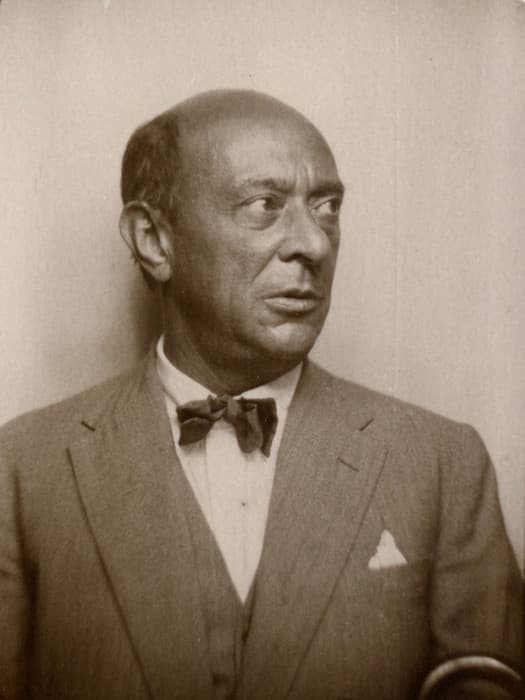
Arnold Schoenberg, ca. 1930
Highlights of the interview:
I planned to tell you what painting meant to me. In fact, it was to me the same as making music. It was to me a way of expressing myself, of presenting emotions, ideas, and other feelings.
And this is perhaps the way to understand these paintings, or not to understand them. They would probably have suffered the same fate as I have suffered; they would have been attacked. The same would happen to them that happened to my music.
I was never very capable of expressing my feelings or emotions in words. I don’t know whether this is why I did it in music, and also why I did it in painting.
I think there is a possibility to learn something of my technical achievements, but I think it is even better to go back to those men from whom I learned them: I mean, to Mozart, Beethoven, Brahms, and Bach. I owe very, very much to Mozart. And if you study, for instance, the way in which I write for strings, then one cannot deny that I have learned from Mozart, and I am proud of it.
Fritz Kreisler (1875–1962)
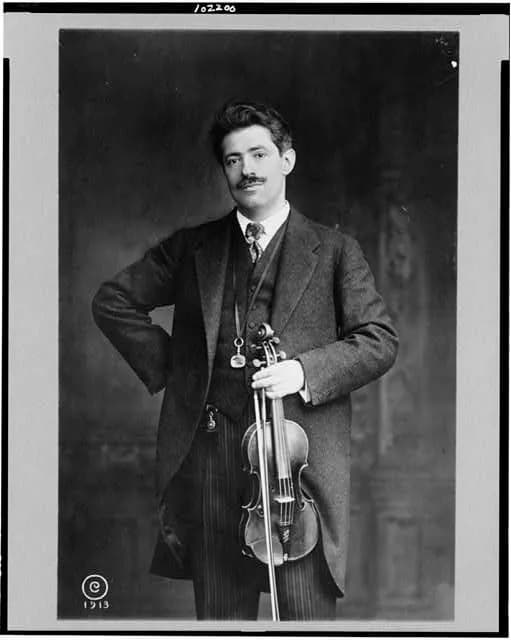
Fritz Kreisler
Fritz Kreisler was a Viennese violinist whose speciality was an unerring quality of intelligence, elegance, and charm.
A child prodigy who matured into one of the most beloved performers of his day, he was also a skilled composer who famously passed off some of his own pieces as rediscovered Baroque gems…until he confessed to their authorship years later.
Kreisler’s playing was warm, expressive, and unmistakably his own. So are his compositions.
(Rare!) Fritz Kreisler’s 80th Birthday Interview (Part 1) (1955-02-02)
(Rare!) Fritz Kreisler’s 80th Birthday Interview (Part 2) (1955-02-02)
Highlights of the interview:
May I tell you that I am under the impression that you have enhanced my very humble position a little too much in all that you said.
When I was a young man, I tried to make a position for myself as a violinist and not as a composer, because at that time the repertoire of violinists was very scanty, very thin. So…I had to increase the repertoire, and I couldn’t do it otherwise than by doing it myself!
And the difficulty arose to put my own name on my program, because being young and unknown, and trying to make a position for myself as a violinist, that would have looked too bad, and nobody would have engaged me to hear my own works…
I had to borrow other names to cloak myself in, because I couldn’t use my own name, and I had to borrow such names of artists that were known, at least in biographical books, but the works of which had not been known enough to be traced.
Consequently, I had to tell them that I found these manuscripts in old libraries, in old museums, you know, all over the world, and had noticed [notated] them on my cuffs, and had made the arrangements.
So you see, during my whole artistic life – well, the whole thing was nothing but a…you might call it a concoction of lies! Of white lies!
When I play, I always try to achieve a certain ideal, and I have never been able to achieve it when I came near it.
And when I advanced in age, well, the ideal had progressed too, so that I never came near it.
Ernő Dohnányi (1877–1960)
Ernő Dohnányi was a Hungarian pianist, composer, and conductor who blended Brahmsian warmth and Lisztian flair in his works.
A virtuoso performer and influential teacher, he helped shape Hungary’s musical life between the wars, mentoring a generation that included Bartók and Kodály.
His music is elegant, lyrical, and full of a gripping kind of charm.
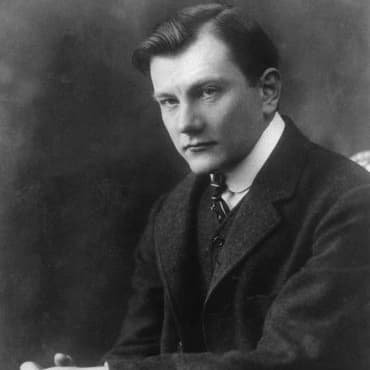
Ernő Dohnányi, 1905
Highlights of the interview:
[My Op. 1] was finished five days before the performance.
My composition teacher, Hans Koessler, was a friend of Brahms and visited Brahms every year in Ischl, where Brahms used to spend his summers. And he just mentioned my quintet, and wrote to me that I should send the score with a box to Ischl, which I did. And afterwards I heard that it was performed there in Ischl in the apartment of Brahms…
It was very interesting, I was there with [Brahms], and he just said, it’s very likely that I’m studying in Budapest because there is nobody in Vienna. And then he…began with Bruckner…and all the musicians in Vienna, he didn’t say very nice things about!
Béla Bartók (1881–1945)
Béla Bartók was a fearless musical explorer who married raw folk traditions with cutting-edge modernism.
As a young man, he traveled deep into the countryside to collect, record, and preserve traditional melodies, then transformed them into fiery, rhythmically complex works that redefined what classical music could sound like.
Due to World War II, Bartók spent his final years in exile in the United States: poor, terminally ill, but still composing masterpieces.
This interview preceded a performance by his pianist wife of his Sonatina for solo piano.
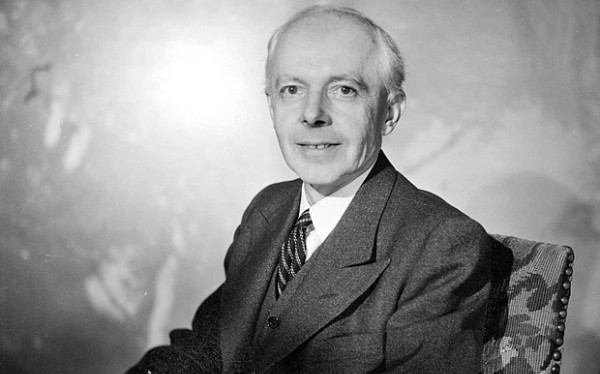
Béla Bartók
Highlights of the interview:
This sonatina was originally conceived as a group of Romanian folk dances for piano. The three parts which Mrs. Bartók will play were selected from a group and given its present title of Sonatina…
The second movement is called “Bear Dance.” This was played for me by a peasant violinist on the G and D strings, so on the lower strings, in order to have it more similar to a bear’s voice. Generally, violinists use the E string…
The [Suite, Op. 14] has no folk tunes. It is based entirely on original themes of my own invention.
When this work was composed, I had in mind the refining of piano technique, the changing of piano technique, into a more transparent style, more of bone and muscle opposing the heavy chordal style of the later Romantic period; that is, unessential ornaments like broken chords and other figures are omitted, and it is more a simpler style.
Igor Stravinsky (1882–1971)
Igor Stravinsky changed the course of music history with The Rite of Spring, an explosive ballet whose premiere in 1913 became a succès de scandale.
Over his long career, Stravinsky reinvented himself constantly – moving from a lush Russian nationalist style to spiky neoclassicism and beyond.
Witty, sharp, and fiercely self-aware of his own genius, he reportedly once quipped, “Lesser artists borrow; great artists steal.”
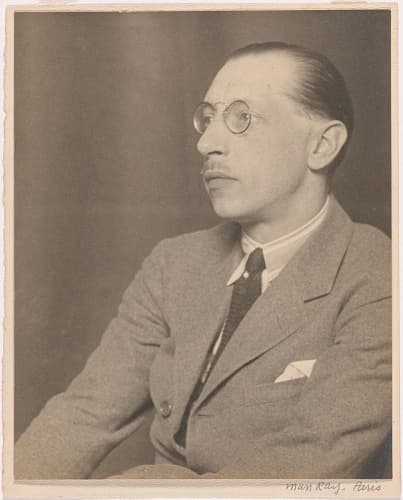
Man Ray: Igor Stravinsky, 1923
Highlights of the interview:
We have to touch the music, not only to hear it. Because touching it, we feel the vibration of the music. It’s a very important thing when you think about Beethoven’s case. You remember when Beethoven was absolutely deaf, he took a stick in his mouth, like this pencil, and he played the music touching the stand to have the vibrations, because he needed to enjoy the vibrations. Otherwise, the music was an abstract matter for him.
I remember that I played the scale on the piano, and playing the scale on the piano, I thought that, after all, who invented the scale? Somebody invented the scale. If somebody invented the scale, I can change something in the scale, and invent something else in the scale.
I had piano lessons from seven; the regular piano lessons I took at nine, and it was very very dull, but I had to do it. And the exercises were dull. And everything seemed to me too large, you know, too big.
Paul Hindemith (1895–1963)
Paul Hindemith was a German composer, violist, conductor, and theorist who wrote music imbued with structure, intellect, and, importantly, a practical purpose.
Equally at home writing symphonies, operas, or teaching counterpoint, he believed every musician should also be a craftsman.
Forced to flee Nazi Germany, Hindemith spent much of his career in the United States, influencing generations of students while also composing prolifically and conducting across the country.
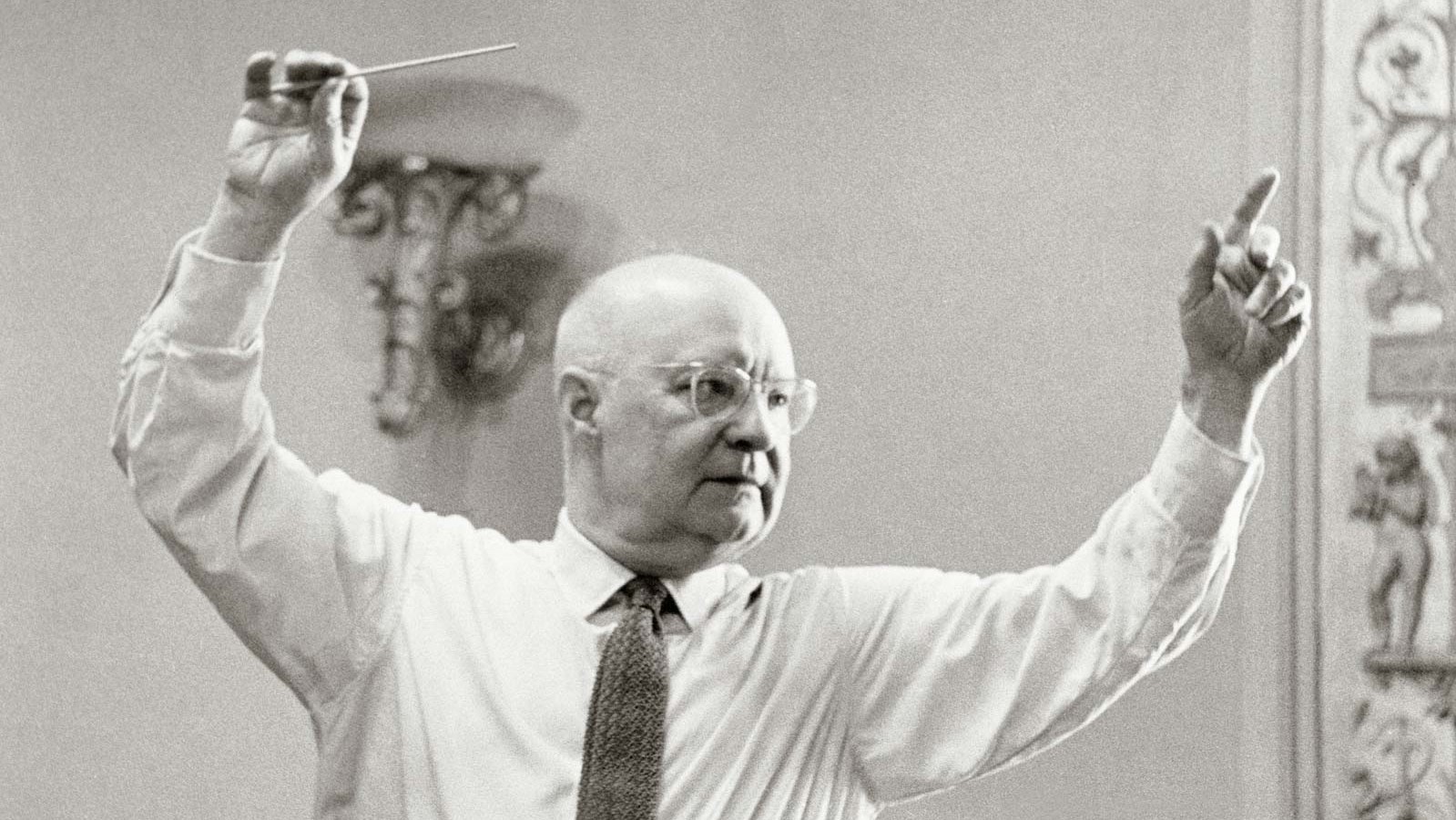
Paul Hindemith
Highlights of this interview before conducting the Chicago Symphony:
As far as this solemnity is concerned [when performing Bruckner], I think that’s somewhat exaggerated. Bruckner is such a universal composer. He has gaiety; he has solemnity; he has always everything. To reduce him to solemnity would be just the same as if you’d say Wagner is just heroism. It’s not true. They are universal composers and in Bruckner, perhaps even more so…
I think it’s always interesting if you’re a composer yourself, whatever that name means, that when you compose, you compose in the same line as your forefathers, so to speak, did, to express not only one aspect of human life, of human thinking and feeling: to try to be just as universal as they have been before.
György Ligeti (1923–2006)
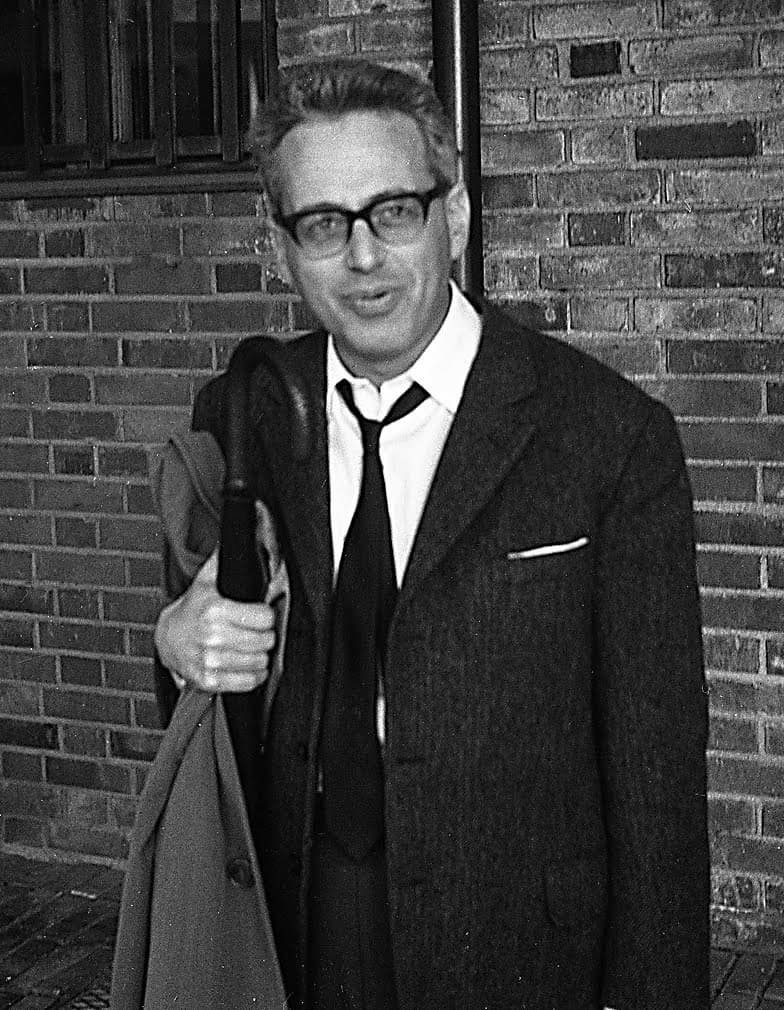
György Ligeti in the 1960s
György Ligeti was a visionary composer whose intense music ranged from eerie to dizzying to everything else in between.
A Holocaust survivor who later fled Communist Hungary, he pushed musical boundaries with works like Atmosphères.
His English in this interview is unconventional, but deeply charming, and he always manages to get his point across.
György Ligeti BBC Radio 3 Interview (1/2)
Highlights of this interview:
I’m a bad pianist because it was too late, it was 14 to begin. I practised for three years and then no longer, because I became a composer and had no time for the piano. And I learned a lot of different instruments. I played timpani in a kind of half-amateur orchestra, and a lot of other things: cello, organ, and so on. This was good for knowledge of instruments, but not very good for a pianist. So I didn’t become a good pianist.
It’s tactile music, not only [auditory], but I’m what is called synesthesial, you know, like Messiaen – always imagining colours, forms, shape, volume, even certain movements, certain speed, and even gravity. Smell. So all senses are melded together.
It has to do with hemiola tradition in Chopin and Debussy and Brahms, and in mental notation, where it comes from dividing a unit in three and in two at the same time, so six is the good number: three times two or two times three. This I knew from the piano literature. But then, discovering for myself all this fourteenth-century music, which is much more complicated. You divide 21 in three times seven and this kind of thing, which makes music to be very complex. And I was always interested in complexity.
Conclusion
We hope you enjoyed these interviews with some of the giants of the history of classical music. Who did you learn the most about?
For more of the best in classical music, sign up for our E-Newsletter





Thank you so much for posting these interviews. They were–in a word–stunning. I appreciate the integrity, humility, and above all the transcendent originality of all these composers.