Artists and composers are famous for their wild love lives. Turns out, their love letters are just as fascinating as you’d expect.
Today we’re looking at love letters from ten composers, including Janáček obsessing over a woman who was young enough to be his granddaughter, a late-in-life attempt at flattery from Puccini, and one of Benjamin Britten and Peter Pears’s tenderest epistolary exchanges. (Read more composers’ love letters from “The Most Passionate Composer Love Letters of All Time, Part 1”.
Béla Bartók, 1907
Bartók’s first violin concerto
Béla Bartók’s first love was a virtuoso violinist named Stefi Geyer. No letters from her survive, so we only have his side of their correspondence.
He wrote a violin concerto for her, but he was intense and mocked her Catholicism. She ended up turning him down.
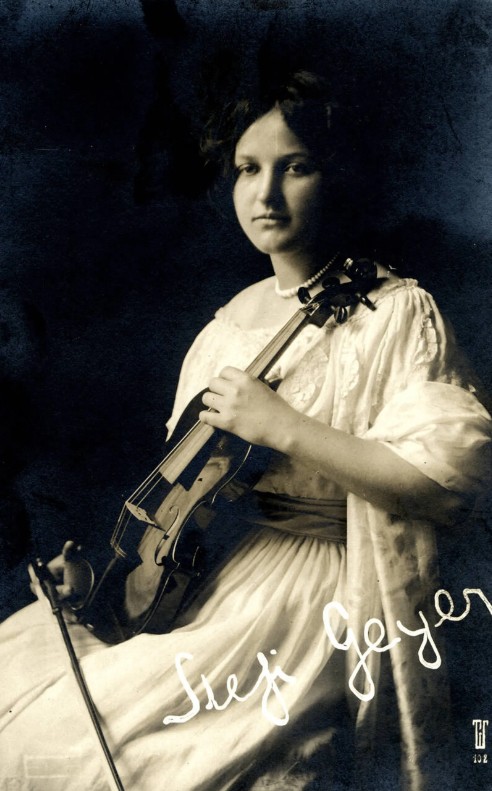
Stefi Geyer
Learn more about why Bartók and Stefi Geyer’s relationship was doomed.
In November 1907, he wrote to her:
You are a dear, a good, a fairy-like, an enchanting girl! who has only to draw a few lines to chase the dark, grimly swirling clouds from the sky and makes the bright sun shine on me. – You are a taciturn, a bad, a cruel, a miserly girl! to begrudge me your powers of enchantment!
Sergei Rachmaninoff, 1912
Rachmaninoff’s Op. 34, No. 14, “Vocalise”
In 1912, the married Sergei Rachmaninoff began a platonic – but romantically tinged – correspondence with poet and author Marietta Shaginyan, who signed her letters to him simply as “Re.”
She later provided poetry suggestions for him when he was looking for lyrics to set to music. Many of her suggestions found their way into his op. 34.
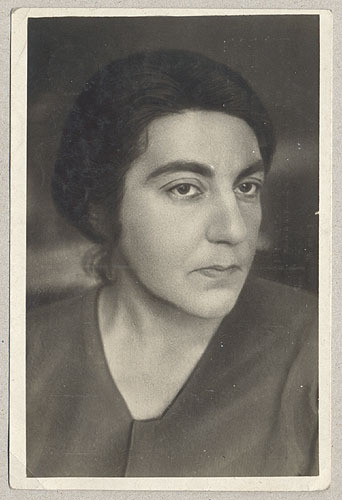
Marietta Shaginyan
In 1912, he wrote to her:
Besides my children and music and flowers, I love you, dear Re, and I love your letters. I love you because you’re clever and interesting and because you’re not extreme (one of the categorical conditions for me to “be attracted” by anyone); and I love your letters because every word in them breathes faith, hope, and love: that balm to heal my wounds. Though there may yet be some timidity and uncertainty, you describe me amazingly and you know me well. How? I never tire of being astonished…
Learn more about the unusual relationship between Rachmaninoff and Shaginyan.
Leoš Janáček, 1917
Janáček’s String Quartet No. 2 “Intimate Letters”
In 1917, 63-year-old composer Leoš Janáček met 26-year-old mother and housewife Kamila Stösslová in the resort town of Luhačovice, in the present-day Czech Republic.
He fell in love with her; she did not fall in love with him; and the resulting relationship was just as awkward as you’d imagine.
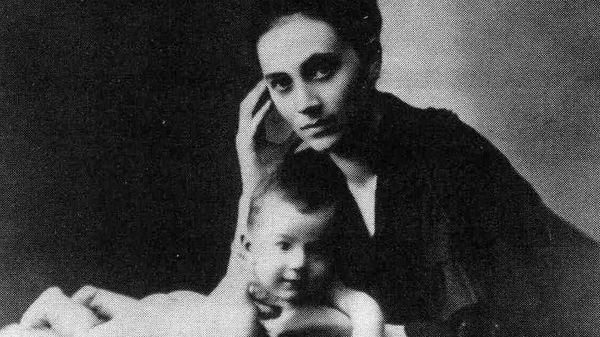
Kamila Stösslová in 1917
He wrote hundreds of letters to her over a period of years. This is the first one:
Luhačovice, 16 July 1917
Dear Madam
Accept these few roses as a token of my unbounded esteem for you. You are so lovely in character and appearance that in your company, one’s spirits are lifted; you breathe warm-heartedness, you look on the world with such kindness that one wants to do only good and pleasant things for you in return. You will not believe how glad I am that I have met you.
Happy you! All the more painfully I feel my own desolation and bitter fate.
Always think well of me – just as you will always stay in my memory.
Heartily devoted to you
Leoš Janáček
Learn more about the work that Kamila Stösslová inspired.
Igor Stravinsky, 1921
Stravinsky’s Mavra, written in 1921
Igor Stravinsky married his first wife (and cousin) Yekaterina Nosenko in 1905. They had four children together.
In 1914, she developed tuberculosis, and by 1921, Stravinsky was having an affair with dancer and artist Vera de Bosset, eight years Yekaterina’s junior.
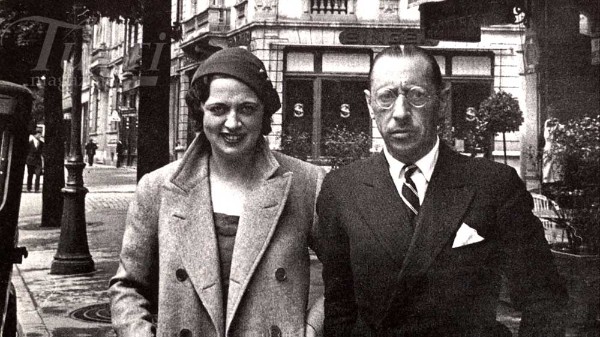
Igor Stravinsky and Vera de Bosset
…Taking advantage of the fact that no one’s at home now and I have sufficient peace and quiet… In the extreme haste and nervousness of my first letter of today…I didn’t answer one of your questions, my Verochka, and this question is so dear to me, so suffused with desire and love, that I’ve been preoccupied with it for 24 hours, repeating it to myself, and have been carrying your letter with this question in my left pocket, afraid to part with it. So, you want to know just “one small thing”: whether I’ll love you in spite of everything. Oh, Verochka, how can I answer you in any other way right now than by asking you the same question?… Perhaps I shouldn’t bother you with this, but when you are in love as deeply and as strongly as I am, it is unthinkable not to mention something which so tortuously affects that love. Verochka, my beloved, tell me that this “coming to terms” won’t be a sign that your feelings for me are weakening … I live only by the smallest of reminiscences, the pain of our separation, and the partial satisfaction of your letters.
Learn more about Stravinsky’s relationships with his wife and mistresses.
Giacomo Puccini, 1921
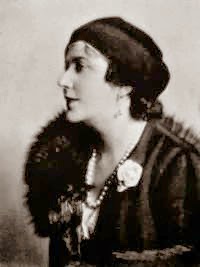
Rose Ader © forgottenoperasingers.blogspot.com
Giacomo Puccini was a notorious womaniser. In 1921, at the age of 62, he wrote to one of his love interests, 31-year-old soprano Rose Ader:
Oh consolation of my eternal sadness! Oh life of my life. Oh Rose, the most beautiful, the most adorable of creatures. My love, my heart, I feel for you! My thought is all for my good will, for you that I adore! … I had lunch out with my poet collaborators = Simoni-Adami — nice and such good young people that I would like you to meet. I told them of my despair and my love for you…
Kurt Weill, 1927
Lotte Lenya sings Weill’s “Pirate Penny”
Composer Kurt Weill and his inspiration, singer and actress Lotte Lenya, had an open marriage, but they always ended up coming back to each other.
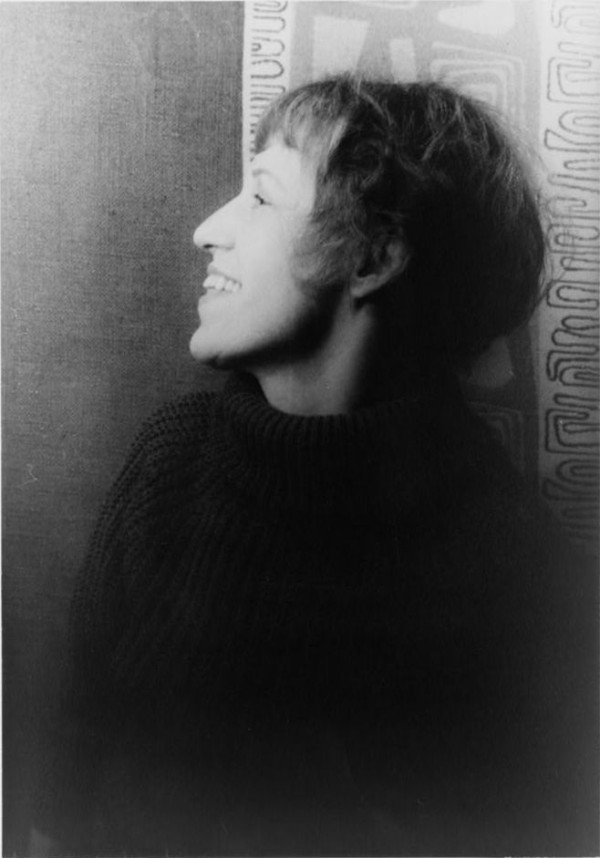
Lotte Lenya
This letter is addressed to Lotte when she was taking a holiday in the German seaside resort town of Prerow:
My Tüti,
Only now can I tell you properly how happy I was about your letter – that it’s so beautiful there, that you’ll get a good rest there, and that you love me. If the weather stays like this and you relax, when I get there next week you’ll be a brown, round, fat little dumpling.
It was wonderful in Grünheide. I swam, lounged around, read, worked very little, and thought much about how I can make life beautiful for my beloved little spirit. That’s at least a reason for being, isn’t it? …
May God keep you, my sweet. Be good, so you stay healthy, because you are the
great joy of my life. Many thousand Bussi on your little bosom.
Your Frosch
Leonard Bernstein, 1940
Bernstein conducts Fanfare for the Common Man
As a young man, Leonard Bernstein hooked up with Aaron Copland. Bernstein wrote this to him in the late summer of 1940:
Aaron, foremost of men,
Where are you? And if so, why no word? You said you’d write, according to Green. Not seeing you is something of a shock, you understand. The summer was a revelation in that regard. Neither of us (I hope) tired of the other (I had feared you might) and I came, in fact, to depend in many ways on you. I’ve never felt about anyone before as I do about you. Completely at ease, & always comforted with you. This is not a love letter, but I’m quite mad about you.
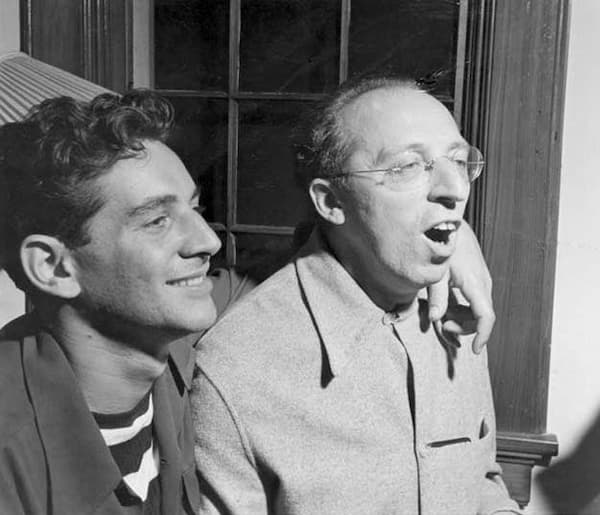
Bernstein and Copland, 1945 (Library of Congress)
Learn more about seven of Bernstein’s lovers (including Copland).
John Cage, 1943
A joint interview with John Cage and Merce Cunningham
In 1943, composer John Cage wrote to his colleague, dancer Merce Cunningham, the man who would become his personal and professional partner for the next several decades:
I’m unsentimental but I’m sitting at one of our tables and looking in a mirror where you often were…
I don’t know: this gravity elastic feeling to let go and fall together with you is one thing, but it is better to live exactly where you are with as many permanent emotions in you as you can muster. Talking to myself.
Your spirit is with me.
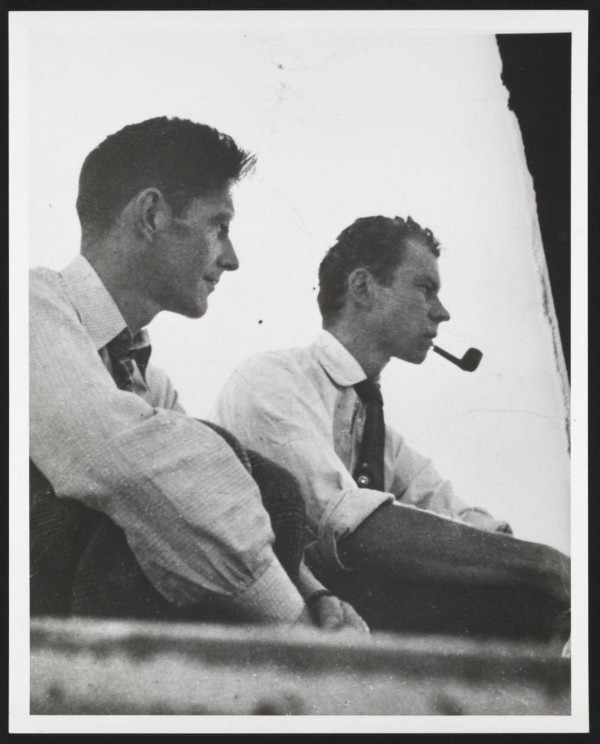
John Cage and Merce Cunningham, 1945
Check out our article about why John Cage is so fascinating.
Ralph Vaughan Williams, 1957
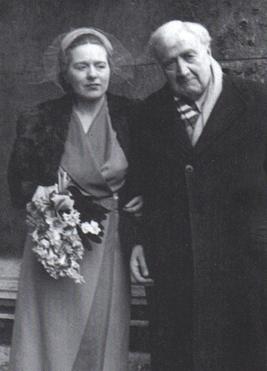
Ursula and Ralph Vaughan Williams in 1953
Ralph and Ursula Vaughan Williams had been a couple for nearly a decade before his first wife, Adeline, died. After Adeline’s death, Ralph and Ursula got married. This letter is from a few years after that, when Ursula visited her mother after her father’s death:
My Dear
I can’t write love letters – but you know it’s there
(Here is a line for you to read between)
I slept well – though Betty is right in saying that I feel lost without you. But I managed my safety razor all right & made tea for the young people.
All said it was a fine performance last night – But I am glad I did my work.
Take great care of yourself my dear – Come back when you can
Give my love to your mother.
All love
Benjamin Britten, 1974
Benjamin Britten accompanying Peter Pears singing Britten’s folksong arrangements
Composer Benjamin Britten and Peter Pears met each other in 1937. For two years, they were close friends – then in 1939, their relationship turned romantic.
They would stay together until Britten’s death in 1976, and their relationship would inspire countless works by Britten. Those works included the 1974 opera Death in Venice, in which Pears played a dying protagonist by the name of Aschenbach. Britten finished the opera and then underwent heart surgery.
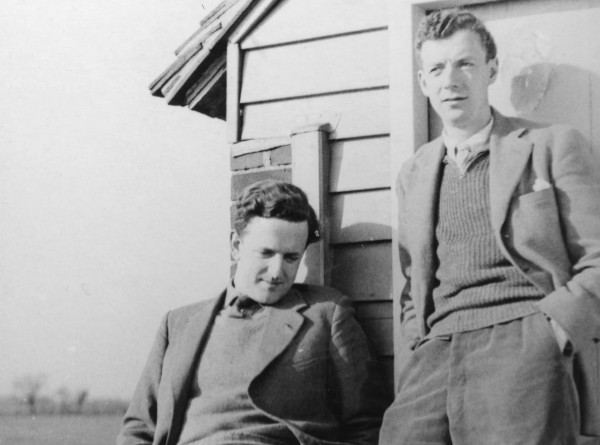
Benjamin Britten and Peter Pears
In late 1974, Pears spent some time in New York, making his Metropolitan Opera debut in the role of Aschenbach. Britten was too ill to go with and stayed at home. During the trip, they exchanged these remarkable letters:
Sunday, Nov. 17th 1974
My darling heart (perhaps an unfortunate phrase – but I can’t use any other), I feel I must write a squiggle which I couldn’t say on the telephone without bursting into those silly tears – I do love you so terribly, & not only glorious you, but your singing. I’ve just listened to a re-broadcast of Winter Words (something like Sept. ’72) and honestly you are the greatest artist that ever was – every nuance, subtle & never over-done – those great words, so sad & wise, painted for one, that heavenly sound you make, full but always coloured for words & music. What have I done to deserve such an artist and man to write for? I had to switch off before the folk songs because I couldn’t anything after – “how long, how long.” How long ? – only till Dec. 20th – I think I can just bear it
But I love you,
I love you,
I love you —- B
P. S. The Folk Song Suite (“Up she goes”?) is just finished – good I hope.
Pears’s response was just as tender:
My dearest darling,
No one has ever had a lovelier letter than the one which came from you today – You say things which turn my heart over with love and pride, and I love you for every single word you write. But you know, Love is blind – and what your dear eyes do not see is that it is you who have given me everything, right from the beginning, from yourself in Grand Rapids! through Grimes & Serenade & Michelangelo and Canticles – one thing after another, right up to this great Aschenbach – I am here as your mouthpiece and I live in your music – And I can never be thankful enough to you and to Fate for all the heavenly joy we have had together for 35 years.
My darling, I love you – P
For more of the best in classical music, sign up for our E-Newsletter