What happens when the greatest English composers sit down for a chat in front of a microphone?
The answer: expressions of dry British wit, surprising candour, and a long list of insights into the wider world of classical music.
In these rare interviews, Ethel Smyth recalls Brahms’s coarse jokes; Rebecca Clarke reflects on the sexism that led to her erasure; Benjamin Britten speaks with heart about what inspires him…and even gives his thoughts on the Beatles!
Taken together, these composer interviews pull back the curtain and reveal personalities as magnetic and multi-faceted as their music.
Ethel Smyth (1858–1944)
Ethel Smyth was a British composer, writer, and suffragette who shattered Victorian norms by storming the male-dominated world of classical music in the mid-nineteenth century.
She studied in Leipzig, befriended Brahms and Clara Schumann, and became the first woman to have an opera performed at the Metropolitan Opera.
Smyth once conducted a performance with a toothbrush in prison, where she’d been incarcerated for throwing rocks in support of the suffrage movement.
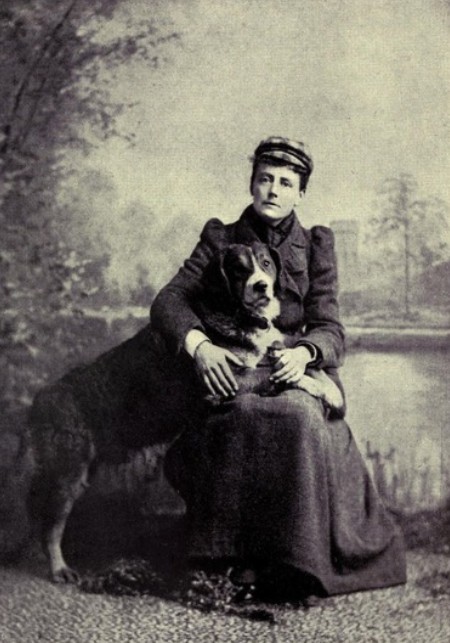
Ethel Smyth with her dog Marco
Highlights from the interview:
“Though too inexperienced to judge perhaps, I had a feeling that Brahms was not a good conductor, and certainly he had an unfortunate knack of rubbing orchestras up the wrong way.”
“Though I never heard him say anything stupid, which perhaps is high praise, I never fathomed wherein lay his much vaunted intellectual supremacy. I should have said his was an average, sound intelligence, but not more.”
“Those who knew declared that his generosity to poor musicians and to old friends fallen on evil days was literally inexhaustible.”
“No one can deny that there was a strong strain of coarseness in his fiber. His taste in jokes sometimes left much to be desired, and what angered me most was, confronted by a pretty face, he had a way of pouting out his lips, stroking his mustache, and staring exactly as a little boy stares at tarts in a confectioner’s window. Yet of this coarseness there is not the faintest trace in Brahms the artist.”
Is your curiosity piqued? Here’s our article on the relationship between Ethel Smyth and her beloved St. Bernard mix, Marco.
Ralph Vaughan Williams (1872–1958)
Ralph Vaughan Williams was the quintessentially British composer of the interwar period. He drew inspiration from folk songs, Tudor music, and the pastoral beauty of the English countryside.
He wrote some of the most beloved works in the classical canon, including The Lark Ascending and a href=”https://interlude.hk/on-this-day-6-september-ralph-vaughan-williams-fantasia-on-a-theme-by-thomas-tallis-was-premiered/” target=”_blank”>Fantasia on a Theme by Thomas Tallis.
He also served in World War I as a stretcher-bearer and paid for it by developing hearing loss.
This interview centers around his fascination with hymn writing.
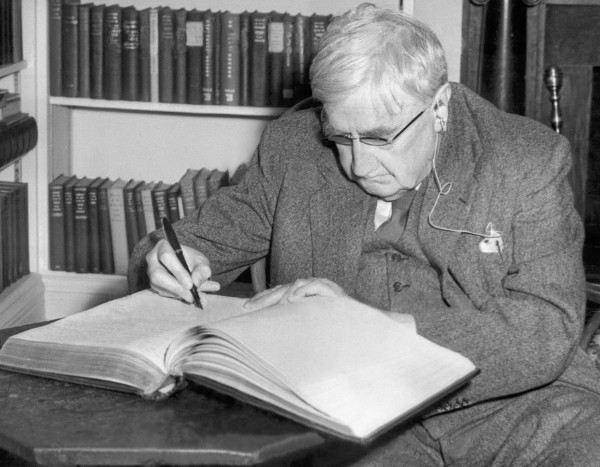
Ralph Vaughan Williams, 1954
Highlights from the interview:
“He asked me to edit the music of a hymn book. I protested that I knew very little about hymns; you see, I’d been an organist.”
“In many hymnals, the first idea of the musical editors seems to have been to include as many as possible new tunes by the editor himself and his friends.”
“I’ve been blamed for using adaptation to folk tunes for hymn purposes, but this is an age-old custom… Certain church melodies of the Middle Ages were adapted from secular tunes.”
Want to hear more about the controversial hymn project that Vaughan Williams is discussing? Read about Ralph Vaughan Williams’ Fantasia on a Theme by Thomas Tallis.
Arnold Bax (1883–1953)
Arnold Bax was a British composer and poet whose lush, romantic music was steeped in Celtic myth and melancholy.
He led a number of double lives. He wrote poetry and prose under the pseudonym Dermot O’Bryne.
He also carried on a decades-long adulterous love affair with a much younger pianist named Harriet Cohen…then, after his wife died, revealed to Cohen that he’d been cheating on her, too!
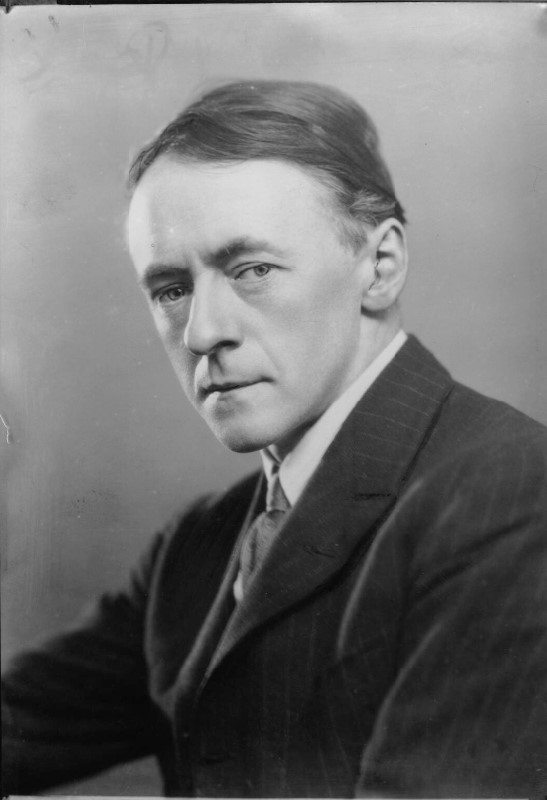
Arnold Bax
Highlights from the interview:
“I bless [Yeats’s] name, yet in spite of my veneration for Yeats, I have never attempted to set any of his poetry to music. It’s too good. The plain fact is that it is sacrilege to temper the great verse by trying to associate it with another art.”
“On being told that I intended to devote myself to composition, Elgar had made no comment beyond a grimly muttered ‘God help him.’”
“Despite the restless and somber mood of the world, or perhaps because of it, many creative artists managed to continue with their work, and even gained in strength. The demon of the time seized upon us and forced us to his will.”
“When my first symphony was performed in America, I mentioned in a program note that, as far as I was aware, the harsh and stormy work was an example of pure music unassociated with contemporary events. Whereupon a New York critic upbraided me as the quibbling Bax, and added, of course, this music from beginning to end represents the reaction of the composer’s mind to the Great War.”
Want an overview of Bax’s music, and what makes him one of the most unfairly neglected British composers of his generation? Learn more about the musical journey of Arnold Bax.
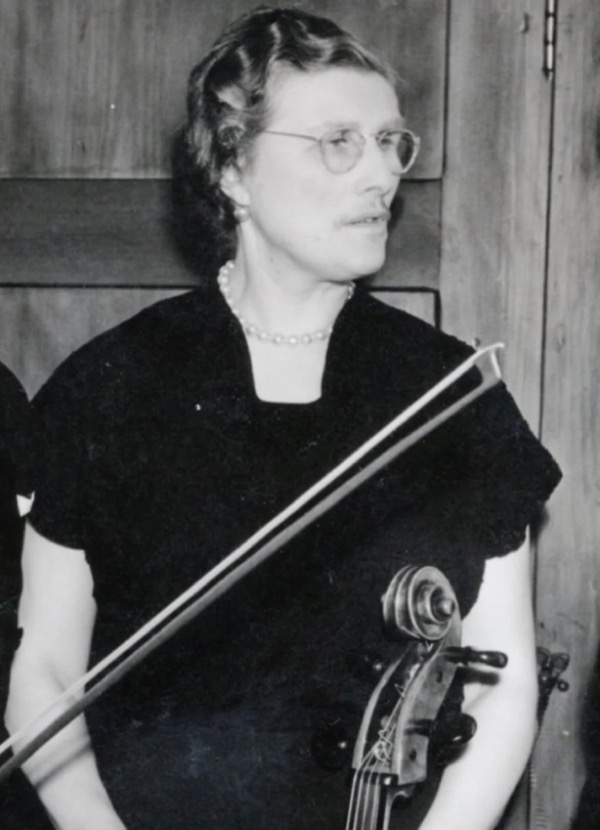
Rebecca Clarke (1886–1979)
Rebecca Clarke was a pioneering British violist and composer, one of the relatively few British women composers of her time to gain international recognition.
Her works were just as good, if not better, than her male contemporaries. But sexism reared its ugly head throughout her career.
Exasperated, she began printing recital programs crediting the non-existent composer Anthony Trent with her works. Predictably, “Trent’s” music was better received by the press than Clarke’s.
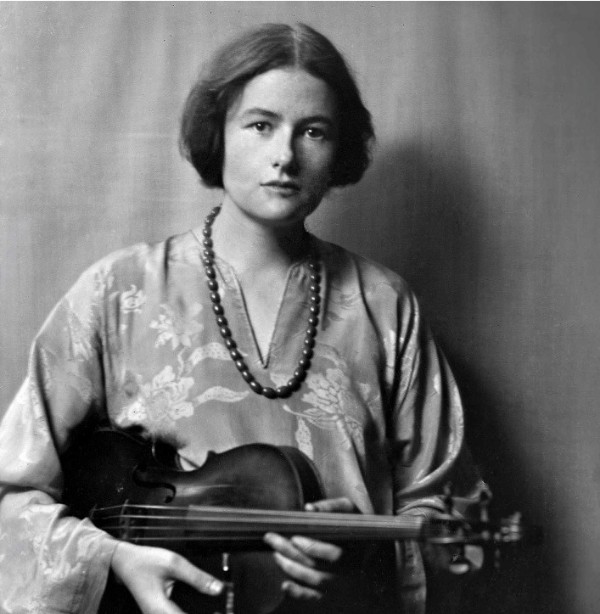
Rebecca Clarke
Highlights from the interview:
This interview took place in 1976, during an unexpected – but welcomed – reappraisal of Clarke’s work. You can tell that Clarke is flattered and bewildered by all the attention!
Interviewer: When you started composing, women composers were even rarer birds than they are now. Did you give that a thought?
Clarke: Awfully few of them around. Yes, I studied at the Royal College of Music with Sir Charles Stanford… I was his only girl pupil. And it was considered something rather unusual.
“The rumour went around, I hear, that I hadn’t written the stuff myself. That somebody had done it for me… [I have] little bits of press clippings saying that it was impossible, that I couldn’t have, that I wouldn’t have written for myself. And the funniest of all was that I had a clipping once which said that I didn’t exist! There…wasn’t any such person as Rebecca Clarke, and that it was a pseudonym! Now these people have got most beautifully mixed.”
Interviewer: When you began your composition studies, did you have any feelings that it was an unusual thing for a woman to be doing?
Clarke: I don’t think I thought about it very much… I just wanted to do it.
Read more about how Rebecca Clarke’s dark childhood contributed to her low self-esteem later in life.
William Walton (1902–1983)
William Walton rose from a modest upbringing in Oldham, Lancashire, to become one of Britain’s most celebrated composers.
He shot to fame in his twenties with the scandalous Façade, a collaboration with poet Edith Sitwell, and later cemented his reputation with grand works like Belshazzar’s Feast.
Known for his wit, sharp rhythms, and cinematic flair, Walton became the go-to composer for royal occasions and film scores alike.
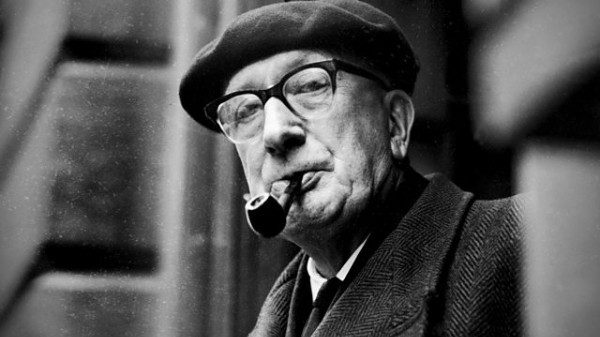
William Walton
Highlights from the interview:
Apparently, Walton was a notoriously difficult interview subject. There are still a couple of gems here, though.
“Then one happens to do something very good by mistake, which is, I think, the best way of doing things.”
Interviewer: “Do you ever return to Façade again?”
Walton: “Not if I can help it.”
Discover more about the story of William Walton’s Façade.
Benjamin Britten (1913–1976)
Benjamin Britten was a towering figure of twentieth-century music. He was especially renowned for operas like Peter Grimes and The Turn of the Screw.
He co-founded the influential Aldeburgh Festival and composed music that was deeply impacted by his beliefs, identity, and love of country.
Partnered personally and professionally with tenor Peter Pears, Britten wrote much of his music with Pears’s voice in mind. The resulting body of work is both intimate and immense.
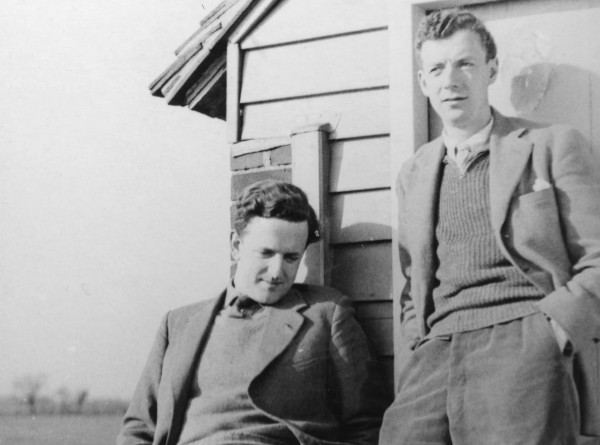
Benjamin Britten and Peter Pears
Highlights from the interview:
“I believe the artist must be consciously a human being. He is part of society, and he should not lock himself up in an ivory tower.”
“This seems perhaps a silly thing to say, but I would rather have my music used than write masterpieces which were not used.”
“I don’t honestly think I can write in a vacuum. I have to write for people or for occasions. I get inspiration, I get incentive for writing for people. That is my greatest pleasure and almost, as I say, the only way I can write.”
“I hope society will keep me alive. I shall be able to make enough money to live on and live perhaps in a way which makes writing music possible, even easy. Not too easy because we must all fight a little bit… If an artist has everything too easy, sometimes the thing becomes a little glib…”
“I think too easy a life is not too good for an artist. Of course, you can go too far the other way and starve him, which…that is not also good for an artist!”
“Obviously, the voice came first, and all instruments, I think, really try, at their height, to imitate the human voice.”
Learn more about Britten’s lifelong love affair with Peter Pears.
Conclusion
We hope you’ve enjoyed these interviews with the great English composers! Whose did you enjoy the most?
For more of the best in classical music, sign up for our E-Newsletter