Composer and pianist Sergei Rachmaninoff had two daughters, Irina and Tatiana, born at the family estate of Ivanovka in 1903 and 1907.
The Rachmaninoff children grew up between Russia, Dresden, and Switzerland before the Russian Revolution forced the family into permanent exile.
Their lives in the West were shaped by grief, resilience, and an unusually close bond with their father – and one of them would experience a tragedy that changed the course of Rachmaninoff’s career.
The Rachmaninoff Marriage
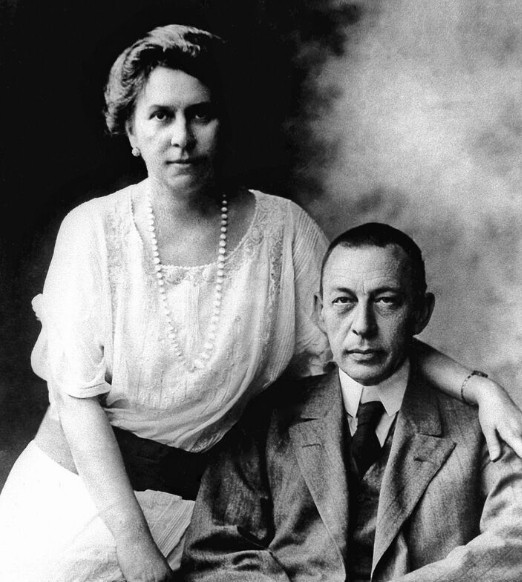
Sergei Rachmaninoff and Natalia Satina
Sergei Rachmaninoff had known his cousin, pianist Natalia Satina, since childhood, but they fell in love while studying at the Moscow Conservatory.
Because the Russian Orthodox Church forbade marriage between first cousins, the Czar’s personal approval was required before they could be wed.
To sidestep some of the complications, the couple married at a military barracks, where priests reported to generals rather than the Holy Synod.
The Czar’s blessing arrived just in time. The couple was married in the spring of 1902 and went on to have two daughters: Irina in 1903 and Tatiana in 1907.
Irina and Tatiana’s Childhood
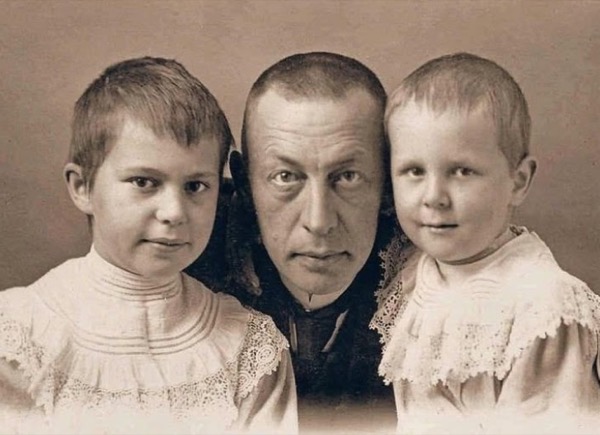
Sergei Rachmaninoff and his daughters
The newlyweds embarked on a multi-month honeymoon across Europe before returning to the Satin family estate, Ivanovka, in the summer of 1902.
By that time, Natalia was pregnant, and their first child, Irina Sergievna, nicknamed Boolya, was born at the estate on 27 May / 9 June 1903.
In the final stages of Natalia’s pregnancy, Rachmaninoff composed his Op. 23 piano preludes, writing the sixth in E-flat major on the day Irina was born.
Rachmaninoff’s Preludes, Op. 23, No. 6
Four years later, on 21 June / 4 July 1907, Tatiana was born, also at Ivanovka.
Growing up, the young sisters spent several years with their parents in Dresden, Germany, and summering at the Satin estate.
In 1909, Rachmaninoff accepted an invitation to tour the United States during the 1909-10 season. He wrote one of his most famous works, his third piano concerto, ahead of that trip. The girls did not travel with him.
In 1912, when his daughters were nine and five, Rachmaninoff took the family to Switzerland on a composing trip. While there, both daughters came down with typhoid. Rachmaninoff was deeply shaken by their illness and brought them to Berlin to see German doctors, whom he trusted more than Russian ones. Fortunately, both girls survived.
A few years later, World War I and the Russian Revolution brought chaos to the region.
In early 1917, Ivanovka was seized by the Social Revolutionary Party. Rachmaninoff gave his last performance in Russia in September of that year, and two days before Christmas, the family took the train from St. Petersburg to the Finnish border, escaping the country.
In 1919, the Rachmaninoffs emigrated to America. It was the year the girls turned sixteen and twelve.
What Happened to Irina Rachmaninoffa?
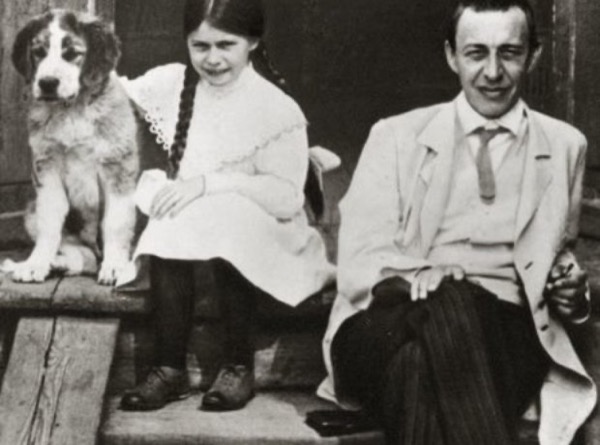
Sergei Rachmaninoff and Irina
On 24 September 1924, at the age of 21, Irina married aristocratic artist Prince Pyotr Volkonsky, aged 27, in Dresden, Germany.
Their engagement had been quick, only lasting for a few weeks. Rachmaninoff himself called the marriage “unexpected.”
Tragically, Pyotr died suddenly in Paris less than a year later, on 12 August 1925, when his wife was eight months pregnant.
The historical record is unclear about his cause of death, but Rachmaninoff biographer Fiona Maddocks notes that composer Nikolai Medtner wrote in a letter that Pyotr was “mentally disturbed about what he saw as the death of religion, as a result of which the doctors considered that he needed treatment for religious mania” – suggesting that mental illness may have played a role in his fate.
The widowed Irina gave birth on 4 September 1925 to Rachmaninoff’s first grandchild: a baby girl named Sophia.
Rachmaninoff wrote a touching letter to Natalia’s sister about the birth:
“The instant Sonechka appeared in the world she began to cry in the loudest imaginable voice and kept it up without a pause until we arrived, so that as we were coming up in the lift we could hear her. Our presence had a beneficial effect on her; she stopped crying and behaved impeccably for the hour we spent with them. I made the sign of the cross over her and kissed her several times, because I have already fallen in love with her. She has long black hair, like mine when I don’t crop it short, and it sticks up just like mine does. The length of her hair caused a sensation in the hospital, and all the nurses crowded in to look at it. The midwife combed it with Irina’s comb. The whole time I was sitting by Irina’s bed, Natasha stood near the baby and never took her eyes off her. I fear she is going to be really spoilt by her grandma.”
How Rachmaninoff’s Publishing House Became a Family Project
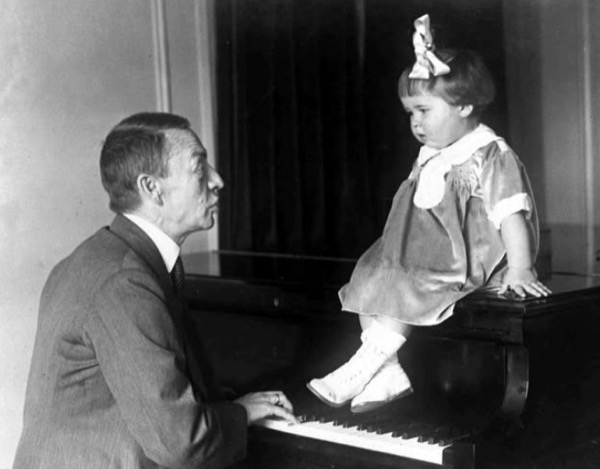
Sergei Rachmaninoff and his granddaughter Sophie
Rachmaninoff had a vague idea of starting a music publishing company, but the venture took on urgency after the financial struggles that accompanied Irina’s widowhood.
He was hopeful that Tatiana and Irina, both shaken by Volkonsky’s death in their own ways, could find purpose in the project in their grief.
He named the publishing house TAIR, after his daughters’ initials. Over the years, it published a variety of works by exiled Russian writers and composers.
Between 1928 and 1933, TAIR published Rachmaninoff’s works, turning his composing into a family business.
What Happened to Tatiana Rachmaninoffa?
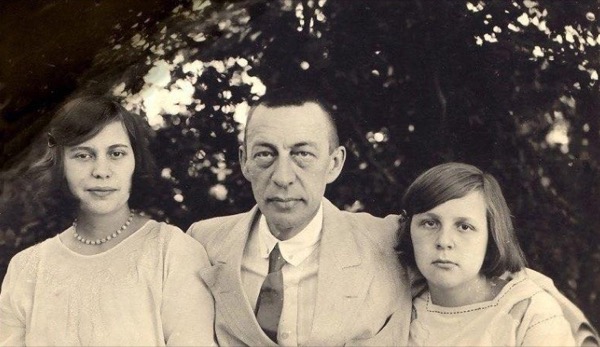
Sergei Rachmaninoff and his daughters
In the spring of 1932, Tatiana married a businessman named Boris Conus.
Boris was the son of Rachmaninoff’s old friend, composer Julius Conus. Julius had been a dedicatee of Rachmaninoff’s Op. 6 and even played the violin at the premiere of Rachmaninoff’s Piano Trio No. 2.
Tatiana gave birth to her first son, Alexandre, in March 1933.
Understandably, around this time, Tatiana’s attention began to wander from the TAIR publishing house project, and it was shut down in 1935.
Tatiana spent her later life working for the cause of so-called “white émigrés”, or people who were pushed out of Russia after the Russian Revolution, Russian Civil War, and rise of the Bolsheviks.
The Deaths of the Rachmaninoff Family
Sergei Rachmaninoff’s health declined sharply in the early 1940s. On doctors’ advice, he moved to Beverly Hills in 1942, near his friend and fellow pianist Vladimir Horowitz. He and Natalia became American citizens in February 1943; he died the following month.
Natalia survived him by nearly a decade, dying of a heart attack in New York City in 1951.
Both daughters spent their remaining years in America. Tatiana died in 1961, and Irina in 1969 – the last close remaining family link to the world that Rachmaninoff built and lost.
For more of the best in classical music, sign up for our E-Newsletter