Spanish violinist María Dueñas was always fascinated by Jascha Heifetz‘s artistry. Her parents had the 1954 Heifetz recording of the Korngold Violin Concerto and Lalo’s Symphonie Espagnole, with the striking cover of the artist’s hand gripping his bow, that she listened to on her way to school.
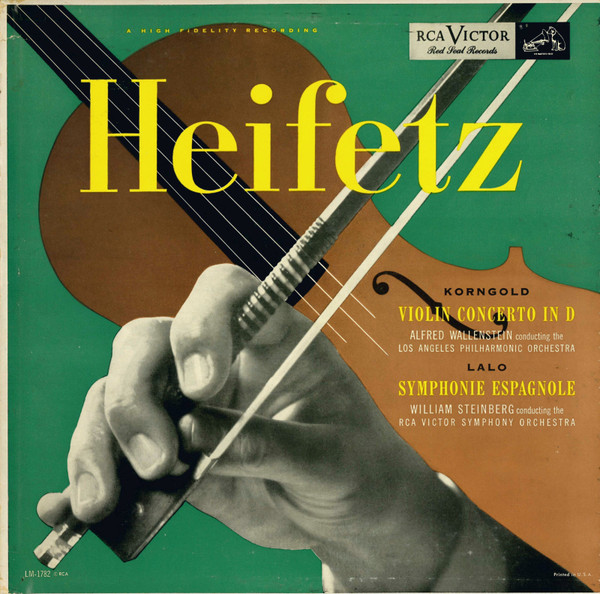
Heifetz 1954 RCA recording
Her memory of those works lies behind this recording. For Dueñas, Heifetz was an inspiring model, his vivid recordings sparking her imagination. Dueñas’ own soul and fire lie behind her radiant sound and her readiness to take artistic risks.
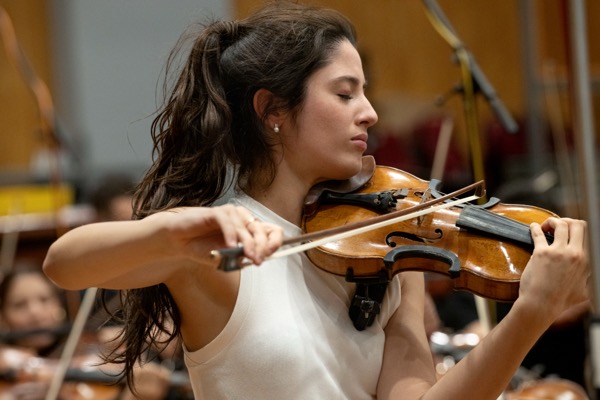
Maria Dueñas © Erik Weiss
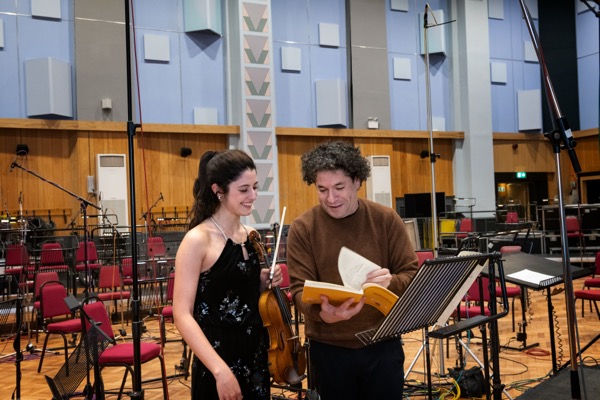
Maria Dueñas and Gustavo Dudamel © Erik Weiss
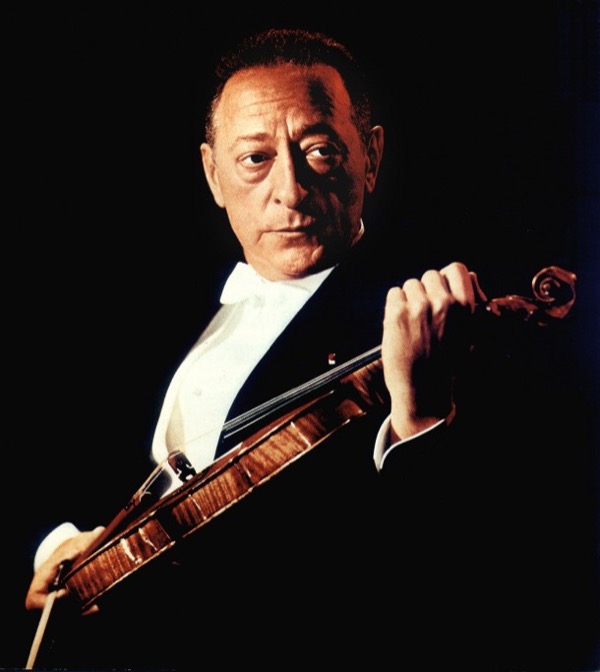
Jascha Heifetz (photo by RCA)
The works on the recording, Lalo’s Symphonie espagnole and Korngold’s Violin Concerto mentioned above, are joined by arrangements of 3 Debussy piano works, one arranged by Heifetz, and close with Manuel Ponce’s Estrellita, again, arranged by Heifetz. Heifetz recorded all the works in his repertoire. In this recording, the last three works were recorded on Heifetz’ own Stradivarius, his 1731 instrument known as the ‘Heifetz, Piel’, owned by Tarisio and Carlos Tome. Dueñas said that it was unlike anything she’d played on before and felt it brought her closer to her hero. The rest of the recording was played on a Nicolò Gagliano violin from 1773 lent by the Deutsche Stiftung Musikleben.
Because she appreciated Heifetz’ soul and fire, Dueñas was very pleased to persuade Gustavo Dudamel to join her on the album. She sees in him that same combination of life and love of music that drove Heifetz, inspiring the young players of the Simón Bolívar Symphony Orchestra of Venezuela.
Heifetz made his first recordings of parts of Lalo’s Symphonie espagnole as early as 1919; Lalo’s ‘concerto-in-all-but-name’ had been created for the Spanish virtuoso Pablo Sarasate, who gave its premiere in Paris in 1875. Heifetz’s 1954 recording gave it a new audience.
Heifetz had been a particular champion of Korngold’s Violin Concerto and gave the work’s premiere in 1947.
Erich Wolfgang Korngold: Violin Concerto in D major – III. Finale. Allegro assai vivace
Korngold wrote of the work and of Heifetz’ performance: ‘Despite its demands for virtuosity in the finale, the work with its many melodic and lyric episodes was contemplated rather for a Caruso of the violin than a Paganini. It is needless to say how delighted I am to have my concerto performed by Caruso and Paganini in one person: Jascha Heifetz’.
In a sense, this whole recording is much like an old-fashioned recital program, built of substantial pieces (the Lalo and the Korngold) and smaller pieces (the Debussy and the Ponce), with the Ponce doing double duty as the encore piece.
The whole recording seems to cast us back in time, both in the repertoire and in the performance. This isn’t necessarily a bad thing, but by the end, we’d like a bit more of the fire that Dueñas mentions so often.
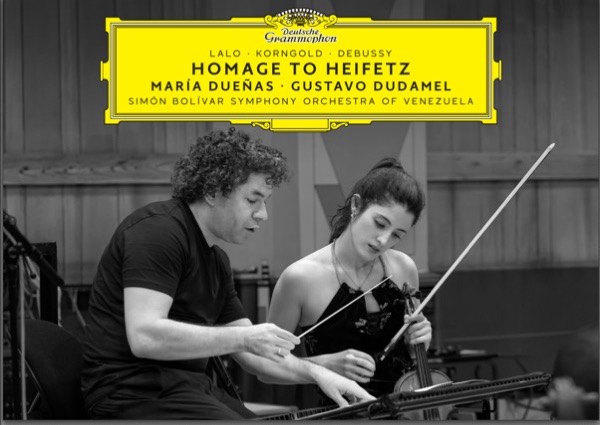
María Dueñas, violin; Simón Bolívar Symphony Orchestra of Venezuela; Gustavo Dudamel
Deutsche Grammophon 00028948674886
Release date: 28 August 2026
For more of the best in classical music, sign up for our E-Newsletter