Classical music lovers don’t always like acknowledging it, but every idolised canonical composer has been deeply inspired by the people who surrounded him.
And in many cases, one of the most inspirational people in any artist’s life is their spouse.
In fact, some of the most cherished works in the Romantic Era classical canon were inspired by composers’ wives.
These were women who loved their husbands deeply – who often suffered and sacrificed for them – and who shaped their partners’ legacies in profound ways. These women weren’t incidental to the creation of these works: they were essential.
Today, we’re looking at some of the classics they inspired and had dedicated to them.
Invitation to the Dance, Op.65 by Carl Maria von Weber (1819)
Caroline Brandt von Weber
Carl Maria von Weber’s “Invitation to the Dance” is widely considered to be the first concert waltz: i.e., a waltz meant to be played in concert, and not danced to at a social gathering.
It’s also the first piece of classical music that’s meant to be a programmatic description of waltzing dancers, paving the way for future works like Hector Berlioz’s Symphonie fantastique and even Maurice Ravel’s La Valse, which was composed a full century later!
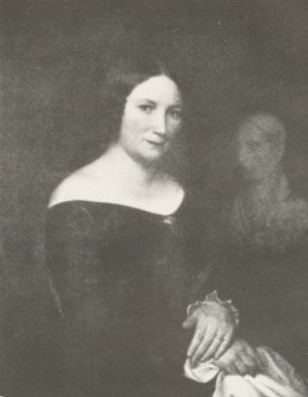
Caroline Brandt von Weber
Here Weber creates a charming narrative, in which you can hear the dancers not just dancing, but sweetly flirting with each other before and after, too.
The piece was dedicated to his new wife, Caroline, whom he had married shortly before writing it. She had also been a successful musician in her own right, appearing as an opera singer before giving up her career to become a mother.
Les nuits d’été by Hector Berlioz (1841)
Marie Recio Berlioz
Les nuits d’été (Summer Nights) is a cycle of six orchestral songs set to poems by Théophile Gautier. The cycle contains some of Hector Berlioz’s most moving music.
The work was composed in 1841. Berlioz had recently moved on from his former muse, actress Harriet Smithson (the inspiration behind the Symphonie Fantastique, whom he had married in 1833), and taken a mistress: a singer named Marie Recio.
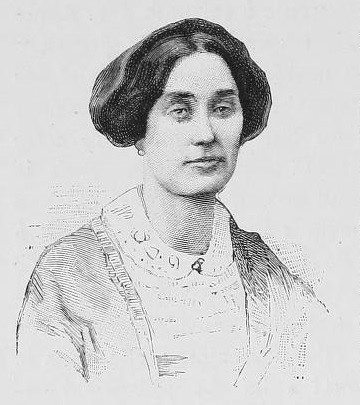
Marie Recio Berlioz
Berlioz wrote “Absence” specifically for Recio, and she enjoyed singing it.
After Smithson’s health and career failed simultaneously, she moved out of Berlioz’s home in 1844…and Marie Recio moved in. The couple married in 1854, after Smithson’s death.
Symphony No. 4 by Robert Schumann (1841, 1851)
Clara Wieck Schumann
Robert Schumann composed his fourth symphony in 1841, dedicating it to his wife, Clara. In 1851, he returned to it and substantially revised it, then dedicated that version to Joseph Joachim.
The older version had lighter orchestration, whereas the later one was more stately.
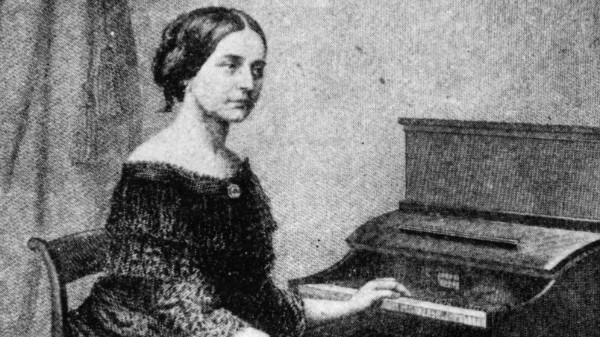
Clara Schumann
Perhaps surprisingly, Clara preferred the version for Joachim. Johannes Brahms, on the other hand, preferred the Clara-dedicated 1841 version.
Decades later, when Clara and Brahms were working on a posthumous edition of Robert Schumann’s works, they got into a serious argument about which version was best!
Mazurka-Fantaisie, Op.13, by Hans von Bülow (c. 1860)
Cosima Liszt von Bülow
Hans von Bülow: Mazurka-Fantasie, Op. 13 (Mark Anderson, piano)
In 1855, Franz Liszt sent his 18-year-old daughter Cosima to live with Baroness Franziska von Bülow in Berlin. Her son Hans was one of Liszt’s most talented piano students, and he had a promising future as a conductor and composer.
Cosima began studying with Hans, and the two fell in love. They were married in the summer of 1857.
Shortly after their marriage, von Bülow wrote this work, a mix of impetuous emotions and dazzling virtuosity.
Unfortunately, the marriage was never particularly happy, especially after Cosima’s two siblings died in 1859 and 1862. Her workaholic husband didn’t understand the toll these losses took on her.
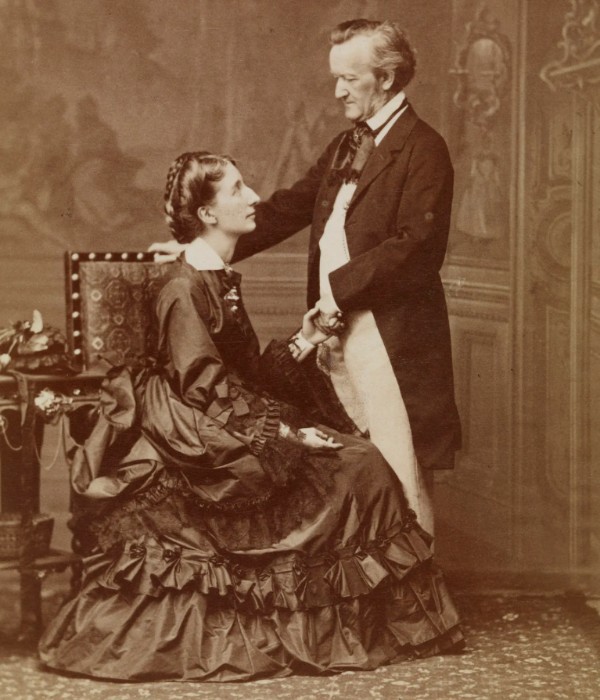
Cosima and Richard Wagner
When she crossed paths with Richard Wagner in October 1862, just after her sister’s death, she was emotionally vulnerable…and ready to fall in love with a new man.
Siegfried-Idyll, by Richard Wagner (1870)
Cosima Liszt von Bülow Wagner
In November 1863, Richard and Cosima took a famous cab ride, during which they professed their love for one another.
Awkwardly, Hans von Bülow was still conducting Wagner’s works, even as Cosima was embarking on a passionate affair with the composer. Between 1865 and 1869, she had three babies with Wagner.
Hans von Bülow initially resisted a divorce, but after the third baby, he gave in. The couple was divorced in the summer of 1870, and Cosima and Richard were married in August.
That Christmas (which was also Cosima’s 32nd birthday), Wagner composed a chamber music work out of themes that would later appear in his opera Siegfried.
Wagner hired an ensemble to play it on the stairs of their villa as a Christmas morning surprise for his new wife. This charming work is still frequently played today: an enduring musical love letter to the woman who had risked scandal to be with him, and who would eventually oversee the establishment of his posthumous legacy.
For more of the best in classical music, sign up for our E-Newsletter