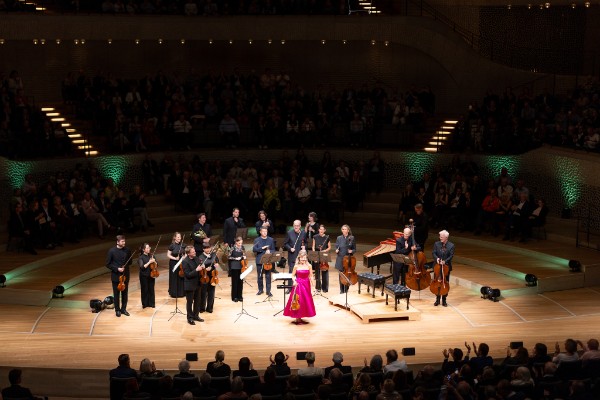
Anne-Sophie Mutter and her long-time partners, the Berliner Barock Solisten, brought an unmistakably individualistic, “Mutter-stamped” program to the Elbphilharmonie. Juxtaposing Mozart‘s classical poise with contemporary works by André Previn and Aftab Darvishi, the evening promised an engaging dialogue between past and present—though it ultimately exposed some unevenness on the micro level of actual sonic execution and music substance.
© Welthungerhilfe/Thomas Ix
The concert opened with the deeply personal, multi-faceted architecture of André Previn’s Concerto for Violin and Orchestra No. 2 with two harpsichord interludes. For Mutter, this rarely heard 25-minute piece yields a sense of spontaneous dialogue and pure joy. The opening Molto rubato – Allegro unfolded as a free fantasy, immediately establishing a witty, neo-classical atmosphere where Mutter occupied the stage with a warm and inherently intimate tone.
Anne-Sophie Mutter – André Prévin: Violin Concerto No. 2
Previn’s choice of a pure string orchestration felt exceptionally clean, punctuated by sharp syncopated figures darting through the ensemble. The movement masterfully embedded extensive, improvisatory solos that bounced between the harpsichord, cello, and violin. The harpsichord interlude, in particular, was beautifully expansive and charming. Throughout these exchanges, Mutter sustained a highly sensitive dialogue with her fellow musicians, letting an extensive solo played at a breathless delicacy, ignite with an inner spark before bringing the movement to a wonderfully straightforward, carefree ending.
In the second movement, the music transitioned into an intimate, lyrical section featuring a poignant duo between a solo cello and Mutter’s violin. Harpsichordist Knut Johannessen provided a brief, silver-glimmering interlude here, weaving a delicate thread through the texture. Following a transitional, contrasting faster passage that evoked an elusive, puzzling hollow feeling, the music plunged directly into the third movement. After an opening sector driven by energetic rhythms, the texture yielded to a serene, pastoral Adagio, before ultimately accelerating into a fierce, high-momentum finale.
© Welthungerhilfe/Thomas Ix
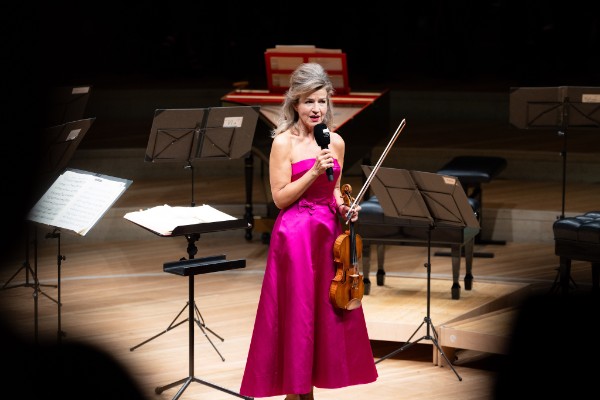
The program then pivoted to Mozart’s early Violin Concerto No. 1 in B-flat major, KV 207, delivered with an exceptional sense of vitality. With oboes and horns integrated into the orchestration, the orchestra’s texture in the opening Allegro moderato initially felt a bit sharp and raw, channelling Mozart’s youthful spirit. The performance completely transformed upon reaching the development section, which proved to be thoroughly engaging; here, Mutter unleashed a bold articulation that swept through the hall before culminating in a seamlessly executed cadenza.
This momentum carried into the Adagio, which unfolded beautifully like a flowing serenata steeped in delicate, nuanced layers of light and shade. The final Presto was absolutely full of energy. It was delivered with a characteristic dialogue—a brilliantly rapid call-and-response between Mutter and the orchestra that playfully feigned a Mozartian mock-serious conversation.
In contrast, Mozart’s Violin Concerto No. 5 in A-major, KV 219, which arrived as the centerpiece of the second half, proved overall less convincing than the performance of the First Concerto. Throughout the piece, Mutter’s tone occasionally sounded floating and lacked focus. In the I. Allegro aperto, following a rising orchestral opening theme, this issue became immediately apparent. Conversely, the orchestra infused the movement with a delightful, even vernacular charm, though the acoustic balance of the horns and oboes frequently felt jarringly prominent and out of place. The II. Adagio would have benefited if the orchestra had avoided an overly mannered articulation and phrasing, thereby allowing the musical flow to remain fluid rather than stagnant. The final III. Rondeau fared much better; here, the ensemble found its footing, delivering the movement’s sharp, contrasting episodes with a compelling conviction.
AFTAB DARVISHI // ‘Likoo, for Violin Solo’ by Anne-Sophie Mutter
Following the Mozart, the second half also featured a contemporary work, with Iranian female composer Aftab Darvishi’s Likoo for Violin Solo. On paper, the program notes promised a charged work—a “soul music” blending Persian oral poetry, desert nomadism, and contemporary protest with structural nods to J.S. Bach. In reality, however, the music was rather uninspiring. The piece revealed itself as a commonplace solo violin exercise. Lasting less than ten minutes, Likoo was not substantial in composition and devoid of genuine architectural inspiration, amounting to nothing more than a few predictable broken chords carrying the faint shadow of Bach. Meanwhile, the claimed Persian influence was limited to occasional hints of an Eastern chant in the solo line’s free phrasing. In general, Likoo felt like a missed opportunity—a piece where the program notes’ rhetoric somehow outshone the plain reality of the score.
To conclude the evening, the encores provided two beautifully contrasting emotional landscapes, each bearing Mutter’s distinct stamp. Antonio Vivaldi’s Presto from Le quattro stagioni’s Summer was a breathtaking, wind-whipped display of virtuosity delivered at a lightning-fast pace. In poignant contrast, John Williams’s Nice to be Around from Cinderella Liberty offered a tender, deeply human intimacy, its warm and lyrical simplicity bringing a comforting solace to the crowded hall. The deeply human aspect of the evening—capped by the intimate final encore—profoundly mirrored the concert’s noble purpose as a benefit concert for the Welthungerhilfe.
For more of the best in classical music, sign up for our E-Newsletter