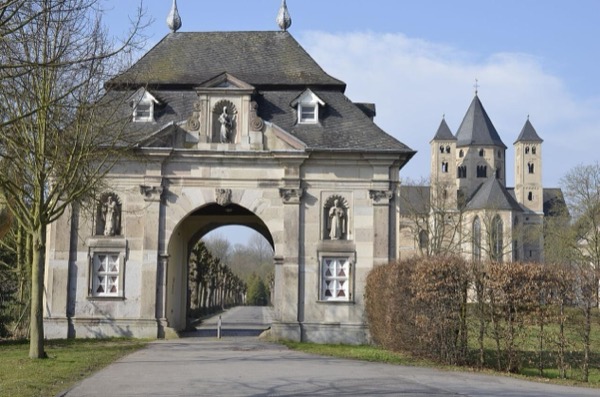
Part V: The Sightseeing in Halle & Surroundings — Beyond the Festival Stage
Given that Halle sits squarely within the tectonic core of German humanism, the rhythmic pulse of the Händel-Festspiele is beautifully synchronised with the slow, reflective pacing of a true cultural holiday. Because the festival’s main operatic and theatrical fireworks rarely ignite before late afternoon, an unhurried expanse of daylight opens up each morning for the discerning festivalgoer. Rather than attempting to capture metropolitan giants like Leipzig or Dresden, this curated itinerary serves as a specialised roadmap to lesser-known cultural gems quietly hidden in Halle’s immediate orbit, allowing travellers to spend their mornings decoding the architectural and social forces that paved the way for the region’s artistic explosions before immersing themselves in Baroque opera by night.
1. Halle’s Internal Sanctuaries: Renaissance Armor and Academic Groves
Before boarding a train out of the city, one must first dismantle the hidden layers of Halle itself, where medieval defensive grit seamlessly fuses with early modern intellectualism.
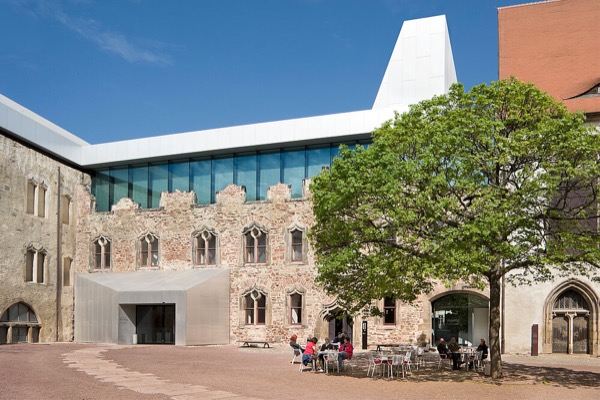
The Kunstmuseum Moritzburg: While the interior of this former palace of Cardinal Albrecht houses a world-class collection of German Expressionism, the architectural shell itself is a masterclass in structural dialogue. In the early 16th century, the Cardinal’s artistic patronage briefly turned Halle into the epicentre of the Early German Renaissance. Today, the monumental, war-scarred medieval defensive walls are dramatically crowned by a contemporary roof of glass and steel. Wandering into the central courtyard is entirely free.
Wilhelm-Friedemann-Bach-House: Tucked away in the old town, this brilliantly preserved late-Renaissance/early-Baroque residence was the home of J.S. Bach’s exceptionally gifted yet tragically erratic eldest son. Now functioning as a highly focused music museum, its timber-framed chambers trace the intricate, knotty musical geography of the Bach family, detailing how the polyphonic traditions of Central Germany directly cross-pollinated with Handel’s early training.
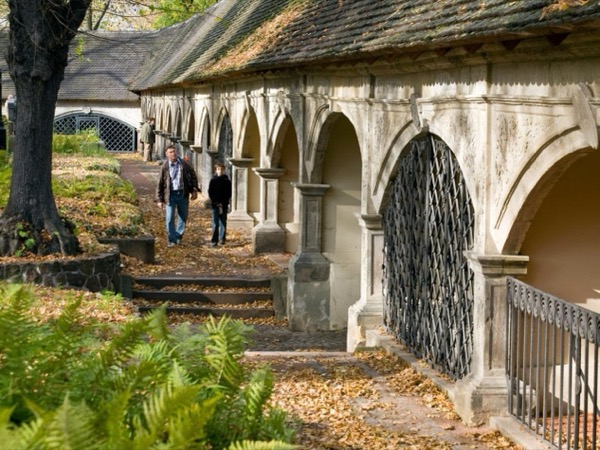
Stadtgottesacker (Sacred Burial Ground): Widely considered the most flawless Italian Renaissance cemetery architecture north of the Alps. Designed between 1557 and 1594 by the architect Camillo Fregoso, it was modelled directly on the iconic Campo Santo in Pisa. The quadrangle features 94 Renaissance arcades adorned with deeply sophisticated reliefs and weathering epitaphs. Walking beneath these stone vaults offers a profound sense of humanist order.
2. Wittenberg: The Visual Propaganda Engine of the Reformation
Distance from Halle: 40–60 minutes via regional/ICE train.
Travelling slightly north along the Elbe brings you to the absolute flashpoint of Northern humanism and the structural cradle of the Reformation.
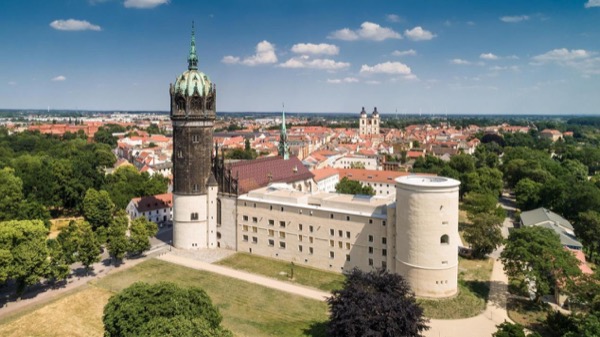
All Saints’ Castle Church (Schlosskirche): The definitive political spark. Here, on the north door, Martin Luther nailed his Ninety-five Theses in 1517. While the original wooden doors were consumed by fire during the Seven Years’ War, the current 19th-century bronze replacement doors stand as a monumental physical text, deeply cast with the complete Latin wording of the theses. The interior showcases a magnificent transition between Late Gothic verticality and Early Renaissance structural mass, providing the final resting place for both Luther and his brilliant academic ally, Philip Melanchthon.
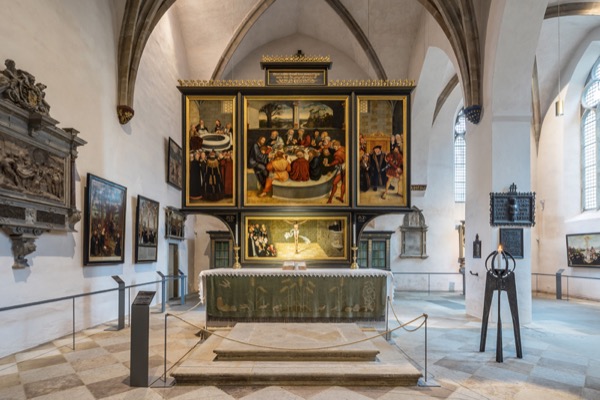
Stadtkirche St. Marien: If the Castle Church was the academic catalyst, the Town Church was the actual performance space for the new theology. This is the oldest building in the city, where Luther regularly preached in the vernacular and established the dual sacraments. The undisputed masterpiece here is the Reformation Altar, designed by Lucas Cranach the Elder and finished by his son. It stands as an extraordinary piece of visual rhetoric; Cranach directly painted the faces of the local Reformers into the sacred biblical scenes of the Last Supper and Baptism, instantly legitimising the intellectual leaders of the movement by embedding them into holy history.
The Cranach-Höfe & Lutherhaus: To understand how these radical ideas spread faster than any previous heresy, one must explore the expansive Renaissance courtyards of the Cranach estates. Lucas Cranach was a wealthy entrepreneur, mayor, and the owner of a massive print workshop and pharmacy. His high-speed printing presses were the literal visual propaganda machine that distributed Luther’s German translation of the Bible across Europe. Afterwards, wander to the nearby Lutherhaus, a former Augustinian monastery turned into the world’s very first bourgeois intellectual family home. Inside, the preserved wood-panelled Lutherstube offers a remarkably intimate glimpse into the domestic space where Luther retreated to write hymns, practice the lute, and hold his famous, wine-fueled Tischreden (Table Talks).
3. The Dessau-Wörlitz Garden Kingdom: The Enlightenment Mapped onto Earth
Distance from Halle: 40–50 minutes via regional train.
For a breathtaking shift from religious fire to philosophical clarity, the Garden Kingdom of Dessau-Wörlitz offers a 150-square-kilometre UNESCO World Heritage landscape that behaves like a walk-in manifesto of the Enlightenment. In the late 18th century, Duke Leopold III Friedrich Franz—profoundly moved by the natural philosophy of Jean-Jacques Rousseau—tore down the traditional, exclusionary walls of his estates and declared his entire territory an open-air educational park, entirely free and accessible to every citizen.
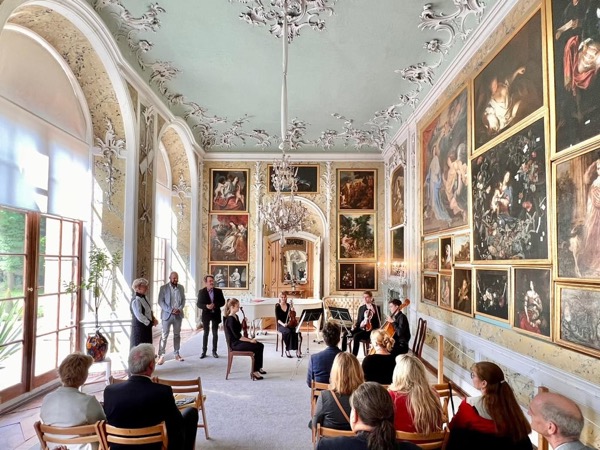
Schloss Mosigkau: Built in 1752 as a summer retreat for Princess Anna Wilhelmine, this exquisite palace is one of the very few grand estates in Central Germany to survive the world wars completely unscathed. The crown jewel is the Galeriesaal (Gallery Hall), a pinnacle of late Baroque and Rococo interior design. The walls are papered from floor to ceiling in the traditional, incredibly dense Baroque salon hanging method, displaying a world-class, unshielded collection of masterpieces by Anthony van Dyck, Peter Paul Rubens, and Jan Brueghel the Elder, completely integrated into the original gilded stuccowork and period furniture.
Credit: Thomas Ruttke
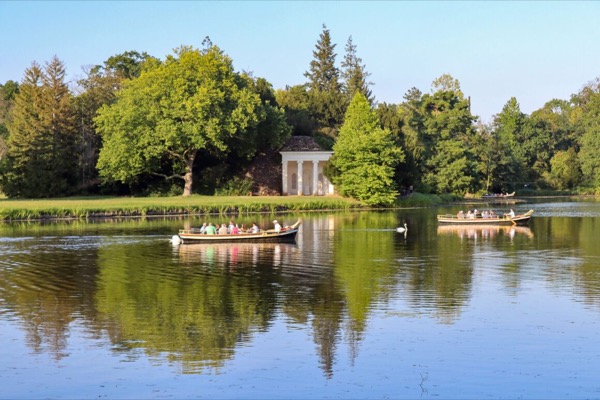
Wörlitzer Park: As the philosophical climax of the Garden Kingdom, Wörlitzer Park (1765–1800) stands as Continental Europe’s first English landscape garden. Rejecting rigid Baroque geometry as a symbol of absolutist tyranny, Duke Franz meticulously engineered its sweeping lawns and unobstructed vistas to mirror Enlightenment ideals. This open-air educational laboratory remains entirely free to explore. Morning visitors can decode its interconnected intellectual monuments—from Schloss Wörlitz, Germany’s first Neoclassical structure, and the pioneering Gotisches Haus, to Insel Stein, an artificial volcano simulating Mount Vesuvius—ideally via a silent, hand-poled gondola ride along its misty, historic canals.
4. Quedlinburg: The Timber-Framed Humanist Sky
Distance from Halle: 90 minutes via regional train.
Nestled against the Harz slopes, Quedlinburg showcases Europe’s most staggering collection of timber-framed architecture (Fachwerkhaus). In the medieval lanes of Breite Straße and Wordgasse, wealthy merchants carved secular Renaissance confidence into monumental Manor Houses (Freihöfe). Their crossbeams feature Sonnenscheiben (sun-disk reliefs) symbolising humanism, alongside elegant Schiffskehlen (ship-keel grooves) and hand-sculpted Knaggen (wooden brackets). In the central square, the historic Rathaus features a magnificent 1616 main portal adorned with intricate Beschlagwerk (rollwork). This grand stone entrance stood as a tactile assertion of bourgeois civic pride, deliberately challenging the spiritual authority of the Castle Hill above.
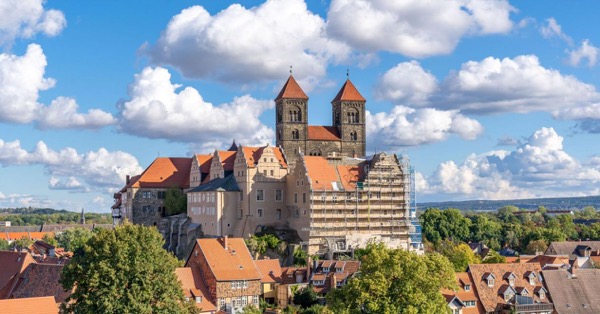
The Castle Hill (Stiftsberg): Ascend the sheer sandstone cliffs of the historic Stiftsberg, the powerful seat of the independent, imperial Prince-Abbesses who ruled the city for centuries. While the adjacent Baroque palace museum is currently closed for a comprehensive, multi-year structural restoration and historical reorganisation, the monumental Romanesque Collegiate Church of St. Servatius remains open. Descend into the dimly lit, highly atmospheric royal crypt beneath the high altar to see the tombs of the first German King, Henry the Fowler, and Queen Mathilde. Here, you can examine rare 12th-century wall paintings that bridge the aesthetic traditions of the Byzantine East with the raw spiritual power of the early Holy Roman Empire.
5. The Geiseltalsee: Industrial Slag Reclaimed by the Vines of Bacchus
Distance from Halle: 45 minutes via regional train.
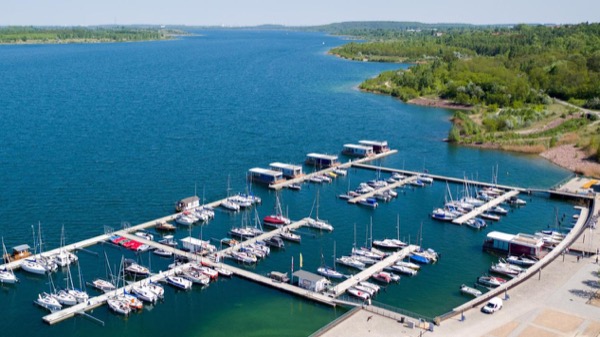
For a striking palate cleanser contrasting with 18th-century aesthetics, look south to Geiseltalsee, Germany’s largest artificial lake. Before hitting the water, visit Mücheln’s old town to experience its dramatic, tiered terraced plaza and the hidden, manicured Barockgarten.
The Modern Marinas (Braunsbedra & Mücheln): Renting a bicycle or walking along the Geiseltalsee-Rundweg—a pristine, 28-kilometre paved ring road tracing the water’s edge—brings you to a landscape that feels unexpectedly coastal. At Marina Braunsbedra, a striking, linear modern pier thrusts out across the 78-meter-deep waters, offering an ideal vantage point for capturing the sharp, high-contrast late-afternoon sun. Meanwhile, Marina Mücheln serves as a stylish, slow-paced resort hub, blending contemporary wooden eco-architecture with boat charters and floating house accommodations.
Epilogue:
By the time the Marktkirche bells signal the start of another Baroque opera, the discerning traveller will have absorbed something the program notes alone could never offer: the Reformation’s thundering certainty, the Enlightenment’s quiet generosity, the burgher’s stubborn civic pride—all of it humming, half-audible, beneath Handel’s own Halle-born sound. The festival’s nightly fireworks do not erupt from nowhere. They rise from this very soil, and now, so do you.
Looking Ahead to 2027: Mark your calendars for next year’s festival from June 3–13, 2027, which will explore the hauntingly introspective theme of Baroque isolation: “Einsamkeit — Am I myself alone?”
For more of the best in classical music, sign up for our E-Newsletter