No other partnership in the history of the piano is quite like the one between Arthur Gold and Robert Fizdale.
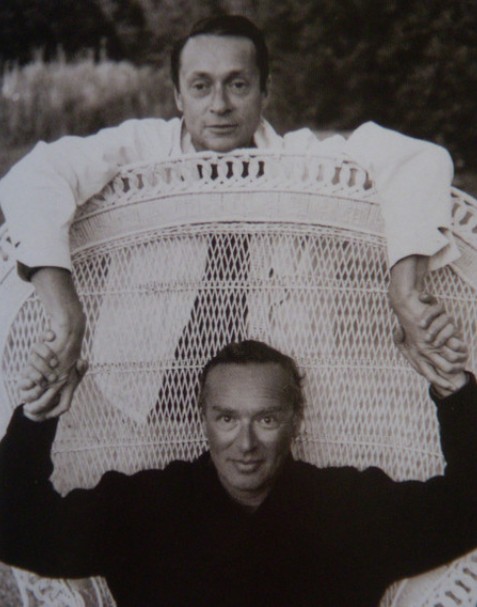
Arthur Gold and Robert Fizdale
Celebrated for their artistic chemistry, as well as their championing of new music, they became one of the leading piano duos of the mid-twentieth century.
However, they had an open secret: they were lovers. Eventually, after fifty years together, they would be buried side-by-side.
Today, we’re looking at the life and times of piano duo Gold and Fizdale.
Arthur Gold’s Family and Training
Arthur Gold was born on 6 February 1917 in Toronto to a family with a Russian-Jewish background.
By the age of three, he was already accompanying his singer sister by ear. He began his formal piano studies at six.
In 1936, when he was nineteen, he moved to New York to study at Juilliard under husband-and-wife teaching duo Josef and Rosina Lhévinne. This famous couple trained Van Cliburn, Garrick Ohlsson, and film composer John Williams, among others.
Robert Fizdale’s Family and Training
Meanwhile, Robert Fizdale – known as Bobby in his personal life – was born on 12 April 1920, to a musical family from Chicago. His grandfather had worked for Czar Nicholas II as a flautist, starting work in the Russian court at the tender age of thirteen!
As a young person, Fizdale loved performing on the piano and in amateur theatrical productions. He studied at the American Conservatory of Music in Chicago, where he won a scholarship to go to Juilliard.
He arrived in New York in 1939, enrolled at Juilliard, and joined the studio of Ernst Hutchinson.
Gold and Fizdale’s Meeting
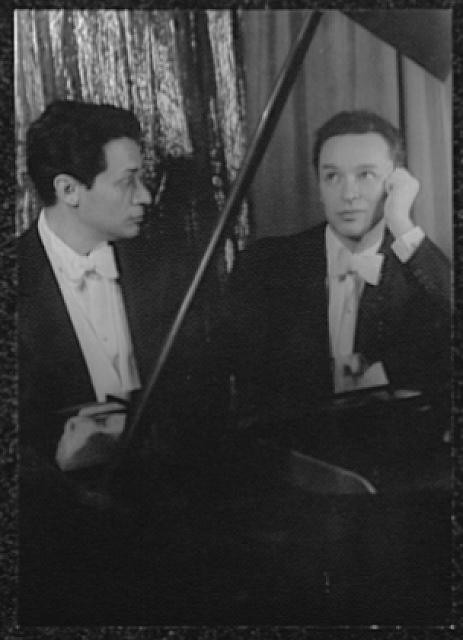
Arthur Gold and Robert Fizdale
Gold and Fizdale met while studying at Juilliard. Decades later, Fizdale reminisced about those early days to the New York Times:
At the time, there were two pianos in all the practice studios at Juilliard, and from the time we first played duets together, it was clear that Arthur and I saw eye to eye about music.
In our last year at Juilliard, which was 1943, we decided to become a two-piano team, and we persuaded our teachers that since that was what we intended to do professionally, we should have a lesson as a duo once a week.
At the time, Gold was twenty-six and Fizdale twenty-three.
Carl Maria von Weber’s 6 Pieces, Op. 3, as performed by Gold and Fizdale
A New Kind of Piano Duo
When they began their careers, the concept of working as a piano duo ensemble was not necessarily new. However, relatively few pianists who weren’t siblings or spouses had made a mark.
Gold and Fizdale decided to change that. They wanted to raise the technical standards of piano duos generally, and also make their mark by commissioning new music from the greatest living composers.
They had gumption. While they were still students, Gold looked up Aaron Copland’s number in the phone book and cold-called him, asking if he’d write a sonata for them.
Fizdale would later remember:
He laughed and said he was too busy, but he took time to speak to us, and put us in touch with other composers.
Debuting Cage
They gave their debut concert as a duo at the New School for Social Research in January 1945. The program consisted entirely of twentieth-century music.
One of the composers whom Copland had put them in touch with was up-and-coming composer John Cage, who, unlike Copland, was available to write for them. Cage produced a brand-new half-hour piece called A Book of Music, and honoured the pianists with the dedication.
John Cage: A Book of Music (1944)
New York Tribune critic Virgil Thomson wrote of the work that it was “original expression of the very highest poetic quality.” Of Gold and Fizdale, he wrote, “Duo-pianism reached heights hitherto unknown to the art!”
In that 1945 appearance, Gold and Fizdale also performed Three Dances for Two Pianos by Cage. Their performance was broadcast on WNYC:
John Cage – Three Dances for Two Pianos (1945 radio broadcast)
Connections With Queer Composers
Arthur Gold and Robert Fizdale
Over the course of their careers, Gold and Fizdale often found themselves gravitating toward promoting the work of other queer musicians.
One of them was author and composer Paul Bowles. Between 1946 and 1953, Bowles wrote the duo four big pieces, including a concerto and a sonata for two pianos.
Paul Bowles’s Sonata for Two Pianos, as performed by Gold and Fizdale
Other queer composers who were inspired by the artistry of Gold and Fizdale included Virgil Thomson and Samuel Barber.
Gold and Fizdale actually commissioned Samuel Barber’s touching four-hand piano work Souvenirs.
Samuel Barber’s Souvenirs for Piano, Op. 28 – I. Waltz
A French Sojourn
In 1948, after the end of World War II, Gold and Fizdale traveled to Paris.
A mutual friend wrote a letter of introduction to composer Germaine Tailleferre, the only woman composer in the famous group of composers known as “Les six.”
She was charmed and took them to lunch to meet Georges Auric and Francis Poulenc. They all got along swimmingly, and the gathering somehow ended with Poulenc singing from an upside-down score of Virgil Thomson’s opera The Mother of Us All, with Tailleferre and Auric improvising a four-hand piano accompaniment.
Over the coming decades, Gold and Fizdale would perform and advocate for the work of both Auric and Poulenc. In fact, Poulenc would write a Sonata for Two Pianos especially for them.
Francis Poulenc: Sonata for two Pianos
For her part, Tailleferre was so delighted with the piano duo’s company that she invited them to stay with her for two months.
During this time, she was writing a ballet called Paris-Magie and an opera called Il était Un Petit Navire. In tribute to her guests, she arranged both works for two pianos.
Even after they left France, the couple stayed on her mind in the years to come. In 1957, she wrote her Toccata for Two Pianos for them, as well as 1974’s Sonata for Two Pianos.
Germaine Tailleferre: Sonata for Two Pianos (1974)
Rave Reviews
Gold and Fizdale’s performances became major events in New York City.
In 1961, critic Alan Rich wrote for the New York Times:
From any standpoint – technique, musicianship, program-making – last night’s Town Hall concert by Arthur Gold and Robert Fizdale deserves a place among the exhilarating events of the musical season.
A capacity audience, which included a larger number of musical notables, spared no effort in informing the duo-pianists of its pleasure.
Without doubt, this is the most interesting two-piano team in the business.
But they didn’t just perform in Paris or New York. They also toured America extensively for decades, including in smaller towns, some of which were hugely antagonistic toward queer people, or even people who gave the mere impression of being queer.
And yet wherever they went, their audiences were enthralled by their music-making and their musical partnership.
Their Recordings
Recordings became a major part of their joint career. Scholar Kennith T. Freeman notes in his May 2009 dissertation about the couple:
Because of their mass public appeal, Gold and Fizdale became the first duo-piano team to sign a recording contract with a major label, Columbia Records.
Together they recorded all manner of works, including pieces by Mozart, Brahms, Bartók, and others. They even revived Mendelssohn’s forgotten two-piano concertos, which he had written as a teenager.
Poulenc’s Concerto for Two Pianos, performed by Gold and Fizdale
In 1963, Columbia released what was arguably the duo’s most famous recording, a rendition of Francis Poulenc’s Concerto for Two Pianos, with Leonard Bernstein conducting the New York Philharmonic. (Bernstein, of course, along with Poulenc, was also a queer composer.)
It’s a sprightly rendition, with two performers who are completely simpatico.
They also recorded a duo concerto by Mozart, as well as Saint-Saëns’s The Carnival of the Animals.
Writing a New Chapter
In the late 1970s, Gold began suffering from arthritis in his fingers, and it made it impossible for him to play at the level he once had.
By 1982, the duo decided to retire from performing permanently.
Some musicians might have despaired. But instead of giving up their professional partnership, the couple began to explore other interests together.
In 1980, they published a co-written biography titled Misia: The Life of Misia Sert, which traced the life and times of alluring pianist and patron of the arts Misia Sert, who lived between 1872 and 1950.
The book was a success, and a decade later, in 1991, they followed it up with a second biography, Sarah: A Biography of Sarah Bernhardt, about the legendary French actress who had dominated late-nineteenth-century stages.
Becoming Famous Cooks
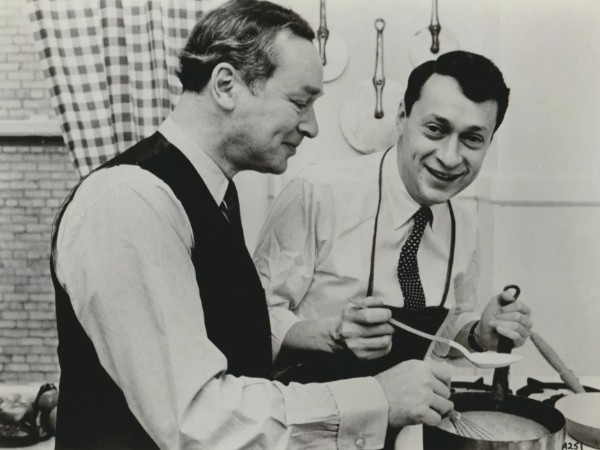
Arthur Gold and Robert Fizdale in the kitchen
However, their creative efforts didn’t stop at biographies. The couple loved to cook and became famous for their efforts. In 1974, Vogue actually hired them to be cooking columnists.
In 1984, they published The Gold and Fizdale Cookbook. The cover boasted a picture of the two men next to a grand piano with the lid open, with all kinds of tasty dishes placed inside on the strings.
Their cookbook included not only recipes but a variety of priceless personal memories. On the first page of the introduction, they mention that Julia Child herself had been the woman to suggest they write a cookbook, back in 1974.
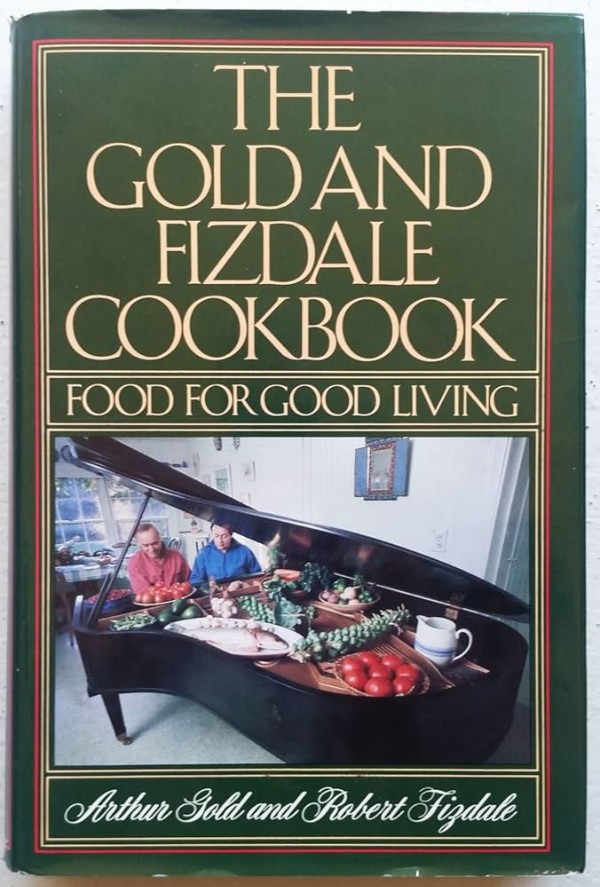
The Gold and Fizdale Cookbook
One summer evening, she came to dine at our house on Long Island. “Julia Child coming to dinner! Good God! What to make?”
(They ended up creating a Moroccan feast, which she enjoyed; she’d never had Moroccan food before.)
The amusing dedication read: “To George Balanchine, In whose kitchen we spent many happy hours…”
The two even ended up hosting their own cooking show.
Final Years and Legacy
Gold died in January 1990 of lung cancer, in the New York City apartment he shared with Fizdale. Almost six years later, in December 1995, Fizdale passed away from Alzheimer’s.
The two are buried side-by-side in a cemetery in Sag Harbor, New York.
Although neither of their obituaries outed them as queer, many people over the decades could attest to their partnership.
Looking back, it’s remarkable how, even in the face of staggering homophobia, they decided that being personal and professional partners was worth the risk.
Even today, their respect for each other as both people and artists shines bright in all of the music, recordings, and books they left behind.
For more of the best in classical music, sign up for our E-Newsletter