Passing through the steep black slate roof of the gatehouse, the outside world fades into lush forest. At its heart stands the Romanesque Basilica, its weathered stone and austere towers rising over quiet, sunlit courtyards. The monastery remains a living sanctuary. Tucked inside a centuries-old abbey in the Rhineland, the Festival Alte Musik Knechtsteden has long been a quiet site for early music lovers. Surrounded by Romanesque arches and quiet courtyard lawns, listeners come here for something curated with insight.
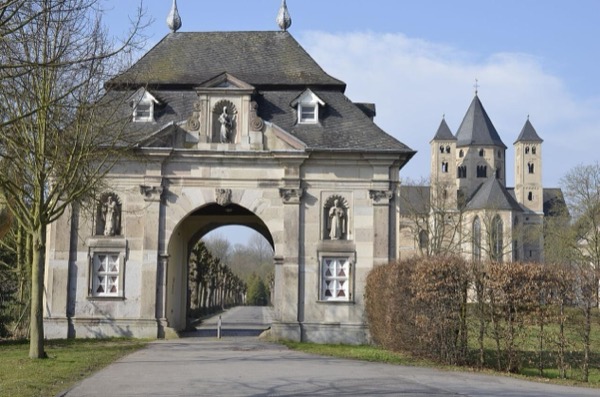
© www.dormagen.de
This spirit continues in the 2026 edition, which marks the 250th anniversary of E. T. A. Hoffmann’s birth. While most know him as a visionary writer of dark, Romantic tales, Knechtsteden turns the spotlight onto his music. That brilliant side of his mind that often gets forgotten. His output of sacred music is played alongside his instrumental compositions in various venues.
By pairing Hoffmann’s Miserere with masterpieces by his legendary idol, Mozart, the festival opening concert creates an intriguing musical dialogue. It feels like two kindred artistic spirits meet across time. Under Edzard Burchards, Concerto Köln and the Rheinische Kantorei delivered a convincing reading. A standout vocal quartet, Anna Nesyba, Alice Lackner, Johannes Gaubitz, and Konstantin Paganetti, impressed with seamless counterpoint and intimate, chamber-like listening. Nesyba shone with golden radiance in Sacrificium Deo and masterful coloratura in Mozart’s Tra l’oscure ombre funeste, while Lackner and Gaubitz brought expressive, operatic flair.
To be sure, Hoffmann’s score sounded polished, revealing a composer steeped in the sacred idioms of Haydn and Mozart. Though its echoes of Mozart’s Requiem are undeniable, the Miserere holds its own through striking contrapuntal fluency and genuine devotional sincerity.
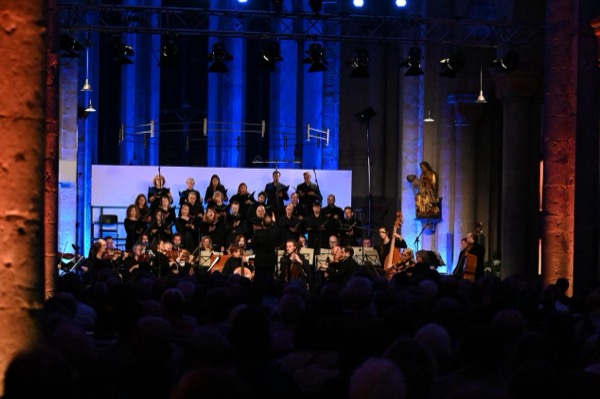
© Michael Rathmann
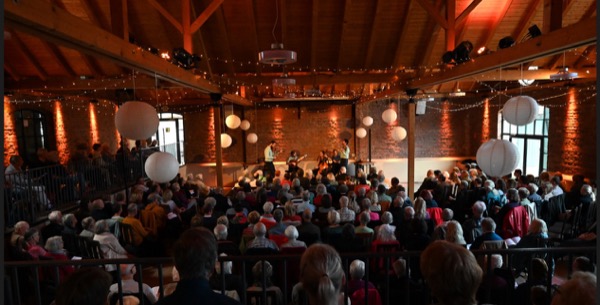
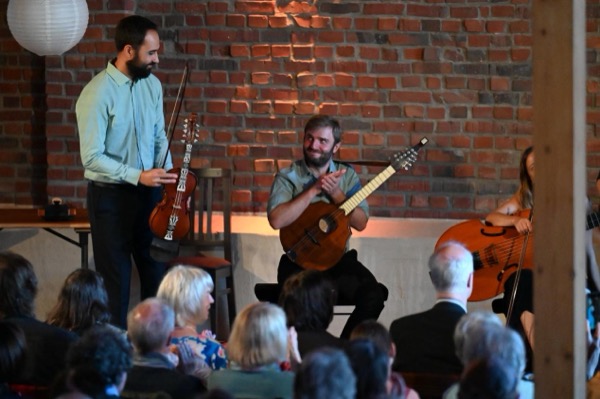
Beyond the grandeur of the main basilica, the festival finds some of its most intimate moments in the converted Bullenstalls of the Kulturhof. The unpretentious, rust-red brick barn workshop serves as the backdrop for the Nordic Sounds program. The early music ensemble The Curious Bards delves into 18th-century Scandinavian tunes, ballads, and Gaelic-influenced folk dances. Resonating with the festival’s 2026 theme, “Unheimlich. Fantastisch (The Uncanny and the Fantastic)”, this music conjures dark caves and enchanted fairy realms. During the performance, the musicians demonstrated visually striking historical instruments, like the bone-inlaid Norwegian Hardingfele, the wooden-keyed Swedish Nyckelharpa, the ornate wire-strung Cister, and the fretted Viola da Gamba.
The Curious Bards – Backstage
© Michael Rathmann
The music was vividly cinematic, and mezzo-soprano Ilektra Platiopoulou brought its rustic, direct texture to life with her expressive storytelling. Instrumentally, many of the pieces leaned into repeating ostinato figures, packed with dazzling improvisational variations and rich embellishments. Sitting in the packed hall, it took no time at all before the room felt completely overheated. This programme certainly built a strong bond between the festival and the public on this sunny afternoon.
© Michael Rathmann
This close bond between local community and heritage could also be seen in the beautiful riverside town Zons. Perched along the Rhine, Zons remains a well-preserved late medieval toll fortress, enclosed by stone walls and circular defence towers. Its cobblestone lanes are flanked by timber-framed houses. Just beyond its ramparts lie quiet river meadows and leafy trails. Tucked right within this historic setting is the Kreismuseum Zons, offering an invitingly intimate venue where young Ensemble Tamuz from Berlin treated the audience to a refreshing chamber music concert.
This visionary and bold ensemble clearly holds strong opinions on standard repertoire like Beethoven’s Ghost Trio and Schumann’s Piano Quintet. Yet, the inclusion of E. T. A. Hoffmann’s Grand Trio in E Major perfectly enriched the program. As both a composer and an influential critic, Hoffmann famously championed Beethoven’s Ghost Trio as the epitome of Romantic interiority, while his own literary and musical legacy later profoundly inspired Schumann’s whimsical Kreisleriana.
The performance was further elevated by the rare opportunity to hear an original piano from the first half of the 19th century—a mystical instrument by an anonymous maker whose craftsmanship clearly draws from multiple national schools. The instrument sounded exceptionally lyrical, with clear vocal projection, a rounded yet focused bass, and a high register of fine granularity. Gilad Katznelson used the pedals with tasteful restraint, delivering phrasing full of brilliant, imaginative sparks that were immediately evident in his improvised preludes before each work.
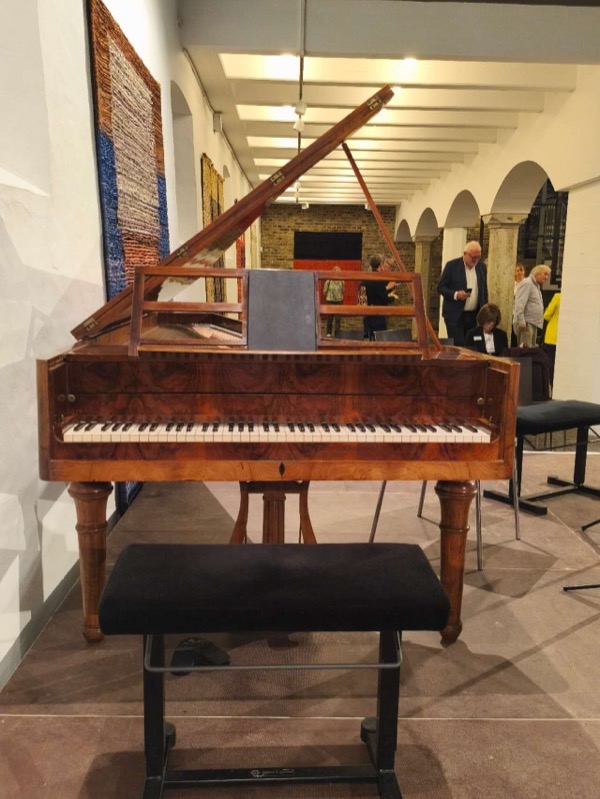
© Mengguang Huang
His string companions matched this adventurous approach at every turn. They never missed a chance to push the music to its emotional limits, treating sudden shifts, sectional transitions, and tense fugal passages with unrestrained youthful courage. Their bowing leaned toward a rustic edge, but these vivid, physical bow attacks gave the music a tangible presence. Certainly not aiming for an overly polished surface, Ensemble Tamuz made it feel as though the music was bursting directly off the page. At the same time, their grasp of overall structure and long musical phrases was exceptional; gradual crescendos built naturally, sonata-form divisions remained crisp, and character contrasts between movements were articulately drawn.
Ensemble Tamuz – A documentary portrait by Yoel Culiner
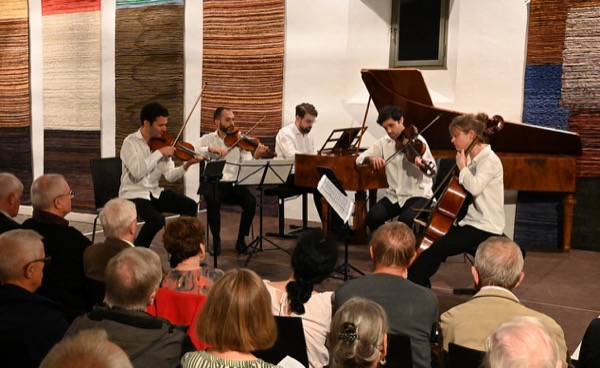
© Michael Rathmann
In the Festsaal of Schloss Arff, text, sound, and space fit together with unforced ease. The pink Rococo facade, which is set against green lawns and the quiet trees around the estate, is an ideal backdrop for Hoffmann’s Romantic restlessness. Light streamed through tall windows onto cream ceiling stucco, framing an early autumn landscape outside.
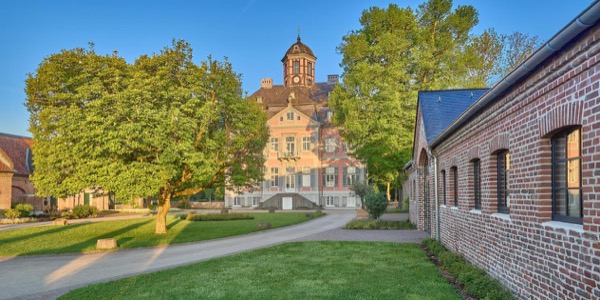
© www.schloss-arff.de
The programme featured various spoken lines, which moved between Hoffmann’s manic monologues as Kapellmeister Kreisler and Schumann’s private letters to Clara. The keyboard music from Hoffmann’s F Minor Sonata & Schumann’s Davidsbündlertänze and Kreisleriana picked up the thread.
In the centre of the room stood the historic piano again from the previous evening. Christine Schornsheim played with a poetic ease that effortlessly summoned an early Romantic atmosphere; her touch was focused and deeply effective. Equally compelling was actor Andreas Grötzinger, whose reading was vividly theatrical. He projected his voice into different corners of the space, effectively turning the connected period rooms into an intimate stage. As the afternoon light faded outside, the entire performance felt like a quiet time machine, drawing one completely back into the world of shadowy fantasies and poetic twilight.
C.P.E. Bach: Rondo in C minor, Wq 59 No. 4 | Christine Schornsheim | BR-KLASSIK
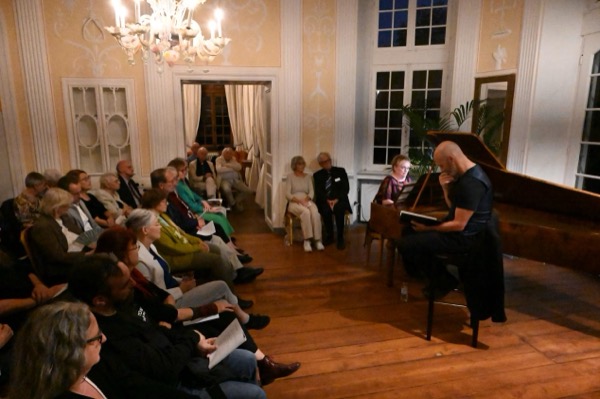
© Michael Rathmann
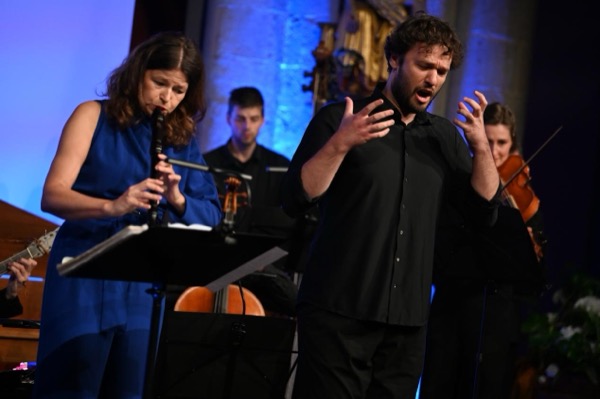
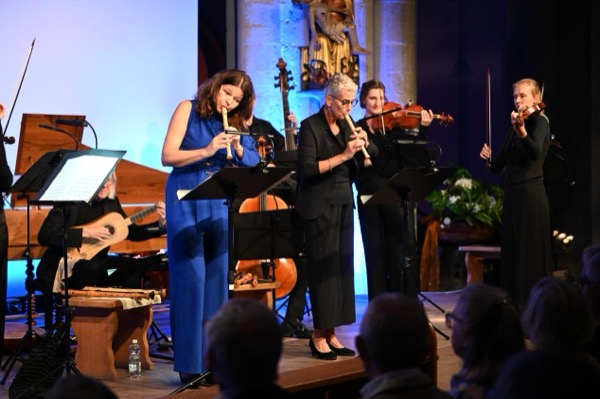
Returning to the solemn Klosterbasilika Knechtsteden, Artist in Residence Dorothee Oberlinger led the Freiburger Barockorchester in a meticulously curated evening program. The selected music built around extreme contrasts of colour, texture, and dramatic tension, explored the uncanny and the fantastic. The concert found its focal point in the exceptional theatrical vitality of bass-baritone Sreten Manojlović, who collaborated with Oberlinger in the 2025 production of Agostino Steffani’s Orlando Generoso.
The program opened with Jean-Féry Rebel’s Les Élémens. In Le Cahos, two recorder parts woven into the orchestral fabric amplified an unsettling sense of disorder, which dissolved elegantly into clarity during the subsequent chaconne’s fluid dialogues. Handel’s Organ Concerto, transcribed for recorder, highlighted woodwind agility. The Larghetto unfolded with vocal-like lyricism, while the wide leaps of the Allegro prefigured the monstrous sorrow of the following sandwiched Handel’s Polifemo (Fra L’Ombre e gl’orrori). Here, Manojlović delivered a hauntingly distorted portrait of a giant’s remorse, complete with sobbing inflexions. It was strikingly in contrast with the noble string accompaniment. After the aria, he remained seated, head in hands, as Oberlinger and the bassoon engaged in a breathtaking chase through the concluding Presto.
© Michael Rathmann
In the second half, Manojlović pushed dramatic limits further with Purcell’s Cold Song, delivering the trembling syllables with high granularity. His stage presence and audience engagement peaked in Biber’s Nachtwächter, where he appeared on the stage as a night watchman to the tolling of night bells. In the final piece, Boccherini’s La Ritirata di Madrid, he disrupted the ensemble with playful antics. He gradually drove the Freiburger musicians off the stage à la Haydn’s Farewell Symphony, until even the last remaining cellist fled under his intimidation.
Le Jardin des Voix – Sreten Manojlovic
Naturally, Oberlinger’s instrumental virtuosity was also eagerly expected by audiences. Vivaldi’s La Notte shifted effortlessly through highly charged emotional states with rich pictorial vividness, while her second Vivaldi concerto offered an even more solo-brilliant contrast.
Antonio Vivaldi: “La Notte”, Flute Concerto in G minor, RV 439 – Oberlinger
© Michael Rathmann
As usual, the Freiburger Barockorchester proved captivating throughout. Performing in a modest formation, the ensemble radiated chamber-music intimacy with unmistakable spontaneity and explosive energy. Special praise belongs to the basso continuo section: the harpsichord wove exquisite preludes and connective threads, the lutenist provided rich tonal nuance by switching occasionally to vihuela, and the cello delivered exceptionally energetic grounding. Though the program’s association with E. T. A. Hoffmann felt loose, it was nonetheless an engaging evening.
Epilogue
Intimate and exquisitely crafted, the festival delivered an experience where a seemingly effortless curated program belied a rich depth of musicological and humanistic reflection. Enhanced by the fresh colours of period instrumentation, each daily concert leaves the listener thoroughly enriched. It is a rewarding poetic excursion through the early days of a German autumn.
For more of the best in classical music, sign up for our E-Newsletter