Wolfgang Amadeus Mozart is one of the most famous composers in Western music history – and one of the most mythologised.
Over the past two centuries, popular culture has transformed Mozart’s legacy into a series of legends: the genius who never revised, the giggling fool, the composer of “easy” music, the enemy of Salieri, and the penniless prodigy whose body was tossed into a pauper’s grave.
Many of these stories are compelling, dramatic, and endlessly repeated – but they also don’t hold up under historical scrutiny.
Today, we’re looking at five of the most persistent myths about Mozart, separating romantic fiction from what historians, letters, manuscripts, and modern research actually tell us about his life and music.
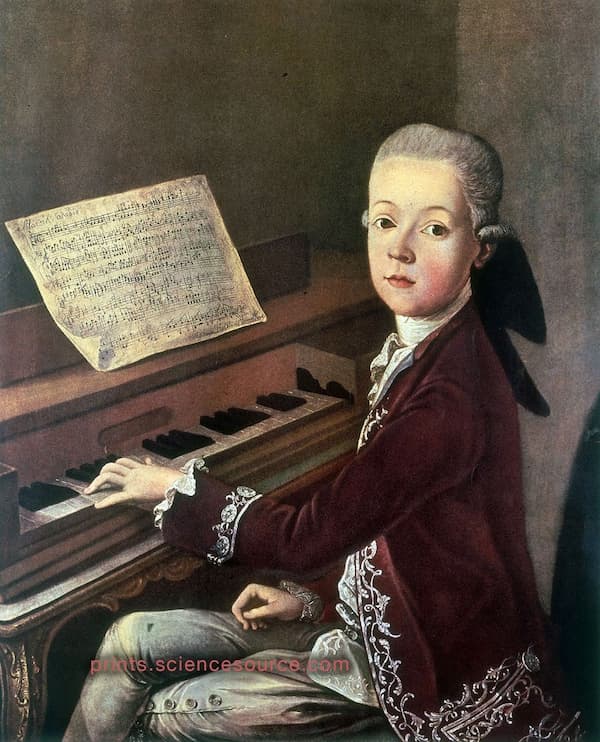
Mozart at the piano
1. Myth: Mozart wrote music effortlessly, without revision.
Mozart: Serenade No 10 for Winds ‘Gran Partita’, III. Adagio | LSO Wind Ensemble
The concept of perfect music pouring out of Mozart without the need for revisions is a romantic myth.
It’s true that Mozart’s final scores often look clean, with few erasures, but that’s because he did much of his experimenting on scratch paper or in his mind before writing the final copy.
He liked having a keyboard at hand to try out new ideas, and occasionally set perplexing passages aside to revisit later.
He even described a set of six string quartets that he dedicated to Haydn as “the fruit of long and laborious effort.”
So why did this legend take hold? One reason was a letter that surfaced in 1815 in which the author described composing in his head without using an instrument. But in the 1850s, that letter was proven to be a forgery. Unfortunately, by that point, it had already contributed to the Mozart mythology.
It’s also important to note that Mozart’s wife, Constanze, burned many of his sketches after his death, leaving us a potentially misleading picture of his process.
In short, Mozart’s easy brilliance was also coupled with industriousness. His music was the product of astonishing inborn talent plus decades of hard work – not effortless magic.
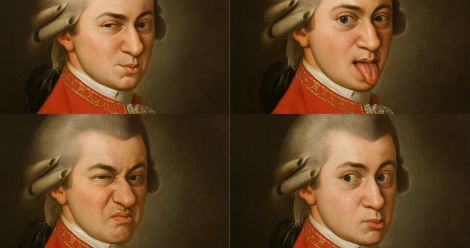
Image created by ChatGPT
2. Myth: Mozart was a childish, giggling simpleton.
Don Giovanni – Overture (Orchestra of The Royal Opera House; Mozart)
The popular 1984 film Amadeus created the image of Mozart as a juvenile, shrieking, giggling buffoon – but historians say this caricature is misleading.
It is true that Mozart did have a bawdy sense of humour, and he made lots of scatological jokes in his letters, but this was not unique to him. Crude jokes of this kind were actually relatively common in 18th-century middle-class Vienna.
But far from being a buffoon, Mozart was highly intelligent and emotionally astute. By his teens, he had a deep understanding of human emotion, as his music attests. His psychological insight is especially evident in the sophisticated characters and emotions portrayed in his operas and Requiem.
He also handled complex business negotiations, taught students, joined the Freemasons, and wrote letters about finances and family matters – hardly the behaviour of a clueless simpleton.
In sum, Mozart was a multifaceted genius: playful and jovial at times, yes, but also serious, diligent, and, contrary to the mythology, emotionally perceptive.
3. Myth: Mozart’s music is “easy.”
Mozart Piano Sonata No. 11 A major K. 331, Daniel Barenboim
Mozart’s music has a reputation for sounding graceful and effortless, which leads some to think it’s simple or easy to perform.
But ask any trained musician, and they’ll quickly dispel that notion. The simplicity of Mozart’s melodies and textures is deceptive; in reality, his compositions demand flawless technique and deep musicality.
A famous quote often attributed to pianist Artur Schnabel sums it up: “Mozart’s music is too easy for children, and too difficult for adults.”
In other words, while a beginner might manage to pick out the notes of a Mozart piece, playing it well is extraordinarily challenging.
And as composer Gabriel Fauré observed, in Mozart’s music “the slightest mistake stands out like a black spot on white.” There’s no room to hide sloppy playing behind thick chords or pedal effects.
It’s true that a few of Mozart’s early works and simple tunes are accessible to students. But his masterworks – the late symphonies, concertos, operas, string quartets – are intricate and demanding.
In short, the graceful simplicity of Mozart’s music is an illusion. Underneath it lies a complexity and difficulty that challenge even the best performers.
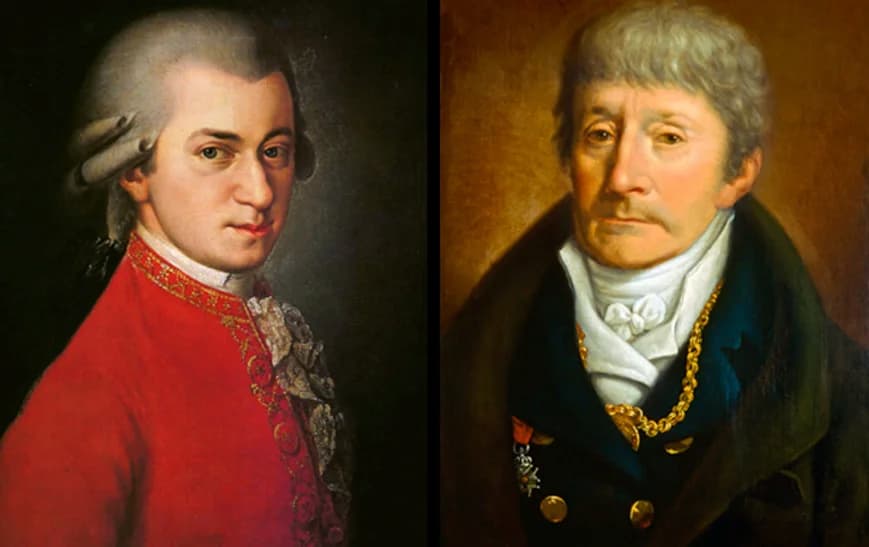
Wolfgang Amadeus Mozart and Antonio Salieri © slavicwritings.com
4. Myth: Mozart hated Salieri
Mozart and Salieri’s “Per la ricuperata salute di Ofelia”
The idea that Wolfgang Amadeus Mozart and Antonio Salieri were bitter enemies – to the point of Mozart “hating” Salieri or vice versa – is mostly a creation of gossip and later dramatisations. (We’re looking at you, Amadeus.)
The kernel of the myth originated in the 1780s, when Wolfgang and his father, Leopold, grumbled to each other in letters that Italian composers were being given better commissions and jobs at the Viennese court than Austrian composers were.
Eventually, however, the two composers enjoyed a more cordial relationship.
They even collaborated on a piece in 1785: a short cantata called “Per la ricuperata salute di Ofelia” for a singer they both admired.
One of Mozart’s last surviving letters from October 1791 describes how he brought Salieri to a performance of The Magic Flute, and how Salieri applauded enthusiastically and shouted “Bravo!” after every aria he liked.
After Mozart’s death, his widow even hired Salieri to teach their son composition.
There is no evidence that Salieri sabotaged Mozart’s career in a significant way, or that he ever harmed Mozart physically. The famous murder plot – Salieri poisoning Mozart out of envy – is pure fiction, made famous by an Alexander Pushkin play and, later, the movie Amadeus.
Tragically, in his old age, Salieri suffered from mental health issues and reportedly believed he had poisoned Mozart. But historians universally agree these thoughts were likely dementia-related delusions, not facts.
In sum, Mozart and Salieri were competitors who respected each other and worked together. The dramatic tale of hatred and poisoning may be an entertaining story, but the historical record reveals a much more mundane – albeit rather heartwarming – truth.
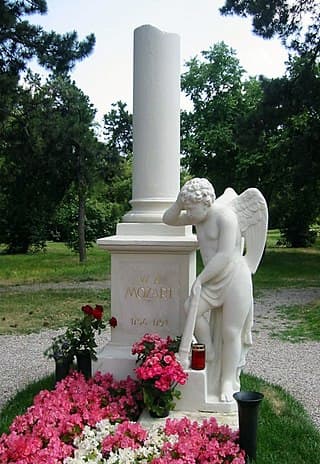
Austria, Vienna, St. Marx Cemetery, The gravestone of Wolfgang Amadeus Mozart
5. Myth: Mozart died poor and was buried in a pauper’s grave.
Mozart : Requiem
The image of Mozart dying in squalor and being dumped into a pauper’s mass grave is an exaggeration that became popular in the 19th century.
It is true that Mozart wasn’t particularly wealthy when he died. He had incurred debts, and his income dipped in the late 1780s due to a number of factors, including fewer concerts during the Austro-Turkish War.
But earlier in the 1780s, he’d actually made a very comfortable living. Modern research shows that during those years, he earned substantial sums – possibly in the top 5% of Viennese incomes for some years – thanks to concerts, teaching, and the support of royal patrons. His problem was cash flow and spending, not lack of money outright.
Consequently, when Mozart died in 1791, he was buried in a standard common grave in Vienna’s St. Marx Cemetery.
His wife, Constanze, and patron, Baron van Swieten, actually paid for his coffin and funeral, so we know he wasn’t buried at state expense or in a charity grave. His body was sewn into a linen shroud (not the cheap sack customarily used for paupers) and placed in a coffin for the funeral.
After the temporary marker disappeared, the grave was unmarked, but this was a customary practice for everyone who wasn’t royalty or a member of the aristocracy – not a reflection of a lack of respect.
So, although it’s tragic that we don’t know exactly where Mozart’s remains ended up, this wasn’t a particularly unique tragedy; it was simply the fate of most citizens who died in Vienna at the time.
Thanks to her savvy promotion and publication of her late husband’s works, Constanze actually was able to pay off his debts within a few years, adding weight to the idea that Mozart was better off than we tend to think of him.
The enduring image of a penniless genius buried in a pauper’s grave may be a popular narrative, but the truth is much less dramatic: he was a prolific working composer who had intermittent cash flow issues, extravagant spending habits, and a totally ordinary burial for his time.
Conclusion
Mozart’s enduring popularity may owe a lot to the powerful myths that surround him, but those same myths often obscure the more interesting truths.
Far from being an effortless savant, Mozart was a hard worker, revising carefully and thinking deeply about his craft. He was playful but perceptive, witty but emotionally intelligent. His music may sound graceful, but it demands extraordinary precision and insight to perform well. His relationship with Salieri was competitive yet respectful, not murderous. And while he struggled financially at times, he did not die abandoned or buried as a pauper.
These myths of effortless genius, childishness, simplicity, rivalry, and poverty may all collapse under scrutiny – but what remains is far more compelling. The real story of Mozart’s life paints a richer, more credible portrait of one of history’s greatest musical minds, and helps us to appreciate the human triumph that is his music better than ever.
For more of the best in classical music, sign up for our E-Newsletter