On 11 June 2026, we honour the birth of John Constable (1776-1837), one of Britain’s most important landscape artists. Some contemporaries found his work as exhilarating as a lungful of oxygen, while others were baffled by his uncompromisingly realistic treatment of the natural world.
Constable lived during a period when landscape was a dominant genre in British art. He did share the stage with the English master J.M.W. Turner (1775-1851), who was equally gifted but probably more fiercely competitive.
English Pastoral
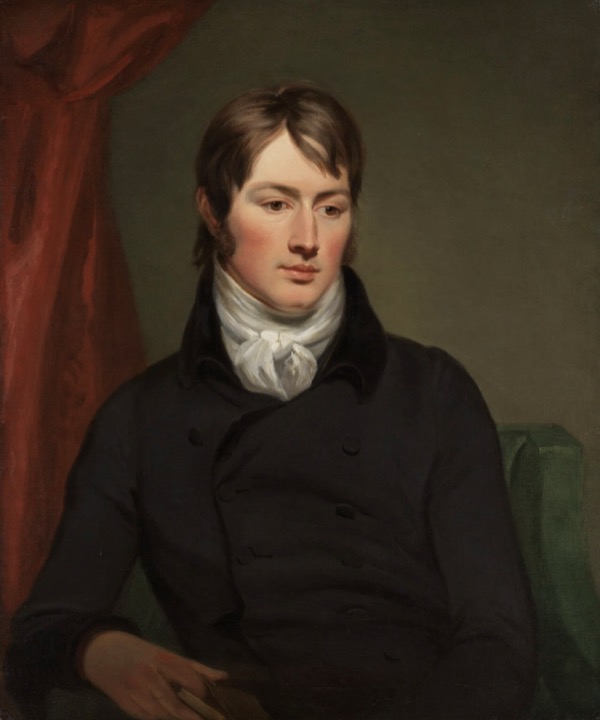
John Constable, by Ramsay Richard Reinagle
Constable did not paint scenes popular with the touring public or other artists, but concentrated on sites where he had family or personal connections. “His landscapes represent a sometimes astonishing capacity to represent natural appearances… as well as a profound and prolonged meditation on the rural realities of a Britain undergoing a bewildering socioeconomic transformation.” (Rosenthal, Britannica)
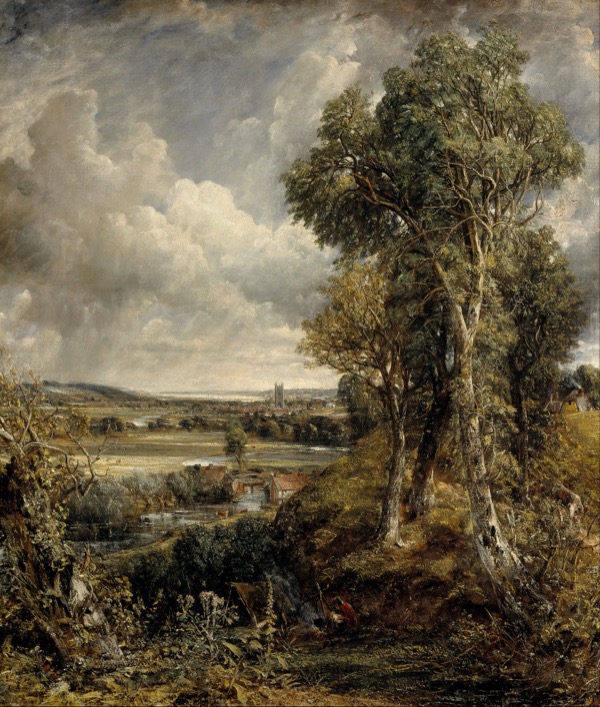
John Constable: The Vale of Dedham
To celebrate Constable’s 250th birthday, let us align his paintings with the music of Gerald Finzi, as both are essentially artists of English pastoral light.
Gerald Finzi: Eclogue for Piano and Strings
An Artist Shaped by Suffolk
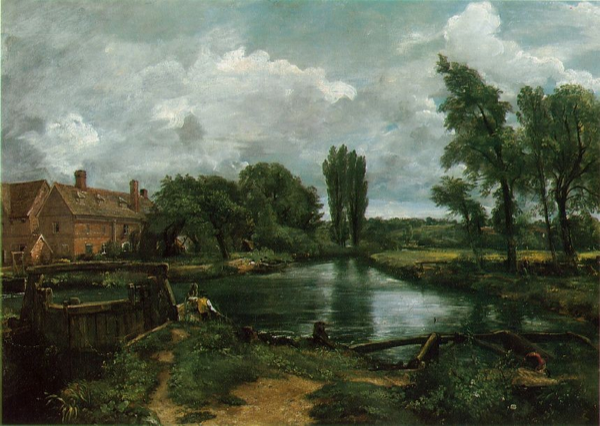
John Constable: Flatford Mill from the Lock
John Constable was born in East Bergholt, a village near the River Stour in Suffolk. His father, Golding Constable, was a wealthy miller and merchant who owned a small ship for transporting corn to London.
In his youth, Constable embarked on amateur sketching trips in the surrounding Suffolk and Essex countryside, and his understanding of its rural economy would later figure in his work. John was supposed to take on his father’s business, but he eventually persuaded his father to let him pursue a career in art.
He entered the prestigious Royal Academy schools in 1799, and in an environment that stressed history painting, Constable started to show a particular interest in landscape. He even refused a post as drawing master at a military academy, so that he could dedicate himself to studying nature and painting landscapes.
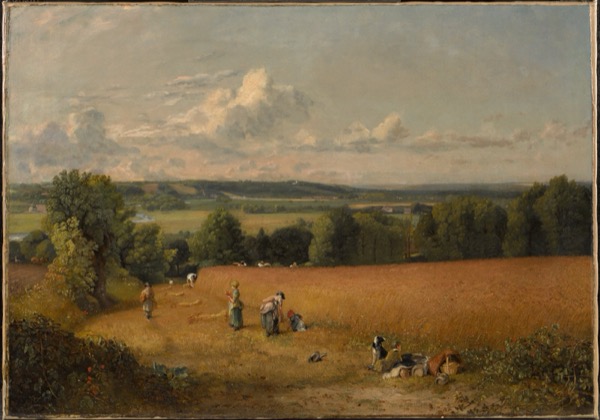
John Constable: The Wheat Field, 1816
In 1803, he exhibited his painting at the Royal Academy, and his early style already featured many qualities associated with his mature work. These include the freshness of light, colour, and touch, and he preferred to use watercolour in his studies of nature.
Gerald Finzi: The Fall of the Leaf, Op. 20 (Hallé Orchestra; Mark Elder, cond.)
Finding the Six-Footers
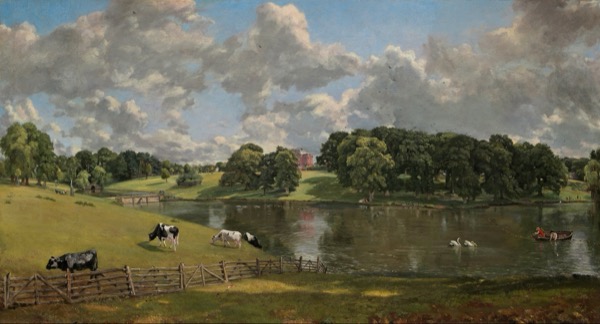
John Constable: Wivenhoe Park, Essex
A two-month tour of the Lake District in 1806 produced some famous landscapes, but an exhibition of these works was unsuccessful. Constable now spent his winter in London and did his painting at East Bergholt in the summer.
On one such stay in 1809, he fell in love with Maria Bicknell, and after a lengthy and acrimonious courtship, they officially married in 1816. Since 1808, Constable had been sketching in oil, and his style had become more focused.
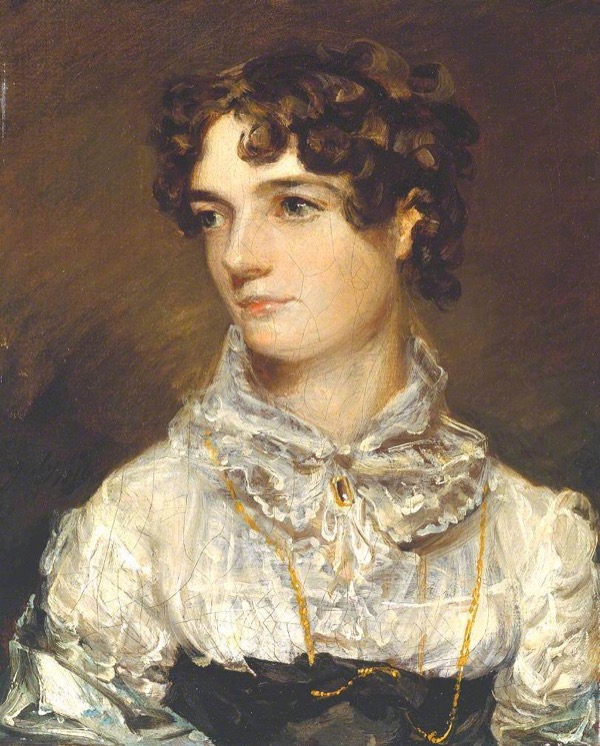
Maria Bicknell, Mrs John Constable (National Gallery)
In fact, Constable was now painting easel pictures in the open. In his works from this period, Constable displayed remarkable precision of touch and accuracy in description, comparable to contemporary landscapes by George Robert Lewis and John Linnell. His iconography was traditional and celebrated the continuity and stability of English country life.
Constable did not sell his first major successful canvas, “The White Horse,” until 1819. He had begun to paint on a large scale, and it led to a series of six monumental landscapes depicting scenes on the River Stour known as the “six-footers.”
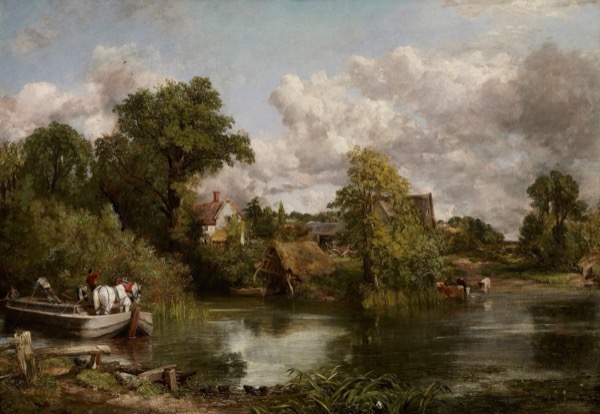
John Constable: The White Horse
The “Six-footers” all featured views of the river, but at a remove, as if filtered through memory. As Constable wrote in 1821, “Still, I should paint my own places best; painting is with me but another world of feeling, and I associate ‘my careless boyhood’ with all that lies on the banks of the Stour.”
Gerald Finzi: Intimations of Immortality, Op. 29 (Guildford Philharmonic Choir and Chamber Orchestra; Vernon Handley, cond.)
Turning Toward the Sky
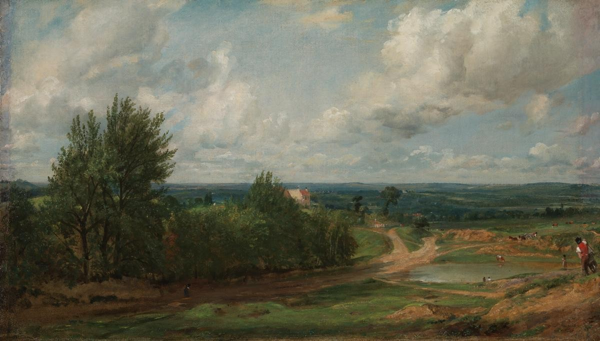
John Constable: Hampstead Heath, with the House Called The Salt Box
Constable finally attracted public attention and generated critical approval, which also aided his election to become an Associate of the Royal Academy. Constable began painting on Hampstead Heath, essentially turning his focus to the skies. His cloud studies are remarkable, capturing the momentary qualities of changeable skies and accurately documenting meteorological phenomena with which he was familiar.
Constable exhibited his most famous painting, “The Hay Wain”, in 1821. Although it failed to find a buyer, it attracted attention on the continent. When the painting was shown at the Paris Salon, it caused a sensation by being awarded a gold medal by Charles X.
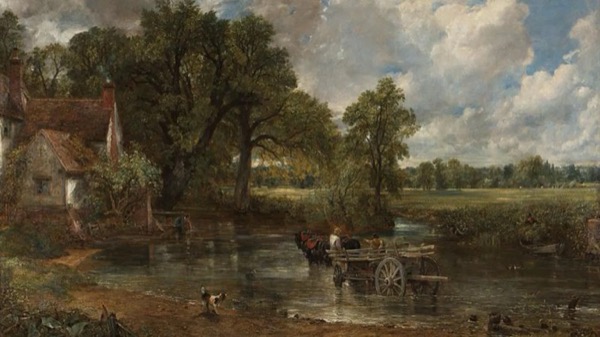
John Constable: The Hay Wain
“By 1824 Constable’s paint surfaces were becoming increasingly fractured, communicating optical effects that evoked the physical experience of nature; these qualities, in addition to his increasingly vibrant, luminous use of colour, have led many, erroneously, to see his work as a precursor to Impressionism.” (Rosenthal, Britannica)
Constable and his family stayed in the fashionable seaside resort of Brighton in 1824, where he produced a last great series of oil sketches. He was finally elected to become a Royal Academician in 1829, yet this honour was soured by the death of his wife, the mother of his seven children.
Gerald Finzi: A Severn Rhapsody Op. 3 (1923)
Against the Current of Modernity
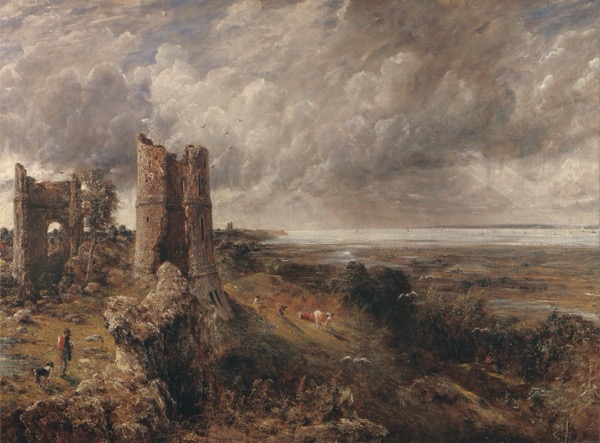
John Constable: Hadleigh Castle, The Mouth of the Thames — Morning after a Stormy Night
Constable and his great contemporary Turner were attacked by a new generation of artists and critics who formed their values in a rapidly developing, industrialised society. Nevertheless, Constable stayed active and continued to exhibit.
He reverted from oil to watercolour and drawing, and he began to deliver public lectures on the history of landscape painting. In a series of lectures at the Royal Institution in 1836, Constable proposed a three-fold thesis: firstly, painting “is scientific as well as poetic;” secondly, “that imagination never did, and never can” produce art to bear comparison with reality; and thirdly, “that no great painter was ever self-taught.”
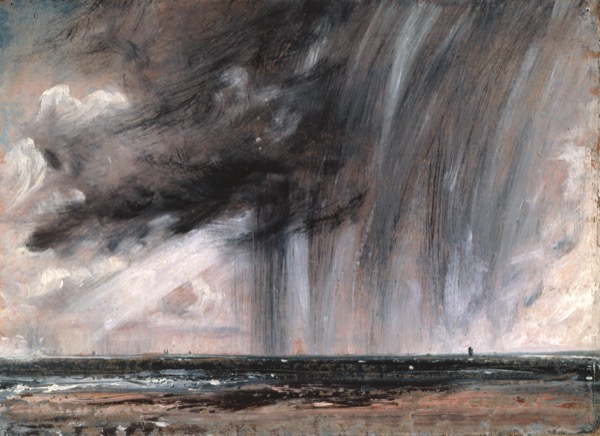
John Constable: Seascape Study with Rain Cloud
John Constable died on 31 March 1837, and during his lifetime, he had achieved a reputation as a respected and significant landscape painter. After his death, his friend Charles Robert Leslie extended his reputation, portraying him as a sincere and dedicated artist struggling against iniquity and incomprehension.
Focusing primarily on his oil sketches, which seemed to anticipate later Impressionism, the early 20th century revisited the work of John Constable. In the late 20th century, however, critics sought a more historically grounded understanding of his landscapes.
G.Finzi: Romance for String Orchestra
A Shared Language of Landscape
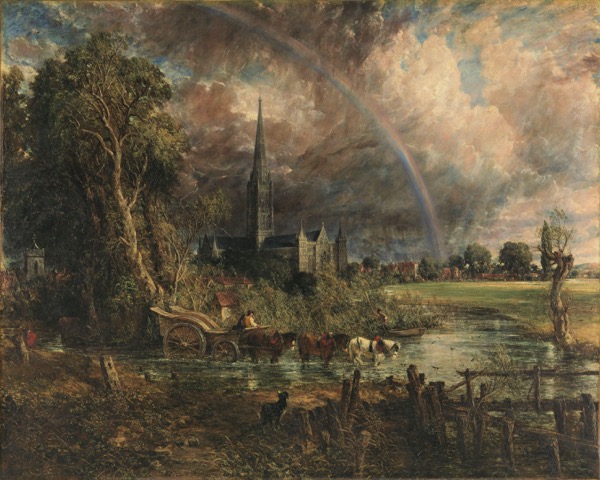
John Constable: Salisbury Meadows
A thorough debate is still ongoing, as some see his paintings as politically charged and deeply tied to their historical moment, while others view them as expressions of a distinctively English identity.
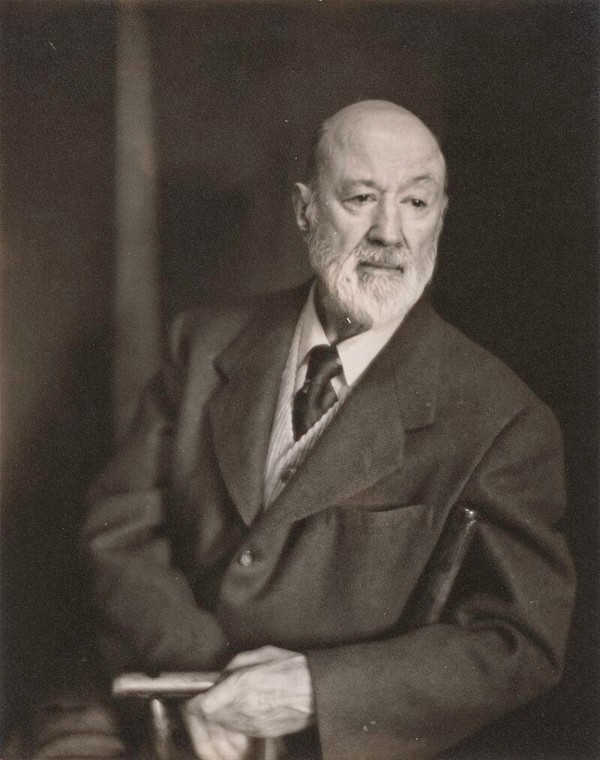
In aligning John Constable with the music of Gerald Finzi, I have clearly taken the path of expressing a distinctly English identity. Constable’s landscapes of Suffolk and the Stour Valley express the same quiet lyricism and intimacy with nature that feature prominently in the pastoral compositions of Gerald Finzi (1901-1956).
Born to Italian and German Jewish parents, Finzi nevertheless became the very symbol of “that form of English folk music comparable to an Italian pastorale…composing music that was as romantic, as dramatic, and natural as Constable’s clouds.” (Milton, Pairing Constable and Finzi, 2012)
Finzi’s pastoral compositions are simple and unpretentious, and far removed from the avant-garde in time and space. However, he was still capable of composing deeply emotive music. Both artists transform the English landscape into something deeply human; Constable paints weather as emotion, and Finzi composes emotion as weather.
For more of the best in classical music, sign up for our E-Newsletter