Musical notation is a fascinating and multifaceted thing. In previous articles, we’ve explored the beguiling ambiguity of graphic scores and the quirky potential of performance directions as exemplified in the works of Erik Satie. Today, we explore so-called “text scores” – musical compositions that consist largely of purely verbal instruction, with little or no actual noteheads or staff lines.
Our initial gut instinct may be that prose or text scores cannot really work, or are not really musical compositions. After all, how can we get a sensible musical outcome from the simple language of the kind we use day-to-day? If musical notation were not utterly essential to the communication of musical works, why would it have been created?
It is true that it would be unbearably cumbersome, nigh impossible, to transmit certain musical works through a text score. I should not want to be tasked with transcribing Beethoven’s 5th Symphony in words. However, this is only one kind of musical creation, relying on specific properties for its effectiveness. Music consists of much more than traditional orchestral timbres or a Western harmonic system. We can also think of music as a kind of decoration or process unfolding in sound through time, as a way of communicating, a way of organising aural gestures or events. Verbal instructions are effective for exploring these other musical dimensions, like the ordering of actions, the orientation of individual performers towards the ensemble, and elements of randomness or aleatoricism. Indeed, although this article is a separate entry from those I have written about graphic scores, text scores developed in historical tandem with these and for similar reasons, with some composers pioneering both media and combining them.
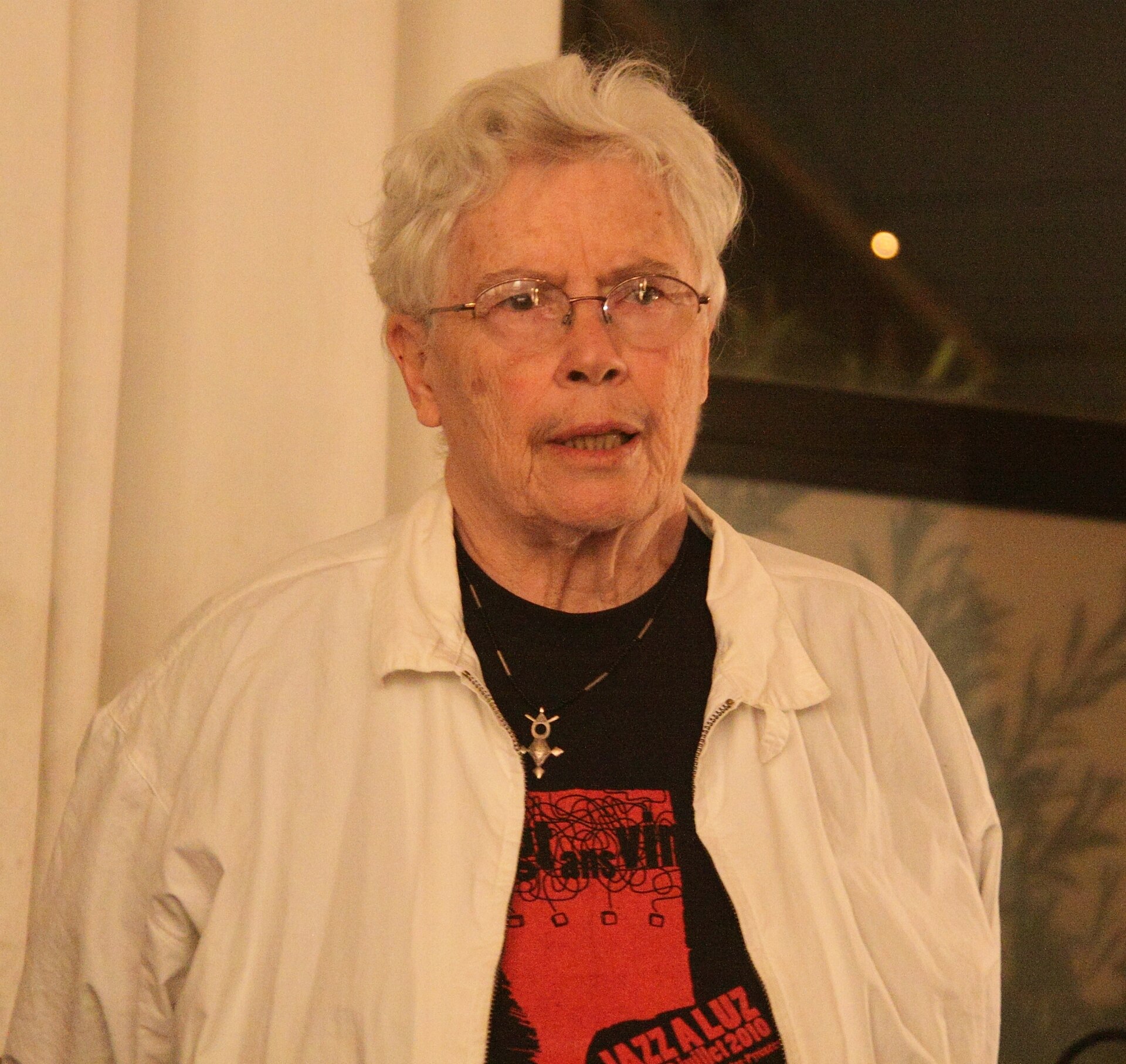
Pauline Oliveros
To give you a concrete example of what we’re dealing with, see this text score by the inimitable Pauline Oliveros, renowned composer and particular pioneer of experimental music. You can perform this by yourself, wherever you are, if you have a few minutes spare:
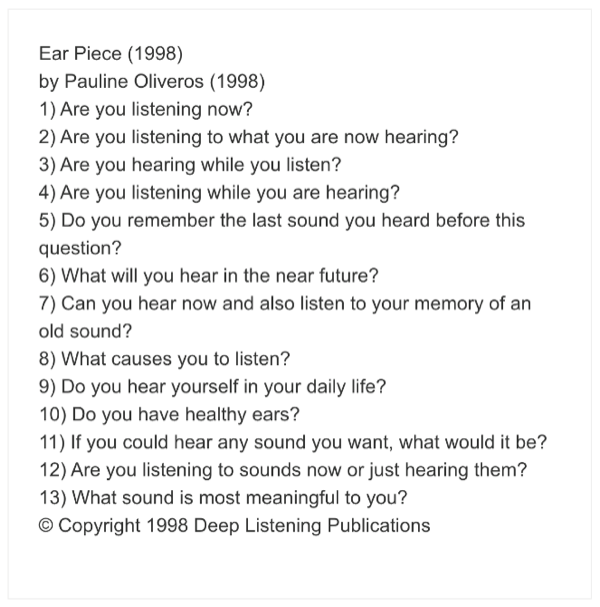
Photo credit: Are.na
Oliveros’ score is introspective and does not necessitate the production of any sound by the one doing the exercise. This is not at all the case for all text scores, as we see with John White’s playful Newspaper Reading Machine, which can be performed very effectively for an audience, and always results in one person yelling at the top of their lungs on their own towards the end (I recently performed this work in a library with an experimental music group as part of an evening concert – it felt incredibly wrong to be raising my voice in a library!).
The single greatest resource for understanding prose scores is John Lely and James Saunders’ Word Events: Perspectives on Verbal Notation. The book is in two parts, the first dealing with the linguistic science of constructing an effective text score, the latter presenting and analysing text-based works by a variety of composers. I will tease out, here, some particularly interesting points made in the book, in lieu of trying (and failing) to succinctly summarise the whole.
In a musical score, the raw material with which to sculpt consists of staves, noteheads, rhythms, rests, key signatures, and more. In prose scores, the raw material is language. As such, subtleties in choice of grammar take on powerful implications for “the processes… in a verbal score and… how that score might be interpreted.” After all, a grammatical change can alter a description into a command and vice versa. How much information is given, and whether that information is carefully explained or presented somewhat mysteriously or abstractly (in Systemic Functional Grammar, as “New” rather than “Given” information), will affect the attitude with which performers approach the piece, and how laterally or creatively they think. The register adopted by the scorer or score-created is also important. The scorer may draw on the registral conventions of “academic writing, gastronomy, folklore, rule books, spoken conversation, and so on,” each of which will result in a radically different performance quality. Language can also be used to govern the mental, material, behavioural, relational, and verbal processes of the performer. The words associated with a verb, a “verbal group,” operate with a modality, which provides information about the grey areas between “yes” and “no” – in other words, modalities include words like “might,” “may,” “could,” “should,” “would,” or “need to.” Modalities relate to permission, possibility, ability, and probability, and are ways to govern how a score develops through time. For example, an instruction for a violinist might be: “you may wish to recreate any pitches you hear on the cello that you are able to pick out.”
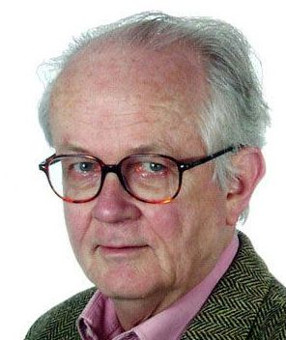
Tom Johnson
When thoughtfully used and inventively combined, these subtleties of language enable an infinite variety of interesting text scores. Some of these cross over into conceptual art or linguistic games, such as Dick Higgins’ Danger Music #12, which merely consists of the instruction, “Write a thousand symphonies.” Others are regularly performed and provide useful ways into music-making for those unable to read musical notation, or groups wishing to explore a new way of approaching music. Let us close with Tom Johnson’s Failing: A Very Difficult Piece for Solo String Bass, an incredibly unique work that defies categorisation and relies heavily on elements of prose scoring for its effectiveness, demonstrating the possibilities – and playfulness – of the medium.
For more of the best in classical music, sign up for our E-Newsletter