
In June 1933, the Chicago Symphony Orchestra performed a symphony by an American woman for the first time in its history.
The composer was Florence Price – a Black woman from Little Rock, Arkansas, who had spent years navigating an art world resisting her participation at every turn.
Her Symphony No. 1 in E minor brought the audience to its feet. Critics praised it, too. One from the Chicago Daily News wrote:
“It is a faultless work, a work that speaks its own message with restraint and yet with passion…worthy of a place in the regular symphonic repertory.”
This performance should have launched a celebrated career. Instead, Price spent the next two decades writing letters that went unanswered, submitting scores to publishers who weren’t interested, and composing prolifically in the hours left over after teaching piano to support her children.
Today, thanks to the work of scholars and musicians, Price’s music is performed by orchestras around the world.
But to understand why it matters, and why her story resonates so profoundly, you first have to understand what she pushed through to create it.
How Florence Price Began Her Unlikely Life as a Composer
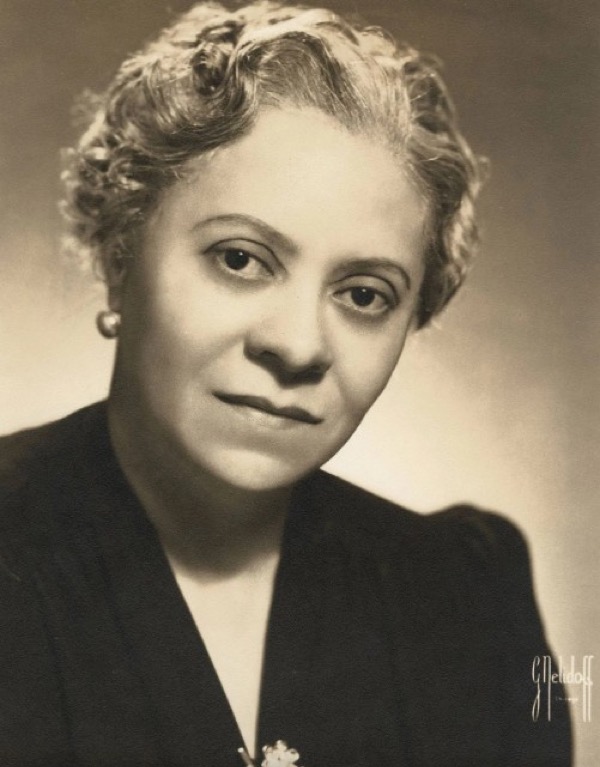
Florence Price
Florence Beatrice Smith was born in Little Rock, Arkansas, in 1887, into a middle-class Black family that took both her education and her musical gifts seriously from the start.
Her mother, a music teacher herself, began giving Florence piano lessons when Florence was a young child. By the age of four, she had begun composing. By fourteen, she published her first piece.
She enrolled at the New England Conservatory of Music in Boston – one of the most prestigious schools in the country – and graduated in 1906 with honours in organ and piano performance.
Price’s Piano Concerto
Before her adult career had officially begun, she was forced to navigate the choppy waters of race and classical music. To gain admittance to the Conservatory, she listed her home state as “Pueblo, Mexico.”
It’s worth pausing to consider what that decision meant: that being perceived as a Mexican composer would be easier than being perceived as a Black composer. Even as a young woman just starting out, she understood how difficult her identity would make her career – and it raised the lifelong question of whether she should embrace it.
Escape from Terror and the Struggle for Recognition
Price’s Violin Concerto No. 2
After her graduation, she returned to the South to teach, eventually becoming head of the music department at Clark Atlanta University, a well-known HBCU (historically black college or university).
She married Thomas Price in 1912 and built a busy life as a teacher, performer, and increasingly prolific composer.

Downtown Little Rock
Unfortunately, Little Rock was becoming unbearable. The racial violence of the Jim Crow South – with its riots, lynchings, and constant terror – convinced the Prices to leave.
In 1927, the Prices participated in the Great Migration, heading north to Chicago in search of a safer community.
She became involved with the legendary Chicago Black Renaissance arts movement, which included musical giants like Louis Armstrong, Earl Hines, and Mahalia Jackson.
Inspired by the creative atmosphere, she threw herself into additional composition studies and also began submitting work to competitions.
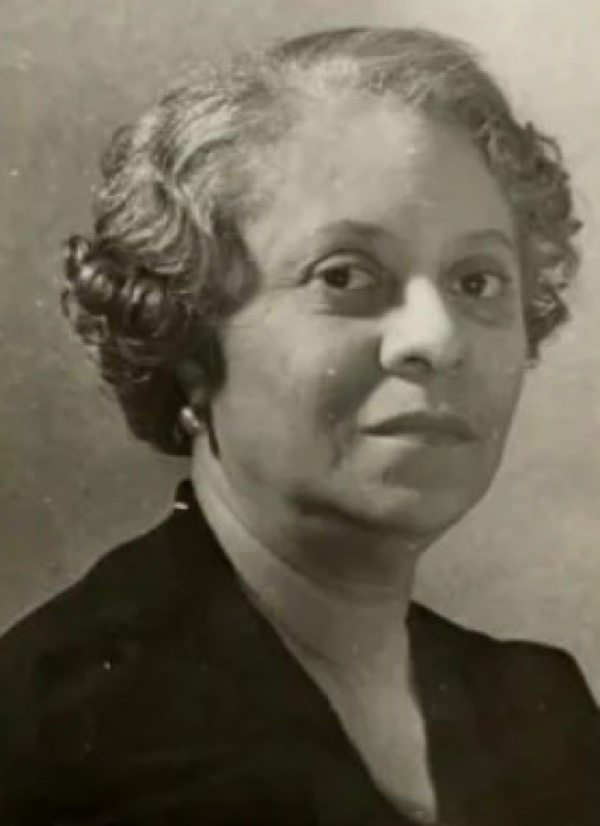
Florence Price
Winning the Wanamaker Contest: Did It Help?
Price’s Symphony No. 1, Movement 1
In 1932, she entered the Rodman Wanamaker Contest in Musical Composition for Composers of the Negro Race. She won first prize in two categories.
The victory caught the attention of Chicago Symphony conductor Frederick Stock and led directly to the historic 1933 performance of her first symphony.
It was a breakthrough. Price became the first Black woman to have a symphony performed by a major American orchestra.
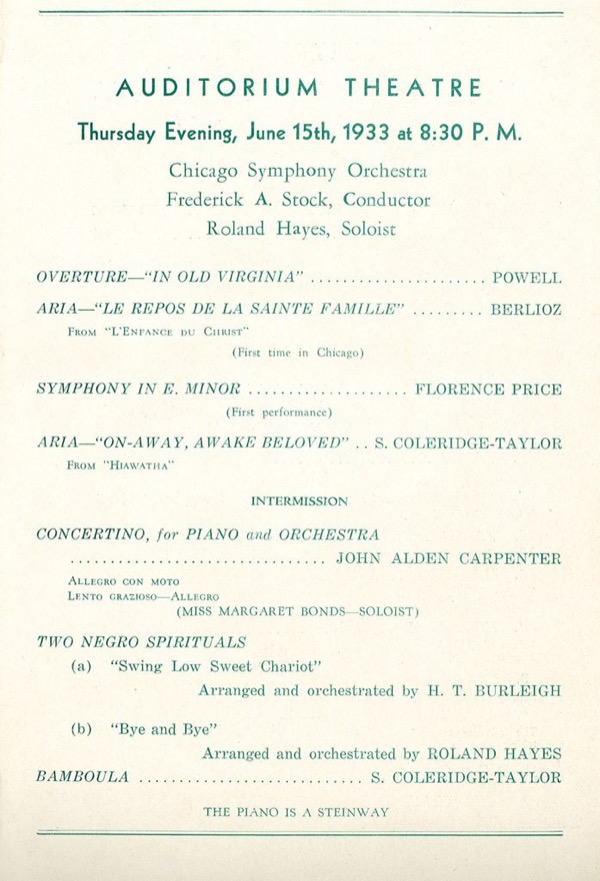
The concert programme in 1933
A listener might assume that such a triumph would open doors for a composer, but they stayed largely shut. The world of American classical music in the 1930s and 1940s was guarded by gatekeepers: concert programmers, music publishers, critics, etc. – most of whom were white and male, and many of whom demonstrated limited interest in championing a Black woman composer.
Despite the obstacles, over the following years, Price persisted. She wrote to major conductors, including seven times to Serge Koussevitzky of the Boston Symphony Orchestra, asking them to consider programming her work.
To Koussevitzky, she addressed the difficulties she faced head-on:
“Unfortunately, the work of a woman composer is preconceived by many to be light, froth, lacking in depth, logic, and virility. Add to that the incident of race – I have Colored blood in my veins – and you will understand some of the difficulties that confront one in such a position.”
In the end, nearly every promising lead she tried to grasp fizzled out. Koussevitzky never programmed her work.
The Silence After the Standing Ovation
Price’s Three Spirituals
Despite her success at the Chicago Symphony premiere, Price struggled to gain a foothold during the Depression and World War II eras.
Music publishers of the era had little commercial interest in concert works by Black composers, let alone female Black composers. The recording industry was similarly indifferent, as was radio broadcasting.
These routes to fame and career growth were often gatekept and therefore segregated in practice, if not law. The boys’ club that had uplifted hundreds of white male composers – grants, commissions, performances, and more – were exponentially more difficult for her to secure.
On top of that, her personal life unravelled around the same time. Thomas Price lost his job in the Depression and developed anger issues. He got the family into financial difficulty and became abusive. Her marriage to him ended in a difficult divorce in 1931.
She was left a single mother with two daughters to support, largely on the income she earned teaching piano or playing live music in movie theatres.
Still, she kept composing, and as she did, her artistic identity came clearly into focus.
She was a prolific and technically accomplished composer who worked across a wide range of forms: symphony, piano concerto, chamber music, organ works, art songs, and more. Her output numbered in the hundreds of works.
Her compositional voice was uniquely her own. She understood the European classical tradition intimately (she had, after all, been trained well at the New England Conservatory).
But she also employed meaningful hints of her Black identity, such as the melodic shape of the spiritual, the rhythms of the juba dance, or the emotional directness of the blues.
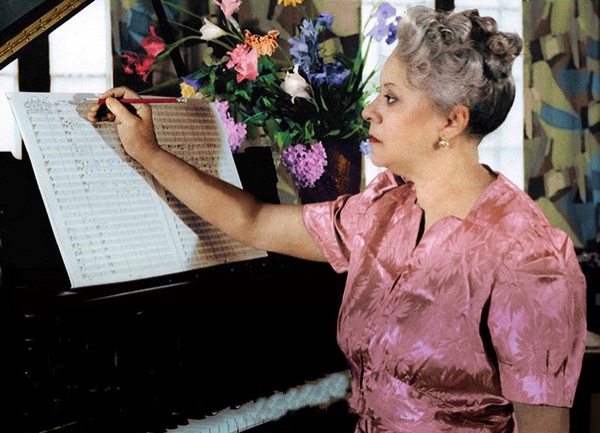
Florence Price
What Florence Price Left Behind – and Who Kept It Alive
Marian Anderson singing Price’s setting of “I Am Bound for the Kingdom” in 1945
One breakthrough came – not surprisingly – through the advocacy of another great Black woman musician: contralto Marian Anderson.
She performed Price’s songs regularly, bringing them before the public in cities across the country. It was a meaningful gesture, but it also could not make up for the broader institutional recognition that Price’s works – judging by the reviews of the first symphony in 1933 – deserved.
Thanks to the advocacy of Anderson and others, when Florence Price died in 1953 at the age of 66, she wasn’t the total unknown that some commentators have suggested. Colleagues, former students, and performers all valued her work.
In certain circles – especially among Black musicians and music educators – her contributions were known and loved. Her legacy was kept alive, in part, because those communities refused to let it disappear over the following decades.
In 1979, Professor Rae Linda Brown – herself a Black woman – was pursuing a graduate degree in African American Studies at Yale University when she came across the manuscript of Price’s third symphony. She was hooked, and one of the specialities of her career was born.
Tragically, Brown died in 2018 before releasing her biography of Price (which appeared only in an edited version in 2020). Her work laid the groundwork for ongoing present-day scholarship.
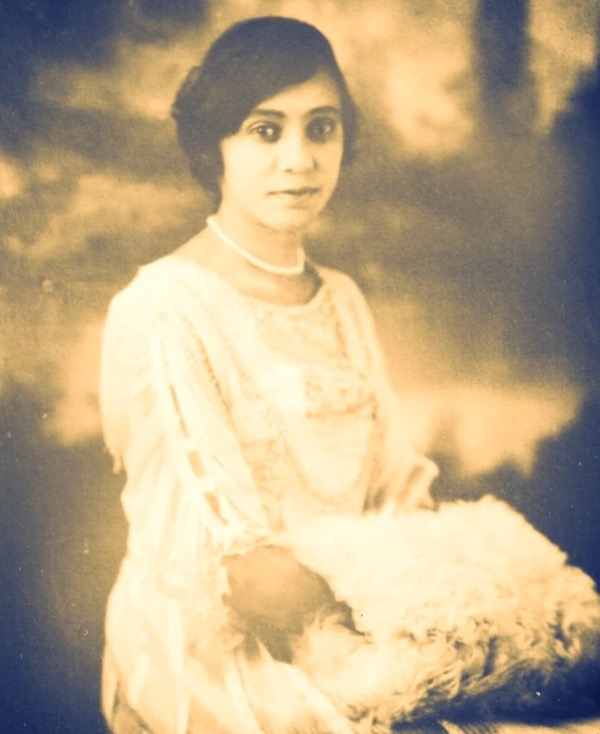
Florence Price
How a Discovery in an Abandoned House Changed Price’s Legacy
Price’s Symphony No. 1, Movement 3, “Juba Dance”
A particularly significant moment in the modern reception of Price came in 2009, half a century after her death, when a large cache of Price’s scores and papers was discovered in an abandoned house in St. Anne, Illinois – a house that she’d once used as a summer retreat.
The manuscripts were in varying condition, but many were intact. Researchers and musicians who examined them found works that had never been performed, or had not been heard in decades.
By that time, others were starting to take up the baton, including Alex Ross at The New Yorker. He wrote a piece in January 2018 called “The Rediscovery of Florence Price.” It wasn’t long before Price began appearing on more orchestral programs.
The pattern was telling: it took a white critic at a prestigious mainstream outlet to move the needle with many institutional programmers. To be clear, Price was not unknown; her music continued to be performed and taught in Black musical communities for decades after her death. What changed in the 2010s wasn’t necessarily her visibility within those communities, but rather the willingness of mainstream institutions to start programming her work.
In recent years, performances of her music have increased dramatically, a trend accelerated by broader social and cultural developments since 2020.
Price’s “Bewilderment”, performed by Karen Slack and Michelle Cann
Her symphonies have now been recorded by leading orchestras. At the 2022 Grammys, the Philadelphia Orchestra’s album of the first and third symphonies won for best orchestral performance. The Chicago Symphony brought her third symphony on tour to Europe in 2022. More recently, in 2025, Karen Slack and pianist Michelle Cann won the Best Classical Solo Vocal Album Grammy for their performances of Price’s art songs.
Why Florence Price Still Matters – and the Prophecy She Fulfilled
Price’s Song of Hope
Florence Price’s music and her uniquely American story continue to intrigue audiences today.
Interestingly, Antonín Dvořák prophesied in an editorial in 1893, the year he wrote his New World Symphony and Price turned six:
“I am convinced that the future music of this country must be founded on what are called black melodies. These can be the foundation of a serious and original school of composition, to be developed in the United States. These beautiful and varied themes are the product of the soil. They are the folk songs of America and your composers must turn to them.”
Of course, the great irony is that nobody saw Price as the fulfilment of that famous prophecy – a prophecy from one of the canonised white male composers, no less. The great gift was that she kept writing – and fighting – anyway.
Florence Price never needed rescue or rediscovery. She needed – and continues to need – the acknowledgement that the barriers placed in front of her were real, that she cleared them with exceptional artistry, and that the serious, original, and American music she left behind deserves to be heard.
The same symphony that earned a Chicago audience a standing ovation in the summer of 1933 has the power to inspire the same excitement today.
For more of the best in classical music, sign up for our E-Newsletter





Thank you once again for this wonderful introduction to Price’s work. With each new work of hers that is rediscovered and recorded it becomes increasingly apparent that we are dealing with a major American composer. The fact that she was both Black and a woman no doubt kept her voice from being heard but thankfully, there is growing interest in her music and she is finally being given the respect she deserves by the musical establishment.