
Classical music explores themes like love, loss, transcendence, and life’s pleasures. Composers often drew inspiration from food and drink, turning flavours into soundscapes and meals into metaphors. J.S. Bach’s Coffee Cantata humorously depicts a father trying to break his daughter’s caffeine habit, showing even the greats enjoyed everyday treats. Others celebrate indulgence: Mozart’s “Champagne Aria” from Don Giovanni fizzes with seduction, while Verdi’s “Libiamo ne’ lieti calici” from La Traviata turns a toast into a celebration of fleeting love. These pieces range from operatic drinking songs to musical desserts, offering a playful, sensory experience that appeals to both your ears and palate. Here’s a selection of compositions that blend music and food.
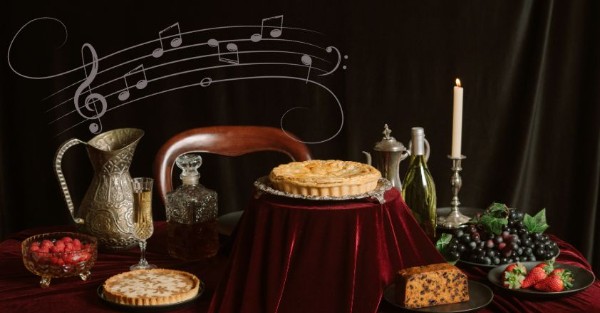
Saint-Saëns’ Wedding Cake, Caprice-Valse, Op. 76 (1885)
Saint-Saëns composed this charming caprice for solo piano and orchestra as a wedding gift, and it truly lives up to its name. With lively waltz rhythms and brilliant piano flourishes, the piece feels like a sweet, festive treat.
Claude Debussy’s La puerta del vino (1910)
Inspired by a postcard from composer Manuel de Falla depicting the “Wine Gate” of the Alhambra in Granada, this evocative prelude simmers with exoticism. Its sultry habanera rhythm and pungent harmonies intoxicate the senses like an intense Spanish red. Though Debussy never visited Spain, he masterfully distilled its flavour into sound.
Yuyama Akira’s Confections: A Piano Sweet (2005)
This playful suite by Japanese composer Yuyama Akira imagines a musical dessert tray. Each miniature captures a treat with rhythmic and harmonic whimsy. No. 8, “Chocolate Bar,” is rich and cheeky, offering pianistic sparkle with a bite of sweetness.
Pyotr Ilyich Tchaikovsky’s The Nutcracker (1892)
The second act of Tchaikovsky’s beloved ballet The Nutcracker transports us to the whimsical “Land of Sweets,” where each dance evokes a different confection. With brilliant orchestration and regional flair, Tchaikovsky creates a musical tasting menu that includes “Chocolate” (Spanish Dance), “Coffee” (Arabian Dance), “Tea” (Chinese Dance), “Candy Canes” (Russian Trepak), and the shimmering “Sugar Plum Fairy.” The result is a fantastical dessert buffet for the ears.
Coffee (Arabic Dance) from The Nutcracker Act II Scene 5:
Engelbert Humperdinck’s Hansel and Gretel (1893)
While known for its fairy-tale sweetness, Hansel and Gretel also vividly depicts hunger and sudden abundance through lively music. In Act I, the children are scolded for neglecting their chores and sent to bed hungry. Then, everything changes: their father enters singing “Rallalala,’ carrying food like sausages, butter, eggs, and flour. This lively scene bursts with joy and energy, emphasising relief and plenty. Humperdinck’s rich orchestration enhances the sensory experience, foreshadowing the enchanted gingerbread house to come.
Nicolas Bernier’s Le Caffé (early 18th century)
Before Bach’s Coffee Cantata, French Baroque composer Nicolas Bernier set the joys of coffee to music in this elegant French solo cantata. In true Baroque style, the piece blends courtly formality with indulgent subject matter. It’s proof that caffeine was fueling artistic inspiration long before espresso bars.
Lee Hoiby’s Bon Appétit! (1989)
Based on a real Julia Child TV episode, this comic monologue opera transforms baking into a bravura performance. The singer channels Child’s energetic persona while making an actual chocolate cake live onstage. With a witty libretto by Mark Shulgasser, it’s a delicious fusion of culinary theater and classical music.
Marc André Hamelin: My Feelings About Chocolate (2014)
In ‘My Feelings About Chocolate,’ Canadian pianist and composer Marc-André Hamelin presents a charming and reflective musical piece that explores the theme of chocolate. This brief composition features whimsical and expressive elements, capturing the diverse sensations associated with enjoying chocolate.
Peter Tiefenbach’s Chansons de mon placard (1993)
Canadian composer Peter Tiefenbach’s *Chansons de mon placard* humorously and theatrically explores everyday kitchen items. The cycle includes four short vocal pieces: Algues de Mer (Seaweed), La Fécule de Maïs (Cornstarch), Épices pour Bifteck (Steak Spices), and A.A.S. (Matches, Garlic, Salt). These pieces turn ordinary pantry staples into characters in a playful culinary story, full of wit and personality. Tiefenbach combines musical talent with theatrical flair, making the cupboard itself a stage for lively performance.
William Bolcom’s Lime Jell-O Marshmallow Cottage Cheese Surprise (1980)
In this satirical song, William Bolcom humorously mocks quirky mid-20th-century women’s club dishes. The cheerful protagonist shares her unique, ‘heaven-sent’ mix of lime gelatin, marshmallows, cottage cheese, pimento, pineapple, mayonnaise, and vanilla wafers. Inspired by his memories of women’s clubs, Bolcom captures their humour with wit. Often performed by Bolcom and mezzo-soprano Joan Morris, the song is a beloved, lighthearted parody of culinary oddities.
Whether it’s silly or sublime, classical music about food has a wonderful way of inviting us to enjoy the delightful connection between sound and taste. It also gently reminds us that music doesn’t always have to be serious. Instead, it can be sweet, quirky, or even deliciously edible! So next time you’re grabbing a snack or pouring a drink, why not treat yourself to a musical pairing from this flavorful playlist?
For more of the best in classical music, sign up for our E-Newsletter





Leonard Bernstein’s song cycle “La Bonne Cuisine”.