’Tis the Season for conductor François-Xavier Roth: in September, he conducted concerts marking World Alzheimer’s Day; in October, his recording of Ligeti with Les Siècles shared the Gramophone Concerto Award; in November, he led the SWR Symphonieorchester in the premiere of composer Philippe Manoury’s violin concerto. Next, François-Xavier Roth is off to Japan with Mozart, Mahler, Janáček, and Manoury, while 2027 promises further engagements with Beethoven. Deeply touched by Roth and SWR’s projects for people living with Alzheimer’s, we invited him to answer a few questions about music and memory, as well as his reflections on composers past and present.
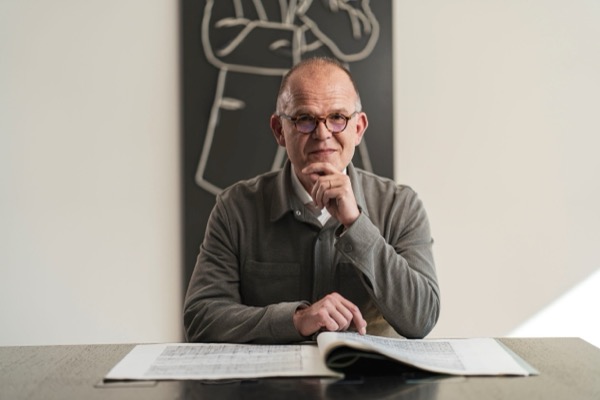
François-Xavier Roth © Wolf-Peter Steinheißer
Music as Medicine
François-Xavier Roth has been bringing music to care homes as part of SWR Symphonieorchester’s commitment to community and participation. This year he conducted several concerts as part of Music Remains! on World Alzheimer’s Day and Germany’s National Week of Dementia.
For Roth, the project carried a deeply personal significance. He recalled not only his grandfather but also the composer Pierre Boulez, both of whom experienced some forms of Alzheimer’s and dementia later in life. Roth had previously shared a moving encounter: “One of the last times I visited Boulez in Baden-Baden, I brought my friend, the flautist Emmanuel Pahud, who played Debussy’s Syrinx for him. I could see how this man, who was completely lost in his own mind, suddenly reconnected to the present through the music.”
For our latest interview, Roth added another moment from the September workshops and concerts. “One lady came to me and said that she didn’t hear the voice of her mother in the past 15 years, and that the mother sang during our concert. This was very moving.” Such encounters have reinforced his belief in music’s capacity to reach people: “It is established today that music can do a great deal for people with these kinds of diseases. That interests me, and I would like to continue to play for these audiences.”
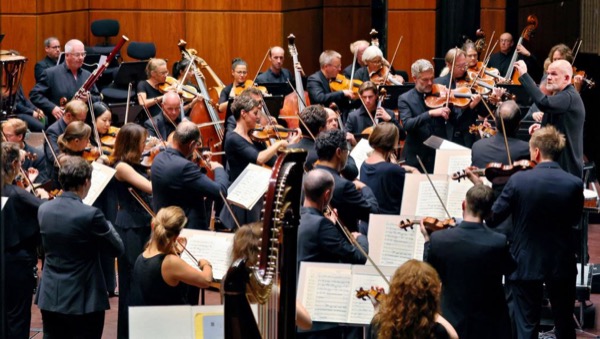
François-Xavier Roth and SWR Symphonieorchester © Markus Proßwitz
Gramophone Concerto Award
Roth’s recording of György Ligeti’s two concerti with Les Siècles received the 2026 Gramophone Concerto Award. Having commemorated Ligeti’s centenary in 2023, Roth has explored the composer’s distinctive musical language in depth. The award also celebrates the unique sound world Roth has developed with Les Siècles since 2003, whose musicians are experienced in performing on period instruments.
For Roth, the recording project remains a cherished experience. “This project is a beautiful memory. We performed a lot of his music across Europe, and we arrived in the best condition for the recording sessions.” He sees Ligeti as a composer whose innovations have become part of the classical repertoire without losing their capacity to surprise. “Ligeti music is a ‘classic’ nowadays and invented so many things which still sound new and fresh today. The ways he treats the harmony, the rhythms or the forms are still an example for the composers today.”
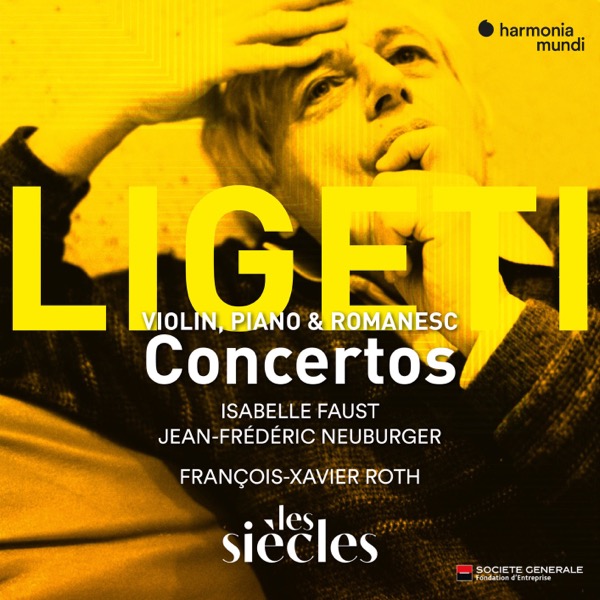
Cover of Ligeti Violin Concerto, Concert Românesc, Piano Concerto
Modernism in Manoury and Janáček
In November 2026, Roth led the SWR Symphonieorchester in a programme pairing Philippe Manoury’s new violin concerto, Oracle, with Richard Strauss’s Ein Heldenleben. Having previously conducted Manoury’s Grammaires du sonore, which is influenced by Pierre Boulez, Karlheinz Stockhausen, and other modernist pioneers, Roth was particularly enthusiastic about introducing Oracle to audiences.
François-Xavier Roth in Manoury’s Grammaires du sonore Documentary
“Manoury has been a great friend for many years and is one of the greatest composers of our time,” he said. Describing the new concerto, Roth highlighted its unusual relationship between soloist, orchestra, and audience: “His new piece Oracle is a marvellous violin concerto which gives the soloist the possibility to engage in dialogue with, or confront, several different groups of musicians, both on stage and throughout the hall.”
For Roth, the pairing with Strauss is more than a contrast between contemporary and late Romantic music. “The music is complex, rich and very accessible, and the concert is the ideal setting for these works to engage in dialogue with one another. When we perform Manoury alongside Strauss, the audience hears the familiar Strauss differently, thanks to the contemporary music. And those who come to hear Ein Heldenleben discover (and this happens very often, in my experience!) that they might love contemporary music!”
François-Xavier Roth conducts Manoury and Strauss at SWR
Roth will also soon bring a programme of Mozart, Janáček, Mahler, and Manoury to Japan. Among the works is Janáček’s Taras Bulba, a rhapsody based on the novel by Nikolai Gogol, alongside the widely loved Sinfonietta. Asked about the challenges of guiding an orchestra through Janáček’s rhythms and dramas, Roth admitted that both works would be new experiences for him as a conductor. “It will be the first time I conduct these 2 works, so I will tell you more after!”
Nevertheless, Roth already has a clear vision on approaching Janáček’s vocabulary. “The main aspect of Janáček’s music is to try to understand his modernism, his experiments and the relationship with the folk music of Mittel Europa. He is a giant, and I can’t wait to conduct this concert in Tokyo and Yokohama!”
Revisiting Beethoven and Bruckner
Looking further ahead to 2027, Roth will turn his attention to Beethoven, including Hans Zender’s 33 Veränderungen über 33 Veränderungen. Rather than simply arranging Beethoven’s Diabelli Variations, Zender approaches the original work through what he calls an “composed interpretation”, a concept that also shaped his treatment of Schubert’s Winterreise.
“I knew Hans very well when I was chief in Freiburg, Baden-Baden. He was an extraordinary musician and composer, and the way he invented this ‘composed interpretation’ with the Winterreise had a big influence on all of us musicians.” Roth added that there is an important distinction between the two: “The principle is the same for the Diabelli, but the text exists no longer here.”
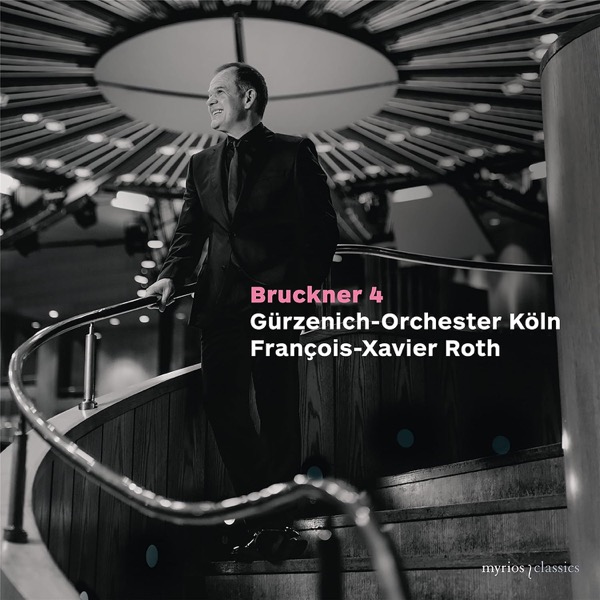
Cover of François-Xavier Roth’s Bruckner Recording
Alongside Beethoven, another composer who has long fascinated Roth is Bruckner. Roth has recorded different editions of the composer’s works. “Bruckner is one of my heroes! He is a ‘modern’ malgré lui as we say in French. He opened the doors for the spectral music. I learned so much by conducting all the different versions of his symphonies. All of them have a charm and I can’t say one is better than the other.”
Roth recently conducted Bruckner’s Eighth Symphony at the 2026 Seiji Ozawa Matsumoto Festival. In a previous interview, Roth described the Eighth as “the most perfect one in any parameters.” As to why he selected the Haas Edition, he explained that Bruckner himself never had the opportunity to hear its first version. “I love the original version, but I think that the Haas version is also maybe more mature and has an element of experience.”
François-Xavier Roth talks about Bruckner
Beyond questions of editions, Roth emphasised the conductor’s responsibility for shaping the architecture of Bruckner’s symphonies. He explained that their dramaturgy requires attention to “the beginning of a section, the climax, the proportions of the structure, and how we support that”. Roth cautioned against making Bruckner sound “bombastic or fat”, stressing the importance of transparency and phrasing.
Finally, when asked earlier what advice he would offer listeners approaching Bruckner, Roth gave a simple but thoughtful answer: “You must let your soul, your hearing, your whole body, take the music as it comes.”
See François-Xavier Roth’s upcoming concerts: https://fxroth.com/calendar/
For more of the best in classical music, sign up for our E-Newsletter