Of all the unusual instruments we’ve looked at, it’s the percussion section that has the most variety. Percussion instruments can be beaten with sticks, whirled through the air, lightly stroked, rubbed, or anything else that’s needed to get the sound out. If the composer thinks up a sound he wants, it’s usually the percussion section that has to figure it out.
Need something that sounds like a whale song or ethereal vibrations in the air? That’s the Waterphone for you! Also called the ocean harp, the instrument has a stainless-steel resonator bowl with a cylindrical neck and is surrounded by bronze rods of different lengths and diameters. The neck can be filled with water, and the rods can be played with a bow or a beater. It’s mainly used in film music for special effects.
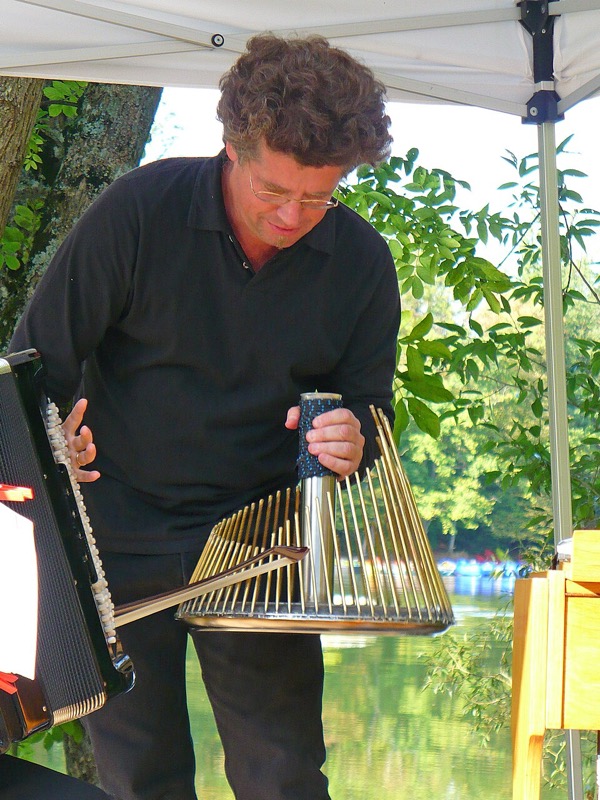
Musician Thomas Bloch playing the waterphone with a bow, 2009 (photo by Fredamas)
Waterphone Demo: Waters-Hubbert
In Anthony DiLorenzo’s score for the ballet Dracula, the beginning of Act I calls for a waterphone, a daxophone (see below), and a theremin.
Anthony DiLorenzo: Dracula: Act I: The Castle (Steven Jackson, clarinet; Rob Schwimmer, theremin, daxophone, waterphone; Ryun Louie, percussion; Proteus 7)
The daxophone was invented by Hans Reichel in the 1980s. It is made up of a wooden ‘tongue’ clamped to a hollowed-out wooden block that contains a microphone. As the wooden tongue is manipulated (bowed, plucked, whatever) the handheld ‘dax’ is used to change the pitch.
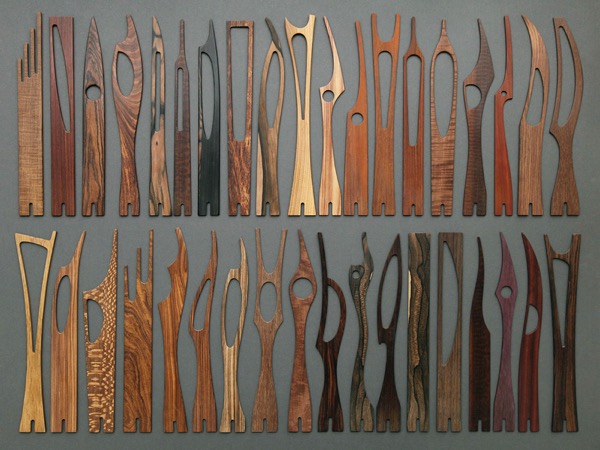
Daxophone ‘tongues’ (photo by Hans Reichel)
Daxophone Demonstration
And, lest you think this is just for special effects, the inventor, Hans Reichel, wrote an operetta, Shanghaied on Tor Road, described as The World’s 1st Operetta Performed on Nothing but the Daxophone.
A much older bowed instrument is the musical saw. This played seated, with the handle between the knees and a handle added to the small end. The instrument is bowed and the pitch is regulated by bending the saw into an S-curve. The flat spot between the two curves is where you bow.
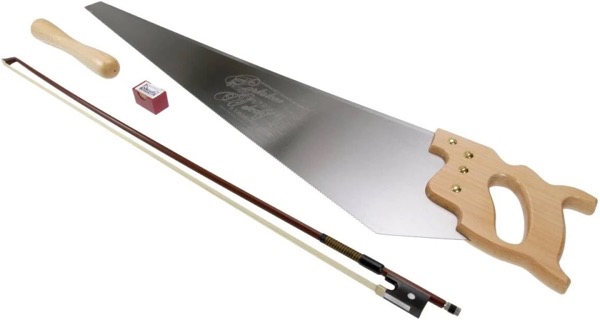
Musical Saw kit
How to Play Musical Saw
The musical saw is used in folk music and has a rare place on the concert stage as well.
A musical saw is called for in the second movement of Aram Khachaturian’s Piano Concerto in D Flat major (listen at 02:39).
Aram Khachaturian: Piano Concerto in D-Flat Major, Op. 38: II. Andante con anima (Iyad Sughayer, piano; Su-a Lee, musical saw; BBC National Orchestra of Wales; Andrew Litton, cond.)
The modern version of the musical saw is the flexatone, where two balls on springs hit a metal tongue that you can manipulate with your thumb to change the pitch.
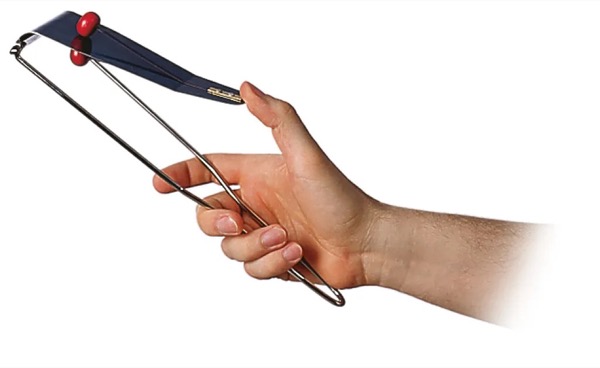
Flexatone
Have You Ever Heard of a Flexatone?
The vibraslap has a ball at one end and a box with metal teeth in it at the other end. You strike the ball, and the motion makes the teeth vibrate. It’s imitating a much earlier Latin American instrument called a quijada, which was made from the jawbone of a large animal (donkey, horse, or mule) that would rattle when it was hit.
The Vibraslap was invented by Martin Cohen in 1967 after percussionists were complaining that their natural quijadas were breaking all the time. It’s used in a lot of jazz and in rock as well (it’s the first instrument heard in Black Sabbath’s Crazy Train, for example).
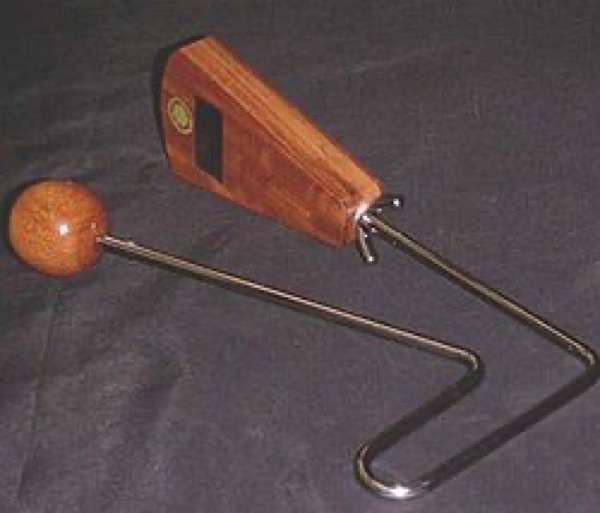
Vibraslap
Wild Sounds!
For George Gershwin’s An American in Paris, he called for 4 different taxi horns, and the story goes that he went to the taxi supply shop in Paris to try them out for pitches. For the work’s premiere with the Cincinnati Orchestra, Gershwin brought the horns with him, mounted on a board. Listen starting at 00:30.
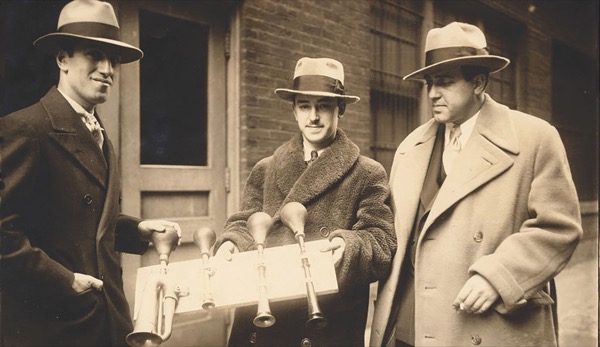
George Gershwin (from left) with percussionist James Rosenberg and tenor Richard Crooks and the original taxi horns used in the Cincinnati Symphony Orchestra’s performances of An American in Paris in 1929.
George Gershwin: An American in Paris (Seattle Symphony Orchestra; Gerard Schwarz, cond.)
The Guiro starts out as an open-ended dried gourd with parallel notches cut on one side. It’s played by rubbing the notches with a stick or hitting the body of the instrument.
It’s used in Cuban and other Latin American music but also in works such as the Missa Luba and the Cuban Dances by Jorge Aragón and others.
Guiro Solo / Demo – Advanced Techniques – “LP Super Guiro” (Latin Percussion)
Jorge Aragón, Wilma Alba Cal, Pepe Gavilondo, Yuniet Lombida Prieto, Yasel Muñoz, Ernesto Oliva: Cuban Dances: No. 2. Danzón de la medianoche (Sarah Willis, horn; Enrique Lazaga, guiro; Havana Lyceum Orchestra; José Antonio Méndez Padrón, cond.)
Natural effects, such as thunder and wind, can be produced in a couple of different ways. One is the thunder-tube.
Thunder Tube
An earlier one is the Thunder Sheet, or thunder machine, a large sheet of metal that can be shaken or struck with a mallet. It has been used in many classical works that require sound effects, including Mozart’s Die Zauberflöte, in Wagner’s Ring, and in Paderewski’s Polonia Symphony.
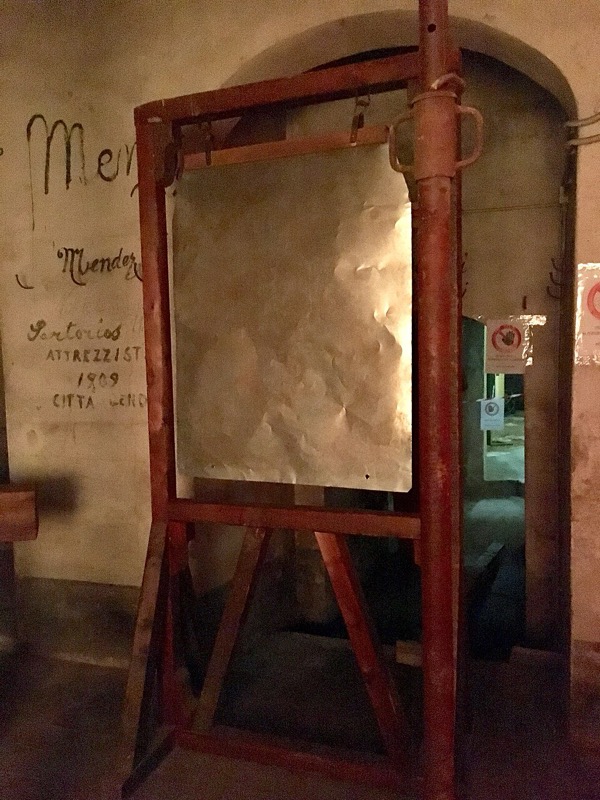
Thunder Sheet at the Teatro della Pergola (photo by Manuelarosi)
Richard Strauss: Eine Alpensinfonie (An Alpine Symphony), Op. 64, TrV 233: Gewitter und Sturm, Abstieg (Thunder and Storm, Descent) (Weimar Staatskapelle; Antoni Wit, cond.)
If you want to bring up the sound of the wind, then slats rubbing against a rough cloth is amazingly effective. This is used in works such as Vaughan Williams’ Sinfonia Antartica and in Strauss’ An Alpine Symphony, which calls for not only a wind machine but a thunder machine.
Wind Machine – The Evelyn Glennie Collection
The Wind Machine – Strauss: An Alpine Symphony
Other composers who used the wind machine in their music include Rameau in Les Boréades of 1763 up to 20th-century composers such as Ravel, Varèse, and Schoenberg.
In the opening of H.K. Gruber’s Frankenstein!!, you can hear all kinds of unusual instruments, including popping paper bags (00:44 in the video) and toy instruments (toy trumpet and horn). Note the toy piano next to the full-sized one!
HK Gruber: Frankenstein!!: Ia. Dedication (HK Gruber, vocals; BBC Philharmonic Orchestra; HK Gruber, cond.)
In Monster, the movement ends with sound tubes being whirled above the player’s head (see video at 09:20). You can’t see him, but the pianist is off to the left side, playing a bird whistle.
HK Gruber: Frankenstein!!: IIc. Monster (HK Gruber, vocals; BBC Philharmonic Orchestra; HK Gruber, cond.)
Frankenstein!! by HK Gruber pt 1
Although you can see these instruments being played by the orchestra, they’re really functioning as part of the percussion section – in this performance everyone has double (if not triple) duty.
Composers imagine the sounds they want and if it’s anything unusual, it’s usually up to the percussion section to play the sound. Many of these instruments were developed experimentally, based on older instruments that might be fragile (Donkey’s Jaw) or that aren’t as common anymore (the musical saw).
For more of the best in classical music, sign up for our E-Newsletter