Georg Solti, born in Budapest on 21 October 1912, became music director of the Chicago Symphony Orchestra in 1969. He dedicated most of the next 22 years to this relationship, taking the orchestra on tour to huge critical acclaim and recording virtually the entire Austro-German orchestral repertory.
As Arthur Jacobs writes, “his podium personality, exuberant and forceful, was clearly imprinted upon his music-making as he snarled and ferociously stabbed his baton. Critics found it both glorious and vulgar but never dull, and he always got what he wanted.” (Jacobs, Grove Music Online, 2001)
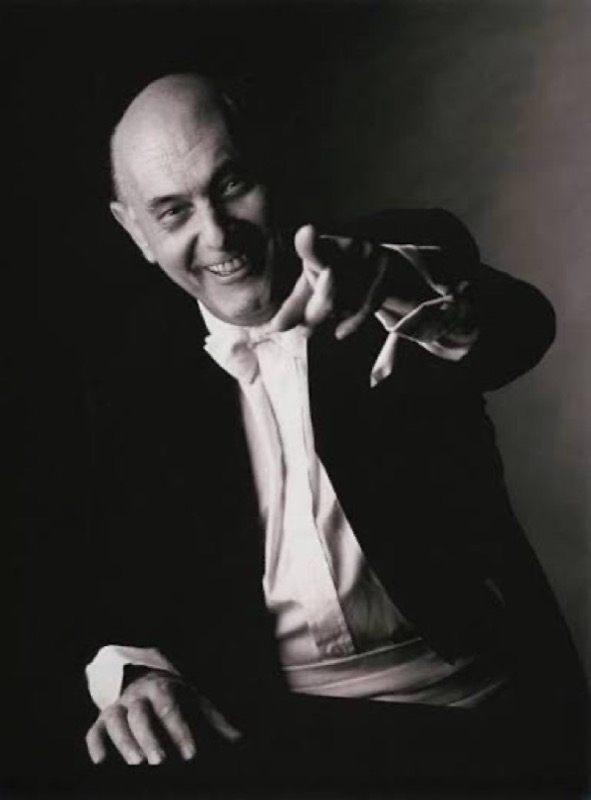
Georg Solti
Solti conducted and recorded the symphonic works of Gustav Mahler extensively between the 1950s and the 1980s. He then took a break to develop a fresh viewpoint before returning to the Fifth Symphony. To celebrate his birthday, let’s take a closer look at Solti’s relationship with Mahler.
Georg Solti conducts Mahler: Symphony No. 2 “Resurrection”
Mahler Across Orchestras
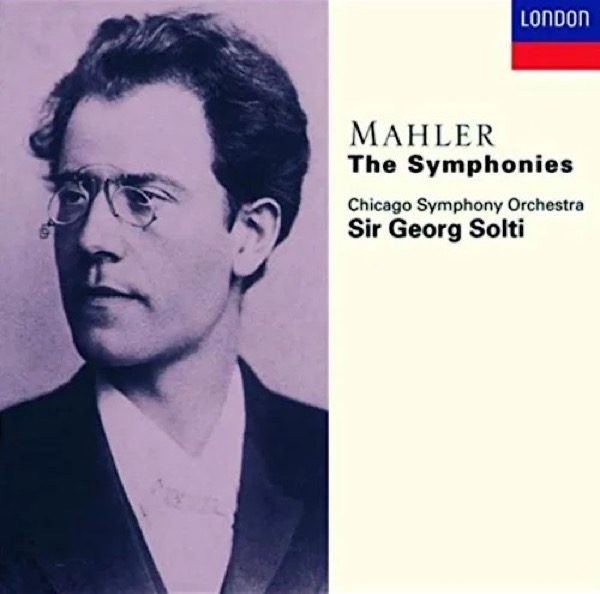
Chicago Symphony Orchestra, Georg Solti, Mahler
Jeremy Lee has nicely summarised the history of Solti’s Mahler recordings, beginning with those made between 1964 and 1971. Solti recorded a Mahler cycle for Decca with the London Symphony Orchestra in Symphonies 1, 2, 3 and 9, the Royal Concertgebouw Orchestra in Symphony No. 4, and with the Chicago Symphony Orchestra in Symphonies Nos. 5–8.
Around 1980, Solti used digital technology to remake Symphonies Nos. 1–4 and 9 with the CSO. Afterwards, he recorded two Das Lied von der Erde, first with the CSO and then with the RCO. He also remade the Fifth Symphony with the CSO, and again with the Tonhalle Zurich Orchestra in the last year of his life. (Lee, Top Ear, 2013)
Solti described Mahler as a great conductor and composer, whose dynamic instructions in his scores are more precise than those of any nineteenth-century symphonic composer. Solti says these instructions must be followed to the letter, especially the written tempo indications, warning against rushing or dragging.
Gustav Mahler: Symphony No. 5 in C-Sharp Minor: IV. Adagietto (Chicago Symphony Orchestra; Georg Solti, cond.)
From Innocence to Grandeur
In his memoirs, Solti provides a rundown of Mahler’s music, calling the First Symphony nearly programme music and Wagnerian. Solti was particularly fond of the first movement, with its childlike, wide-eyed, and enchanting character, and its strong hints of folksong and birdsong.
Solti considers the Second Symphony reminiscent of Beethoven, direct and dramatic, and not as tortured as some of its successors. For the conductor, the offstage band in the finale is hard to coordinate, and the unaccompanied choral singing can be dangerous.
“The structure of the Second is heavier than that of the First, but the Third is even more massive. The Fourth is lighter, shorter, and closer in nature to the First. Then begins the big crescendo in Mahler’s work.”
“Five, Six, Seven, Eight, each more grandiose than its predecessor. What I especially like about the first movement of the Sixth is that it begins with an introduction of only five bars, and even those five bars contain essential thematic material.” (Solti, Memoirs, 1997)
Gustav Mahler: Symphony No. 6 in A Minor, “Tragic”: I. Allegro energico, ma non troppo. Heftig, aber markig (Chicago Symphony Orchestra; Georg Solti, cond.)
From Nightmare to Heartbreak
Solti clearly didn’t like the Seventh, calling it a “strange piece of music.” The opening reminded him of a nightmare composed by a madman. By contrast, Solti considers the Eighth Mahler’s last great nineteenth-century work. It is a vast opera whose visual aspects remain in the imagination.
Tonality virtually disappears in the Ninth, yet it is an amazing piece because, structurally speaking, it returns to the relative simplicity of the earlier symphonies. However, it is exceptionally difficult and requires a virtuoso orchestra. “Wonderful though Das Lied is, the Ninth seems even more consistently remarkable and remains for me Mahler’s greatest work.” (Solti, Memoirs, 1997)
Solti did conduct the opening movement of the Tenth, and he considered the melodic invention heartbreakingly beautiful. Solti heard Mahler’s illness and Alma’s affair with Walter Gropius in the first violin’s endless cry. He did not like Deryck Cooke’s reconstruction of this symphony, as it apparently lacked the contrapuntal element.
Gustav Mahler: Symphony No. 7 in E Minor: I. Langsam – Allegro con fuoco (Chicago Symphony Orchestra; Georg Solti, cond.)
Less Becomes More
Solti was not an unqualified champion of Mahler, and he did reach a point in his career when he felt he had to turn away, for a while, from these huge symphonic pronouncements and return to the miraculous world of Mozart.
Solti clearly understood that Mahler had become an idol and cult figure, and that his appeal to contemporary audiences derived from the fact that the music is charged with anxiety, love, suffering, fear, and chaos, states that characterise our age.
He also understood why composers, after listening to Mahler’s symphonies and other massive orchestral works, opted for smaller structures and ensembles. This trend continued through to the Minimalists of our time.
Solti preferred the music of early “minimalists” such as Haydn and Mozart, whose music is simple but full. “Think of what Haydn achieves in the first few pages of The Creation. He describes the creation of the world out of chaos and pain, and when he arrives at the final forte C major chord of the phrase, it feels louder and mightier than all the massive chords Wagner or Bruckner or Mahler ever wrote.” (Solti, Memoirs, 1997)
Gustav Mahler: Symphony No. 8, Part I, Veni, creator spiritus: Veni, creator spiritus – (Heather Harper, soprano; Lucia Popp, soprano; Arleen Augér, soprano; Yvonne Minton, mezzo-soprano; Helen Watts, alto; René Kollo, tenor; John Shirley-Quirk, bass-baritone; Martti Talvela, bass; Vienna Boys Choir; Wiener Singverein; Vienna State Opera Chorus; Chicago Symphony Orchestra; Georg Solti, cond.)
Gustav Mahler: Symphony No. 8, Part I, Veni, creator spiritus: Imple superna gratia – (Heather Harper, soprano; Lucia Popp, soprano; Arleen Augér, soprano; Yvonne Minton, mezzo-soprano; Helen Watts, alto; René Kollo, tenor; John Shirley-Quirk, bass-baritone; Martti Talvela, bass; Vienna Boys Choir; Wiener Singverein; Vienna State Opera Chorus; Chicago Symphony Orchestra; Georg Solti, cond.)
Gustav Mahler: Symphony No. 8, Part I, Veni, creator spiritus: Infirma nostri corporis – (Heather Harper, soprano; Lucia Popp, soprano; Arleen Augér, soprano; Yvonne Minton, mezzo-soprano; Helen Watts, alto; René Kollo, tenor; John Shirley-Quirk, bass-baritone; Martti Talvela, bass; Vienna Boys Choir; Wiener Singverein; Vienna State Opera Chorus; Chicago Symphony Orchestra; Georg Solti, cond.)
Gustav Mahler: Symphony No. 8, Part I, Veni, creator spiritus: Accende lumen sensibus – (Heather Harper, soprano; Lucia Popp, soprano; Arleen Augér, soprano; Yvonne Minton, mezzo-soprano; Helen Watts, alto; René Kollo, tenor; John Shirley-Quirk, bass-baritone; Martti Talvela, bass; Vienna Boys Choir; Wiener Singverein; Vienna State Opera Chorus; Chicago Symphony Orchestra; Georg Solti, cond.)
Gustav Mahler: Symphony No. 8, Part I, Veni, creator spiritus: Da gaudiorum praemia (Heather Harper, soprano; Lucia Popp, soprano; Arleen Augér, soprano; Yvonne Minton, mezzo-soprano; Helen Watts, alto; René Kollo, tenor; John Shirley-Quirk, bass-baritone; Martti Talvela, bass; Vienna Boys Choir; Wiener Singverein; Vienna State Opera Chorus; Chicago Symphony Orchestra; Georg Solti, cond.)
Gustav Mahler: Symphony No. 8, Part I, Veni, creator spiritus: Gloria sit Patri Domino (Heather Harper, soprano; Lucia Popp, soprano; Arleen Augér, soprano; Yvonne Minton, mezzo-soprano; Helen Watts, alto; René Kollo, tenor; John Shirley-Quirk, bass-baritone; Martti Talvela, bass; Vienna Boys Choir; Wiener Singverein; Vienna State Opera Chorus; Chicago Symphony Orchestra; Georg Solti, cond.)
Between Exhilaration and Excess
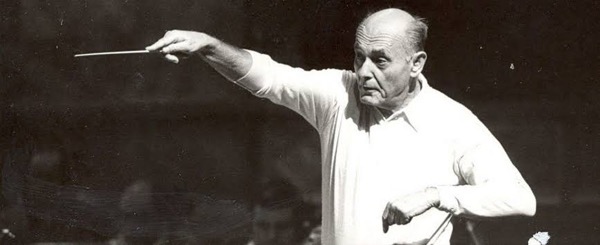
Georg Solti
As a conductor of Gustav Mahler’s music, Georg Solti’s approach is thrilling and muscular, with blazing brass and incisive articulation taking centre stage. Particularly in his CSO recordings, we experience the sheer impact of the orchestra’s phenomenal virtuosity. Without ever sacrificing clarity, his interpretations always carry a sense of momentum.
Critical response was not uniformly enthusiastic, however, as his interpretations have also been described as rash and insensitive at times. The Chicago recording of the Sixth was called brusque and unrelenting, and in the Seventh Solti was charged with a one-dimensional approach.
Georg Solti’s relationship with Mahler was as complex as the music itself. While he admired Mahler’s extraordinary imagination, he was wary of turning Mahler into an unqualified object of veneration.
We sense this tension in his own interpretations, where restless energy and exhilaration could overwhelm everything else. Solti was fascinated by Mahler throughout his life, but he also understood the need to step away from the emotional extremes and monumental gestures.
For more of the best in classical music, sign up for our E-Newsletter
Gustav Mahler: Das Lied von der Erde (Song of the Earth): VI. Der Abschied (The Farewell) (Yvonne Minton, mezzo-soprano; Chicago Symphony Orchestra; Georg Solti, cond.)