The Quatuor Hermès (Omer Bouchez, violin 1; Elise Liu, violin 2; Lou Yung-Hsin Chang, viola; and Yan Levionnois, cello) have brought together three musical emblems of Vienna on their new album Echoes of Vienna. Wolfgang Amadeus Mozart (1756–1791), Anton Webern (1883–1945), and Erich Wolfgang Korngold (1897–1957). They view Korngold as the source of these echoes, signalling through his 1933 String Quartet the end of the brilliant ‘music school of Vienna’ created by Mozart and which Webern had ushered ‘into modernity’. Through his farewell, Korngold, who was to leave the city in 1934 for Hollywood, acknowledge the twilight of the once-great city of music.
In choosing their works for this album, the Quartet looked at both Beethoven and Haydn before settling on Mozart. As the starting cornerstone, Mozart’s 1783 quartet (Quartet No. 15 in D minor) opens the discussion. The Quartet sees Webern and Korngold as further embodiments of the Viennese soul.
Wolfgang Amadeus Mozart: String Quartet No. 15 in D Minor, K. 421 – I. Allegro moderato
The invisible body in the middle of these works is Romanticism, and by jumping from Mozart’s Classical quartet, which they view as ‘pre-Romantic’, to Webern’s and Korngold’s definitive post-Romantic works, we’re asked to imagine what lies between them. Mozart’s dramatic quartet and its use of D minor as its key only emphasises the work’s ‘post-Classical’ position in this context.
Webern’s Langsamer Satz, written in 1905, transcends Romanticism on the edge of atonality. Webern sets a love story in a man’s walk with his beloved, but at the same time finds traditional atonality unable to fully convey the emotions he wants to express. In the same idea of intimacy and anxiety that can be found in Mozart’s Quartet No. 15, said to have been written while he awaited the birth of his first child, Webern carries us with a sense of emotional restraint.
The album ends with Erich Korngold’s String Quartet No. 2. The precocious Korngold was often compared to the equally precocious Mozart, and one of the strengths of his music from the beginning was its ability to conjure up stories and images. The Quartet first met Korngold through his Piano Quintet, and they found the same sense of farewell in this String Quartet. They are protagonists in an epic tale, and the music seems to have cinematic qualities, as will so much of his future Hollywood material.
The recording is an imaginative and creative look at the string quartet as it moves from tradition to the future. Emotions give way to emotional stories that lead to cinematic ones.
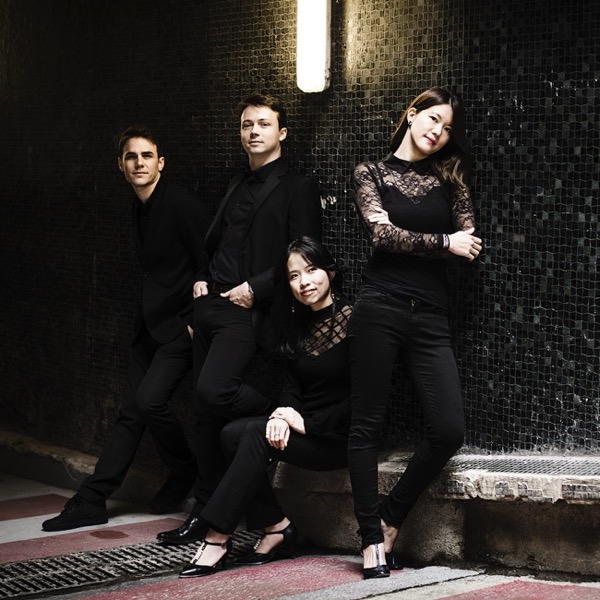
Quatuor Hermès (photo by Lyodoh Kaneko)
They play with skill and authority, and their extensive work with late Romantic and Early Modern quartets and quintets gives them a unique modern viewpoint. They note that this recording is their first to include Mozart.
This album joins an extensive list on La Dolce Volta by the Quartet, including Schumann’s Three Quartets, Op. 41 (LDV 17), String quartets by Ravel, Dutilleux, and Debussy (LDV 33), Brahms’ Piano Quintet in F minor, Op. 34, with Geoffroy Couteau (LDV 61), and his Piano Quartets nos. 1–3 (LDV 62.3), and Schubert’s Rosamunde and Der Tod und das Mädchen (LDV 85).
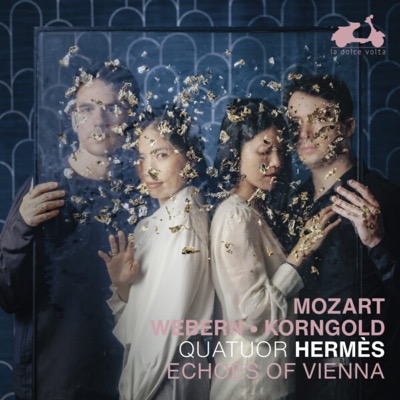
Echoes of Vienna: Mozart, Webern, Korngold
Quatuor Hermès
La Dolce Volta LDV 134
Official Website
For more of the best in classical music, sign up for our E-Newsletter