The Concertgebouw in Amsterdam, located on the southwest side of the Museumplein, has a certain gravity and looms large in my professional career. Not only is the hall considered one of the best in Europe, if not the world, but it was also there that I played my last orchestral concert after 34 years—32 as associate principal cello of the Minnesota Orchestra and two in the same position with the Indianapolis Symphony. On that day we performed Beethoven’s Symphony No. 3, the Eroica. How fitting, the unforeseen denouement of my musical life.
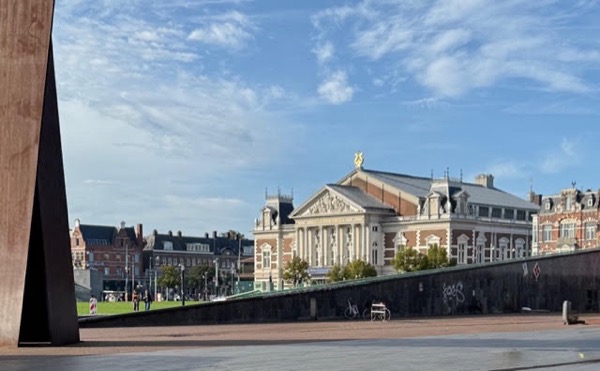
The Concertgebouw on the Museumplein
Some of you may know that I’d suffered a noise-induced ear injury called hyperacusis, which led to my having to leave my profession. Below is the story.
https://www.theatlantic.com/health/archive/2015/10/a-musician-afraid-of-sound/411367/
But the Concertgebouw was also where, in 2013, I heard the Berlin Philharmonic play the Concerto for Orchestra by Béla Bartók—the first time I attempted to hear a concert after a two-year imposed exile from sound. Hearing one of my favourite works performed by one of the greatest orchestras was revelatory and emotional.
Imagine entering that hallowed space again this year, in August 2026, to hear The Royal Danish Orchestra with the esteemed violinist and conductor Nikolaj Szeps-Znaider as the soloist, led by the chief conductor of the Royal Danish Orchestra, Marie Jacquot.
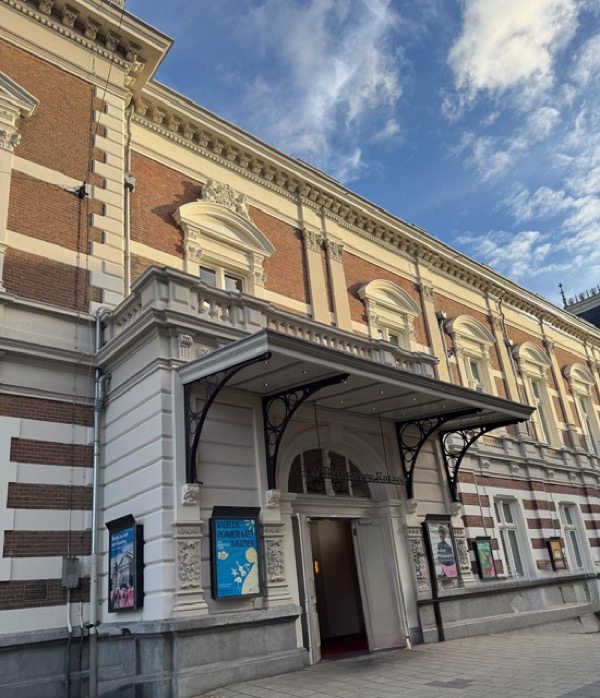
The Concertgebouw entrance
The program was not to be missed: The Brahms Violin Concerto in D, Op. 77 and Sergei Prokofiev’s Romeo and Juliet from the Suites 1, 2, and 3, preceded by the prolific Danish composer Hans Abrahamsen’s Three Pieces for Orchestra.
The red double doors beckoned.
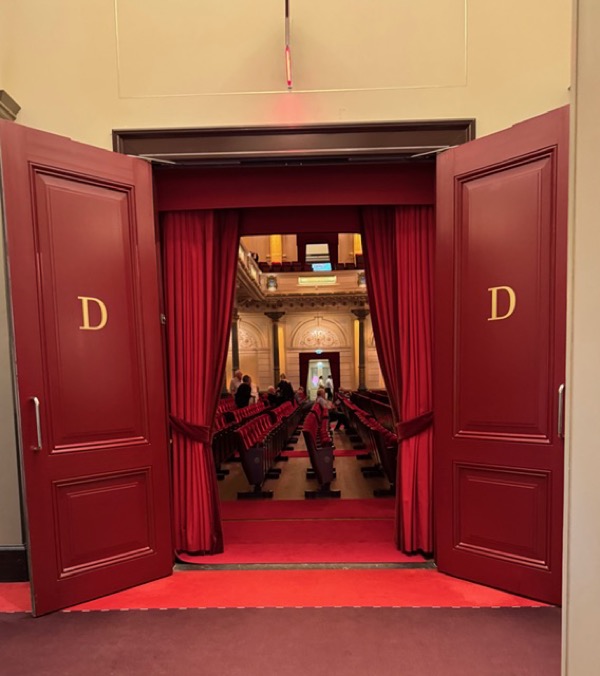
The red doors at the Concertgebouw
When I entered the hall, the majesty of the red velvet seating and drapery, the chandeliers, the names of composers engraved on the balconies, and the memories took my breath away.
The audience hushed in anticipation as the lights lowered. Once the orchestra had tuned, the doors opened above the orchestra, and the young conductor descended the red-carpeted, steep 26 steps to the stage, bounding down fearlessly.
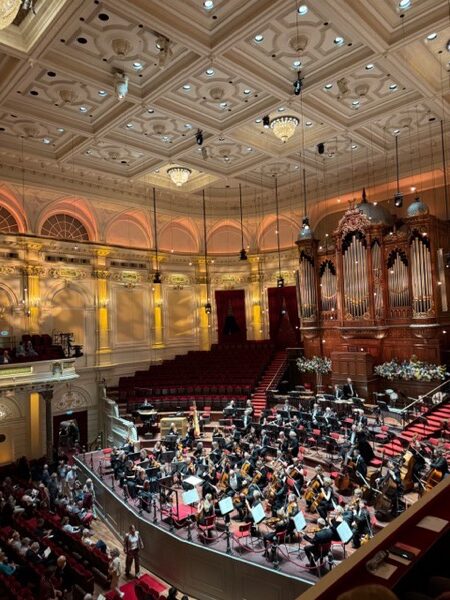
Concert at the Concertgebouw
Architecturally, this style of hall, where the artists’ rooms are located on an upper floor behind the organ, gives us this dramatic top-down entry. But it isn’t the only hall in this design. The Berlin Philharmonie is designed in a vineyard style, with the stage in the centre and seating rising around it. The dressing rooms sit high above stage level, and conductors and soloists enter from a doorway behind the orchestra, descending a long flight of stairs to the podium. Both Birmingham Symphony Hall and Usher Hall in Edinburgh, Scotland also have a top-down configuration.
https://interlude.hk/the-great-concert-halls-my-visceral-reactions-to-them/
Abrahamsen’s Three Pieces for Orchestra opened the program. Commissioned by the Berlin Philharmonic and dedicated to Sir Simon Rattle on his farewell tour as chief conductor of the orchestra in 2018, it reworks three of his Ten Studies for piano solo, numbers 5–7. You can hear the piano settings below.
Hans Abrahamsen: 10 Studies for Piano: No. 5. Boogie-Woogie (Anne Marie Abildskov, piano)
Hans Abrahamsen: 10 Studies for Piano: No. 6. For the Children (Anne Marie Abildskov, piano)
Hans Abrahamsen: 10 Studies for Piano: No. 7. Blues (Anne Marie Abildskov, piano)
The first piece, ‘With a restless and painful expression,’ has an angular swing and fast-paced rhythms of the boogie-woogie style, a genre of blues music of the 1920s. The second piece, ‘Calmly moving’ from the movement originally entitled For the Children, sits in the higher frequencies, with glockenspiel, celeste, and piccolo that create a childlike ambience. The third movement, ‘Heavy’, from the original piano piece Blues, is a stark contrast, featuring a lower tessitura and a slow, languorous feel.
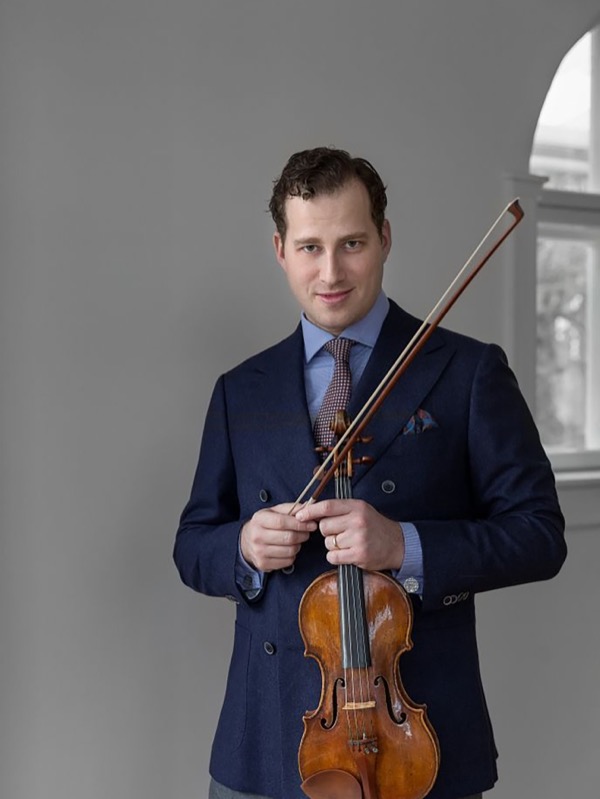
Nikolaj Szeps-Znaider (Photo by Lars Gundersen)
Nikolaj Szeps-Znaider, the soloist in the Brahms Concerto, took the stage following the Abrahamsen. While assuming the role of Music Director of Orchestre National de Lyon in September 2020 and regularly appearing as guest conductor of the world’s leading orchestras, such as the Chicago Symphony, Cleveland Orchestra, Orchestre Symphonique de Montréal, Bamberg Symphony, and the Royal Stockholm Philharmonic Orchestra, he has maintained a career of performing—doing both with aplomb. A towering figure, his playing was powerful, at times aggressive, and he played an intense cadenza, one I’d never heard, full of challenging double stops, chords, and dazzling pyro-techniques.
Szeps-Znaider received a huge ovation from both the audience and the musicians. Before playing an encore, he told us about his long association with the Royal Danish Orchestra, adding that he’d played chamber music with some of the members when he was but a child in short pants!
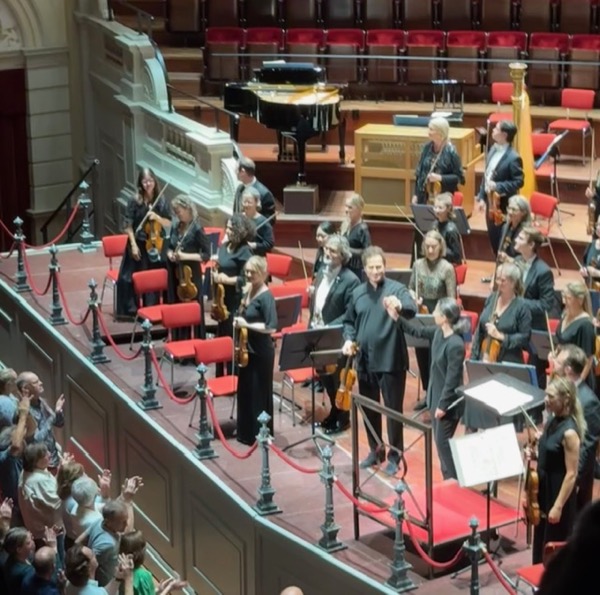
Soloist and conductor at the Concertgebouw
Listen to this short interview and the first movement of a performance of the Brahms Concerto here with Maestro Valery Gergiev and the Vienna Philharmonic.
Meet Nikolaj Szeps-Znaider, the new Music Director of Orchestre national de Lyon
Johannes Brahms: Violin Concerto in D Major, Op. 77: I. Allegro non troppo (Nikolaj Znaider, violin; Vienna Philharmonic Orchestra; Valery Gergiev, cond.)
After intermission, we were treated to the stunning music of Romeo and Juliet, eleven movements selected from the three suites. If you’ve never heard this music, you’re in for a treat. Originally a ballet based on Shakespeare’s play, it was revised after the Bolshoi Ballet initially and astonishingly rejected the score, saying it was “impossible to dance to.” Prokofiev created three orchestral suites from the ballet, which proved them wrong, and is much beloved by musicians and audiences alike.
The music adheres to the emotion of the story. One experiences everything from the threat of the Montagues and Capulets, the menace of the Dance of the Knights, the delightful fleeting character of The Young Juliet, the tension in the Masks movement as Romeo and Mercutio enter the ball of their enemies, the poignant, lush music of the balcony scene, the breathless, furious music of the Death of Tybalt, and finally, the dreadful, devastating revelation and Death of Juliet.
The Montagues and Capulets begin with the brass in an increasingly foreboding crescendo. When they suddenly cut off, we hear hushed strings. Prokofiev achieves this ingenious effect by having the strings enter at the same time as the brass fortissimo, so that when the brass abruptly stop, the soft, held notes of the strings are immediate. The heavy-footed brass then enter, and we imagine the pompous, arrogant strides of the warring factions.
Sergei Prokofiev: Romeo and Juliet Suite No. 2, Op. 64ter: I. Montagues and Capulets (Philadelphia Orchestra; Riccardo Muti, cond.)
The balcony scene is written with muted high strings that create a poignant tenderness. Prokofiev develops the music into a lush, romantic, and more extroverted love scene.
Sergei Prokofiev: Romeo and Juliet Suite No. 1, Op. 64bis: VI. Romeo and Juliet (Philadelphia Orchestra; Riccardo Muti, cond.)
The Death of Tybalt is taken at a breathtaking tempo, with the strings playing a flurry of notes. But soon fifteen blows of the percussion take over, and the finality of the music that follows, blaring and ominous, is gut-wrenching.
Sergei Prokofiev: Romeo and Juliet Suite No. 1, Op. 64bis: VII. Death of Tybalt (Philadelphia Orchestra; Riccardo Muti, cond.)
In The Young Juliet, Prokofiev captures the main character’s fleeting movements as she scurries around with excitement and her heart races. When the music is interrupted by distant flutes and then a solo cello, it may illustrate Juliet’s doubt and hesitation.
Sergei Prokofiev: Romeo and Juliet Suite No. 2, Op. 64ter: II. The Young Juliet (Philadelphia Orchestra; Riccardo Muti, cond.)
The Masks movement captures a facetious, mocking, mischievous mood.
Sergei Prokofiev: Romeo and Juliet Suite No. 1, Op. 64bis: V. Masks (Philadelphia Orchestra; Riccardo Muti, cond.)
With remarkable pathos, Prokofiev captures the scene of Juliet’s death. The melody is gorgeous and at the same time elicits the pain and remorse of the families who now recognise how their behaviour contributed to the tragedy that unfolded. The movement ends with a contrabassoon on very low notes that gently fade out.
Sergei Prokofiev: Romeo and Juliet Suite No. 3, Op. 101: VI. The Death of Juliet (Bergen Philharmonic Orchestra; Andrew Litton, cond.)
I’ve performed this piece many times over. Still, I especially remember playing these movements in Lahti, Finland, on the occasion of our former Music Director Osmo Vänskä’s return to his native country, the first time with his new orchestra, the Minnesota Orchestra. I can tell you there wasn’t a dry eye in the house.
It’s difficult to find words to describe this music—vivid, brilliant, flamboyant, radiant, touching, arresting, evocative. The Royal Danish Orchestra’s performance, enriched by the luminous sound of the Concertgebouw, was this and more, and it was a wonderful return visit for me.
For more of the best in classical music, sign up for our E-Newsletter