The French composer Félicien David died at Saint-Germain-en-Laye on 29 August 1876 at the age of 66. He was well-known and respected during his lifetime. At the premiere of Le Désert at the Paris Conservatoire on 8 December 1844, Hector Berlioz proclaimed the arrival of a great composer.
David was closely connected with the Saint-Simonian movement, and his predilection for Middle Eastern subjects strongly influenced later generations of French composers. David was recognised as an Officier de la Légion d’honneur in 1862, and he succeeded Berlioz as a member of the Académie des Beaux-Arts in 1869.
Following his death, however, his reputation declined sharply. While selected works have periodically been revived, the majority of his output has disappeared from the repertoire. As we mark the 150th anniversary of David’s death, we take the opportunity to explore the life and works of one of the pioneers of Western musical Orientalism.
Félicien David: Les Minarets, “Adieux à l’Orient”
From Cathedral Choir to Paris
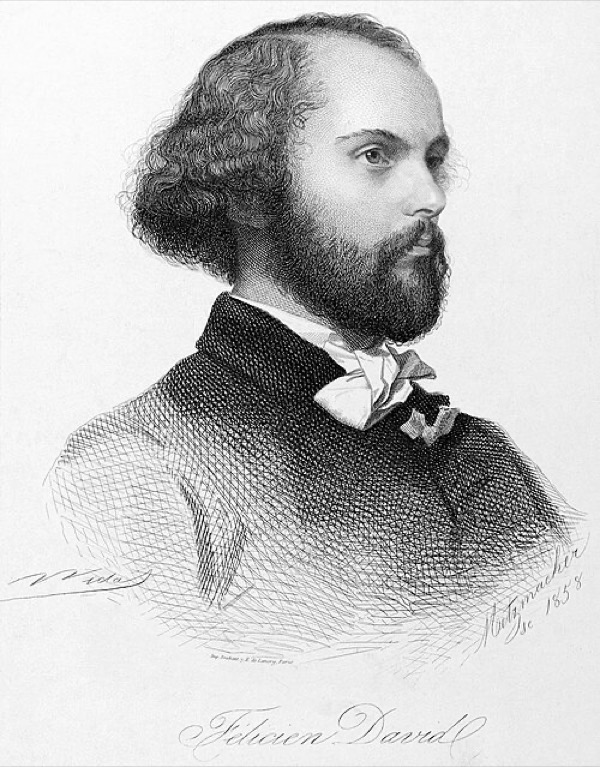
Félicien David
Félicien David was born on 13 April 1810 in Cadenet, a village in the Vaucluse department in the Provence-Alpes-Côte d’Azur region in southeastern France. His father was an amateur violinist, but he lost both parents when he was six.
Since he had a good voice, he was accepted to study as a choirboy at the Cathedral of Saint-Sauveur in Aix-en-Provence, and he soon began composing motets, hymns, and a string quartet. As such, he secured a scholarship at the Jesuit college of St Louis at Aix, and he discovered the music of Haydn, Mozart, and Cherubini.
After three years of study, David worked as an assistant conductor and as a clerk to a lawyer. Still, he continued to write several church works and other compositions fashionable at the time. Yet, he probably realised that he needed to study in Paris to complete his musical education.
Félicien David: String Quartet No. 2 in D Minor (Quatuor Mosaïques)
From Disappointment to Discovery
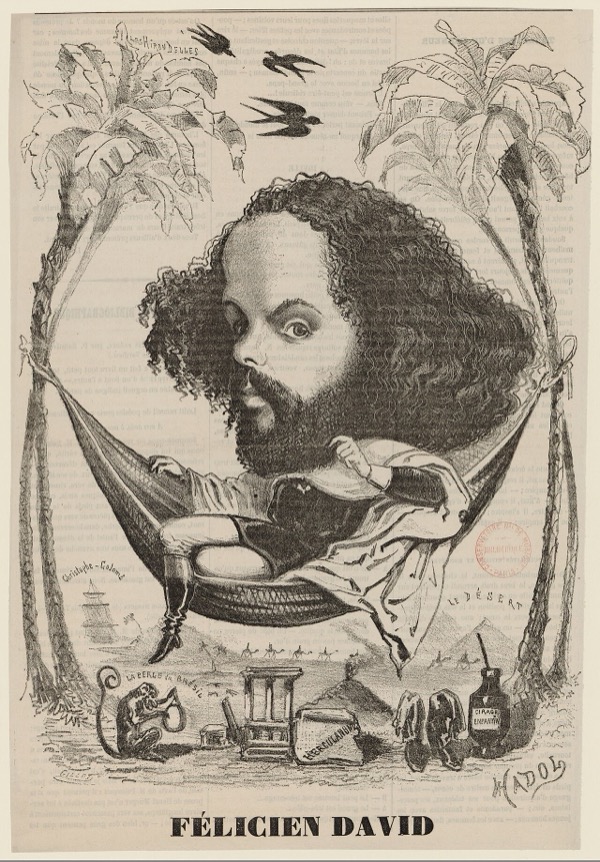
Félicien David
For a place in the Paris Conservatoire, David was interviewed by Cherubini, who, according to later biographical accounts, apparently reduced him to tears of inferiority. Nevertheless, he was admitted to Millaut’s counterpoint class, and he attended counterpoint and fugue with Fétis, and organ with Benoist.
David also studied privately with Henri Reber and made a meagre living by giving lessons. Unable to gain a prize at the Conservatoire, and hampered by abject poverty, he decided to give his life a new direction by joining the Saint-Simonians.
Félicien David: Herculanum, “Je crois au Dieu”
The Dream of a New Society
The Saint-Simonian movement originated with Claude-Henri de Rouvroy, Comte de Saint-Simon. It exerted a strong and eccentric influence on French political thought in the first half of the nineteenth century.
Saint-Simon had fought as an officer in the American War of Independence, made a fortune, and later lost it through property speculation. Yet, he had some powerful ideas about the reorganisation of society. Espousing essentially socialist ideals, he suggested that intellectuals should govern a European federation and that its institutions and educational system should be common to the federation’s member states.
Artists would have an important role, and after the death of Saint-Simon in 1825, the lectures given by his followers in Paris in the early 1830s attracted the interest and approval of musicians such as Liszt, Hiller, and Berlioz, and, of course, of poets and painters.
Félicien David: Piano Trio in E-flat Major, “Allegretto”
From Utopia to the East
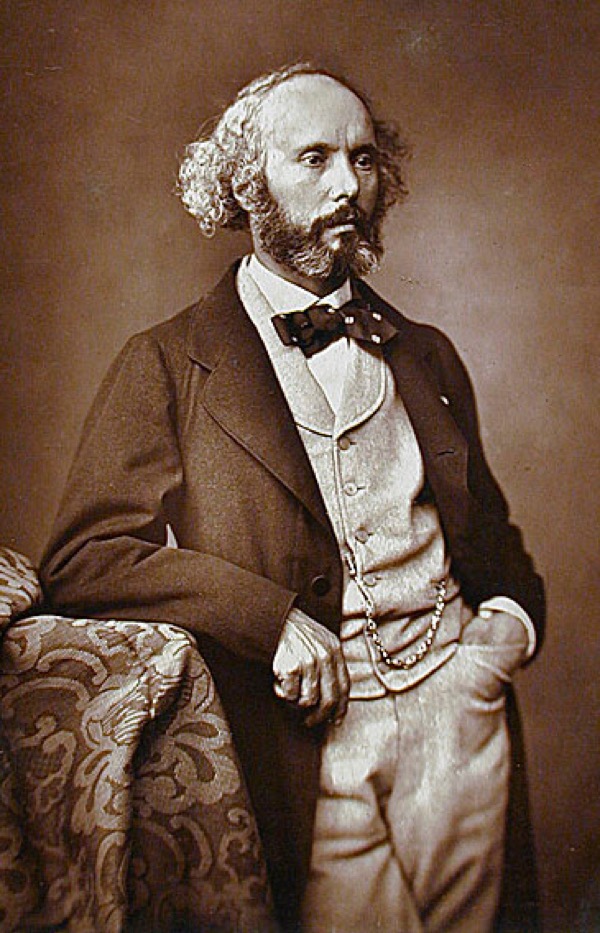
Félicien-César David
By 1831, David followed one of the leaders to a community established at Ménilmontant, with “Père” Enfantin presiding over a kind of socialist convent. David became the most prominent musician in the sect, composing choruses for the daily liturgy and other occasional pieces.
The government dispersed the community in 1832, and David and a few followers set out for Egypt in 1833, to preach their new doctrines and restore Egypt to its ancient prosperity. They sailed via Marseilles, Constantinople, Jaffa, and Jerusalem before finally reaching Egypt. As Hugh Macdonald writes, “the ardour of their apostolic mission was gradually superseded by the fascination of the East, at least in David’s mind, for he clearly recognised a powerful source of musical inspiration in the customs, religions, and landscape of the countries he visited.”
David devoted much time during the voyage to composing songs and piano pieces, and he stayed in Cairo for nearly two years. These years of adventure and discovery came to an end with an outbreak of plague, and he returned to Paris in 1835.
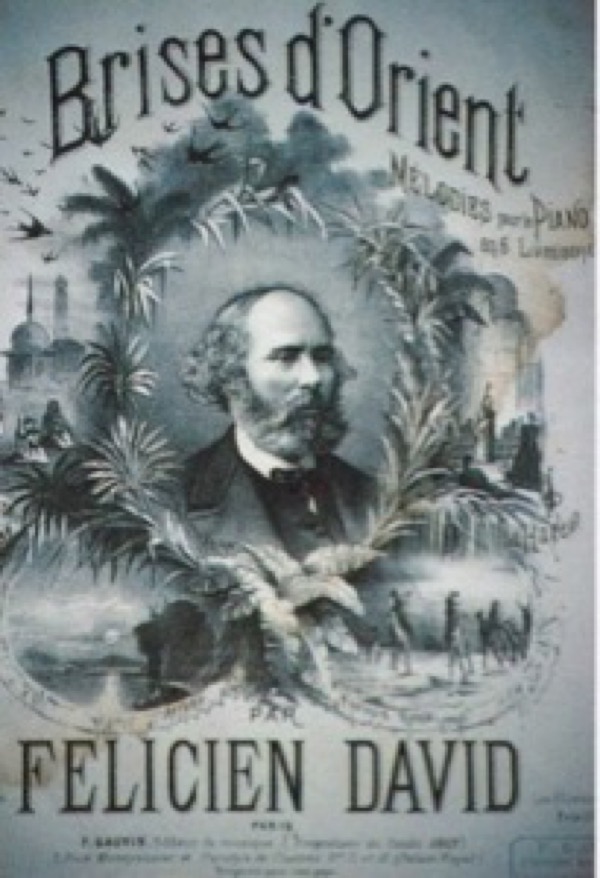
Félicien David: Les Brises d’Orient
Félicien David: Les Brises d’Orient: Smyrne (Daniel Blumenthal, piano)
Félicien David: Les Brises d’Orient: Danse orientale (Daniel Blumenthal, piano)
Félicien David: Les Brises d’Orient: Priere (Daniel Blumenthal, piano)
Félicien David: Les Brises d’Orient: Vieux Caire (Daniel Blumenthal, piano)
Félicien David: Les Brises d’Orient: Fantasia Harabi (Daniel Blumenthal, piano)
Félicien David: Les Brises d’Orient: La Sultane (Daniel Blumenthal, piano)
Félicien David: Les Brises d’Orient: Egyptienne (Daniel Blumenthal, piano)
The Desert Comes to Paris
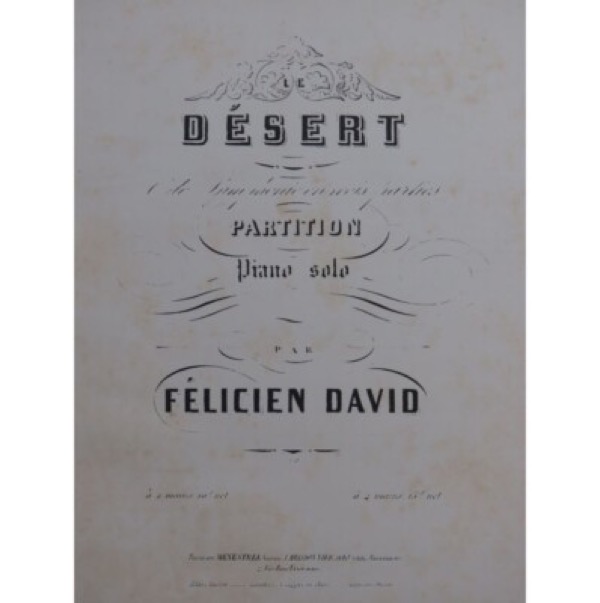
Félicien David: Le Désert
Upon his return, David began publishing piano pieces and songs based on melodies and drumbeat rhythms he had heard. He also composed two symphonies, several string quintets, and, upon a return to Paris in 1841, he completed his third symphony.
In 1844, David completed the ode-symphonie with spoken narration titled Le desert. It describes an Arab caravan, the wind-blown sands of the desert, a sandstorm, and the delights of the night-time at an oasis.
It was an immediate success and initiated a series of descriptive works across many genres that explored the French passion for Oriental subjects. We can easily discern these tendencies in compositions by Reyer, Gounod, Bizet, Delibes, Saint-Saëns, Roussel, Messiaen, and many others.
Félicien David: Le Désert (Berlin Radio Symphony Orchestra; Guido Maria Guida, cond.)
Beyond Le Désert
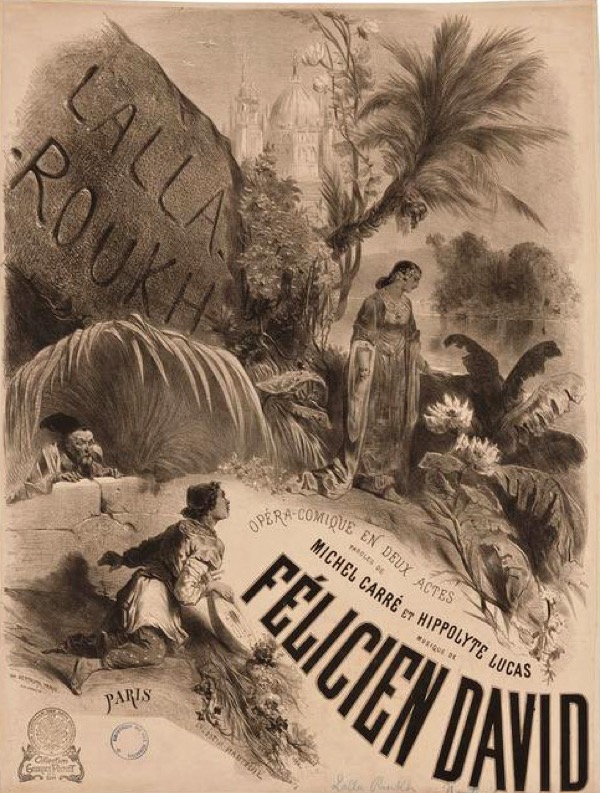
Poster for Lalla Roukh
David toured Germany and Austria in 1845, and he met Mendelssohn in Frankfurt and Meyerbeer in Berlin. He also attended the Beethoven celebrations in Bonn. He followed Le desert with additional works evoking locations that were perceived as exotic at the time.
These include two Biblical oratorios, one dealing with Moses on Sinai, and the other with Adam and Eve in the Garden of Eden. Christophe Colomb, again with spoken narration, retells the first voyage to the Caribbean. He finally ventured to the operatic stage, and the central character in La perle du Brésil is a native woman from South America in love with a Portuguese sailor.
His next opera, Herculanum, premiered in 1859 and contrasts Christian and pagan worlds. Lalla Roukh, based on a narrative poem by Irish poet Thomas Moore, tells the prose tale of the princess of Delhi who travels to Kashmir to meet the man to whom she is being betrothed. Along the way, her intended husband, disguised as the minstrel Feramorz, sings four remarkable stories and gradually wins her love.
Félicien David: Lalla Roukh: Ouverture (Opera Lafayette; Ryan Brown, cond.)
Félicien David: Lalla Roukh: Act I Scenes 1-3: Scene et Choeur: C’est ici le pays des roses (Opera Lafayette; Ryan Brown, cond.)
Félicien David: Lalla Roukh: Act I Scene 5: Melodie: Sous le feuillage sombre (Opera Lafayette; Ryan Brown, cond.)
Félicien David: Lalla Roukh: Act I Scene 6: Couplets: De pres ou de loin (Opera Lafayette; Ryan Brown, cond.)
Félicien David: Lalla Roukh: Act I Scene 7: Choeur: Voici le repas du soir (Opera Lafayette; Ryan Brown, cond.)
Félicien David: Lalla Roukh: Act I Scene 7: Ballet: La nuit tombe (Opera Lafayette; Ryan Brown, cond.)
Félicien David: Lalla Roukh: Act I Scene 7: Choeur danse: Bayaderes plus legeres (Opera Lafayette; Ryan Brown, cond.)
Félicien David: Lalla Roukh: Act I Scene 8: Scene, Dieu, c’est lui! Quatuor, Je n’ose lever les yeux (Opera Lafayette; Ryan Brown, cond.)
Félicien David: Lalla Roukh: Act I Scene 8: Romance: Ma maitresse a quitte la tente (Opera Lafayette; Ryan Brown, cond.)
Félicien David: Lalla Roukh: Act I Scene 10: Couplets: Si vous ne savez plus charmer (Opera Lafayette; Ryan Brown, cond.)
Félicien David: Lalla Roukh: Act I Scene 12: Duo, La nuit en deployant ses ailes (Opera Lafayette; Ryan Brown, cond.)
Félicien David: Lalla Roukh: Act I Scene 12: Ballade, Lorsque l’etoile du ciel sans voile (Opera Lafayette; Ryan Brown, cond.)
Félicien David: Lalla Roukh: Act I Scene 13: Ronde de Nuit et Final du 1er Acte, La nuit au manteau sombre (Opera Lafayette; Ryan Brown, cond.)
Between Utopia and the Picturesque
Félicien David remained deeply committed to the Saint-Simonian cause until the end of his life. However, his most successful works did not carry social dogma or idealism, but were content to exploit the picturesque and the evocative.
As Hugh Macdonald writes, “in some respect his music echoes Berlioz, but he showed no awareness of the richer harmonic language of Chopin and Liszt. Rather his music falls into the French tradition of being an agreeable diversion, strongly coloured but often emotionally naive; in this he preceded and greatly influenced a whole school, including Gounod, Thomas, Lalo, Saint-Saëns, Massenet, and, probably most strongly, Delibes.”
In his day, David was regarded as second only to Berlioz among French composers. His contemporaries were delighted to linger in the evocation of David’s mysterious and exotic locales. A reviewer at the premiere of Lalla Roukh writes, “Everything in it is fine, distinguished, noble, and elegant. Melody flows copiously, and the harmony is always simple and natural, yet never commonplace. The orchestration spreads ingenious and splendid colourations before our eyes, so to speak.”
For more of the best in classical music, sign up for our E-Newsletter