German composer Paul Büttner (1870–1943) started work on his 3rd Symphony in 1910, completing it in 1915. Before finishing his 3rd, he’d already started on his 4th in 1912, completing it in 1918. These two symphonies gave us the vehement voice of the early 20th-century German symphonist and led to him being considered one of the greatest contemporary symphonists after Brahms and Bruckner.
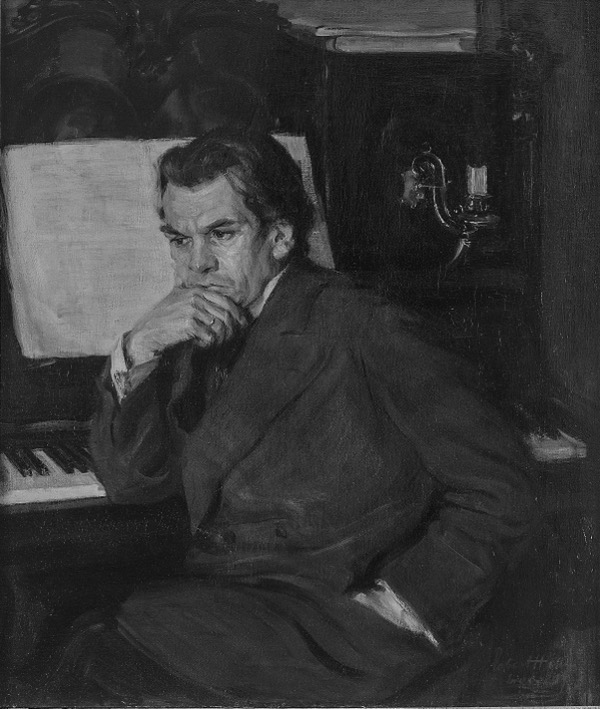
Robert Hahn: Paul Büttner (Museums of the City of Dresden, Municipal Gallery, Saxon State and University Library Dresden)
But you’ve never heard of him. Why was his musical arc so short? Political changes in Germany caused his music to be labelled as ‘degenerate ’, and so he vanished from the public eye. It wasn’t because of his religious beliefs, but because of his political beliefs: he was a Social Democrat and an outspoken critic of National Socialism, and so his star not only faded, it was removed from the heavens entirely.
Büttner studied composition at the Dresden Conservatory with Felix Draeseke (1835–1913) and was considered his teacher’s most gifted pupil. Appointments followed: in 1896 he was appointed choral conductor and singing teacher at the Dresden Conservatory. In 1905, he was chief conductor of the Dresden Workers’ Choral Association, teaching hundreds of workers the joys of music and introducing them to the international musical canon. For 30 years, he was music critic for the Dresdner Volkszeitung, the newspaper of the Saxon workers, and then from 1924, he was artistic director of the Dresden Conservatory.
On 18 May 1933, he was stripped of all his appointments and was dismissed from the Conservatory. The newspaper was banned. His music was placed on the list of undesirable art.
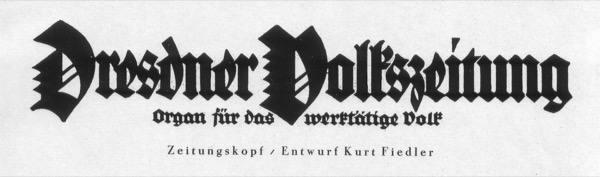
Masthead of the Dresdner Volkszeitung
More persecutions followed. Büttner’s Jewish wife, Eva Malzmann, a professional pianist, art expert and journalist, who was also a member of the Saxon state parliament for the Social Democratic Party, was subjected to intermittent ‘protective custody’ as part of an overall campaign of intimidation.
After he was removed from the public eye, Büttner spent his last decade as a private music teacher and did his compositional writing only ‘for the drawer’. He died in poverty in 1943, and his wife, with the help of a doctor, feigned death by poisoning and hid away, reemerging only in May 1945 to resume activities in the cultural politics in the Dresden area.
Büttner was eventually recognised by the East German government, with a representative grave monument in Dresden-Löbtau’s New Anne Cemetery.
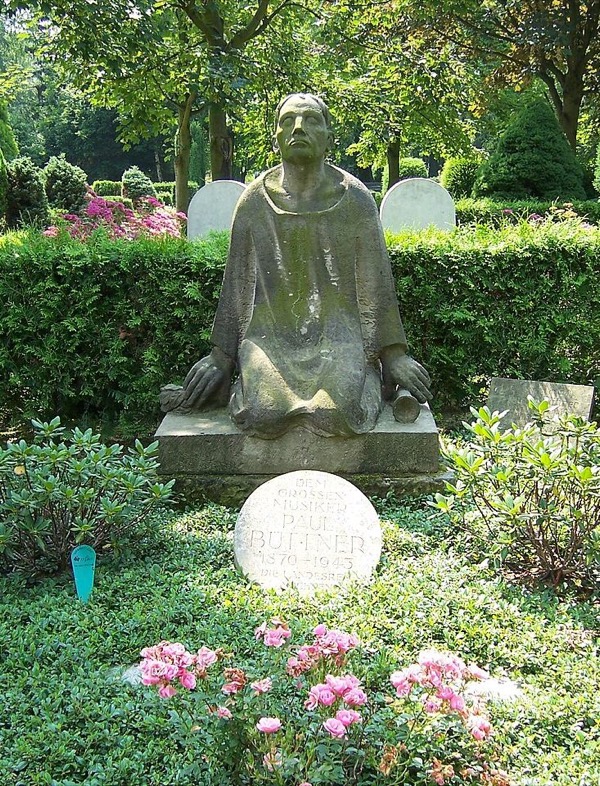
Büttner’s grave monument in Dresden (photo by Paulae)
In 1962, the public music school in Dresden was named for him, but his name was removed when East Germany rejoined West Germany. West Germany never took him into its musical heart, and it wasn’t until the 21st century that Büttner’s qualities as a composer began to be recognised and heard as ‘timeless’.
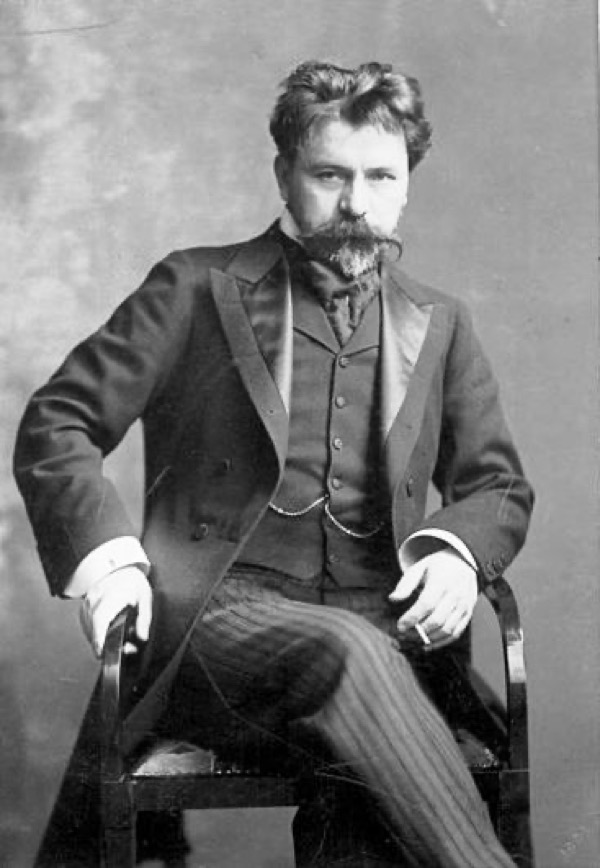
Nicola Perscheid: Arthur Nikisch, 1901 (Friedrich Nicolas Manskopf Portrait Collection, Johann Wolfgang Goethe-University Frankfurt am Main)
It was the premiere of his Symphony No. 3 on January 21 1915, performed by the Leipzig Gewandhaus Orchestra under Arthur Nikisch, that thrust Büttner suddenly into the limelight. Here was a symphony for a new age, and German conductors were quick to take him up. Conductors such as Fritz Busch, Joseph Keilberth, Carl Schuricht, Rudolf Kempe, Heinz Bongartz, Rudolf Mauersberger, and others performed Büttner’s symphonies and other works from 1915 onward with leading orchestras in Dresden, Leipzig, and Berlin.
The symphony has only three movements, each with its own characteristic: the first is ‘animated’, the second is ‘simple and heartfelt ’, and the last movement is ‘passionate and stormy’.
The traditional opening Allegro was thought by Büttner to be too light a designation for this work, and so he added Bewegt, mit erhabenem Ausdruck (Animated, with august expression) to the tempo designation. It’s a movement in full sonata form but cast in the time signature of 2/2 rather than 4/4 and has not one but two development sections. The other anomaly is the key signature of D flat major. With five flats in the key, the strings cannot play anything on open strings and serve to support the overall expression of the movement as ‘serious and tender, dramatic and rhapsodic’. One writer hears this movement as summoning forth a veritable pantheon of German Romanticism: ‘Here we have marching past us Beethoven, Weber, Wagner, Bruckner, Strauss, and then, above all: Robert Schumann’.
Paul Büttner: Symphony No. 3 in D-Flat Major: I. Allegro: Bewegt mit erhabenen Ausdruck (Berlin Radio Symphony Orchestra (Rundfunk-Sinfonieorchester Berlin); Christopher Ward, cond.)
The second movement has its Adagio further detailed as Einfach und innig (Simple and heartfelt). The chorale-like opening seems to recall works by Brahms and then later, Brucknerian appearance as the chorale speeds up. A later section is labelled ‘Suddenly more animated (but always ponderous)’ and gives us an idea of the hidden weight behind his melodies.
Paul Büttner: Symphony No. 3 in D-Flat Major: II. Adagio: Einfach und innig (Berlin Radio Symphony Orchestra (Rundfunk-Sinfonieorchester Berlin); Christopher Ward, cond.)
The last movement, Leidenschaftlich und stürmisch (Passionate and stormy), follows without a pause, and the quiet ending of the 2nd movement is destroyed in a roll of timpani. What would have been a dance-like Scherzo movement is jettisoned in favour of a movement that alternates a storm and a calm. Are we looking to Schumann for a model or perhaps the Scottish music of Mendelssohn? ‘Impassioned drive’ alternates with ‘lyrical repose’ and comes to an ultimately triumphal ending.
Paul Büttner: Symphony No. 3 in D-Flat Major: III. Finale: Leidenschaftlich und stürmisch (Berlin Radio Symphony Orchestra (Rundfunk-Sinfonieorchester Berlin); Christopher Ward, cond.)
Büttner’s 4th symphony, completed in 1918, was a very different work. Although started in 1912, it wasn’t completed until 1918, by which time four years of war had convulsed Europe. It’s a symphony of memory, of Viennese waltzes matched with funeral marches – the beloved past and the vivid present combined. The final movement is both Allegro and Flammend (flaming), summoning the spirits of Wagner, Bruckner, but also bringing in the joyous birdsong we know from Mahler. Blocks of Bruckner, Wagnerian flow, and a bit of Mahler make for a unique combination that has been withheld from the light of day for too long.
As one of the last composers in the line of Brahms and Bruckner, Büttner could have been one of the 20th century’s greatest symphonists, but, kept down by political forces that were seemingly unendingly personal in their attacks on them, it’s only now that we can hear his music for what it is.
For more of the best in classical music, sign up for our E-Newsletter