This article is a continuation of Episode 1 | The Venice of the North: A Republic’s Musical Startup, Episode 2 | The Business Animal of Opera House: Reinhard Keiser’s Baroque Empire and Episode 3 | The Baroque Silicon Valley: Christoph Graupner and the Hamburg Opera Incubator.
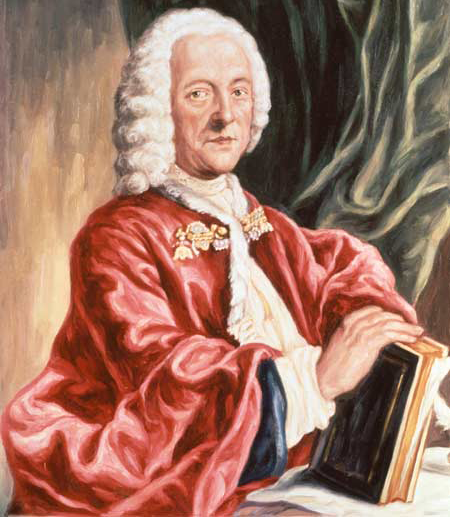
Georg Philipp Telemann
If Reinhard Keiser was the Cavalier who built the foundation of the Hamburg stage, and Christoph Graupner was the intellectual refugee who tested its psychological boundaries, then Georg Philipp Telemann (1681–1767) was the undisputed CEO of the Baroque media empire. As we saw in our last episode, Telemann was a master of professional leverage, successfully playing the Leipzig city council against the Hamburg Senate to secure a massive salary increase. Arriving in Hamburg in 1721 as the city’s director of public music, Telemann did not just write music; he systematised it. He weaponised the printing press, fought the earliest copyright wars, and transformed the Oper am Gänsemarkt into a laboratory for cross-cultural, paneuropean entertainment. His 1726 masterpiece, Orpheus, stands as the ultimate corporate manifesto of this musical empire.
The Orpheus Tradition: A Myth Built for the Stage
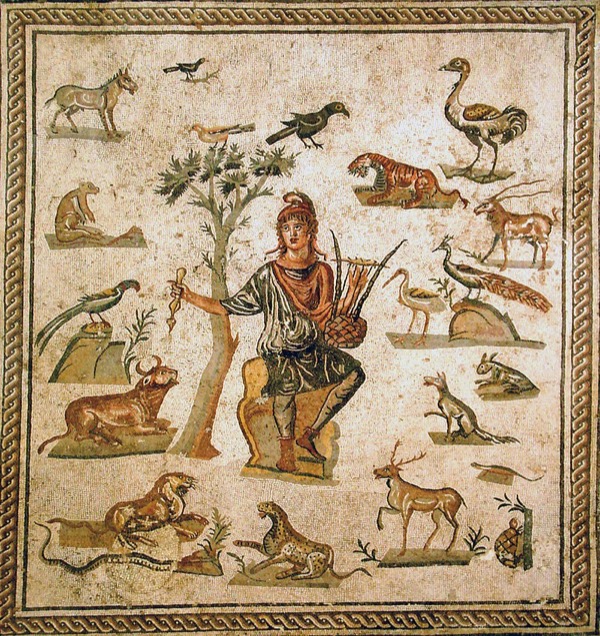
Orpheus, Roman mosaic (c. 2nd century AD). Source: Antonino Salinas Regional Archeological Museum, Palermo, Italy
The myth of Orpheus is the foundational DNA of opera itself. From Virgil’s Georgics—where the legendary singer weeps beneath the icy cliffs of Strymon, taming tigers with his grief—the story has fascinated dramatists for centuries. The premise is custom-built for the lyrical stage: a musician whose art is so powerful it can move trees, rocks, and the iron heart of Pluto himself.
From Claudio Monteverdi‘s ground-breaking L’Orfeo (1607) to the classical reforms of Gluck and Haydn, and later the satirical updates of Offenbach, every generation has used Orpheus to redefine the boundaries of musical theatre. The core narrative is a reliable engine of tragedy: the toxic snakebite at the wedding, the desperate descent into the underworld, the fragile terms of Pluto’s pardon, and that fatal, heartbreaking glance backwards that plummets Eurydice into the abyss.
The Hamburg Pivot: A Complex Corporate Triangle
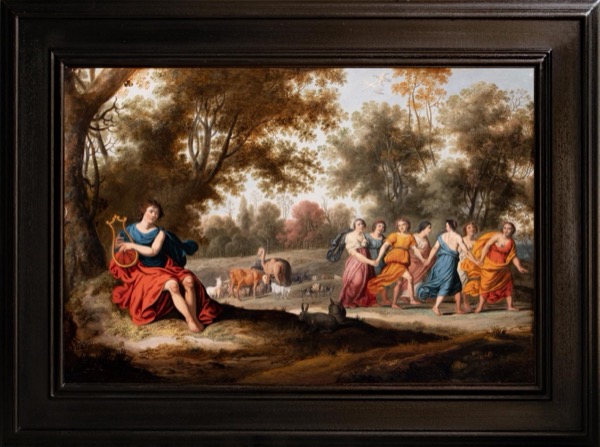
Orpheus Playing and Singing, by an unknown Dutch master (c. 1650). Source: Private Collection
As a seasoned veteran of the commercial stage, Telemann knew that while the ancient myth was perfect, the 1726 Hamburg audience required something more immediate, engaging, and highly entertaining. A minimalist two-person tragedy about restraint would not fill the boxes of the Gänsemarkt.
To maximise the dramatic conflict, Telemann adapted a French libretto by Michel Du Boulay, transforming the myth into a high-stakes, violent psychological thriller. He introduced a new corporate rival into the narrative: Orasia, the widowed Queen of Thrace. Orasia replaces the faceless, abstract concept of Fate. She is madly in love with Orpheus, and when her passion is met with cold indifference, her jealousy turns lethal. It is Orasia who orchestrates Eurydice’s murder. By injecting this toxic love triangle, Telemann turned a passive tragedy into an explosive clash of human passions. Crucially, Telemann respected the myth’s absolute tragedy. Unlike his contemporaries who forced happy endings (lieto fine) onto their works, Orpheus ends in bitter desolation—making it the only opera in Telemann’s catalogue that refuses to grant the audience a comforting resolution.
Georg Philipp Telemann: Orpheus, Act III: Sinfonia – Recitative: Weist du, Ismene, dass ich frey (Ditte Marie Bræin, soprano; Vox Nidrosiensis, Ensemble; Orkester Nord; Martin Wåhlberg, cond.)
The Trilingual Prototype: A European Integration
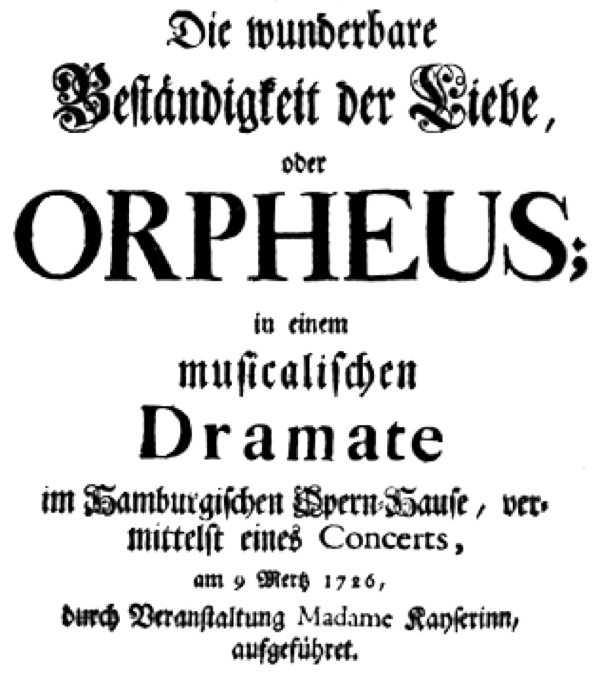
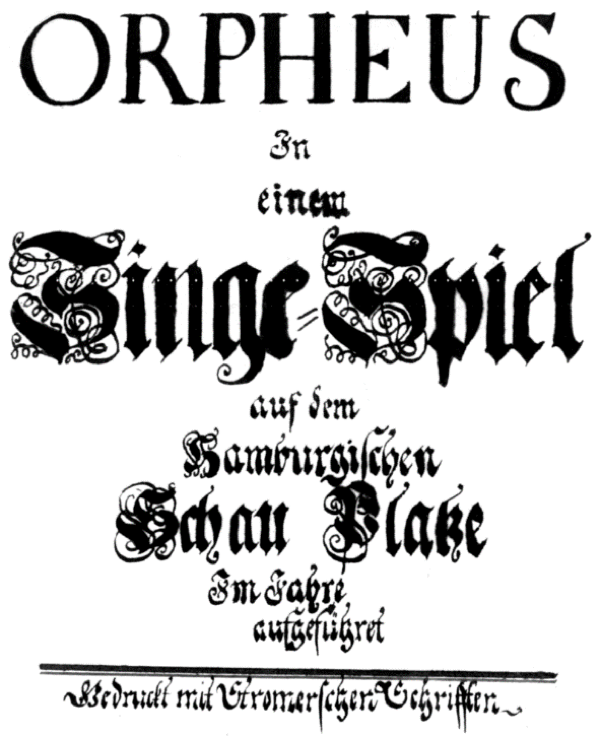
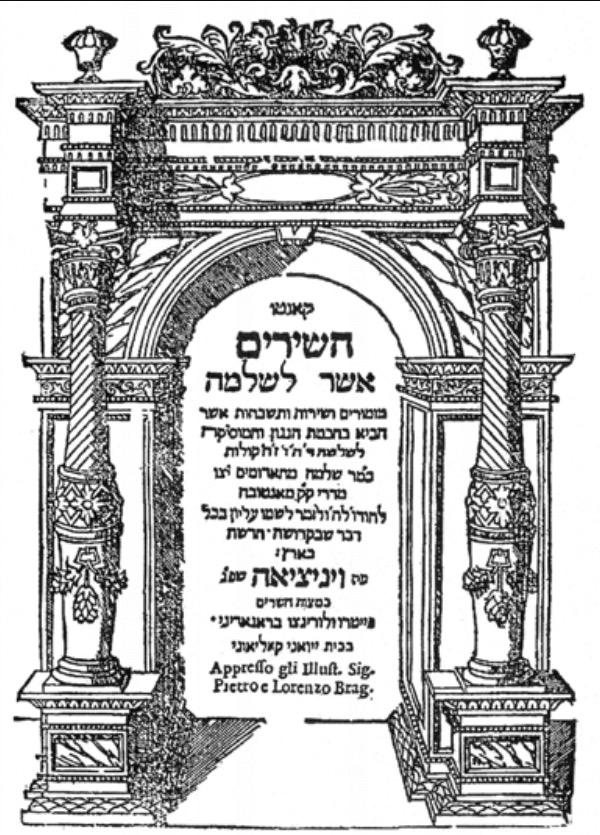
Title pages of the two historical editions of Telemann’s Orpheus
On its original 1726 playbill, Orpheus was labelled a German Singspiel, a title Telemann later Latinized to Dramma. In reality, the work was a radical, unprecedented hybridisation of French lyrical tragedy and Italian opera seria. Telemann personally constructed the libretto as a trilingual manifesto: all recitatives were delivered in German, the grand choruses shifted between German and French, and the high-prestige arias seamlessly alternated between German, French, and Italian.
To a modern observer, this linguistic cocktail seems chaotic, but to the port city of Hamburg, it was a stroke of marketing genius. It reflected the polyglot, cosmopolitan nature of a major European trading hub. Practically, it also solved a recurring human resource problem: many Italian singers travelling through Germany possessed terrible German diction but demanded showcase arias to display their vocal virtuosity. These standardised showpieces were known as suitcase arias (arie di baule). Rather than fighting this corporate reality, Telemann leaned into it, synthesising French courtly elegance and Italian bravura into a single coherent system.
Stylistic Diversity: The Multi-Layered Score
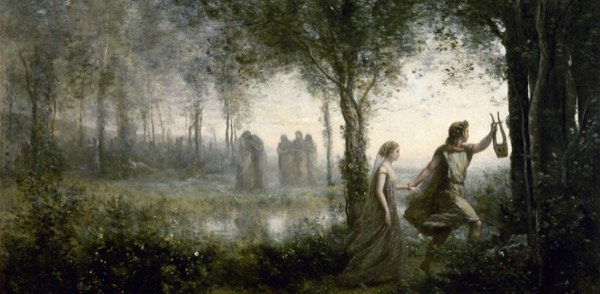
Orpheus Leading Eurydice from the Underworld, by Jean-Baptiste-Camille Corot (1861). Source: The Museum of Fine Arts, Houston, USA
Telemann’s true genius lay in his ability to use these different national styles as psychological signposts for the audience. The main plot is driven forward by Italianate recitatives and German expressive depth, while the grand choral and dance sequences are engineered with strict French precision.
Orpheus (The Italian/German Core): The title character balances Italian vocalism with German gravity. His most profound moment occurs when he confronts Pluto in the underworld. Telemann uses a sparse, haunting string pizzicato to mimic the ancient lyre. The music carries the bleak, desolate weight of a German Passion aria, an emotional gravity that successfully melts the underworld king’s resolve.
Orasia (The Virtuosic Disrupter): The villainous queen utilises linguistic shifts to map her psychological collapse. In her opening scenes, two back-to-back German da capo arias establish her deep, wounded heartbreak. But when her sorrow turns to rage, she shifts instantly into Italian for her third aria—a textbook example of high-velocity Italian vocal pyrotechnics. The orchestra aggressively, violently interrupts the vocal line with jagged profiles, wide interval leaps, and breathless rests, vividly illustrating a woman plotting murder.
Eurydice (The French Ideal): Eurydice’s gentle, optimistic nature is captured in her sweet German duets with Orpheus. However, her deepest expressions of desire and despair are delivered in sophisticated French airs, following the strict rhythmic laws of the Versailles tradition. This French influence dominates the choruses of nymphs, Bacchic revellers, and underworld spirits, culminating in a final, tragic chorus set to the stately rhythm of a French Loure—a masterpiece of noble restraint and collective grief.
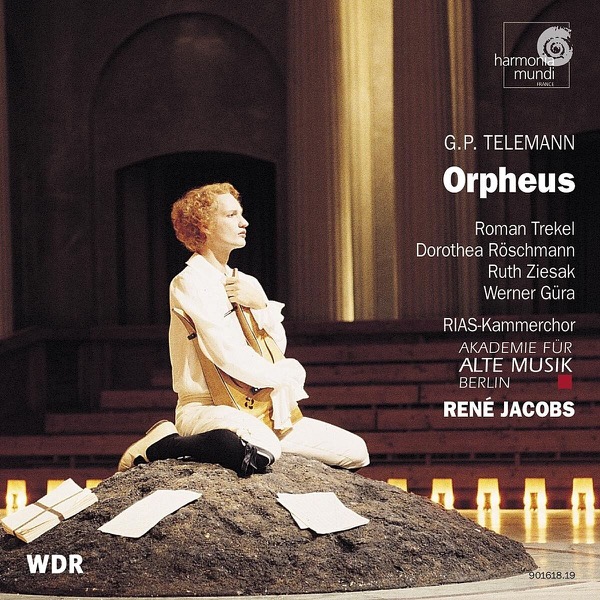
Cover of the landmark recording of Orpheus conducted by René Jacobs, featuring a production still from the 1994 performance at the Berlin State Opera
Georg Philipp Telemann: Orpheus — Act I Scene 1: Su, mio core a la vendetta (Orasia) (Akademie für Alte Musik Berlin; René Jacobs, cond.)
Georg Philipp Telemann: Orpheus — Act I Scene 9: Ach tod, ach susser Tod! (Orpheus) (Akademie für Alte Musik Berlin; René Jacobs, cond.)
Georg Philipp Telemann: Orpheus — Act II Scene 6: Mit dir mich zu ergetzen (Eurydice) (Akademie für Alte Musik Berlin; René Jacobs, cond.)
Death and Resurrection: The Discovery of a Masterpiece
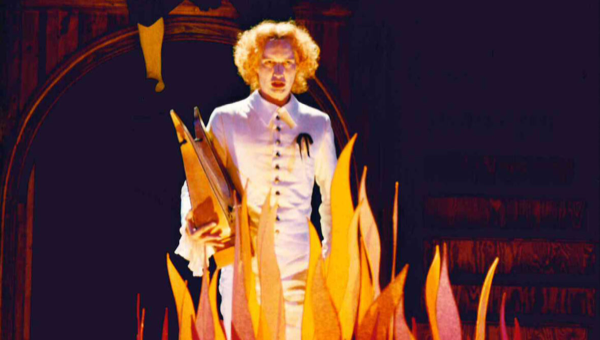
Production still from the 1994 staging of Telemann’s Orpheus at the Innsbruck Festival of Early Music, Austria
Unlike Gluck, Telemann did not publish grand manifestos demanding the reform of opera; as the critic Johann Christoph Gottsched noted, Telemann’s strength lay in his total lack of prejudice—his ability to absorb every contemporary European trend and test its efficacy on a paying public.
Yet, like most Baroque stage works, Orpheus vanished from the repertoire after its initial run, buried by shifting musical tastes. When the 20th-century early music revival began, scholars focused almost exclusively on Handel and Vivaldi, dismissively writing Telemann off as a mere “facile note-spinner.” The libretto of Orpheus was known to exist, but the score was presumed lost forever.
The system reboot occurred in the late 1970s when a German musicologist discovered an anonymous, untitled manuscript in a remote archive in Wiesentheid. Because of its bizarre mix of languages, researchers initially assumed it was a pasticcio—a patchwork quilt of songs by different composers. However, advanced stylistic analysis revealed that every note was the original work of Telemann. In 1994, conductor René Jacobs fully restored the score, filling in minor missing fragments with music from Telemann’s other vocal works, and mounted a historic, world-class production at the Berlin State Opera. Years later, Jacobs staged the work in Spain as part of an “Orpheus Trilogy” alongside Monteverdi and Gluck. Through this comparative resurrection, Telemann’s Orpheus finally took its rightful place: not as a compromise, but as a triumphant synthesis of the entire Baroque world, proving that the Media Emperor of Hamburg had built a theatre capable of speaking to all of Europe at once.
Epilogue: The Twilight of the Oper am Gänsemarkt
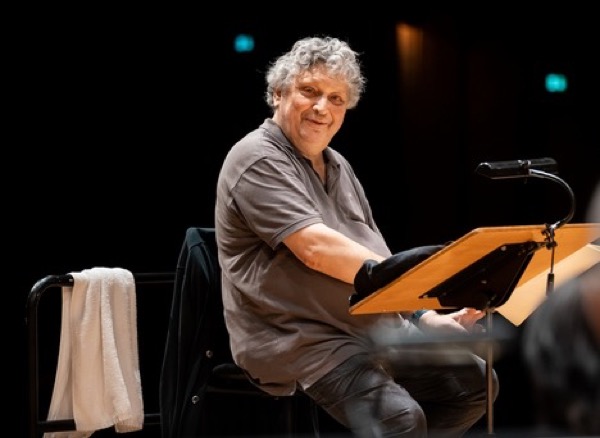
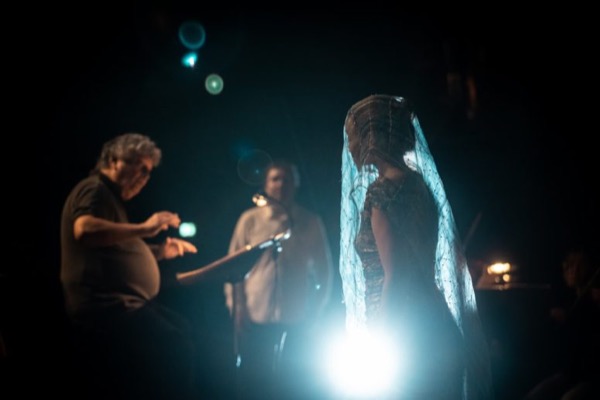
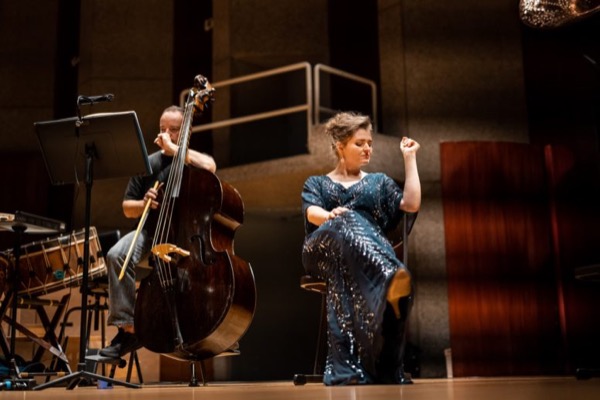
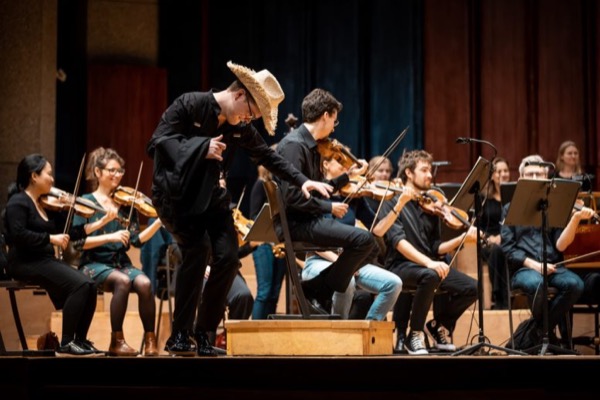
Conductor René Jacobs during the 2021 revival concert tour of Orpheus in Spain.
Rehearsal photos courtesy of the B’Rock Orchestra (Belgium)
By the late 1720s, however, the Oper am Gänsemarkt faced a fatal crunch. Boardroom takeovers by foreign diplomats and lavish budgets couldn’t save it from shifting public tastes toward lighter Italian styles. In 1738, crippled by high overhead and insolvency, the world’s first civic opera house closed forever, leaving a timeless blueprint for the future of commercial theatre.
For more of the best in classical music, sign up for our E-Newsletter