In the history of European music, certain cities seem to hold a magnetic pull, drawing in talent and capital to create something entirely new. In the late 17th century, that city was Hamburg. Today, we often think of Baroque opera as a lavish entertainment for kings and queens in sprawling palaces. However, nestled in the heart of this wealthy Hanseatic city, far from the royal courts of Vienna or Paris, a different kind of miracle occurred: the birth of the Oper am Gänsemarkt (the Opera at the Goose Market).
The Bank and the Opera: A Unique Urban Identity
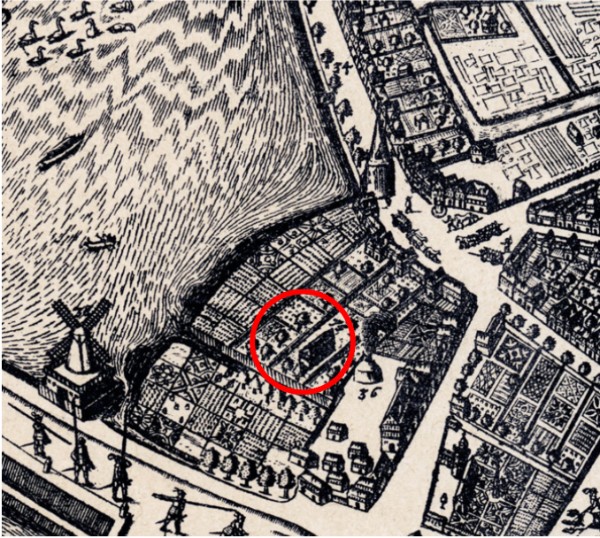
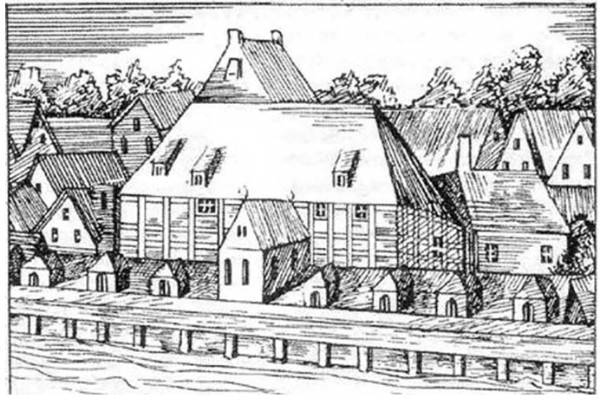
Detail from the Hamburg City Map by Petrus Grooten (1690), featuring the Oper am Gänsemarkt (marked as No. 75).
Source: Museum für Hamburgische Geschichte (Hamburg Historical Museum).
To understand the rise of Hamburg’s opera, one must first understand the city’s soul. Johann Mattheson (1681-1764), the famous Hamburg composer, critic, and lexicographer, once made a striking comparison that remains relevant today. He noted that great lords and scholars were often persuaded to stay in a city because of its famous opera house. He famously argued:
“The city enjoys a reputation for excellent opera, just as it does for excellent banks. Because the latter is for service, the former is to bring pleasure; the latter is to provide security, the former is to teach. Where the best banks are, there must also be the best opera houses.”
This was not just poetic flair; it was a socio-economic manifesto. In the 1670s, Hamburg was a Free City within the Holy Roman Empire, second in population only to Vienna. Unlike other European capitals, it had no resident monarch to foot the bill for the arts. Instead, it had merchants, sailors, diplomats, and a thriving middle class. In Hamburg, opera was not a gift from a prince; it was a civic investment, a cultural “bank” that provided intellectual and moral interest to its citizens.
Transplanting the Venetian Model: The Public Experiment
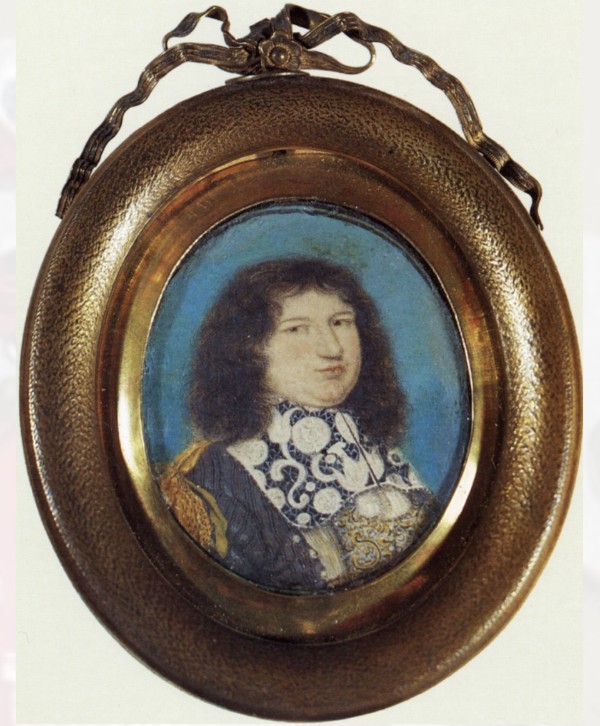
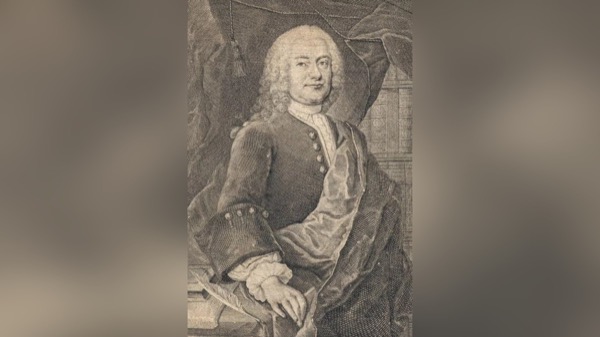
Portrait of Gerhard Schott (1641–1702)
In 1678, the Oper am Gänsemarkt opened its doors as the first public opera house in Europe outside of Venice. This was a revolutionary transplant of the Italian model. The blueprint was Venice’s Teatro di San Cassiano, which in 1637 had become the first theatre to open to paying audiences.
Before this, opera was a private, aristocratic affair—exclusive, expensive, and hidden behind palace walls. In Hamburg, “public” meant the theatre did not belong to a court; anyone who could afford a ticket could walk through the doors. It meant the risks were carried by private individuals, most notably Gerhard Schott, a jurist and member of the Hamburg Council.
Schott was the quintessential Hamburg arts entrepreneur. He wasn’t just a lawyer; he was a man of deep humanistic education and artistic vision. Alongside the organist Johann Adam Reincken and Mayor Peter Lütkens, Schott steered the opera through its infancy. Like any modern startup, the opera house faced immense financial and logistical hurdles. Yet, the cosmopolitan nature of Hamburg—a bustling port city filled with international travellers—provided a hungry audience for this modern art form.
Architecture of the Goose Market: A Baroque Spectacle
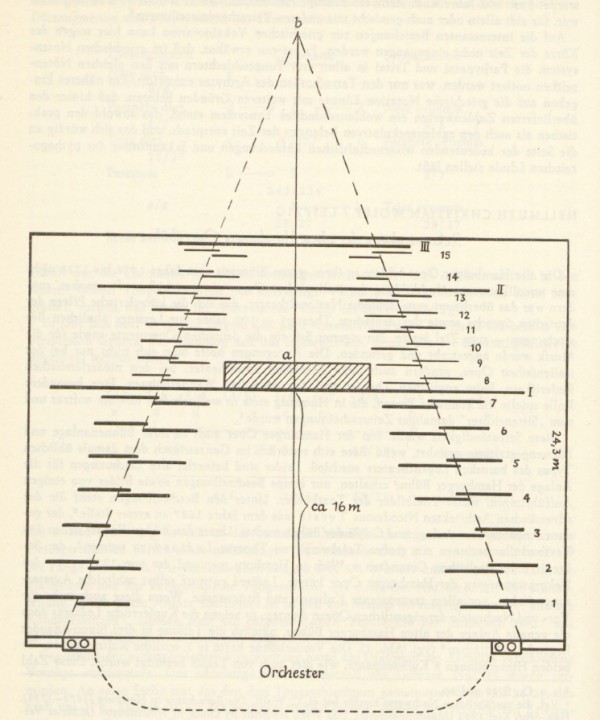
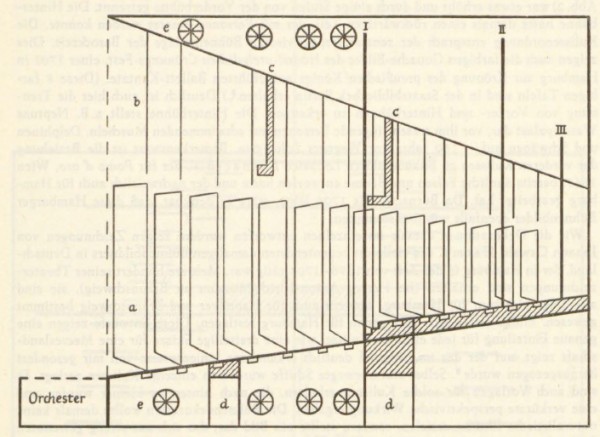
Floor plan and cross-section of the stage machinery at the Oper am Gänsemarkt, reconstructed by H. C. Wolff.
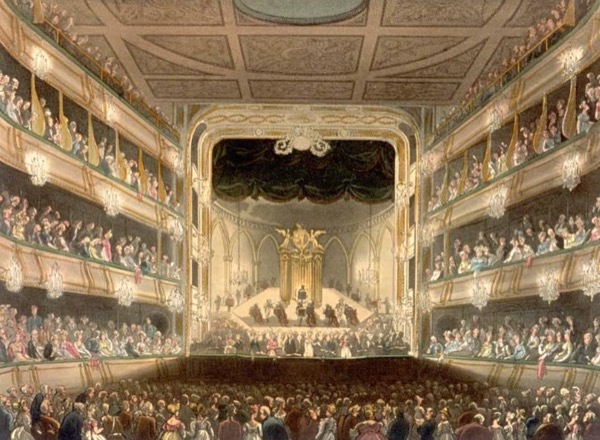
To accommodate this new public, Schott commissioned the Italian master Girolamo Sartorio to build a dedicated house on the Goose Market. Historical reconstructions suggest the theatre could hold up to 2,000 spectators—a staggering number for the time.
The hardware was equally impressive. The stage was twenty-eight feet deep, equipped with sophisticated machinery and sliding wings that could transform a scene from a stormy sea to a celestial palace in seconds. There were four tiers of boxes for the wealthy and space for the general public.
The schedule was gruelling: performances took place two to three times a week, usually on Monday, Wednesday, or Thursday afternoons, lasting four to six hours. With 90 to 100 performances a year, the Oper am Gänsemarkt was a powerhouse of production: it was a machine designed to produce wonder for a commercial audience.
The Moral Battlefield: Opera vs. The Church
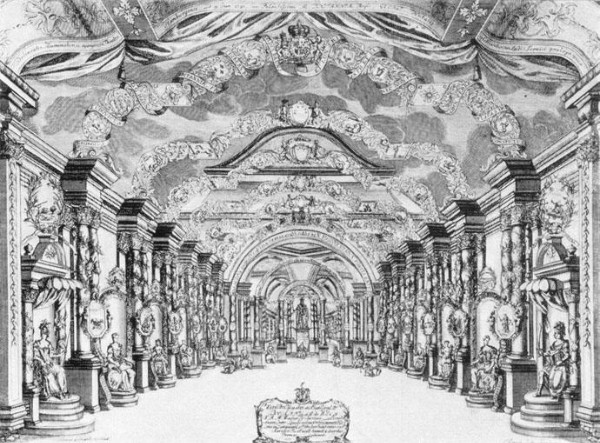
Festive stage decorations designed by Girolamo Sartorio for a royal celebration at the Hamburg Opera House (1727).
However, not everyone in Hamburg was clapping. The theatre’s opening in 1678 with a production about Adam and Eve was intended as a peace offering to the religious community, but it backfired. For the next thirty years, a fierce Theological Dispute raged in the city.
Many local pastors used their pulpits to denounce the opera as a “hotbed of sin.” They argued that the sensory pleasure of music and the vanity of the stage distracted the soul from God. On the other side, enlightened theologians like Heinrich Elmenhorst, a deacon at St. Catherine’s Church, defended the art form. Elmenhorst actually became one of the key librettists for the theatre’s first phase.
The defenders of opera leaned into Mattheson’s philosophy: opera was not just for pleasure; it was for teaching. They argued that by combining architecture, painting, dance, poetry, and music, opera became a “total art form” that could model moral philosophy and noble behaviour. In a city without a king to provide a moral compass, the stage became a classroom for the citizens.
The Conradi Era: A Melting Pot of Styles
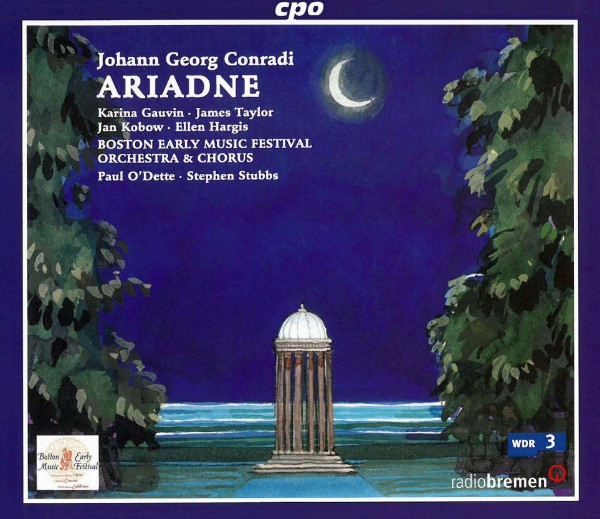
The first decade of the theatre relied heavily on German translations of Italian plots. Early composers like Strunck, Franck, and Förtsch were deeply influenced by the Venetian style—simple, tuneful, and focused on the voice. But the true Golden Age of the opera house began in 1691 with the arrival of Johann Georg Conradi (1645-1699).
Johann Georg Conradi: Die schöne und getreue Ariadne — Act III Scene 8: Passacaille: Edles Paar, dem nichts zu gleichen (Boston Early Music Festival Orchestra; Paul O’Dette, cond.; Stephen Stubbs, cond.)
Conradi’s masterpiece, Die schöne und getreue Ariadne (1691), is the earliest complete opera written specifically for Hamburg that survives today. It is a fascinating document of musical globalisation. In Conradi’s hands, the Italian transplant began to take on a uniquely North German flavour by incorporating French elements.
Conradi was likely familiar with the music of Jean-Baptiste Lully from his time in various courts. Ariadne opens with a classic French Overture—stately, dotted rhythms followed by a fast, imitative section. Even more impressive were his massive Chaconnes, stretching over 200 bars, where French-style vocal melodies floated over a repeating bass line.
In Conradi’s work, the lines between an aria, a chorus, and a ballet were beautifully blurred. He used French dance forms—the Bourrée, Gavotte, and Minuet—to give the music a rhythmic elegance that the earlier, purely Italian-influenced works lacked. Furthermore, he began to elevate the orchestra. Nearly half of the 38 arias in Ariadne featured orchestral accompaniment, a sign that the “Hamburg Sound” was becoming richer and more instrumental.
The success of Conradi’s Ariadne proved that Hamburg’s opera experiment was working. The foundation was set for the theatre’s most brilliant chapter: the rise of its first true superstar, Reinhard Keiser.
For more of the best in classical music, sign up for our E-Newsletter