Mark Hambourg (1879–1960) was born in Russia but made his career in England. His entire family was musical: his father was the pianist Michael Hambourg (1855–1916), a student of Anton Rubinstein, and three of his younger brothers, Boris, Jan, and Clement, were also musicians. Boris (1885–1954) was a cellist, Jan was a violinist (1882–1947), and Clement (1900–1973) was a pianist and musical organiser. In addition, his uncle, Alexander Hambourg, was a conductor, and his cousin, Charles Hambourg (1895–1979), was both a cellist and a conductor.
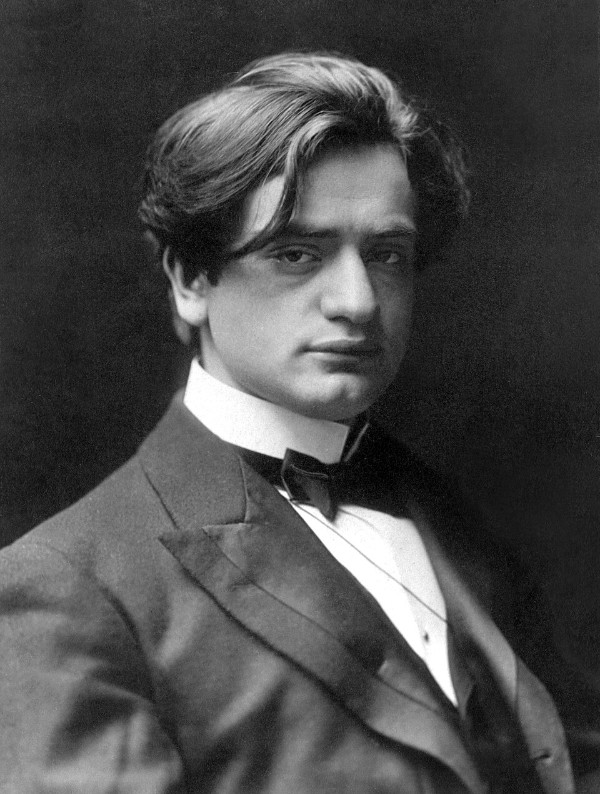
Perkins Studio: Mark Hambourg ca. 1908 (Boston Public Library)
The family relocated from Boguchar, Voronezh Governorate, to London in 1889, fleeing the Tsarist regime. Mark came to Paderewski‘s attention and made his public debut on 12 July 1890, at the age of 11. This success was followed by another London concert and then a tour of the country. Although the family would have preferred a more private life for him, as refugees, they needed his income.
In London, his beauty brought him into the circle of Felix Moscheles (son of the pianist Ignaz Moscheles); other members included Oscar Wilde, Bernard Shaw, Ellen Terry, and others. Moscheles was a painter, writer, pacifist, and internationalist, the first president of the London Esperanto Club, and involved in developing international dispute-resolution protocols at The Hague.
During his England tours, Hambourg was said to grow ‘tired of elderly ladies wanting to kiss him and permitted them to do so only in exchange for a large box of chocolates’. GB Shaw feared that the child was being exploited by the Lyric Theatre, but finally was convinced in 1891 that Hambourg had a genuine talent, albeit one that needed training.
Paderewski sponsored him for study in Vienna for three years (1891–1893), where he worked with Theodor Leschetizky. He was awarded the Liszt Scholarship while in Vienna and made his first public appearance in 1895 as an adult pianist, appearing with the Vienna Philharmonic, led by Hans Richter, performing Chopin’s Piano Concerto No. 1 in E minor. Replacing the indisposed Sophie Menter at short notice, he played Liszt’s Hungarian Fantasia under Felix Weingartner and was able to bring a disappointed audience to their feet. In the banquet that followed, Brahms proposed a toast to Hambourg.
Hambourg returned to London in 1895 and, after a concert at St James’ Hall under Henry Wood, started on his first world tour at the age of 16. Henry Wood compared Hambourg to Anton Rubinstein in both appearance and technique, and Ferruccio Busoni considered him the greatest talent of the time.
The first stop on his world tour was Sydney, where he was so successful that he was asked to stay an additional six weeks. Returning to London, he stood in for Paderewski playing Anton Rubinstein’s Piano Concerto No. 4. Then, he was off to Paris in 1896, and on to Brussels and Berlin.
He made it to America in late 1898, first appearing in New York with the Boston Symphony Orchestra before starting his nationwide tour. Returning to London, he appeared with Henry Wood in 1901 at the Proms. His European tour took him to Poland, Russia, and Germany. In 1906, he toured South America, at times having to bring his own piano with him to remote locations.
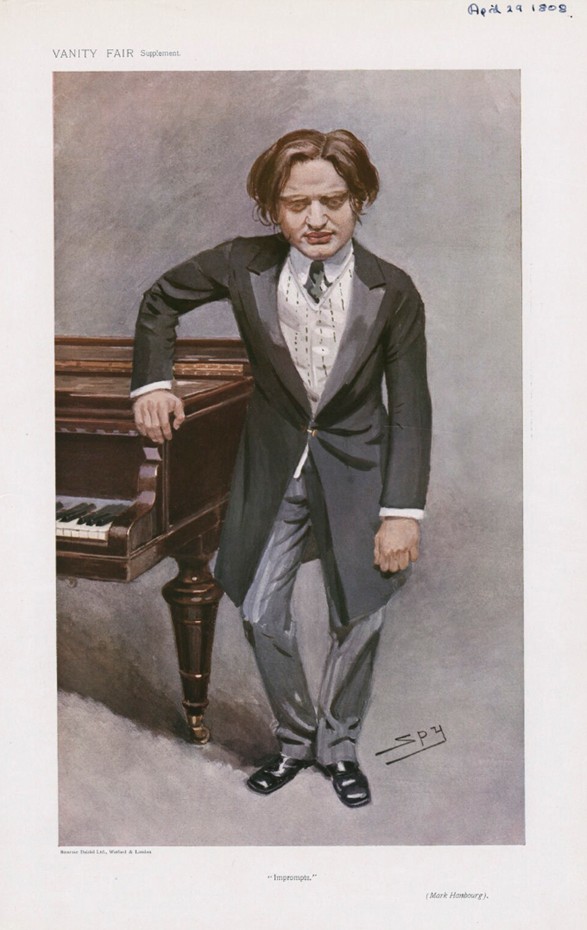
Leslie Ward: Impromptu (Men of the Day. No. 1116: Mark Hambourg), 1908 (Vanity Fair) (London: National Portrait Gallery)
Canada opened its doors to him during his 1909 tour. The anti-German sentiment of WWI brought out rumours that Hambourg was German, and he had to not only prove his Russian birth but also show that he was a naturalised British citizen and had been so for some time. The Daily Mail, which had started the rumours, had to pay him damages for their allegations. His last tour before the war was back to the US, where he missed his boat back to the UK, the RMS Lusitania, which was sunk by a German U-boat off the southeastern coast of Ireland. He remained in the UK for the remainder of the war, playing recitals at Aeolian Hall and at concerts at the London Coliseum.
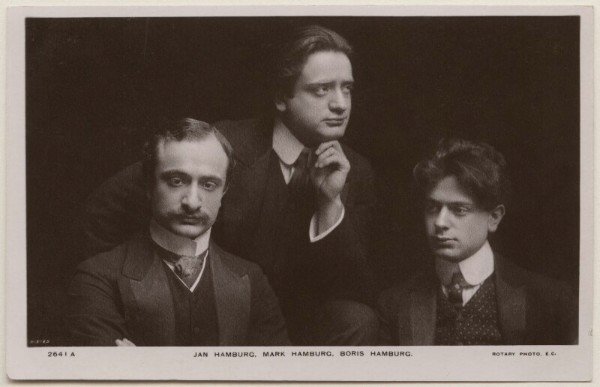
Ernest Walter Histed: Jan Hambourg, Mark Hambourg, and Boris Hambourg, 1909 (National Portrait Gallery)
Cécile Chaminade: 6 Études de concert, Op. 35: No. 2. Autumn: Lento (Mark Hambourg, piano)
After WWI, he resumed his world tours, travelling through Europe, South Africa, Canada, and throughout Britain.
Hambourg Beethoven Concerto No.3 (1929) 3rd mov.
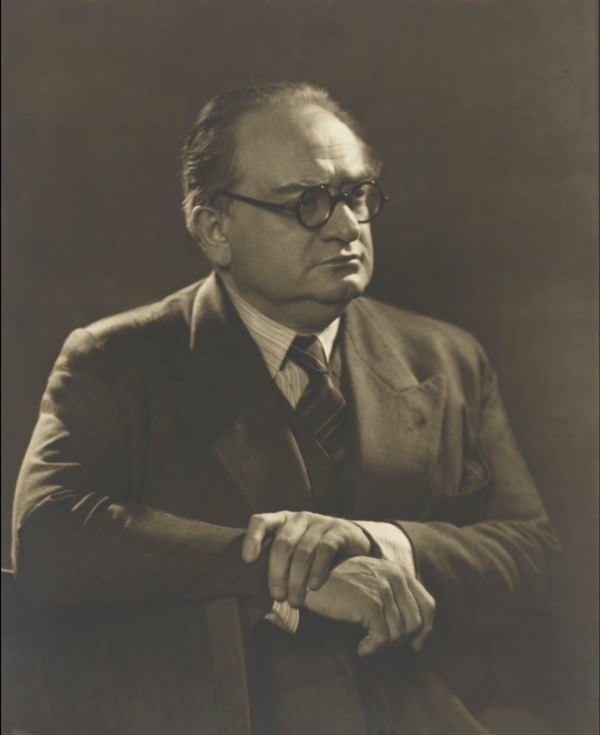
Dorothy Wilding: Mark Hambourg, 1938 (London: National Portrait Gallery)
In addition to being an international virtuoso, he was a composer best known for his Variations on a Theme by Paganini, inspired by the famous 24th violin caprice.
Mark Hambourg: Variations on a theme by Paganini (Goran Filipec, piano)
Hambourg also played chamber music with his violinist brother Jan as part of the Hambourg Trio. His career didn’t last beyond the 1930s, although in the 1920s and 1930s, his fame was international.
For more of the best in classical music, sign up for our E-Newsletter