Their website spells it out: The vocation of the Palazzetto Bru Zane – Centre de Musique Romantique Française is the rediscovery and international promotion of the French musical heritage of the long nineteenth century (1780–1920). They’ve made their remit as broad as possible, spanning music from orchestral to chamber. Sacred music, operatic music, and those uniquely French genres such as chanson, opéra-comique, and operetta all have a place in their research.
Their desire to rediscover the lost is underpinned by solid musicology, matched with a broad knowledge of the performers who created the works in the first place and of the performers today who would be interested in taking part in the Palazzetto Bru Zane projects. They research archival collections, digitising where necessary, they create recordings of works, they create editions of works, and they have conferences on their research. And then, you can listen to Bru Zane Classical Radio for a 24-hour streaming service of their music. They have their own label for music (Bru Zane) that does even more to spread the word about French Romantic music.

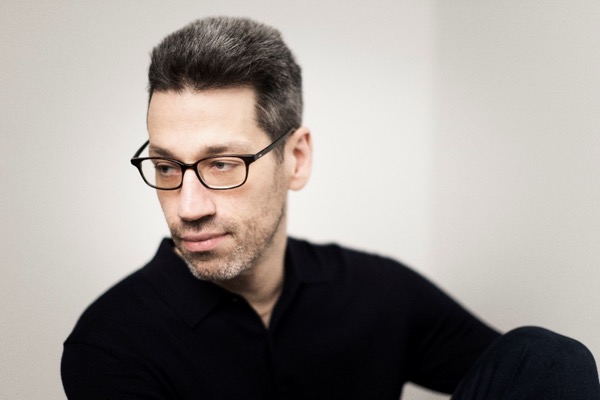
Alexandre Dratwicki
We spoke with Dr. Alexandre Dratwicki, the artistic director and resident musicologist for the Palazzetto Bru Zane, about what drives their work. As a musicologist, he is particularly concerned with the sources and stories that lead to a performance. In many cases, the researchers are not only looking at a particular work by a particular composer but also creating the whole world of the composer. He gave me the example of Offenbach’s La vie Parisienne.
La vie Parisienne, an operetta written by Offenbach in 1866 to a libretto by Henri Meilhac and Ludovic Halévy, was one of the composer’s most popular works. Simple, yes? Well, no. Work on the operetta to get to a performing score took over two years of work and included reinstating music that had vanished over time. Ensemble pieces, such as sextets, septets, and octets, had been banished from the score because they had gradually been found too difficult and were reassessed. Luckily, they had been removed from the operetta, but, fortunately, not discarded. You can see the difference in that a typical recording of the operetta is 1 hour and a bit more, whereas the Bru Zane reconstruction comes in at over two and a half hours! They’ve reinstated the larger ensembles, the dialogue, and all the things that dropped out as the work became more popular and were stripped back for expediency (and cost).
Jacques Offenbach: La vie parisienne (Parisian Life) – Overture (Orchestre national du Capitole de Toulouse; Romain Dumas, cond.)
Scholars can recreate a score for a lost work, but the next step is getting it into the hands of performers. Dr. Dratwicki emphasised the importance of working with performers to ensure that the music that they were given could be sung. Just as a composer worked with the singers for the premiere, rewriting, dropping down an octave (or jumping up another one) as needed for the voices at hand, the musicologists on the Bru Zane projects offer performers other reasonable options.
And today, the step that follows is getting the music out to the public. Bru Zane has a long-standing publishing program for scores, for CDs and DVDs in partnership with a number of different labels, and for books. This is all part of their goal to bring French Romantic music out from the shadows.
We talked about why French Romantic music had fallen to the wayside, and Dr. Dratwicki discussed a couple of reasons. The great men of French Romanticism (Berlioz, Ravel, Debussy, and Fauré) established the genre, and then the next generation had to wait for a space at the table. French music was always delayed, he said: it took some 20 years for the next generation to make its mark in France and even ground-breaking composers, such as Wagner, had to wait some 40 years to finally hit France. When you add in secondary composers and women, France was a difficult place for any composer to make a mark.
There was also a question of professionalism. If you were a teacher, could you also be a composer? The leaders at the great institutions, such as the Paris Conservatoire or the Institut de France, were not regarded as being the same as composers who were successful on their own, despite their influence.
When we discussed the role of women in French Romanticism, Dr. Dratwicki noted that Bru Zane has been one of the leaders in that research. The reason we now know so much about composers such as Augusta Holmès, Mel Bonis, Rita Strohl, and Louise Bertin is because of the work done at Bru Zane to bring their music back. And, unlike most research in women’s music, they do not make chamber music their sole interest. They’re bringing back the orchestra music of these women, their operas, oratorios and similar works for large forces.
Because Bru Zane is so concerned with sources, they’ve been able to put together programs that truly capture the glories of the French stage, including their production of George Bizet’s Carmen, which goes back to the original 1875 production. With the researcher Michela Niccola, they could get to the sources of the original French scenography. Research by Rémy Campos and Aurélien Poidevin brought out how actors at the time were taught to move on stage. The large number of studio photographs showing actors and singers in costume and in fixed poses underscored this invisible education in movement and posture that the performers had all been taught.
The result is a Carmen that plays down the Spanish-ness and emphasises the French-ness of it all. It’s on their website in all its late 19th-century glory:
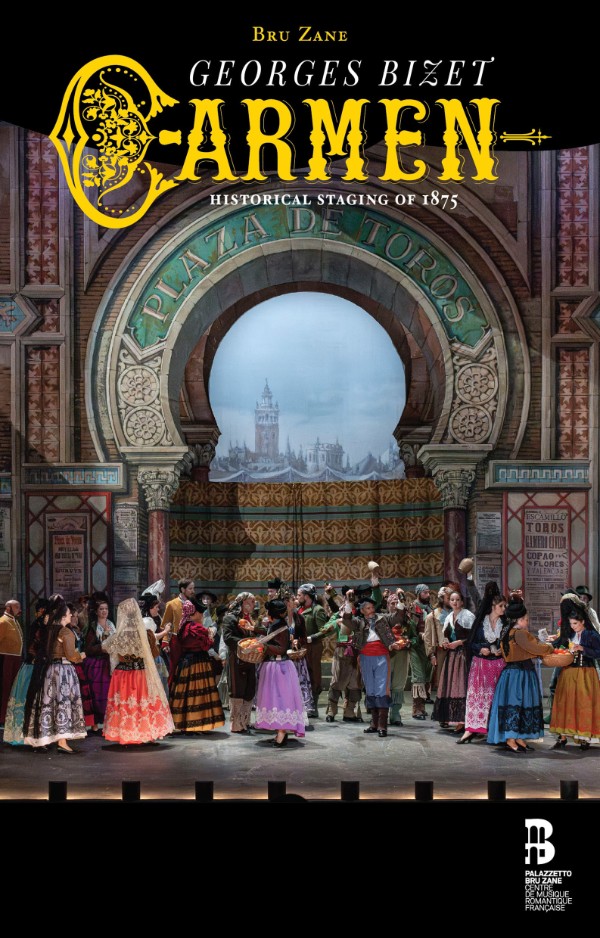
Carmen DVD, Bru Zane Label, BZ 3001
This production has been touring the world, from Paris to Dallas and Hong Kong, and is coming to Athens in April 2026 (https://www.nationalopera.gr/en/stavros-niarchos-hall/sn-opera/item/7435-karmen). The sexuality of Carmen, the flame of desire of Don José, and heroic poses of the bullfighters are all brought to life in a way that few modern productions have been able to do, either in traditional or modern-dress settings. Press reports from the premiere of Carmen emphasised the ‘garish colours’ that stood out on the dark stage, and so you’ll see them in this production.
A look at the final scene is quite rewarding. The first image is from the black and white poster for the premiere by Prudent Louis Leray showing the dying Carmen in the arms of Don José as the triumphant toreador Escamillo comes out from his field of battle with the bull.
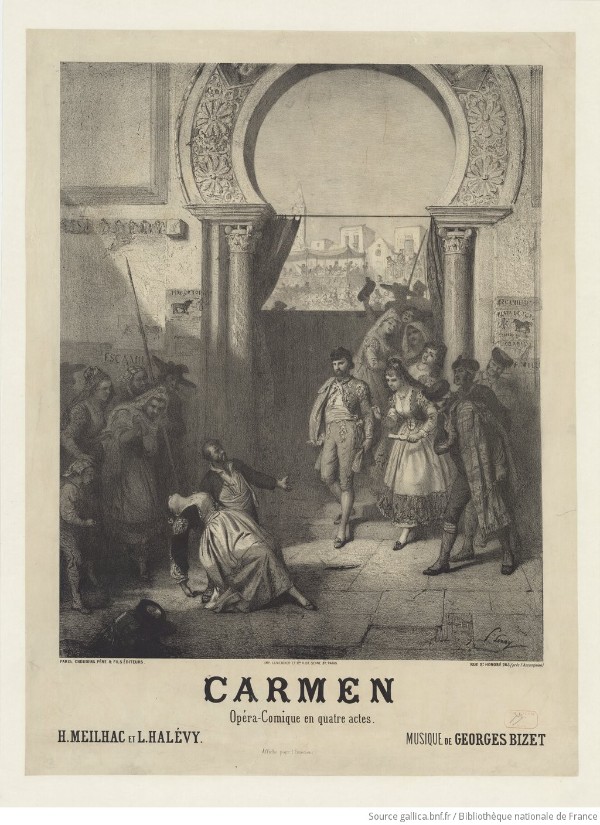
Prudent Louis Leray: Carmen, poster, 1875 (Gallica: btv1b53187276q)
The second image is from the end of the Bru Zane reconstructed opera as produced in 2023. This shows how closely they’ve followed the documentary trail about this opera and the premiere.
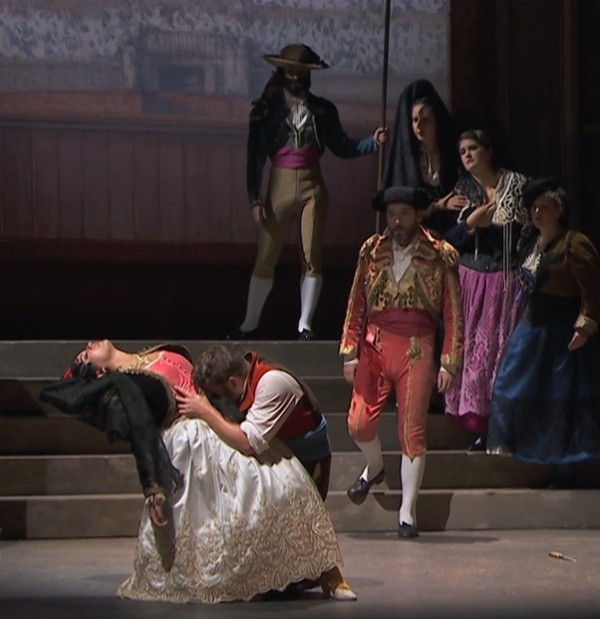
The Death of Carmen (Deepa Johnny, Carmen; Stanislas de Barbeyrac, Don José; Nicolas Courjal, Escamillo), 2023 (L’opéra de Rouen Normandie)
The livret de mise en scene gives a precise choreography for this critical ending scene:
Carmen, frightened, takes a few steps backwards and rushes towards the entrance to the bullring. José seizes her on the steps and stabs her, with his back to the audience, and she falls close to the curtain, her head stage right. José kneels beside her.
At the end of the offstage reprise of the chorus, the curtains of the bullring open again, and the crowd rushes onto the stage, mostly going stage right.
Since the chorus is singing at this point, this last entrance is only made by the minor characters and extras.
The dragoons line the back of the stage, and the Alcade and his two alguazils are on the steps.
Escamillo enters last.
And so he discovers the death of Carmen.
The Palazzetto Bru Zane was built and completed in 1697 as the Casino Zane, housing the entertainments of the Zane family, who lived nearby in the Palazzo Zane. The Palazzo is now the Scuola Livio Sanudo. The Fondation Bru purchased the Casino in 2006 and spent the next few years restoring it. The Casino Zane was renamed the Palazzetto Bru Zane and opened in 2009.
The building is filled with artwork from the late–17th century designed by the original architect, Anton Gaspari, and completed by his assistant, Domenico Rossi. The modern building has 16 rooms, including the glory of the house, a double-height salon (music room of the Zane family) with a magnificent coved ceiling bearing a huge painting of Hercules with Fame and Virtue in the centre, and Olympian gods in grisaille in the four corners.
The Palazzetto Bru Zane is bringing a particular part of French Romantic music to life and, in doing so, shows us how much we have been ignoring. From the very first piece on their very first concert in 2009, women composers have been part of their repertoire. And, not just the chamber music that you mostly hear, they perform the symphonic works, the operas, and the large-scale pieces that have been largely set aside in the 20th-century marginalising of women.
Mélanie Bonis: Le Songe de Cleopatre, Op. 180 (Lyon National Orchestra; Nikolaj Znaider, cond.)
Come discover the joys of the long (French) nineteenth century through the work of the Palazzetto Bru Zane. Their website holds a world of information to guide you through one of the richest periods in modern French history.
Official website: https://bru-zane.com/en/
For more of the best in classical music, sign up for our E-Newsletter