
The double piano concerto is a musical form that is seen relatively rarely in the classical music world.
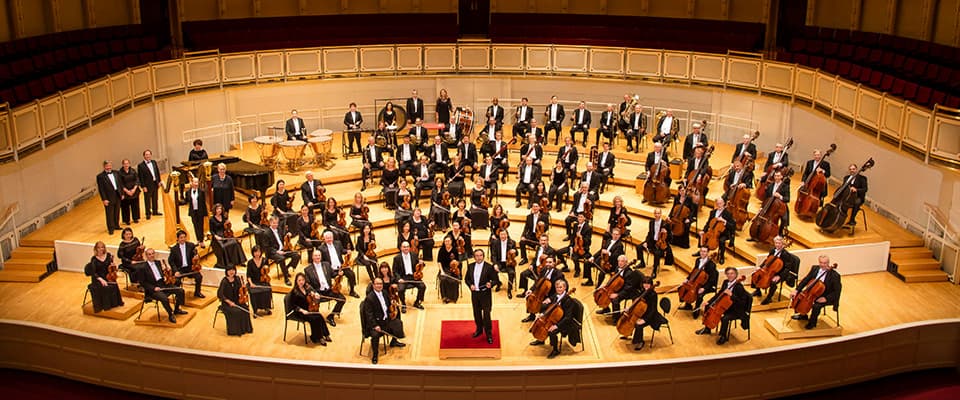
This type of concerto features two piano soloists and two pianos placed at the front of the orchestra.
Double piano concertos offer exciting opportunities for composers to create unique sound worlds and gripping three-way dialogue between soloists and orchestra.
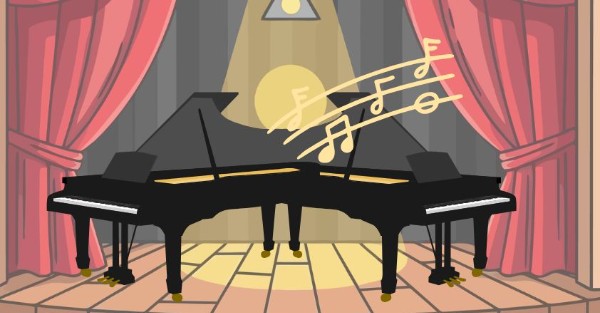
Today, we’re doing a speedrun through ten of the best double piano concertos in the repertoire, spanning from the Baroque era to the late twentieth century.
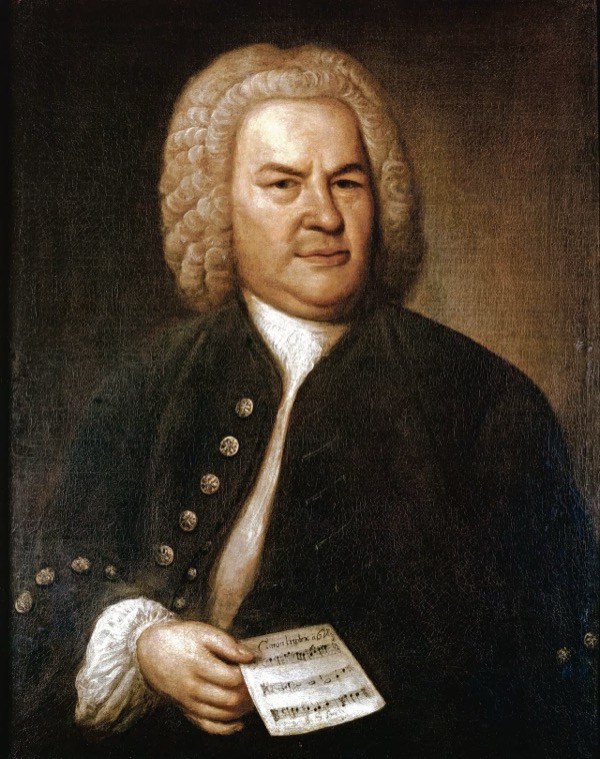
Johann Sebastian Bach – Concerto for Two Harpsichords in C-minor, BWV 1060 (c. 1735)
We’re cheating a little bit here, since Johann Sebastian Bach didn’t actually write this concerto for two pianos.
In fact, he wrote it for two harpsichords in the late 1730s. (The modern piano didn’t develop until later in the eighteenth century.)
However, nowadays it is almost always played on two pianos, given that it’s easier to find two pianos than two harpsichords.
It is believed that this concerto was rearranged from another double concerto for violin and oboe.
Its outer movements feature lively dialogue between the soloists, while the slow middle movement is a touching and spiritual adagio.
Wolfgang Amadeus Mozart – Piano Concerto No. 10 (1779)
Historians surmise that a young Wolfgang Mozart composed this concerto for himself and his fellow prodigy sister Nannerl. She was 28, and he was 23. He eventually performed it with one of his students, Josepha Barbara Auernhammer.
It is the only concerto he wrote specifically for two pianos.
The work bursts with playful energy, especially in the spirited finale, but it never loses its trademark Mozartean elegance.
Felix Mendelssohn – Concerto for Two Pianos and Orchestra in E-major (1823)
Felix Mendelssohn wrote his first double piano concerto in 1823, the year he turned fourteen.
Like Wolfgang, Felix was deeply inspired by his older piano prodigy sister Fanny. Felix premiered this concerto at a private house concert in December 1823 with Fanny, who was eighteen.
It is believed that this double concerto, along with the second in A-flat that followed close on its heels, was the first orchestral work that Mendelssohn ever attempted.
Although it is lyrical and charming, Mendelssohn ultimately decided it was an immature work and chose not to publish it during his lifetime.
It’s a fascinating glimpse of a composer who was only a few years away from writing great chamber and orchestral works like his Octet and his Midsummer Night’s Dream Overture.
Felix Mendelssohn – Concerto for Two Pianos and Orchestra in A-flat-major (1824)
Interestingly, Mendelssohn wrote a follow-up to his first double piano concerto a year later, in November 1824.
It was inspired by his mentor, celebrated pianist and piano teacher Ignaz Moscheles, who had given both Felix and Fanny lessons and praised them both.
Mendelssohn and Moscheles gave the first performance of this concerto in Berlin in 1825.
Max Bruch – Concerto for Two Pianos and Orchestra (1915)
In 1911, elderly German composer Max Bruch heard two young American sisters, the Sutros, perform his Fantasy in D-minor for Two Pianos.
They were one of the first professional piano duo acts in America, and they were on the hunt for repertoire. In 1915, they asked if he could write a double concerto for them, and he agreed.
He repurposed material from his Third Orchestral Suite, which meant the concerto had a quick turnaround time.
He declared that the double concerto should only be performed in America, presumably to leave space for the orchestral suite that inspired it to be heard in Europe.
The Sutro sisters – for reasons that are unknown to us – ended up drastically altering the score. They performed a version of it twice, then suppressed it. It was only rediscovered and reconstructed after their deaths.
The music is a heartfelt souvenir of late German Romanticism, the kind that World War I would soon kill off for good.
Ralph Vaughan Williams – Concerto for Two Pianos and Orchestra (1926–1946)
Ralph Vaughan Williams initially conceived this concerto as a work for solo piano and orchestra, but its difficulty and thick texture led him to revise it for two pianos.
He wrote the first version for one piano between 1926 and 1930. He then reworked it on the advice of a conductor friend, and that reworked version was premiered in 1946.
The end result feels like a mashup of a couple of historical and musical eras…because it was!
The music is edgy and powerful, even as it employs tinges of English folk influences that one might initially think of as pastoral.
Francis Poulenc – Concerto for Two Pianos and Orchestra (1932)
One of the most beloved works in the double concerto genre, Francis Poulenc’s concerto is witty, colourful, and irresistibly charming: a true highlight of the jazzy 1930s.
The work draws on a wide array of inspirations: Balinese gamelan music that he heard at the 1931 Paris Colonial Exhibition, the easy virtuosity of Mozart’s concerto writing, and the orchestral colour of his compatriot Maurice Ravel.
Poulenc was pleased with the concerto, writing to one musicologist, “You will see for yourself what an enormous step forward it is from my previous work and that I am really entering my great period.”
He was right. Its fizzy, effervescent spirit has made it a staple of the two-piano repertoire.
Bohuslav Martinů – Concerto for Two Pianos and Orchestra (1943)
Composed during World War II, Martinů’s double concerto was written a decade after Poulenc’s, and, although it may be similarly high-spirited, it also seems to reflect the frantic anxiety of the ongoing world war.
The concerto was commissioned by husband-and-wife piano duo Pierre Luboschutz and Genia Nemenoff, whom Martinů had met while attending the Tanglewood music festival in 1942.
At the Philadelphia premiere of the concerto in 1943, Martinů wrote in the program notes:
“In the Concerto…I have used the pianos for the first time in the purely ‘solo’ sense, with the orchestra as accompaniment. The form is free; it leans rather toward the Concerto grosso. It demands virtuosity, brilliant piano technique, and the timbre of the same two instruments calls forth new colours and new sonorities.”
Grażyna Bacewicz – Concerto for 2 Pianos and Orchestra (1966)
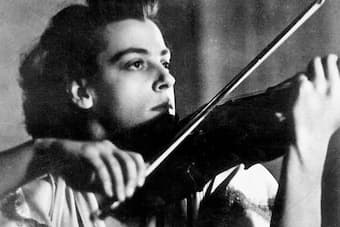
Grażyna Bacewicz
Grażyna Bacewicz: Concerto for 2 Pianos (Peter Jablonski, piano; Elisabeth Brauss, piano; Finnish Radio Symphony Orchestra; Nicholas Collon, cond.)
Polish composer, violinist, and pianist Grażyna Bacewicz wrote an astonishing series of mid-century works of staggering quality.
Unfortunately, her name never became as famous as her Soviet contemporary Shostakovich. Luckily, though, she is being rediscovered today.
Filled with motor-like rhythms (an instinct that, amusingly, Bacewicz attributed to her premature birth), rumbling and percussive piano writing, it is both avant-garde and, as new music of the 1960s goes, approachable.
Luciano Berio – Concerto for Two Pianos and Orchestra (1972–1973)
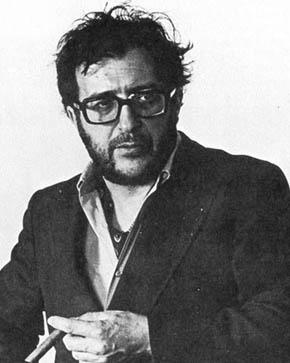
Luciano Berio
Luciano Berio: Concerto for 2 Pianos (Antonio Ballista, piano; Bruno Canino, piano; London Symphony Orchestra; Luciano Berio, cond.)
Berio’s concerto, dedicated to the pianists Katia and Marielle Labèque, takes Bacewicz’s avant-garde attitude and pushes it forward.
In this double concerto, Berio creates a tireless kaleidoscope of sound, layering fragmented solo piano parts against equally fragmented orchestral textures.
Unfortunately, at its premiere, Harold Schoenberg from the New York Times was less than impressed, writing:
“As the concerto continued, it became very dense, very complicated and very reminiscent of Stockhausen, Stravinsky and others. Mr. Berio really does not have much in the way of an original statement to offer.”
However, even if you agree with Schoenberg’s analysis, you can’t deny the work’s energetic nature: a trait that all of the works on this list share.
Perhaps there is just something innately extroverted about this particular combination of instruments.
Conclusion
From the pens of Bach to Berio, the double piano concerto has been written by many hands, taking on many identities in the process.
These ten works highlight the genre’s diversity, revealing how two pianos can collaborate, clash, and converse with the orchestra in endlessly fascinating ways. All ten are uniquely thrilling for pianists and listeners alike.
Have you ever seen a double piano concerto live? Which one is your favourite on the list?
For more of the best in classical music, sign up for our E-Newsletter





Bartok? I’d say much more known than Berio.