Today, we’re going back in time to hear ten of the earliest and oldest classical music recordings of all time.
Long before streaming services, records, or radio, engineers were experimenting with ways to preserve sound on fragile wax cylinders.
The result is a handful of recordings dating from the late nineteenth century. They offer us a direct (if at times static-y) link to the musicians, composers, and ensembles of the distant past.
1888 – Excerpts from “Israel in Egypt” by Handel, performed by the Handel Festival
On 29 June 1888, a remarkable performance took place in London’s massive Crystal Palace.
Handel’s oratorio Israel in Egypt was performed by approximately 500 musicians and 4000 singers, to the delight of an audience of 23,000.
In the press box was a man named George Edward Gouraud. He worked for American inventor Thomas Edison and was operating a new invention called the phonograph.
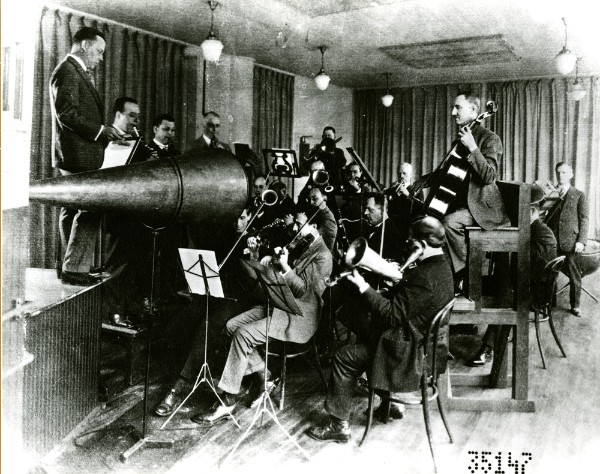
During the performance, Gouraud oversaw the recording of portions of the oratorio using a large cylinder.
This is the first recording of music ever made that has survived. It was thought lost until it was unearthed by the BBC in the 1980s and restored.
Unfortunately, the technology was in its early infancy, and the recording deteriorated over time, so little of the performance remains audible today.
But despite all the ghostly static, it’s still a fascinating relic from a bygone era.
1888 – “The Lost Chord” by Sir Arthur Sullivan, performed by unknown musicians
Gouraud continued his work on the phonograph.
In the summer of 1888, an anonymous pianist and cornet player sat in front of the cylinder to perform an arrangement of Sir Arthur Sullivan’s popular song “The Lost Chord.” The recording was played at a press conference in August 1888.
Unfortunately, due to technological limitations, the song cuts off before it finishes. On the plus side, it’s much more audible than the Handel recording.
The YouTube video above also features an interesting companion performance dating from October 1888: a greeting from Sir Arthur Sullivan to Thomas Edison.
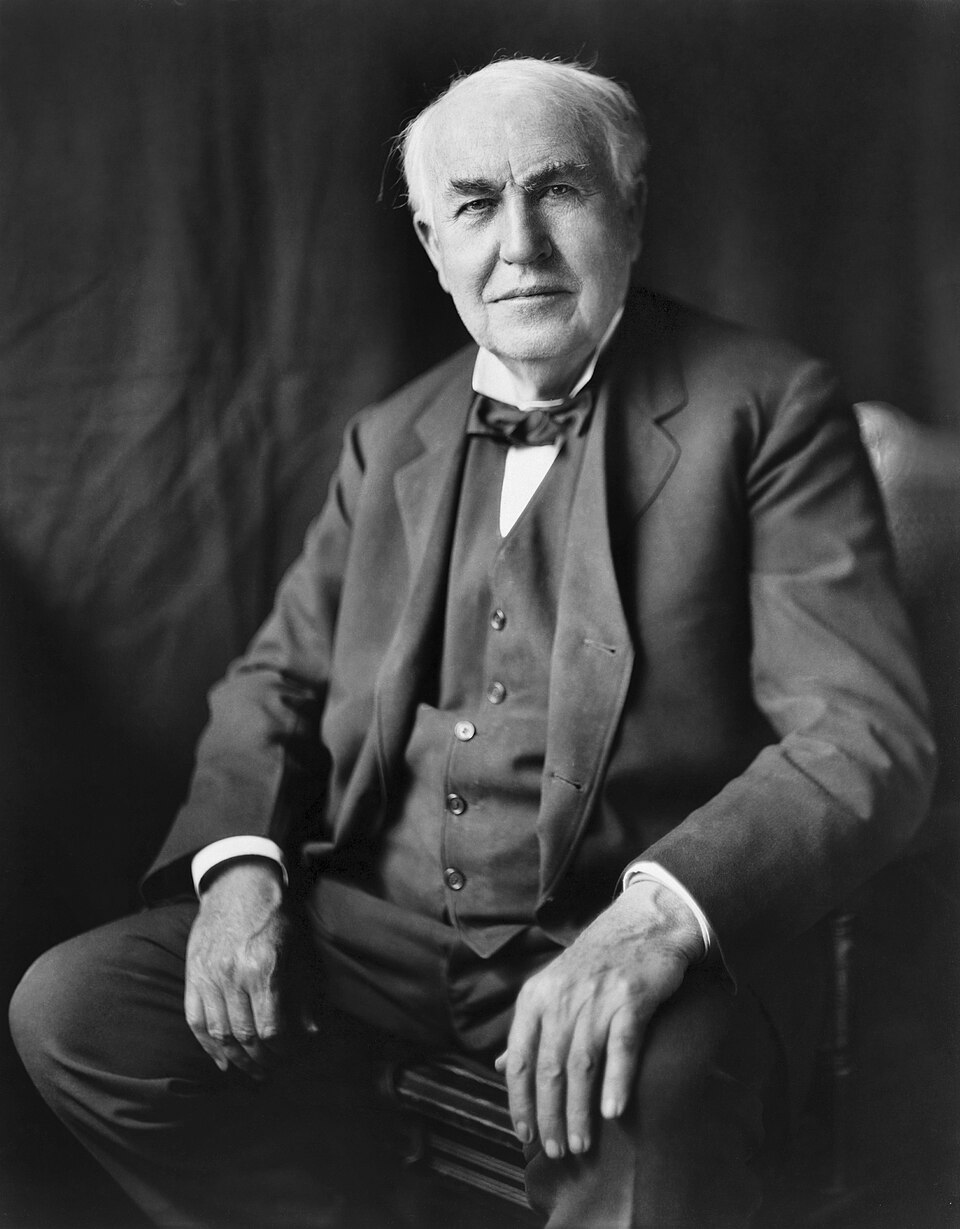
Thomas Edison
Transcribed, Sullivan’s amusing message reads:
Dear Mr. Edison, if my friend Edmund Yates has been a little incoherent, it is in consequence of the excellent dinner and good wines that he has drunk. Therefore, I think you will excuse him. He has his lucid intervals. For myself, I can only say that I am astonished and somewhat terrified at the result of this evening’s experiments: astonished at the wonderful power you have developed, and terrified at the thought that so much hideous and bad music may be put on record forever. But all the same, I think it is the most wonderful thing that I have ever experienced, and I congratulate you with all my heart on this wonderful discovery. Arthur Sullivan.
1888 – Song Without Words, op. 62, no.6, by Mendelssohn, performed by Miss Eyre
These brief Edison recordings date from 1888 in Britain. The pianist is a woman named Miss Eyre, whose full name and biography have unfortunately been lost to history.
However, what we do know is that this is among the earliest piano recordings ever made, and the first of millions to come!
1889 – Hungarian Dance No. 1 by Brahms, performed by Brahms
In December 1889, Adelbert Theodor Wangemann, an American immigrant and Edison employee, traveled back to his native Europe. While there, he made a recording of one of the best composers of the era, Johannes Brahms.
At the recording session, Brahms played an excerpt from the piano version of his first Hungarian Dance, as well as a polka called “Die Libelle” by Johann Strauss, Sr.
The recording has deteriorated so badly that it is difficult to make out, which is why the video above includes a modern recording to demonstrate which excerpt from the score Brahms played.
It is unknown whether the voice on the recording shouting Brahms’s name is actually Brahms, but it’s certainly fun to imagine it is!
As a bonus, this video also includes audio of a 1903 performance by violinist Joseph Joachim. Joachim was one of Brahms’s dearest friends and the dedicatee of his violin concerto. His interpretation is an invaluable artefact.
1889 – Excerpts from Don Giovanni by Mozart, performed by Peter Nicholas Schram
This recording is believed to be the first opera recording ever made.
It was sung by Danish singer Peter Nicholas Schram, who was born in 1819, making him seventy years old at the time of recording. His age makes him the earliest-born opera performer ever recorded!
(Fun fact: this recording was actually made after his last performance as Leporello at the Danish Royal Opera; when he recorded it, he was at an after-party.)
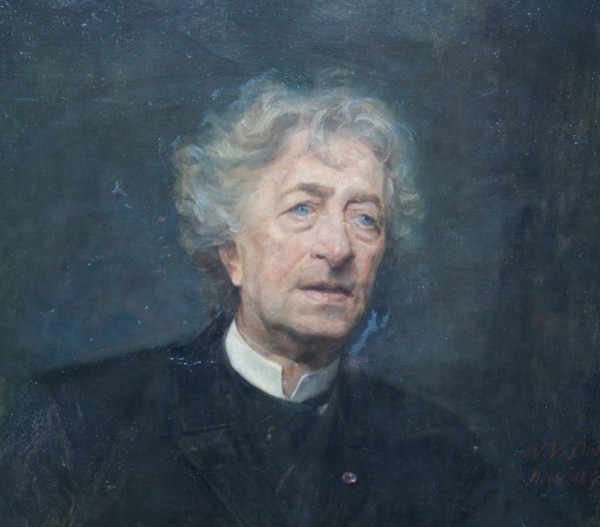
Peter Nicholas Schram
Schram’s most famous role was as Leporello in Mozart’s opera Don Giovanni. Schram studied under the master nineteenth-century vocal pedagogue Manuel Garcia, who in turn sang the role while the opera’s librettist, Lorenzo da Ponte, was in the audience and available to provide feedback.
Consequently, this recording is a tantalisingly close glimpse into Mozart’s sound world.
1890 – “Wohin?” from Die Schöne Müllerin by Schubert, performed by Karl Mayer
This recording is a movement from Schubert’s song cycle Die Schöne Müllerin for baritone and piano.
It was made in Cologne, Germany, by Adelbert Theodor Wangemann, the same engineer who made the Brahms recording.
The baritone is Karl Mayer and the pianist is Franz Wüllner.
Not much information is available about Mayer, but Wüllner’s career is well-documented. He was a pianist, composer, and conductor who premiered Wagner’s Das Rheingold and Die Walküre. He was born in 1832, which makes him the earliest-born pianist whose playing we have an acoustic recording of.
1890 – Piano Concerto No. 2, by Chopin, performed by Otto Neitzel
Pianist Otto Neitzel was born in 1852. He began playing piano as a child and studied with Franz Liszt between 1873 and 1875. In the years that followed, he became a professional musician, as well as a music writer and teacher.
This recording was, judging by the voices present, a relatively informal one. Neitzel plays an excerpt from the much longer Chopin Piano Concerto No. 2, without orchestral accompaniment.
This recording was, like others on this list, also overseen by Adelbert Theodor Wangemann.
1890 – Rubinstein and Tchaikovsky, by Vasily Samus and maybe Anton Rubinstein
In 1890, cylinder-maker Julius Block kept trying to get celebrated pianist Anton Rubinstein to make a recording. Rubinstein, sixty years old at the time, kept turning him down, claiming he didn’t want his mistakes to be preserved for all time.
However, a recording of tenor Vasily Samus has made historians wonder if Rubinstein eventually (secretly) acquiesced.
Samus’s uncredited piano accompanist in this 1890 recording sounds incredibly accomplished, and it has been suggested that the vocal announcement before the performance includes the words “es spielt der Titan [the Titan plays].” Block referred to Rubinstein as a titan in his journal.
If that’s not convincing enough, in the song “Longing” by Rubinstein, the anonymous pianist takes a number of improvisatory liberties, suggesting an intimate familiarity with the score and an authority to alter it. Is it possible that this recording belongs to Rubinstein himself?
1894 – The Liberty Bell by John Philip Sousa, by the United States Marine Band
John Philip Sousa was born in Washington, D.C., in 1854 to a trombonist in the United States Marine Band and his wife. Sousa enrolled in the band at the age of thirteen as an apprentice. By 1880, he was head of the Marine Band. In 1892, he and the band became national sensations due to their recordings.
Sousa left the band in July to pursue a civilian career.
He wrote “The Liberty Bell” in 1893. Originally, it was written for an operetta that was never finished or produced, then given the patriotic Liberty Bell moniker later.
This is one of the earliest examples of recorded ensemble playing. The technology of the time made recording for multiple instruments difficult and unwieldy, but Sousa and his Marine Band eventually became masters at it.
1897 – Morning Serenade by Boston Fadettes Ladies Brass Quartette
The United States Marine Band and the Sousa Band weren’t the only noteworthy brass groups of the late nineteenth century.
The Fadettes of Boston was an all-woman ensemble based in Boston, conducted by violinist Caroline Nichols. (This was a time when women were barred from playing in most American orchestras.)
The Fadettes began as a chamber ensemble in 1888 but grew to become a full orchestra during the 1890s.
Over the next thirty years, they gave over six thousand concerts across the United States.
In 1897, their brass section made this recording.
Conclusion
All of these recordings are difficult for modern listeners to make out. But the windows they grant us into the musical world of the 1880s and 1890s – as brief and static-y as they are – are still incredibly tantalising.
Which is your favourite? And which Romantic Era composer do you wish had made a recording?
For more of the best in classical music, sign up for our E-Newsletter