The great composers are not particularly famous for their faithfulness. Many had extramarital affairs.
The stories of those relationships provide intriguing glimpses into their complicated personal lives.
Today, we’re looking at the relationships between five composers and their mistresses: how they met, how their wives reacted to being sidelined, and how their mistresses shaped their creative output and legacies. (More from The Most Famous Mistresses in Classical Music History: Part 1)
Claude Debussy and Emma Bardac
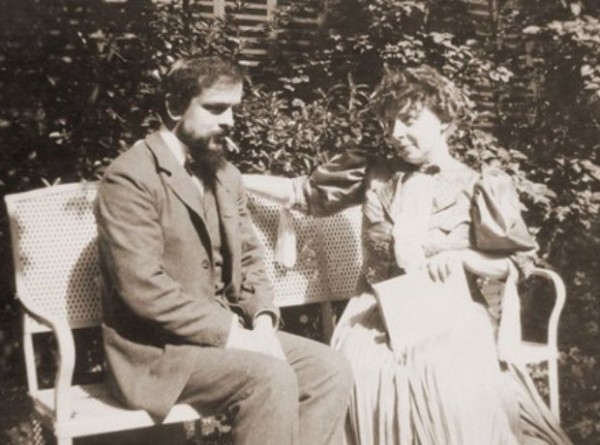
Claude Debussy and Emma Bardac
Claude Debussy is famous for his sensitive Impressionist-era compositions, but when it came to his love life, he was a brute.
Debussy married Lilly Texier in October 1899, after threatening to kill himself if she didn’t accept his proposal.
Their marriage was happy for three years, but his eye soon began to stray. In October 1903, Debussy met the mother of one of his piano students: the singer Emma Bardac, a sophisticated banker’s wife with an angelic voice.
By early 1904, Debussy and Bardac were a couple. That summer, when Lilly went to visit her family in the country, Debussy stayed behind and traveled to the Isle of Jersey with Emma instead. He decided that his marriage was over and told Lilly so…by letter!
In a fit of despair, Lilly shot herself. After Debussy heard the news, he went to her doctor to see if she’d survive. Once he found out that she would, he left her again.
Debussy’s Sonata for Flute, Violin, and Harp, which was dedicated to Emma
Debussy’s unconscionable behaviour shocked Parisian society to its core, and he lost a number of good friends over it. The scandal only became worse when Bardac left her husband for Debussy.
Debussy and Emma both divorced their respective spouses in the summer of 1905. That October, they had a baby girl together. They married in 1908 and stayed together until Debussy’s death in 1918.
Giacomo Puccini and Multiple Mistresses
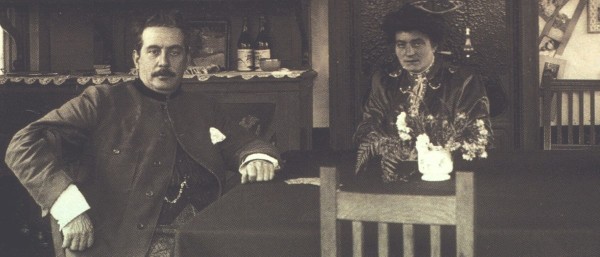
Puccini and Elvira Gemignani
Puccini’s operas are famous for their dramatic plots, but they don’t hold a candle to the drama of his real life.
Puccini’s relationship with his future wife, Elvira Gemignani, began in the 1880s. Puccini was single at the time, but Elvira was married to another man.
Elvira separated from her husband (although she did not divorce him) and gave birth to Puccini’s baby in 1886.
However, in a truly operatic twist, her husband died in 1903…at the hands of his mistress’s husband!
Puccini married the widowed Elvira the following year. But he was a relentless womaniser, and he had a string of mistresses during his marriage.
Women who are believed to have been Puccini’s mistresses at one time or another include Blanke Lendvai (composer Ervin Lendvai’s sister), aristocrat Josephine von Stengel, and singer Rose Ader. Although we know that Puccini had many affairs, we don’t have a lot of documentation about them.
“Un bel dí vedremo” from Puccini’s opera Madame Butterfly
The toxic mix of Puccini’s serial infidelity and Elvira’s paranoia came to a horrifying head in 1908, when Elvira accused their maid Doria Manfredi of being one of her husband’s mistresses.
Doria, unable to handle the stress surrounding the accusations, poisoned herself, suffering an excruciating death. A post-mortem medical exam indicated that she was a virgin. Doria’s mother sued Elvira for defamation.
Learn more about the scandalous court case that dogged the Puccinis.
Alban Berg and Hanna Fuchs-Robettin
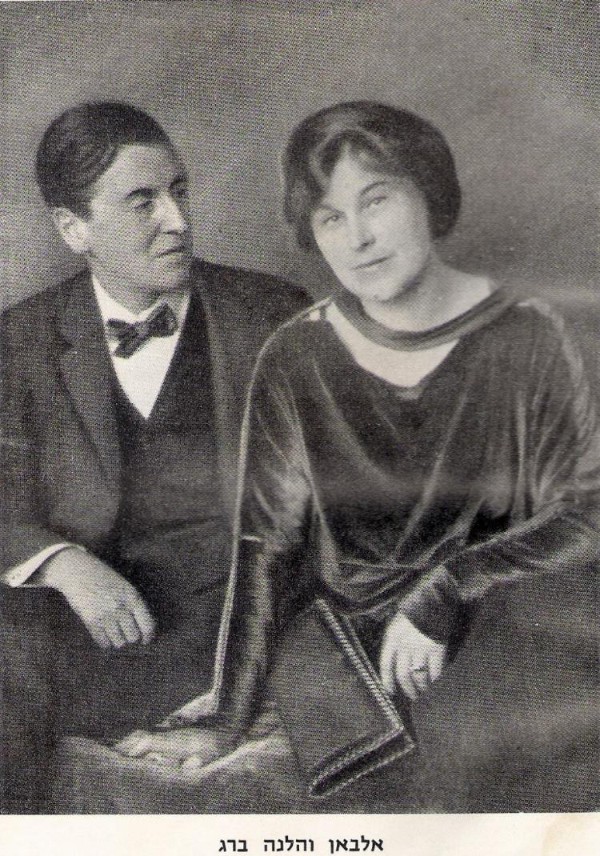
Alban Berg and Helene Nahowski
In 1906, at the age of 21, Alban Berg met singer Helene Nahowski. She was from a wealthy family, and it was an open secret in Vienna that she was the illegitimate daughter of Emperor Franz Joseph I.
The couple married in 1911. Her family wasn’t enthusiastic about the match, believing that Berg’s professional prospects were dim.
Berg had a number of affairs during his marriage, but always returned to Helene. They never had any children.
In 1925, Berg met a woman named Hanna Fuchs-Robettin when he was in Prague attending a musical performance.
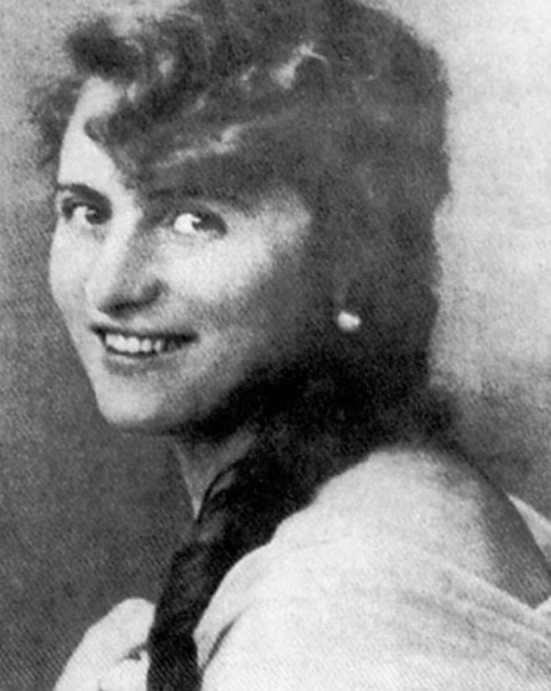
Hanna Fuchs-Robettin
At the time, she was married to one of Berg’s friends, industrialist Herbert Fuchs-Robettin, who, awkwardly, had been the one to invite the composer to their home.
Berg later wrote to her:
It all started with your eyes, those eyes, that glance – who could find words for it? The poet is not yet born – can music even express it?
Berg’s Lyric Suite
He certainly tried. Berg wrote one of his most famous works, the Lyric Suite, when he was in love with Hanna.
This six-movement work for string quartet included a variety of codes, including permutations of the note names A and B for Alban Berg, and H (or B-flat) and F for Hanna Fuchs.
He wrote in an annotated score for her:
[The Suite] has also, my Hanna, allowed me other freedoms! For example, that of secretly inserting our initials, HF and AB, into the music, and relating every movement and every section of every movement to our numbers, 10 and 23. I have written these, and much that has other meanings, into the score for you… May it be a small monument to a great love.
The couple continued their affair until Berg’s death in 1935. Hanna kept the annotated manuscript for the rest of her life, but it was only rediscovered decades later.
Igor Stravinsky & Vera de Bosset
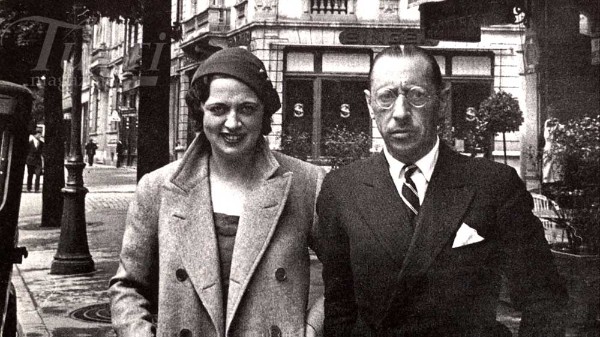
Igor Stravinsky and Vera de Bosset
Igor Stravinsky married his first cousin, Yekaterina Gavrilovna Nosenko, in 1906. Between 1907 and 1914, they would have four children together. Stravinsky wrote several of his most famous works during this time, including The Firebird and The Rite of Spring.
During the late 1910s, Yekaterina’s health began deteriorating, and the couple was exiled from Russia after the Revolution. They began drifting apart, and Stravinsky began seeing other women. In 1921, he began an affair with a married woman named Vera de Bosset.
Early in the affair, Vera told Stravinsky that she couldn’t stay with him, fearing that the relationship would hurt Yekaterina, but Stravinsky had another vision: that both women could become friends!
Stravinsky’s Octet, dedicated to Vera
In 1922, Stravinsky told Yekaterina about his relationship with Vera. She was shattered by the betrayal.
Yekaterina’s future daughter-in-law later wrote:
For [Yekaterina] there now began the long and terrible agony of her life, and a veil of sadness was drawn forever over her beautiful face.
For her children’s sake, she learned how to conceal her torment, her injury. She wanted to see them playing happily, so she kept her knowledge to herself.
She knew that Igor could be fickle, but now she had to learn to think of it in another way.
With what grandeur of soul she faced the truth and accepted that the man she loved was leading a double life. From now on, Igor would accommodate two women in his heart.
The women did end up being cordial with one another. Yekaterina and Vera began a correspondence and even met in person. Supposedly, Yekaterina said, “If there has to be another woman, I am glad that it is you.”
Stravinsky paid for Vera’s apartment in Paris, and, disturbingly, forced Yekaterina to deliver the money to Vera to pay for it.
Yekaterina’s health situation – a tuberculosis diagnosis – became dire in the late 1920s. She died in 1939. After her death, Stravinsky married Vera, who would become the composer’s caretaker as he aged.
Sergei Prokofiev & Mira Mendelson
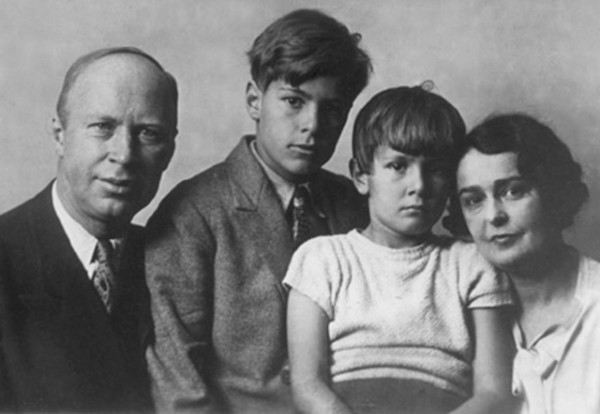
Sergei Prokofiev, Lina Codina and their children
Sergei Prokofiev married his first wife, Lina Codina, in 1923 after dating for four years. They had two sons together.
Lina was born in Spain and spent time in the United States. So when Prokofiev decided to return to his Russian homeland in the 1930s, she was hesitant to go with him. She feared what might happen to him or their family under Stalinist rule. Prokofiev, however, dismissed her concerns.
In 1938, while the family was on vacation, he met a young poet named Mira Mendelson. He was 48 and she was 24.
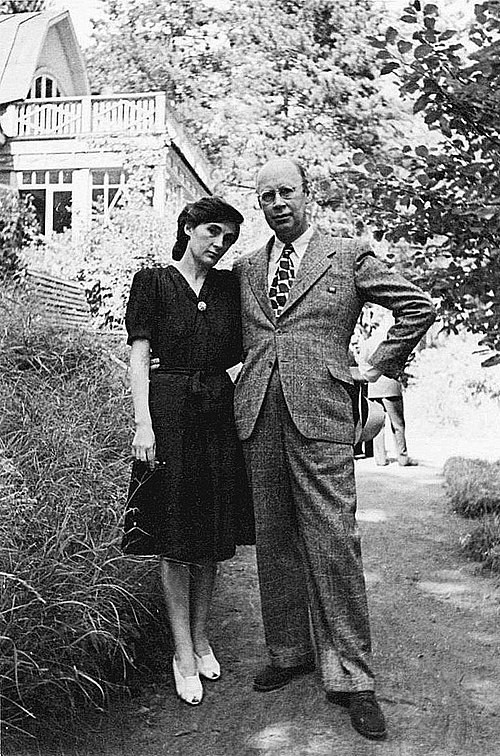
Prokofiev and Mira Mendelson
They fell in love and began collaborating professionally. That year, he used one of her poems in his collection of Seven Songs, and in the 1940s, she would write the libretto for Prokofiev’s opera War and Peace.
An aria from War and Peace
In the fall of 1938, he began appearing in public with Mira at events, sidelining Lina. In 1941, Prokofiev left Lina to live with Mira, although he continued to pay for Lina’s upkeep.
In 1947, after World War II was over, Prokofiev filed for divorce from Lina. He married Mira in January 1948, making his mistress his wife.
Just five weeks later, Lina was arrested and, horrifyingly, sentenced to twenty years in the gulag, possibly due to her repeated attempts to escape the country. In 1953, she found out that Prokofiev had died by hearing it on the camp radio.
As for Mira and Prokofiev, their short marriage, lasting until his death, was content. Mira spent her widowhood devoting herself to preserving her husband’s musical legacy.
For more of the best in classical music, sign up for our E-Newsletter