Robert and Clara Schumann were never going to be a normal couple. She was one of the greatest pianists in Europe, and he was one of the greatest composers.
From the beginning, their love story was a turbulent one. Clara’s father famously didn’t want his daughter to marry Robert. However, after a court battle, the couple received permission from the court to marry. They did so in September 1840, the day before Clara’s twenty-first birthday.
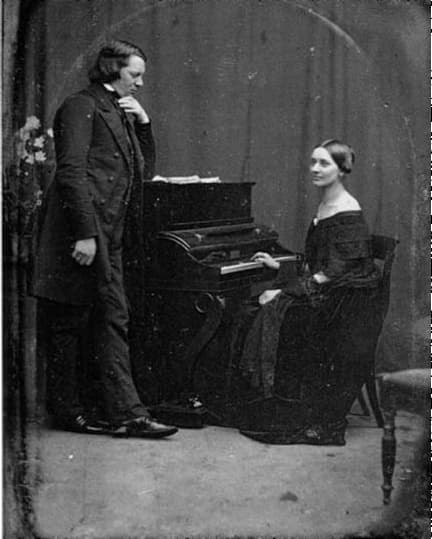
Robert and Clara Schumann
Of course, their fascinating love story didn’t end there. As newlyweds, they had to learn how to balance their art with raising their children and earning enough money to live.
The challenges that would characterise their entire marriage came into sharp focus in 1844, during a joint four-month tour to Russia.
Arguing Over Money
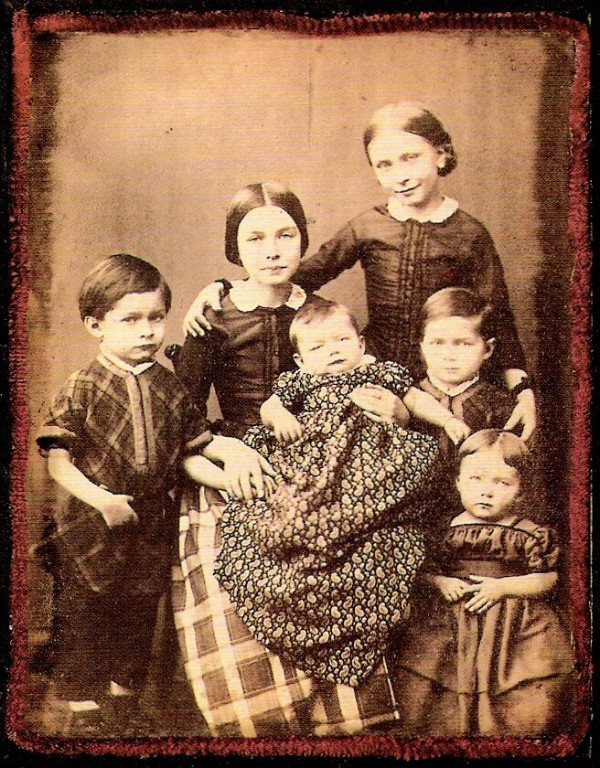
Robert and Clara Schumann’s children
Nearly every couple has disagreements over money at some point in their relationship, and Robert and Clara were no exception.
By 1843, Clara had already had two babies, and it was clear the family was going to keep growing…alongside mounting financial pressures.
In February 1843, shortly before the birth of their second child, Robert admitted, “We need more than we earn.”
This knowledge made Clara antsy. She was much more famous than her husband, and in huge demand as a concert artist.
As historian Nancy B. Reich points out in her Clara Schumann biography, “They both knew she could earn more in one three-week concert tour than [Robert] Schumann obtained from composing and editing in a year.”
Robert’s Hesitance
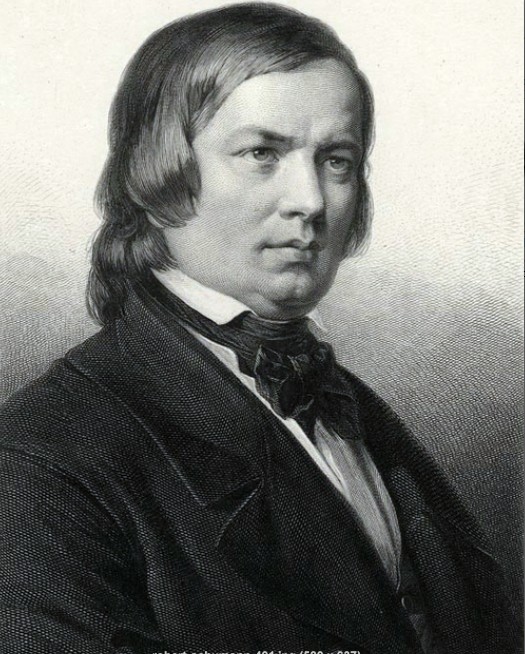
Robert Schumann
Nowadays, the solution seems obvious: have Clara tour for a few weeks and pay the bills! Unfortunately, Robert felt that his wife’s concertizing was emasculating.
He wanted to support her artistic life – indeed, her musical ability was one of the reasons he’d fallen in love with her in the first place – but he was also most comfortable in his marriage when she focused on her role as traditional Hausfrau.
It’s also worth remembering that in nineteenth-century Germany, it was very common for women musicians to retire from the stage completely once they married, or to only give public performances for charity. Comparatively few married women performed for money.
Clara’s concertizing could easily have been interpreted by audiences as an indictment of Robert’s ability to provide for his family.
Robert was especially sensitive to these kinds of accusations, given that during the recent court battle, Clara’s father had testified publicly about Robert’s supposed inability to provide for his daughter.
However, Clara had a practical streak and a love for the spotlight that overrode these kinds of considerations. In late 1842, she set her sights on a longtime goal: touring Russia.
Clara Schumann’s Piano Sonata, 1841-42
Preparing for the Trip
Even before they’d set the date of their departure in stone, Robert’s mental health began deteriorating.
Clara eventually went to none other than Felix Mendelssohn for advice on how to handle the situation!
After much protest, on 6 January 1843, Robert finally agreed to the Russian tour. His stated reason for changing his mind? Not an admission that they needed money, but his belief that the trip would give him an opportunity to focus on composition.
The couple said goodbye to their two young daughters, leaving them with Robert’s brother and sister-in-law. They left for Russia on 25 January 1843.
Why Russia?
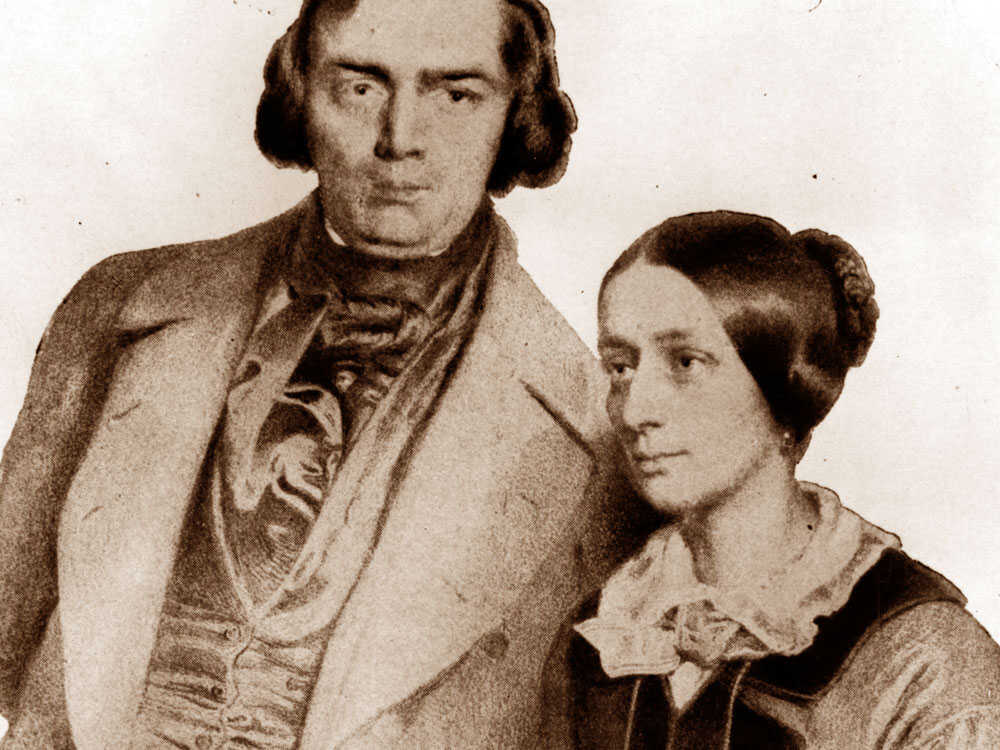
Robert and Clara Schumann
Clara had wanted to go to Russia for years. She had thought about going in 1840, but Franz Liszt was touring the country at the time. He was one of the few pianists playing at her level, and she didn’t want to compete with him.
What was so attractive about Russia for classical musicians in the mid-nineteenth century?
During her reign, Catherine the Great (1729-1796) had encouraged the development of the arts. Plus, Russia was continuing to become more and more international. Many Russian aristocrats had family members or tutors from countries like Italy, France, England, and Germany.
A Russian writer named Vladimir Stassov observed:
In those days, the Russian ruble had a very good clink to German ears; it was customary for such musical luminaries as Liszt, Thalberg, [Giuditta] Pasta, [Pauline Garcia] Viardot, … and others to come.
Clara’s younger brother, Alwin, had even relocated from Germany to St. Petersburg to make a career as an orchestral violinist.
Clara Schumann’s Impromptu in E-major, c. 1844
Clara’s Industriousness While Traveling
Robert and Clara did not travel alone. In those days, artists served as their own agents, and as a budding child prodigy, she had learned from her father/manager how important personal connections were when traveling to a new city or country.
Consequently, the Schumanns brought along two friends, pianist Adolph von Henselt (a figure later admired by a young Sergei Rachmaninoff) and composer Heinrich Romberg, both of whom had had success in Russia previously.
Their journey was grueling, but Clara flourished. Reich describes it this way in her Clara Schumann biography:
Clara, with her amazing stamina, had no difficulty with the rigours of a Russian tour in midwinter. She described several weeks of cold, exhausting travel by coach and sleigh through forests, over frozen rivers, huddled under furs and rugs, and stopping at uncomfortable and dirty inns… They almost froze, but Clara, exhilarated and fulfilled, pressed on.
Robert, however, became sick and miserable, suffering from physical aches and pains as well as profound anxiety and depression.
When they stopped in the city of Dorpat (now the city of Tartu in present-day Estonia), they consulted three doctors, who diagnosed Robert with the vague condition “nerve fever.”
His mental health was aggravated by one of Clara’s private performances in Dorpat, when a baron invited them to dinner, had Clara play for the guests, and then pressed 150 rubles into Robert’s hand. Already touchy about his wife out-earning him, he was humiliated by the gesture.
Robert Schumann’s Symphony No. 1, 1841
Arriving in St. Petersburg and Moscow
Eventually, the party arrived in St. Petersburg, where Clara promptly set to networking with Henselt. In the words of Reich, they visited “ministers, officials, and the court.”
They then set off for Moscow (with a brief detour to visit Robert’s uncle, who had moved to Russia forty years earlier).
During the trip, Robert became weak and dizzy. At one point, his symptoms became so severe that he feared he was going blind. Fortunately, he improved with rest, although he never did feel well enough to compose while on the road.
Whirlwind in Moscow
Clara was a triumph in Moscow. She gave a series of well-received concerts, culminating in a performance for the tsar and tsarina in the legendary Winter Palace. On 5 March 1844, she was awarded honorary membership in the St. Petersburg Philharmonic Society.
In the end, she would walk away from the tour with 6,000 taler, half of which was pure profit.
Robert also – finally – began to be appreciated. Two noble patrons, Count Mikhail Wiellhorski and a princess named Elena Pavlovna, were familiar with his music and deeply complimentary of it.
However, their praise was not enough to overcome the increasing obviousness of Robert’s mental health struggles.
One surviving account by a guest of a soiree hosted by Count Aleksei Federovich Lvov paints an alarming picture:
Schumann was, as usual, silent and withdrawn the whole evening. He spoke very little and just murmured incomprehensibly to the questions put by Count Wielhorski and the host, A. F. Lvov.
Something like a conversation developed with the famous violinist [Wilhelm Bernhard] Molique, who had just arrived in St. Petersburg a few days earlier, but it was carried on in whispers, without life and vivacity.
Most of the time, Schumann sat in a corner near the piano … with a sunken head, his hair hanging in his face; he had a pensive expression on his face, and it looked as if he were about to whistle to himself.
Robert Schumann’s Piano Quintet, 1842
Clara’s Reaction
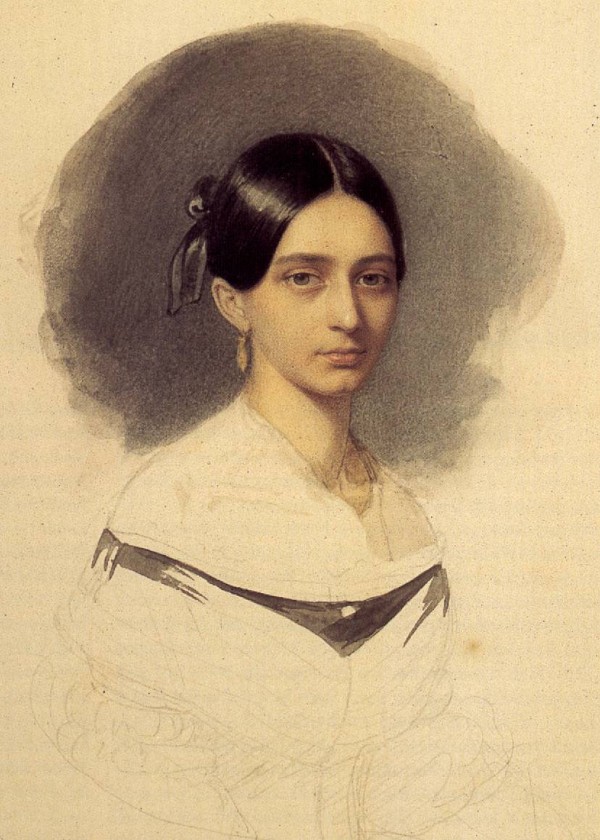
Clara Wieck Schumann
Remarkably, apparently, Clara was having such a wonderful time and was so thoroughly in her element that she never noticed her husband’s distress.
Robert made a terse complaint in his diary: “Almost unbearable suffering and Clara’s conduct!”
Clara responded by writing:
I know of nothing, but it seems to me now, as I read through the notebooks, that I frequently provoked Robert’s anger, though it was certainly never done intentionally, but only because of my own awkwardness and because I am slow. It often takes quiet deliberation on my part to understand what other, wiser souls may see in a moment.
However, for whatever reason, she swept his troubles under the rug the following day, when she wrote a glowing account of the trip and her triumphs to a friend.
Return to Leipzig
The tour ended on 30 May 1844, when the couple arrived safely back home in Leipzig.
She must have felt a bit like Cinderella after the spell was broken: the glamorous interlude she had spent as an in-demand concert artist was over, and now she was expected to return to her workaday duties as wife and mother.
About a month after their return, she got pregnant again. Around the same time, Robert’s mental health deteriorated even further. He even became bedbound for a time.
In the end, the Russia trip was a portent of things to come: Robert’s ill health and inability to carry out his professional abilities, as well as the strength Clara would draw from touring.
She would have to draw on every ounce of that strength during her husband’s ensuing illness and, afterwards, her long widowhood.
For more of the best in classical music, sign up for our E-Newsletter