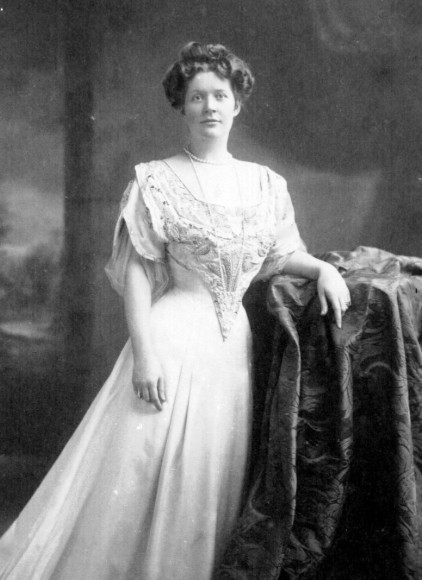
Leonora von Stosch Speyer is a particularly fascinating figure in the history of classical music.
Not only was she a celebrated violin soloist, but also a noted patroness of many composers in the early 1900s.
She also became a celebrated poet in her middle age, winning a Pulitzer Prize for her poetry collection Fiddler’s Farewell in the 1920s.
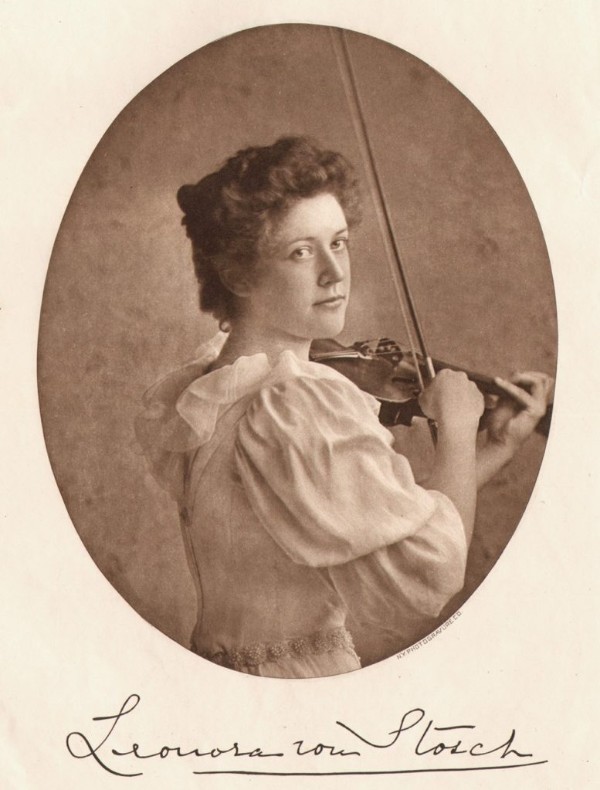
Leonora von Stosch Speyer
Today, we’re looking at how she did it all.
Leonora von Stosch’s Family Origins
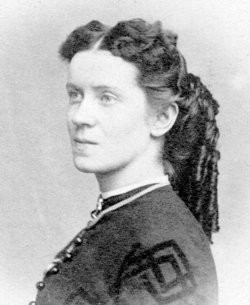
Julia Thompson von Stosch
Leonora von Stosch was born to an intellectual family in Washington, D.C., on 7 November 1872.
Her father was Count Ferdinand von Stosch, an immigrant and an American Civil War veteran. Her mother was Julia Thompson von Stosch, a talented amateur musician and a professional writer renowned for her short stories. Clearly, Julia was an important role model for her daughter.
Ferdinand and Julia had four children together. Leonora was the youngest. Tragically, Ferdinand died in May 1872, six months before Leonora’s birth. She grew up fatherless.
Leonora von Stosch’s Childhood
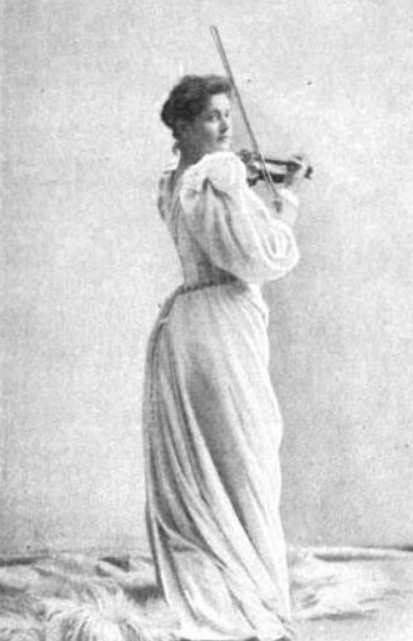
Leonora von Stosch Speyer
It was clear from an early age that Leonora was very musically talented. She studied both piano and violin and started composing. She also gave music lessons to her friends, charging them a penny for each lesson.
While still a child, she concertized around the Washington area. At the age of ten, she gave a public performance of Beethoven’s Moonlight Sonata.
But as she got older and more advanced, she felt she had to choose between the piano and the violin. Fatefully, she chose the violin.
Leonora von Stosch’s European Education
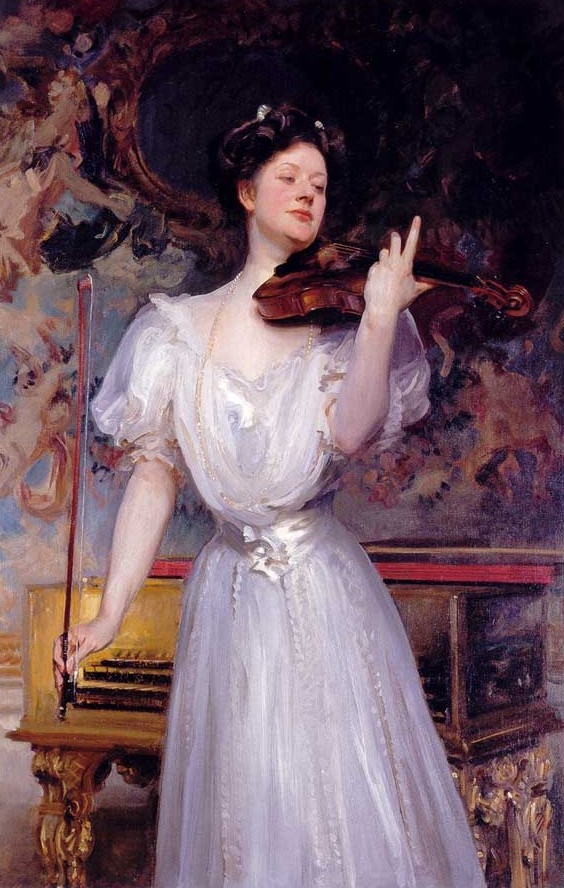
Portrait of Leonora von Stosch Speyer by Sargent
Her Washington teacher – a man named Professor Joseph Kaspar – urged her to finish her training in Europe.
So in 1889, when she was sixteen, she and her mother, Julia, sailed to the Continent.
She began her studies in Brussels, where she studied at the Conservatory of Music for two years. In her second year, she was awarded a first prize.
Shortly after her graduation, she played for Berlin-based violin soloist and teacher (and dear friend of Brahms) Joseph Joachim.
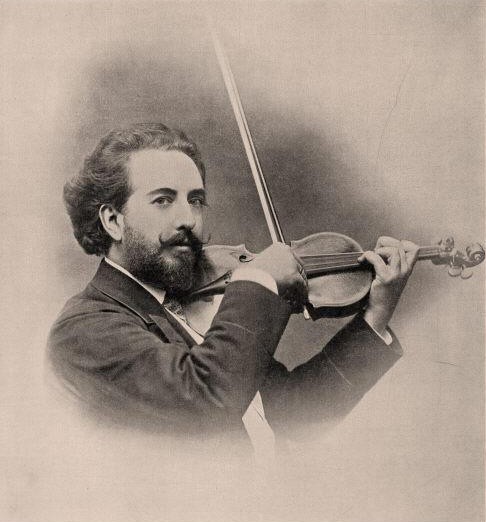
Martin Pierre Joseph Marsick
In 1891, she moved to Paris, where she studied for six months under Belgian violinist Martin Pierre Joseph Marsick. Marsick taught a number of violin greats like Carl Flesch, Jacques Thibaud, and George Enescu.
She also traveled to Leipzig to study under Arno Hill.
For unknown reasons, she and her mother left Europe not long afterwards and returned to America. (One contemporary magazine noted vaguely: “Circumstances at this time interfered, necessitating a trip home, where success and honour awaited the pretty, gifted girl.”) Other contemporary articles hint at a family crisis back home. Perhaps part of the issue was financial. More research has to be done to know for sure.
First Marriage
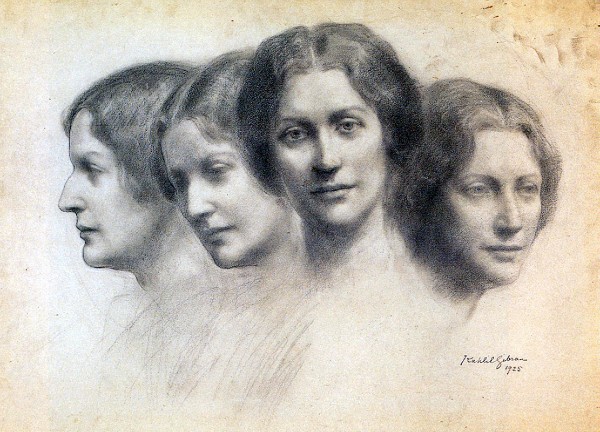
Combined portraits of Leonora von Stosch Speyer by Kahlil Gibran, 1925
Upon her return, she appeared with orchestras in Boston and New York.
In the 1890s, one benefactor, elderly industrialist Gordon McKay, loaned her a Stradivari violin that she could keep…for as long as she remained single.
But love beckoned. In the spring of 1894, when she was 21, she married Louis Meredith Howland, a scion of a prominent New York family who had made its fortune in the shipping industry.
By the terms of the agreement with McKay, she had to return the violin: a horrifying proposition for any woman soloist to contemplate today. (Fortunately, however, the instrument was eventually returned to her.)
Leonora and her husband had one daughter together in 1896, named Enid Virginia, and moved back to Europe for Howland’s work. Leonora gave up her musical career to become a wife and mother.
But it wasn’t long before the marriage broke down. In 1902, the Howlands divorced in Paris.
A (Brief) Return to the Stage
In October 1901, she gave an interview with The Strad explaining how her marriage had triggered her departure from the concert circuit.
My marriage at this time closed my public career, and for eight years [a slight exaggeration, perhaps] I did not play concerts.
However, last year I determined to take up my work again, and came to London, where Mr. Newman engaged me to play in twenty-five concerts at Queen’s Hall. After fulfilling six of these engagements, however, I was obliged to give up, owing to an injury to my shoulder.
This timeline seems to suggest that the marriage had been on the rocks for a while before her divorce. Perhaps her desire to return to the stage contributed to its breakdown.
In 1899, she made her British debut (interestingly, under her maiden name, even though her divorce was still three years in the future). One reviewer for the Morning Post wrote about the concert:
Saint-Saëns’ Andante and Rondo Capriccioso for violin was played with much lightness and vivacity by Madame Leonora von Stosch, a remarkably clever performer, who ought to make her mark.
Sadly, however, she could never fully shake her injury. It was eventually diagnosed as neuritis, or nerve inflammation. Her chronic pain became a major reason why she abandoned the concert stage altogether.
Saint-Saëns’ Andante and Rondo Capriccioso
Meeting Edgar Speyer
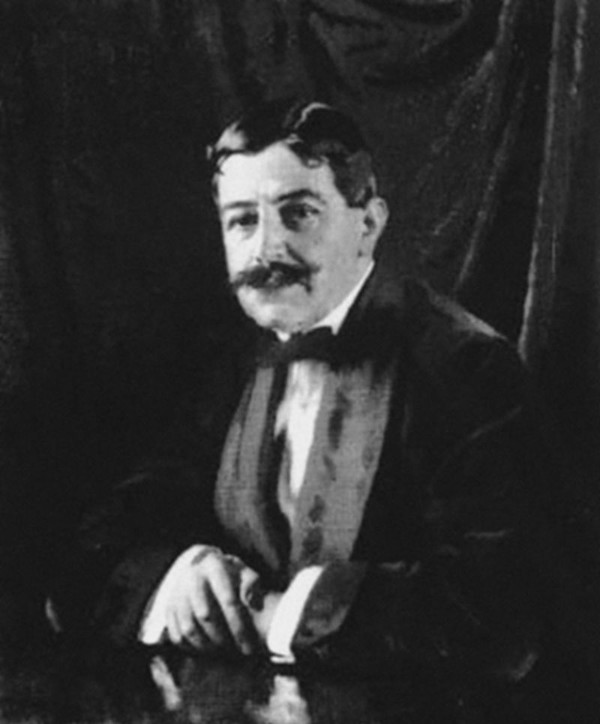
Edgar Speyer
Life changed for her forever when she met her second husband at a salon held by British composer Maud Valerie White.
Edgar Speyer was a wealthy German-Jewish banker and musical patron who had become a British subject in 1892.
He and Leonora married in early 1902, soon after her divorce from Howland.
Fortunately, her second marriage was much happier than her first, and she had three more children with Edgar: Pamela in 1903, Leonora in 1905, and Vivien in 1907.
Between marriage, motherhood, and her injuries, she decided to step away from the concert platform for good, preferring to appear at private salons instead.
The Legendary Speyer Salon
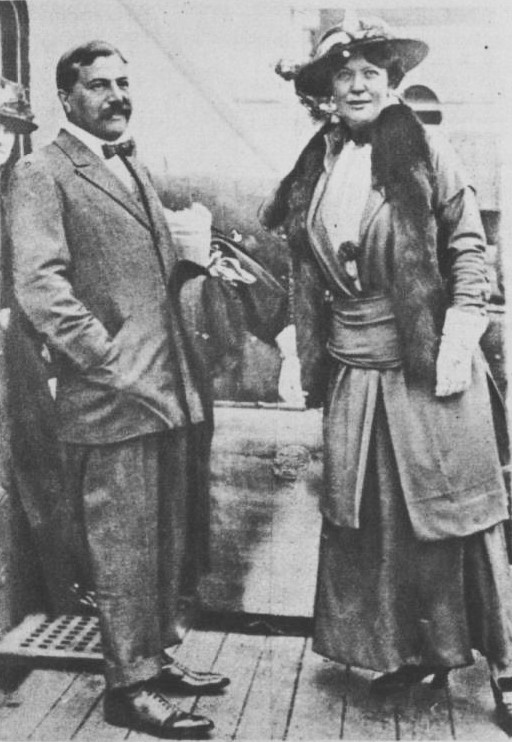
Leonora and Edgar, ca 1921
In 1910 and 1911, the couple redesigned and renovated their Grosvenor Street home in London. Before the renovation, the property had been two homes; afterwards, it became a single eleven-bedroom mansion.
The beating heart of the house was its large music room, where the couple would entertain every prominent musician traveling through London.
On one wall hung a stunning portrait of Leonora playing the violin that Edgar had commissioned from John Singer Sargent.
Debussy, Elgar, Grieg, Richard Strauss, and countless others visited the Speyers’ famous music room.
Strauss was so grateful for their friendship that he dedicated his groundbreaking 1905 opera Salome to Edgar.
Leonora Speyer: Still a Great Violinist Even in Retirement
Leonora von Stosch Speyer
Even though Leonora didn’t play very often (if ever) in public during this time, it’s very clear that she continued performing at an extremely high level.
Speyer purchased violins for his wife, including a Stradivari and the legendary Lord Wilton Guarneri.
The Speyers also paid for a few recording sessions for Leonora in 1909, making her one of the earliest women violinist recording artists.
A clip from a recording Leonora Speyer made of Brahms’s Hungarian Dance No. 5 in 1909
But the most convincing evidence of her continued musical expertise is her advocacy of new music inside her own salon.
In January 1910, Edward Elgar came to visit with the manuscript of his violin concerto in-hand. Today it’s considered to be one of the more grueling concertos in the repertoire. Despite her years off the concert platform, Leonora read through portions of the concerto with Elgar himself at the piano. (Fritz Kreisler premiered the entire thing in November that year with the London Symphony Orchestra, to acclaim.)
An excerpt from the second movement of Elgar’s violin concerto
In 1914, she performed violin sonatas by Gabriel Fauré and Richard Strauss, with the composers at the piano.
Fauré’s first violin sonata
The Speyers’ philanthropy extended well beyond their music room. They also supported public-facing musical organisations.
In fact, their donations single-handedly kept the Queen’s Hall Orchestra from shutting down. The Queen’s Hall Orchestra inaugurated London’s famous Promenade Concerts. (It also served as a predecessor ensemble to the modern-day BBC Symphony and London Philharmonic.) Without the generosity of Edgar and Leonora Speyer, British classical music might look very different today.
The World War Changes Everything
In 1914, World War I began, triggering disaster in the Speyers’ personal lives and in the wider world.
Despite their extensive contributions to British musical life, virulent anti-German sentiment grew during the war, and questions began to be raised about Edgar’s business connections in Germany.
Even Leonora came under fire for being American and having married a German man. In fact, in October 1914, British journalist Leo Maxse went so far as to write, “Your [Edgar’s] millionaire alien walks abroad with his society wife, who may be a common spy.”
In 1915, the government revoked Edgar’s British citizenship, and the family was forced to sell their famous London dream home. They chose to relocate to New York City.
While there, they fundraised to support Edgar’s friends and family members from Germany. Consequently, both British and American spies kept an eye on the Speyers during the remainder of the war, suspicious that they were assisting the Central Powers.
Going Into Poetry
The couple made out well in America, financially speaking. They moved into a house on Washington Square in New York, hiring an extensive household staff that both impressed and intimidated visitors.
Between her injury and her exile from the musical life of London, Leonora began to take her interest in poetry more seriously.
She ended up writing a number of well-received poems. In 1927, her poetry collection Fiddler’s Farewell even won a Pulitzer Prize.
This second career as a poet became increasingly rewarding. In fact, Leonora began teaching poetry at Columbia University in 1942. She taught there for over a decade.
She often made connections between the acts of creating poetry and creating music. She wrote in her essay “On the Teaching of Poetry”:
The actual process of poetry-writing, the colour and harmony of words can be, surely must be, learned; the instrument must be mastered like any other instrument…
Despite the difficulties she’d faced in her musical life, she found peace and fulfilment in poetry.
Swinging from my strap in the subway, returning from Columbia, books slithering from my grasp, I reflect: “What wondrous life is this I lead! Ripe apples drop about my head…”
She served as president of the Poetry Society of America for many years, and in 1956, earned a gold medal from them in appreciation of her work.
Leonora’s poem “Mine Be the Lips” set to music by composer Amy Beach
Leonora’s Legacy
In 1932, Edgar died unexpectedly while on a visit to Germany.
Leonora, ten years his junior, lived for many years without him. She eventually died in New York City in 1956 after a long illness. She was 83.
Her New York Times obituary touched on a few of her musical accomplishments, but its lede only mentioned that she was “Leonora Speyer, poet.”
She was a poet, but her musical accomplishments were arguably just as impressive. It is incredibly rare to find an artist, male or female, who succeeds at such a high level in two different arts…and who wrote so beautifully about the intersection of those arts.
In the title poem “Fiddler’s Farewell” from her award-winning collection of the same name, Leonora Speyer says goodbye to her violin, leaving a poignant greeting for the musicians who would follow her and play her instrument next. It’s a powerful connection between her art and modern listeners who are still hearing her violins played today.
Words for my fiddle now,
Abundance of goodly words!
My deft, my dear,
My witty one
With your brave answer ever ready,
My box of birds,
Crony and hearty,
Winged hubbub,
Tool,
And tear-
Fiddle, fiddle,
To leave you lying here,
To leave you lying here!
In time,
A stranger with the supple fiddler’s hand,
And the rapt eye
That sees the sound sublime,
Will come,
(Must come, I wish it so!)
To coax these stagnant strings,
Kindle their numb
And awful apathy with one imperative blow
Of the fleet accurate bow;
Release the fiddle-cry!
For more of the best in classical music, sign up for our E-Newsletter