A small number of pianists have died onstage or collapsed at the keyboard, never to recover.
These are not myths or rumours but documented historical events, witnessed by audiences and reported in the press.
Here are the stories of five great pianists who died onstage or following an onstage collapse.
Simon Barere (1896-1951)
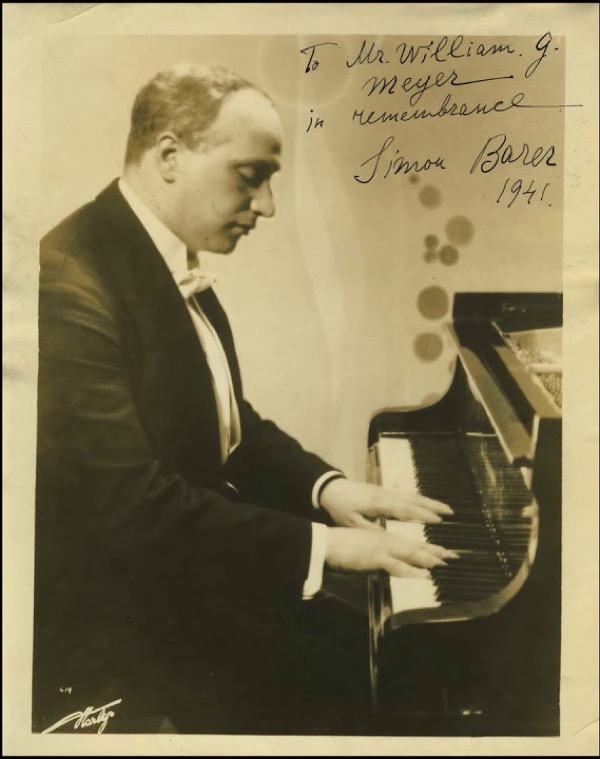
Simon Barere
Simon Barere playing Liszt in 1950
Simon Barere on the Ken Murray Show (March 18, 1950)
Simon Barere was born in 1896 in Odesa in present-day Ukraine, the eleventh of thirteen children.
He studied piano at the St. Petersburg Conservatory with Felix Blumenfeld, the same teacher who would teach Vladimir Horowitz. Blumenfeld actually preferred Barere as a student to Horowitz.
After teaching in Kyiv, he emigrated to continental Europe in the 1930s. Then, when the Nazis came to power, he left for the United States. He began making regular performances at Carnegie Hall in New York City.
On 2 April 1951, he appeared at Carnegie Hall with the Philadelphia Orchestra under Eugene Ormandy, playing the Grieg piano concerto. The concert was sponsored by the American-Scandinavian Foundation and featured a variety of works by Scandinavian composers.
New York Times reviewer Olin Downes was present at the performance and later reported that Barere was in fine form during the concerto’s opening.
However, to Ormandy’s confusion, Barere began pushing the tempo to be faster and faster. Finally, he leaned over the keyboard, then fell to the floor.
The performance was immediately halted, and a doctor was called. Barere’s body was carried backstage to a green room for treatment. Doctors worked for half an hour to try to revive him.
Rumours spread in the audience that Barere had only fainted, and the orchestra decided to continue with the next work on the program. But after intermission, the director of the American-Scandinavian Foundation came onstage to announce Barere’s death.
The concert was cancelled, and the shaken audience and performers returned home.
The cause of death was declared to be “spontaneous cerebral haemorrhage.”
We wrote about Simon Barere’s life here: https://interlude.hk/simon-barere-the-pianist-who-died-mid-concert-at-carnegie-hall/.
Lil Hardin Armstrong (1898-1971)
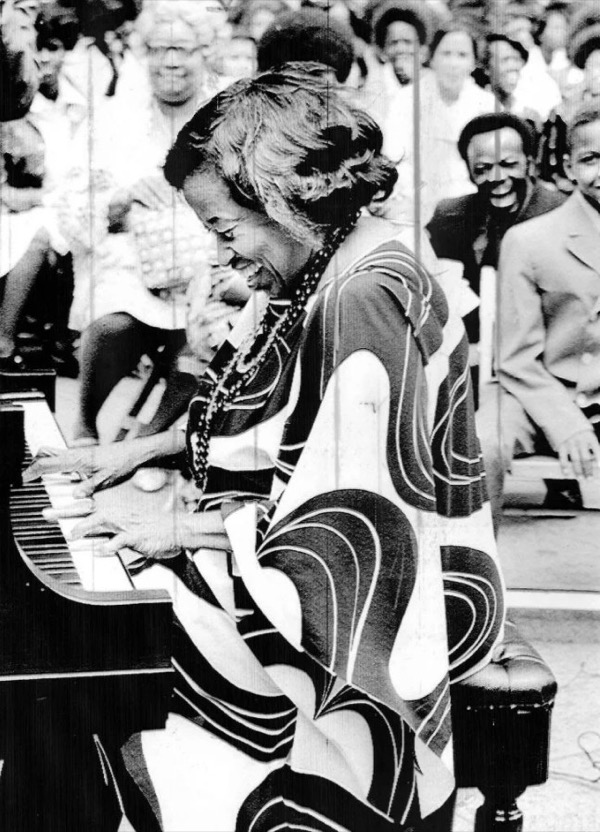
Lil Hardin Armstrong
Lil Hardin Armstrong playing in 1959
Lillian Hardin was born in Memphis, Tennessee, in 1898. Her grandmother had been enslaved in Mississippi before the Civil War.
Lillian began studying piano in third grade. After she graduated from high school, she enrolled at Fisk University in Nashville, a well-respected historically Black liberal arts college. She would later earn a second degree at the New York College of Music.
In 1918, when she was twenty, she moved to Chicago and got a job as a sheet music demonstrator. At the time, before recordings were widely available, music stores would hire talented sight-readers to demonstrate new sheet music to clients.
However, the pay at the music store was low compared to what she could earn playing with bandleader Lawrence Duhé and other jazz musicians.
She married fellow jazz musician Louis Armstrong in 1924. Lillian believed in her new husband’s talent and pushed him to assert himself professionally. She even helped him choose new fashionable clothes.
Unfortunately, their relationship became strained in the 1920s over money. They each formed their own bands and divorced in 1938.
She drifted away from music in her later years, training as a tailor in the late 1940s. Her graduation project was actually making a tuxedo for her ex-husband.
She began writing an autobiography in 1962, but ultimately postponed the project because she didn’t want to hurt Louis by writing about him. After he died of a heart attack in July 1971, she decided to return to the manuscript.
The following month, in August, she performed at a televised memorial concert in honour of Louis. She collapsed at the piano and was brought in an ambulance to the hospital. But she died on the way – like Louis, of a heart attack.
After her death, her autobiography manuscript vanished.
Mindru Katz (1925-1978)
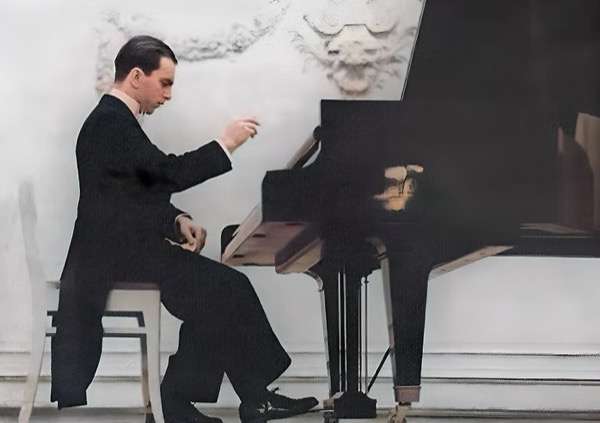
Mindru Katz
Mindru Katz playing Chopin’s Etude Op. 10, No. 3, in E major
Mindru Katz was born in 1925 in Bucharest. His musical talent was clear from an early age. Starting when he was four, composer, pianist, and violinist Georges Enesco took an interest in his training and recommended him to the best teachers in Bucharest.
Katz enrolled at the Royal Academy of Music in Bucharest when he was six. He had to use a special device to operate piano pedals because his legs weren’t long enough to reach them.
In the mid-1930s, during the rise of fascism in Romania, he was forced to take a break from his music studies. Between 1943 and 1944, he was conscripted into forced labour.
After the Allies won the war, he returned to the Academy and graduated in 1947. An international career followed, bringing him to over forty countries.
After World War II, he moved to Israel and became a piano professor in Tel Aviv.
In 1974, he, along with Arthur Rubinstein, was invited to be a jury member at the inaugural Arthur Rubinstein International Piano Master Competition. Emanuel Ax was the competition’s first winner, an accomplishment that helped to launch Ax’s decades-long career.
In January 1978, Katz went onstage to perform a recital in Istanbul, Turkey. Beethoven‘s seventeenth piano sonata, nicknamed the Tempest, was on the program. Katz collapsed during the performance and died of a heart attack.
Before he left for Turkey, he’d told a cardiologist friend, “I know I won’t return alive from Turkey, but I prefer to die on stage than die in a hospital connected to a respiratory device.”
Katz was 52 years old.
Louis Moreau Gottschalk (1829–1869)
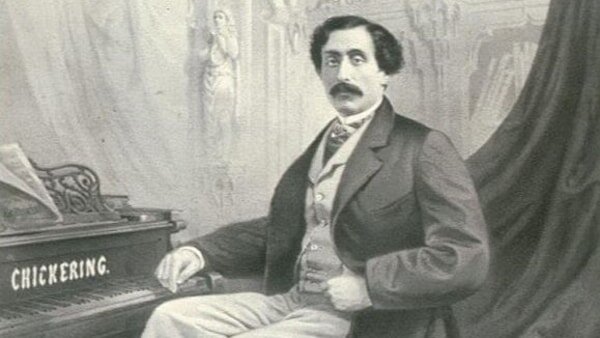
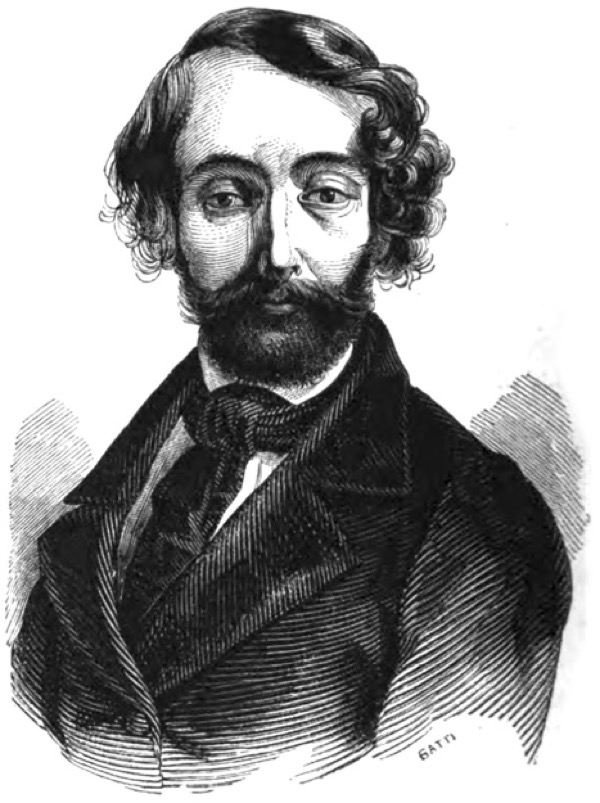
Louis Moreau Gottschalk
Gottschalk’s “Morte!”
Louis Moreau Gottschalk was born in New Orleans in 1829. He was a child prodigy and made his debut in New Orleans in 1840 at the age of eleven.
His father recognised that his son would have to go to Europe to receive the best musical training, so in 1842 they sailed together to Paris, where Louis could study at the Conservatory.
His application was rejected on account of his nationality (“America is a country of steam engines,” one professor remarked). Still, he was enthusiastically embraced by the wider musical community in Paris, including Liszt and Chopin.
He returned to the New World in 1853 and became famous for his long, gruelling tours through North, Central, and South America. He would soon become the best-known pianist in the Western Hemisphere.
In November of 1869, he played a concert in Rio de Janeiro while sick with yellow fever. He finished his piece “Morte!” (“Death!”), then began to play another of his pieces, “Tremolo”, when he collapsed.
Although he didn’t die onstage, he never recovered from the collapse. He ultimately died in a hotel room a month later, possibly from a quinine overdose.
Louis Vierne (1870-1937)
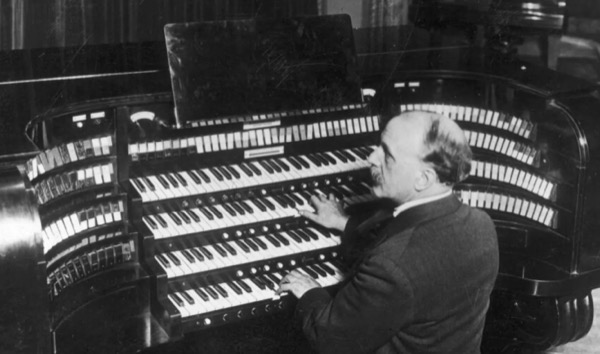
Louis Vierne
Vierne’s Piano Quintet, Movement 1
Louis Vierne was born on 8 October 1870, in the city of Poitiers, France. He was born blind due to congenital cataracts.
When he was just two years old, a neighbour played a Schubert tune for him on the piano. Vierne responded by finding the keys and playing back the melody. He began studying piano soon after.
As a young child, he had surgery to attempt to restore his vision. After the surgery, he was able to read large letters and notes on large staves. He also learned Braille.
During the 1880s, he studied at the Institut National des Jeunes Aveugles (National Institute for the Young Blind) alongside a fellow blind pianist, Louis Specht.
But in 1881, when he was eleven, he heard César Franck play the organ, and the experience changed his life forever.
“I could not hold back my tears. I knew nothing; I understood nothing; but my instinct was violently shaken by this expressive music echoing through every pore,” he wrote later.
He began studying the organ, too, and in 1890, enrolled at the Paris Conservatoire. By 1894, he was awarded first prize in the organ class.
In 1900, he would go on to win the position of organist at the Notre-Dame de Paris. He travelled internationally to concertize and raise money for the instrument’s restoration.
The following years brought him a series of tragedies. He divorced his wife in 1909, his son Jacques died by suicide at the front during World War I in 1917, and then his brother René, also an organist, was killed by Austrian shrapnel in 1918.
Through it all, music was the constant in his life – composing as well as performing at the organ.
On 2 June 1937, he gave his 1,750th recital at Notre-Dame. He finished the concert with improvisations and was preparing the instrument when he slumped forward and fell off the bench. His weight landed on the low E organ pedal, which resonated through the cathedral. He died there at the age of 66.
He had long wished to die at the console of Notre-Dame. Many things in life had not gone his way – but his death certainly did.
For more of the best in classical music, sign up for our E-Newsletter