There is a long list of composers who died poor – and it includes some of the most celebrated names in the Western canon.
Vivaldi, Schubert, Paganini, and others wrote music that outlasted empires, but died with little to their names.
The reasons varied: bad contracts, bad timing, bad luck, and the general chronic precariousness of a life spent making art rather than money.
Here’s how five of music’s greatest names went from celebrated masters to destitute.
Antonio Vivaldi (1678–1741)
Vivaldi’s Four Seasons
During his lifetime, Antonio Vivaldi was celebrated as one of Europe’s most famous composers. One contemporary reported that he’d earned an eye-watering 50,000 ducats during his lifetime.
We don’t know exactly how much he made, but he worked as an impresario in the volatile, high-risk, high-reward world of opera, which could help explain his financial successes – and failures.
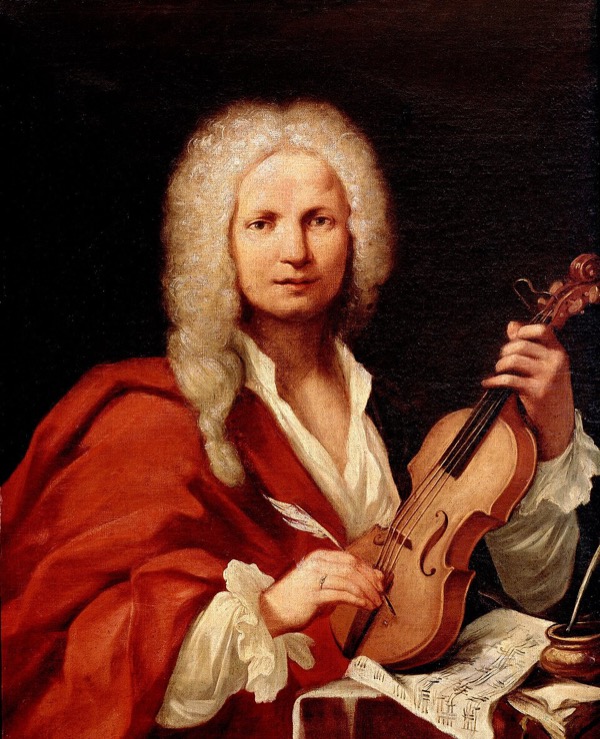
Antonio Vivaldi
By the 1730s, his style was fading in popularity. In 1740, he sold manuscripts to finance a trip to Vienna, likely to seek the patronage of Holy Roman Emperor Charles VI.
But Charles VI died that October. Theatres closed to observe his death, making it impossible for Vivaldi to work.
Vivaldi’s health deteriorated, and he died of infection late in the night of 27 July 1741. His simple funeral cost 19 florins and 45 kreutzer; no music was played.
He left behind just a handful of possessions, like clothes and unsold manuscripts.
We wrote about Vivaldi’s final years and death here: https://interlude.hk/on-this-day-27-28-july-antonio-vivaldi-died/.
Wilhelm Friedemann Bach (1710–1784)
Wilhelm Friedemann Bach’s Sinfonia in D minor
Wilhelm Friedemann Bach was Johann Sebastian Bach’s son. From an early age, his family groomed him for the business.
His brother Carl Philipp Emanuel once remarked that, of all twenty Bach siblings, Wilhelm had the musical talent most similar to their father.
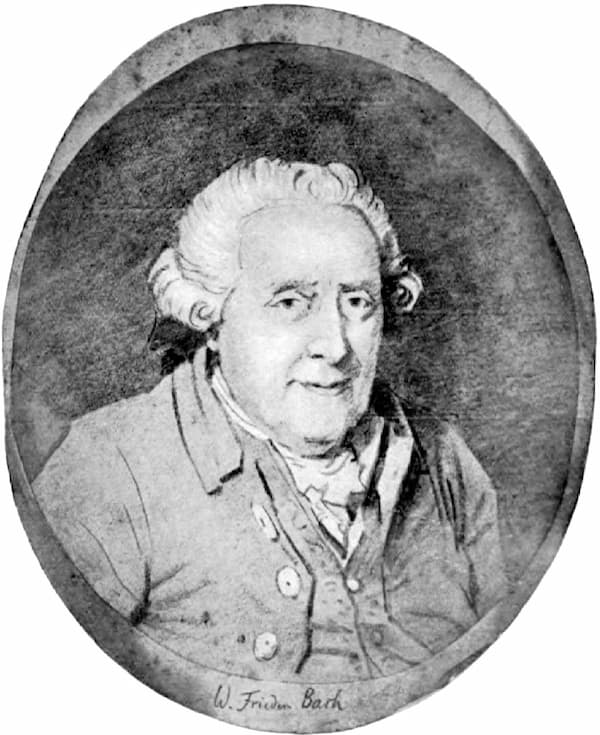
Wilhelm Friedemann Bach
In April 1746, Wilhelm Friedemann became the music director and organist at the Church of Our Lady in Halle.
Over the years, he grew disillusioned with the job and eventually resigned in 1764, in his mid-fifties.
He couldn’t retire, so he pursued a freelance career, teaching, performing, and composing. However, without the guaranteed income of a court position, his finances suffered.
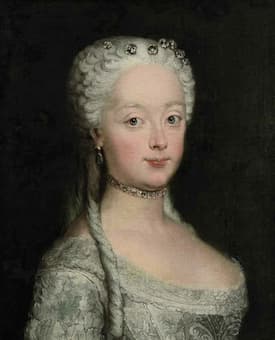
Antoine Pesne: Princess Anna Amalia of Prussia
In the mid-1770s, he tried to manoeuvre into a court position with Princess Anna Amalia, the sister of Frederick the Great, but his politicking turned off the court, and he lost out on the job. His career never recovered.
He died destitute in Berlin in 1784. The cemetery he was buried in was destroyed in World War II; his marker and remains were lost.
We delved into the history and fate of all twenty of Bach’s children here: https://interlude.hk/what-happened-to-bachs-twenty-children/.
Franz Schubert (1797–1828)
Schubert’s Trout Quintet
Schubert’s poverty stemmed from the society he was born into and his professional choices.
In 1815, a draconian marriage consent law passed in Vienna, seeking to cut back on societal poverty. It required that before any young man married, he first had to prove that he made enough money not only to support his wife, but a household.
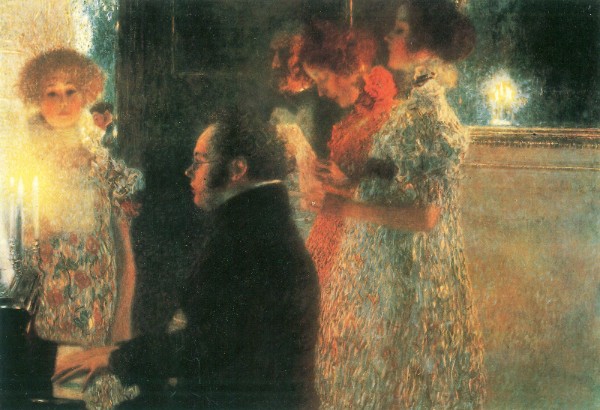
Schubert at the Piano (1899) by Gustav Klimt
Schubert was therefore put into a position where – essentially – he’d have to choose between conventional, marriageable respectability and a life devoted to composing. He chose composing, and with it, a bohemian lifestyle.
Although he worked at his schoolteacher father’s school for a while, he relied on couch-surfing and rooming with his artistic friends to survive.
Unlike some of his colleagues, he never pursued a career as a performing virtuoso. He tried to make some money by submitting his work to publishers, but it wasn’t enough to live on.
He only gave one public performance of his own works in his life, in March 1828, just a few months before his death.
The inventory of his estate makes for sad reading: essentially a few items of clothing and a mattress, which did not cover his outstanding medical and funeral expenses.
We looked at Schubert’s death here: https://interlude.hk/on-this-day-19-november-franz-schubert-died/.
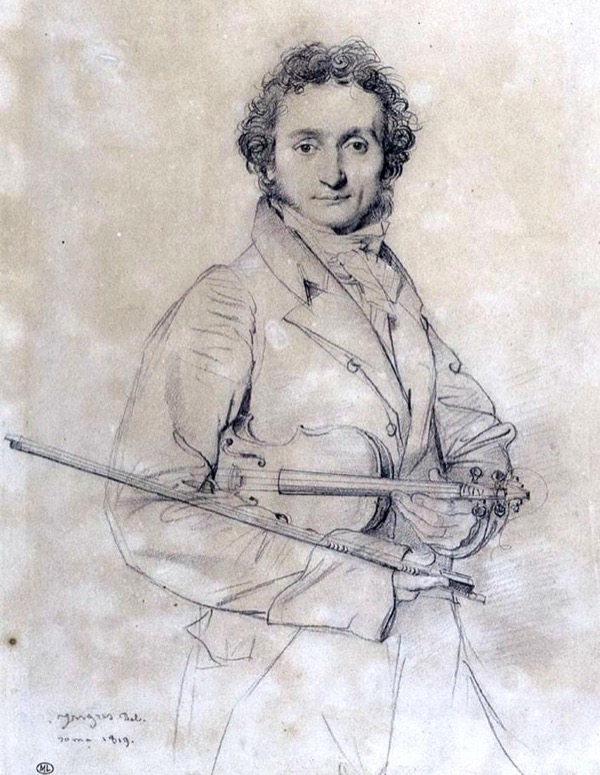
Niccolò Paganini (1782–1840)
Paganini’s Violin Concerto No. 1, Movement 3
Unlike the others on this list, Paganini wasn’t destitute when he died. But few composers fell from such heights so fast. His financial collapse was sudden – and self-inflicted.
During his lifetime, he was one of Europe’s best-paid performers. He earned a lot of money – so what led to his late-in-life destitution?
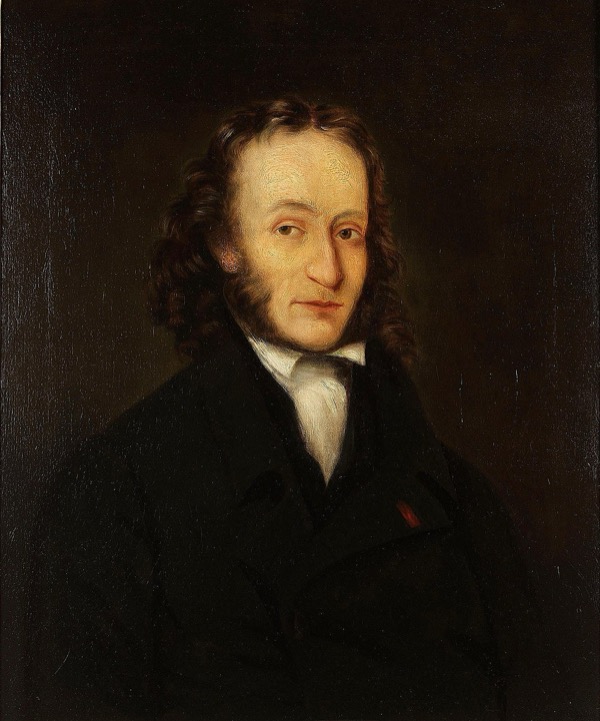
John Whittle: Paganini, 1836 (private collection)
In 1836, in his mid-fifties, he and investors poured money into an ill-fated Parisian establishment dubbed the Casino Paganini.
They didn’t get a gaming license, so they marketed it as a concert venue where Paganini would be the house entertainment.
In practice, however, the venue turned into a gambling den. It lasted only a few months before going bankrupt, and Paganini then faced legal fees on top of that.
To cover his debts, he was forced to auction off most of his personal effects, including his musical instruments – though tellingly, he held onto one guitar, a prized Fabricatore, until his death.
He retreated to Nice, ill with tuberculosis and the accumulated damage of years of mercury treatment for syphilis.
He died in May 1840 of internal haemorrhaging, his once-vast fortune gutted by lawsuits stemming from the Casino Paganini debacle.
We looked at Paganini’s turbulent final years here: https://interlude.hk/on-this-day-27-may-niccolo-paganini-died/.
Max Bruch (1838–1920)
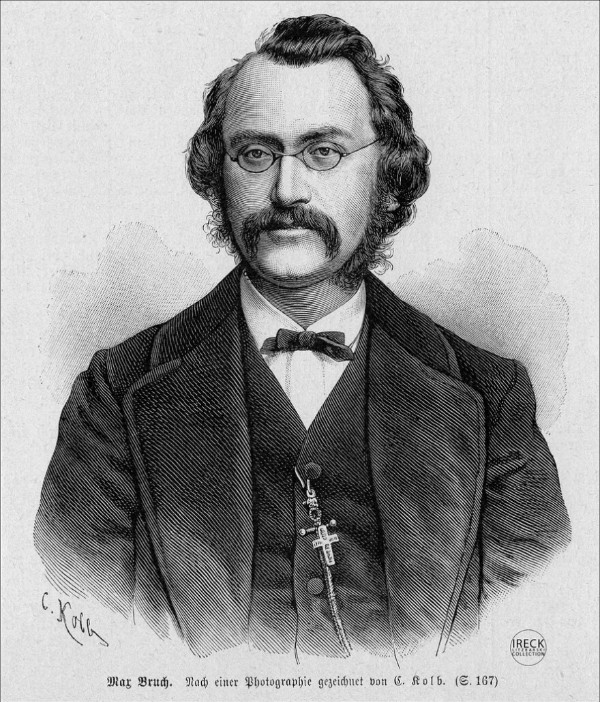
Max Bruch
Bruch’s financial ruin is inseparable from the history of a single work.
In 1868, he sold his Violin Concerto No. 1 in G minor outright to the publisher August Cranz for 250 thalers.
Bruch’s Violin Concerto No. 1
This meant that Bruch saw no financial benefit beyond that single, modest payment, even though it became one of the most popular works in the repertoire.
Bruch received nothing, and eventually could not bear to hear it. Reportedly, visiting Rome in old age, he fled his hotel when a barrel organ in the street below began playing themes from it.
Bruch was in his mid-seventies when World War I broke out. Because of his German nationality, formerly friendly audiences in Britain, France, and America stopped playing his works, and royalties dried up.
On top of that, inflation grew in Germany at a terrifying rate, and his financial situation collapsed further.
In desperation, he turned to two former students – the American duo-pianists Rose and Ottilie Sutro – and entrusted them with the autograph manuscript of the concerto to sell in the United States.
The sisters did indeed sell it – but never returned the money. They ignored his increasingly desperate letters and eventually cut off all contact with the now-destitute composer.
Bruch died in 1920, nearly penniless, without ever seeing the score again.
Months later, the Sutro sisters contacted his family with a few worthless German banknotes and no explanation.
We looked at the story of the Sutro sisters, the “villainous piano duo who scammed Max Bruch”, here: https://interlude.hk/the-sutro-sisters-the-villainous-piano-duo-who-scammed-max-bruch.
Conclusion
Notably, even after these composers died, their music survived.
Vivaldi’s concertos still fill concert halls; Schubert’s song cycles are studied in conservatories worldwide; Bruch’s G minor concerto remains one of the most performed works in the violin repertoire.
But the composers themselves died without pensions, without adequate medical care, and in some cases without a marked grave.
These stories make clear that classical musicians dying in poverty wasn’t an anomaly; it was a structural condition that no amount of genius could reliably protect against. It’s an important thing to remember while listening to their work – and it makes their work all the more remarkable.
For more of the best in classical music, sign up for our E-Newsletter