Mozart symphonies are not always by Mozart.
Over the centuries, works by his father Leopold, his colleague Michael Haydn, and even anonymous composers have all ended up bearing Wolfgang Mozart’s name.
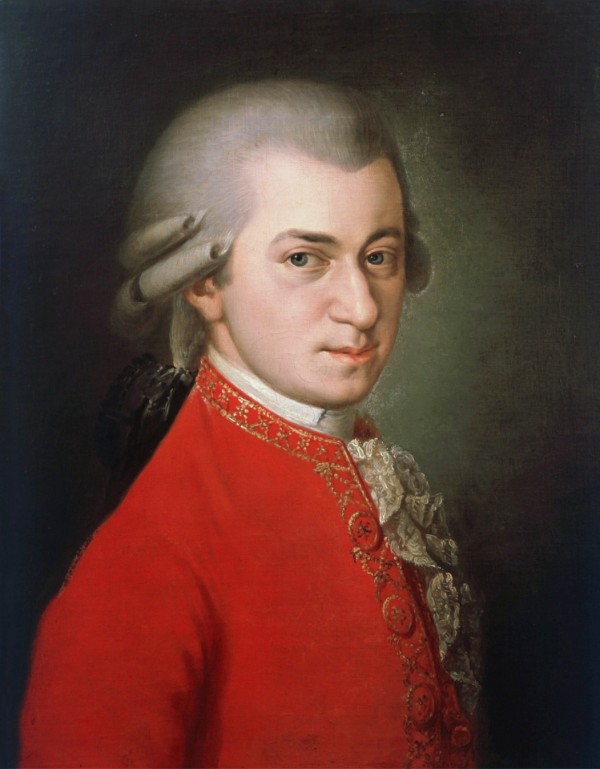
Barbara Krafft: W. A. Mozart, 1819 (Gesellschaft der Musikfreunde)
The catalogue of Mozart’s symphonies has been quietly corrected and re-corrected ever since scholars began investigating it in earnest, and several “Mozart” symphonies have turned out to be something else entirely.
Symphony No. 2 in B-flat major, K. 17
Mozart’s Symphony No. 2 was written around 1765 or 1766, making Wolfgang about ten years old at the time of its composition.
The score appeared in the Alte Mozart-Ausgabe (Old Mozart Edition), the first complete edition of Mozart’s music, published by Breitkopf & Härtel between 1877 and 1882.
In that version of the score, the only string parts written out are those of the first violins and the cellos—editors filled in the second violin and viola parts.
Musicologist Cliff Eisen specialises in Mozart and has attributed the work to Wolfgang’s composer father, Leopold.
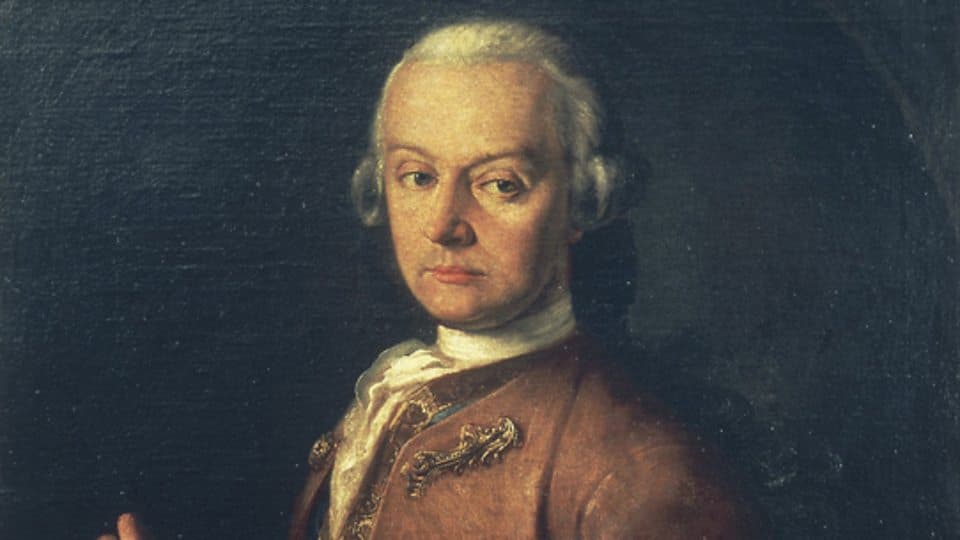
Leopold Mozart
Symphony No. 3 in E-flat major, K. 18
The work formerly known as Mozart’s Symphony No. 3 dates to 1764, when Mozart was eight. It was a shocking achievement for an 8-year-old – seemingly too good to be true.
In the end, it did turn out to be too good to be true.
This symphony is actually by 41-year-old Carl Friedrich Abel, a respected German composer. He had served as director of music at the Dresden court and, by 1764, was in London working as a chamber musician in the employ of Queen Charlotte.
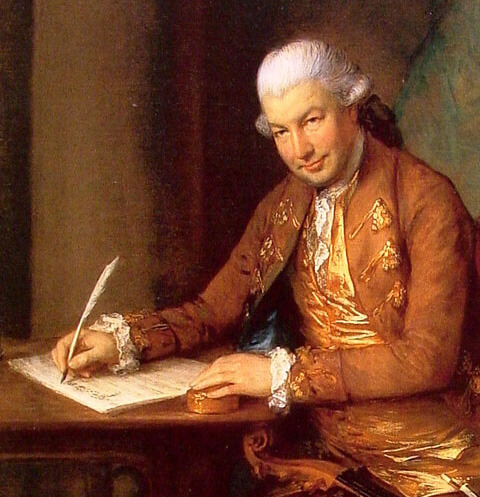
Carl Friedrich Abel
Mozart was also in London then, touring with his family. While there, he copied one of Abel’s symphonies from his Op. 7 to study it – not to pass it off as his own.
But over the years, researchers forgot Abel and wrongly attributed it to Mozart.
Its true origin was only rediscovered after the Alte Mozart-Ausgabe was published.
Symphony in A minor, “Odense”, Anh. 220
A few years after Mozart died in 1791, the publishing firm Breitkopf & Härtel attempted to gather as many of his works as possible. He didn’t start keeping a catalogue of his own works until February 1784, so there wasn’t a clear-cut list to work from.
Researchers gathered works from all over, including from his wife, sister, and colleagues. Those researchers found a four-bar incipit (i.e., the condensed first four bars of a work used to catalogue and identify), but couldn’t find the full manuscript.
Nevertheless, they included this symphony in their list of his works.
The work remained a “ghost symphony” until 1982 when, remarkably, the full score was discovered in the archives of the Municipal Symphony Orchestra in Odense, Denmark.
Years of study and debate followed, and a consensus emerged: several unfamiliar hands copied the score, and its style doesn’t match Mozart’s other works from the 1760s or 1770s.
So we don’t know who wrote it, but it doesn’t seem to be Mozart.
Symphony No. 44 in D major, K. 81
Researchers have discovered a group of symphonies dating from Leopold and Wolfgang Mozart’s trips to Italy between 1769 and 1773.
The problem is that all surviving scores are copies, so nobody can fully judge their authenticity.
One copy of this particular symphony is dated 25 April 1770 and is attributed to Wolfgang. Interestingly, a letter from that same day also survives, in which Wolfgang reports to his sister that their father is copying one of his symphonies.
That evidence may seem clear-cut enough to attribute it confidently to Wolfgang. However, the Breitkopf & Härtel catalogue listed this as Leopold’s work – and scholars have argued about both its quality and character. For instance, musicologist Alfred Einstein called it “charming and intelligent” while Neal Zaslaw called it “superficial and conventional.”
Some attribute it to Wolfgang; others, to Leopold. Cliff Eisen, for instance, included it in his catalogue of Leopold’s symphonies.
No definitive consensus has emerged.
Symphony No. 37 in G major, K. 444
Mozart’s 37th symphony retained its Mozartean attribution for generations after his death – until 1907, when musicologist Lothar Perger was putting together a catalogue of a Michael Haydn‘s works, and he realised that Mozart’s 37th was, in reality, Michael Haydn’s 25th.
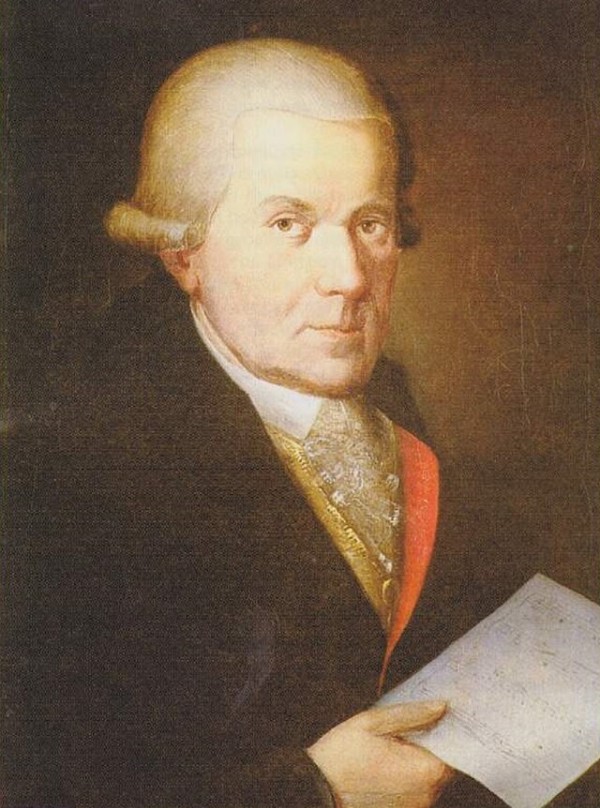
Michael Haydn
Mozart was a big fan of Michael Haydn. Michael Haydn – not to be confused with his more famous brother Joseph – had moved to Mozart’s hometown of Salzburg to work as a court musician when Mozart was six, meaning that they’d been colleagues for a long time.
The main difference between the two versions is a majestic slow introduction that Mozart added. (He also made some minor instrumentation tweaks.)
It is believed that Mozart made a copy of Haydn’s work because he was programming it for a concert in November 1783, at which his own 36th symphony (nicknamed the “Linz”) was premiered.
Somehow the true identity of this symphony slipped past scholars for over a hundred years, thanks to their mistaking Mozart’s copy for an original work.
As a result, Mozart’s 37th, once a beloved staple of orchestral programming, is played much less frequently today – even though nothing about the music itself has changed.
Conclusion
These misattributed Mozart symphonies tell a story that goes beyond any individual work. They reveal how fragile authorship can be when documentation is thin, and the pull of a famous name is strong.
In some cases – Symphony No. 37, especially – a piece lost much of its performance life the moment its true composer was identified, even though the notes on the page hadn’t been altered.
These misattributions raise fascinating questions about classical music canonisation more broadly. How much of the classics’ popularity is due to the music itself, and how much is due to the popularity of the composer?
In any case, even though these works may not be by Mozart, they shed light on his work – and how listeners have historically received it.
For more of the best in classical music, sign up for our E-Newsletter