
Salamone Rossi was born around 1570 into a prominent Jewish family in Mantua, a busy city in Northern Italy. During this period, life for Italian Jews was shaped by tight legal restrictions and social isolation. European rulers often viewed Jewish populations with suspicion, and Mantua followed suit. By 1612, the local authorities forced the city’s Jewish residents to live inside a gated ghetto and made them wear a yellow badge on their clothes whenever they walked through the streets. Yet, beyond these harsh laws, Mantua was also a place where art, theatre, and music flourished under the rule of the wealthy Gonzaga family.
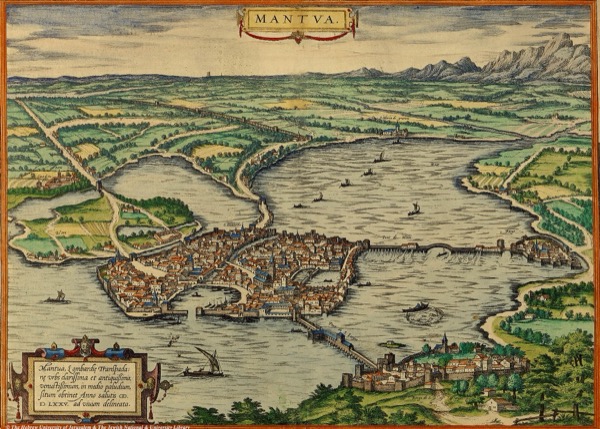
Bird’s-eye view of Mantua, from Civitates Orbis Terrarum, vol. II, 50, published 1575, edited by Georg Braun and engraved by Franz Hogenberg.
Rossi was a remarkably gifted violinist and singer. His talent caught the attention of the court early on, and he officially joined the Duke’s musical household in 1587. He was only a teenager then, but he quickly proved himself. Over the next forty years, Rossi worked his way up from a basic performer to the court concertmaster, leading instrumental groups and providing music for every major court occasion. He composed pieces for royal weddings, grand state dinners, theatrical plays, and outdoor celebrations.
His reputation as a musician was so high that Duke Vincenzo I made a rare exception for him. In 1606, the Duke issued an official decree exempting Rossi from wearing the yellow badge. This was a major concession for the time. It meant Rossi could walk freely through the city and perform his duties at the palace without carrying the visible mark of discrimination forced upon his neighbours. His sister, a talented opera singer known as Madama Europa, also performed at court, making their family a central fixture of Mantuan musical life.
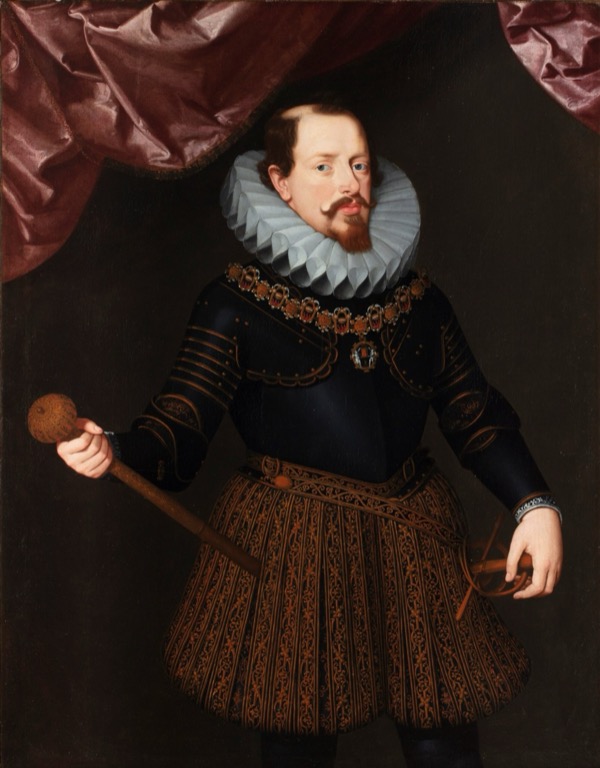
Portrait of Duke of Mantua Vincenzo I Gonzaga wearing the collar of the Order of the Redeemer by Frans Pourbus the Younger
Living in the Gonzaga palace put Rossi in direct contact with some of the era’s greatest creative minds, including Claudio Monteverdi. At the turn of the seventeenth century, European music was going through a major change. Composers were moving away from the complex Renaissance style, where many vocal lines sang different parts at the same time, and turning toward the new Baroque style. This new approach focused on a clear, expressive lead melody supported by a continuous bass line.
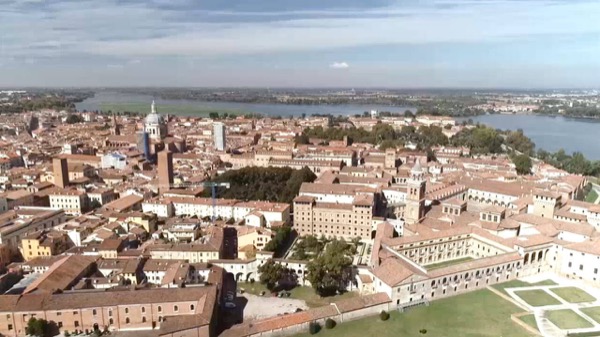
Bird’s-eye view of Palazzo Ducale Mantua (Credit:https://www.mantovaducale.beniculturali.it)
Rossi became a pioneer of this new musical language. He applied these fresh ideas directly to instrumental playing, which was quite rare then. Up until that point, instrumental music was mostly used to accompany dancers or backup singers. Rossi changed that by writing published collections of standalone sonatas and sinfonias. He usually wrote for two violins playing above a steady bass instrument like the lute or cello. This specific setup became known as the trio sonata. It was a huge success, and it served as the standard format for chamber music across Europe for the next hundred years.
Salamone Rossi: Il primo libro delle sinfonie e gagliarde: Sinfonia prima a 3 (Profeti della Quinta)
Salamone Rossi: Il terzo libro de varie sonate, sinfonie, gagliarde, brandi e corrente, Op. 12: Sinfonia quinta (Profeti della Quinta)
Even as Rossi climbed the ladder at the Christian court, he never lost touch with his own roots. He remained a devout and active member of the Mantuan Jewish community. This dual identity led to his most famous and daring creation. For centuries, Jewish synagogue music relied on a single cantor singing traditional chants without any backing instruments or complex vocal harmonies. Many rabbis opposed changing this practice because they felt modern theatrical music had no place in sacred worship.
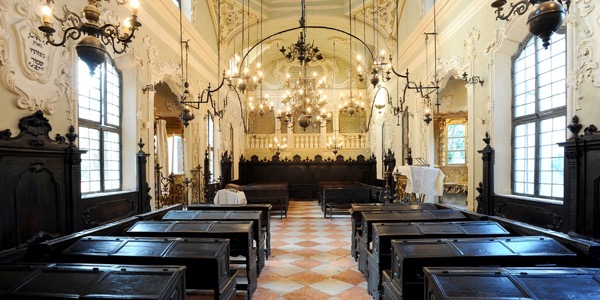
The interior of the only extant Jewish Synagogue in Mantua (Credit:https://www.itinerariebraici.it)
Rossi disagreed and set out to modernise synagogue music. In 1622-3, he published a groundbreaking collection of music in Venice titled Hashirim Asher Li-Shlomo (The Songs of Solomon). The collection contained 33 original choral pieces written for three to eight voices, setting traditional Hebrew prayers, psalms, and hymns to multi-part Western harmonies. To publish the work, Rossi had to overcome real technical challenges. Printers had to align the Hebrew text, which reads from right to left, with European musical notation, which reads from left to right.
The 400th anniversary of Salomone Rossi’s Hashirim Asher LiShlomo (1622)
Rossi also needed religious backing to protect his project. He worked closely with a prominent Venetian scholar, Rabbi Leon of Modena, who wrote a formal defence explaining why polyphonic music was appropriate for Jewish services. This work was the very first published collection of polyphonic synagogue music in history, bringing the sounds of the Italian Baroque into the sanctuary.
![Salamone Rossi, Shir asher lishlomo [Songs of Solomon], ca. 1623 (title page).](https://interlude-cdn-blob-prod.azureedge.net/interlude-blob-storage-prod/2026/09/image5-6aacb0d9d4a3a.jpg)
Salamone Rossi, Shir asher lishlomo [Songs of Solomon], ca. 1623 (title page).
Sadly, the world Rossi built came to a sudden, violent end in the late 1620s. A feud over who would rule Mantua triggered the War of the Mantuan Succession. In July 1630, foreign Imperial troops invaded and captured Mantua. The soldiers sacked the city and destroyed the Jewish ghetto, forcing the residents to flee. To make matters worse, a brutal outbreak of the plague swept through the region around the same time.
Historical records regarding Rossi stop after 1628, so we do not know the exact details of his final days. Historians generally believe he died around 1630, killed either during the military attack or by the plague. Most of his friends and family vanished from the record during the same chaotic period.
After his death, congregations largely set aside and forgot Rossi’s synagogue music, mostly because they returned to older traditional chants. However, modern music scholars look at his life with great respect. Without any extant portraits, Rossi built bridges. He navigated two completely different cultural worlds—the courtly world of Renaissance princes and the enclosed world of the Jewish ghetto—and left behind a legacy that transformed both instrumental music and sacred song.
For more of the best in classical music, sign up for our E-Newsletter





Composer Lukas Foss (1922-2009) created a Salomon Rossi Suite for modern symphony orchestra using Rossi’s music adapted along the lines of similar adaptations by Stravinsky, Respighi.