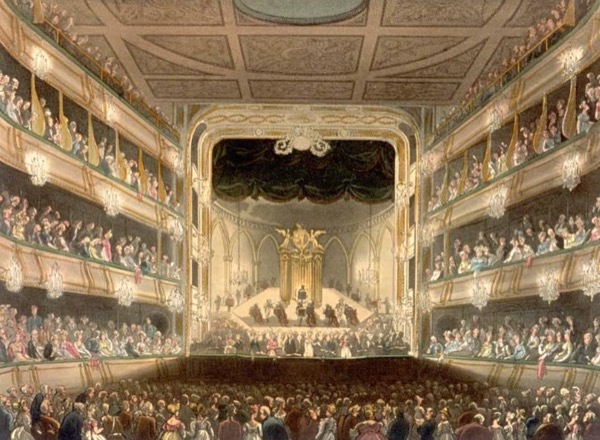
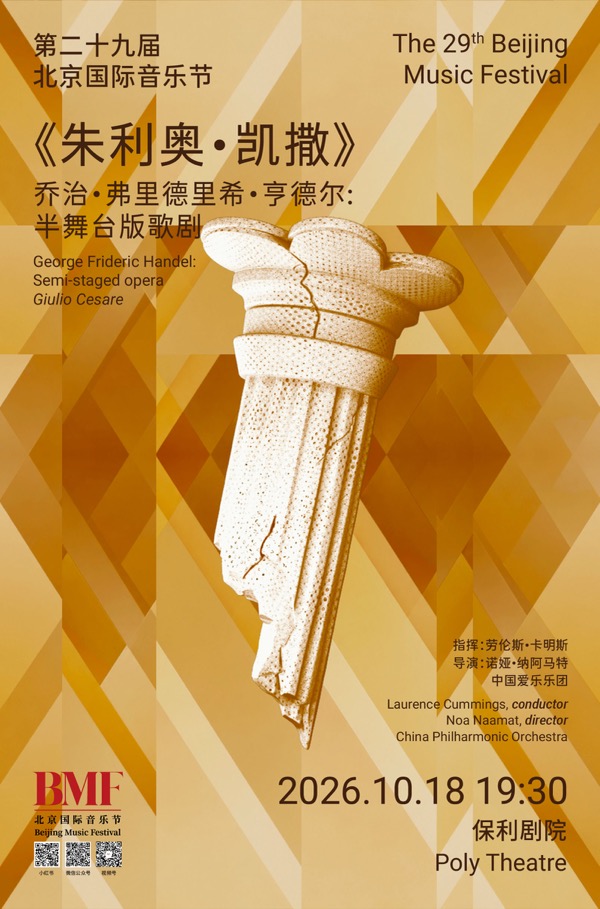
On 20 February 1724, Handel’s three-act opera Giulio Cesare (in full, Giulio Cesare in Egitto) received its premiere at the King’s Theatre in London. Exactly 125 years earlier, the same city had witnessed another great drama about Caesar: Shakespeare’s celebrated Julius Caesar, first performed at the Globe Theatre on the opposite bank of the Thames. The British, living on what had once been a distant frontier of the Roman Empire, seem to have possessed a particular fondness for historical drama set in ancient Rome. At the 2026 Beijing Music Festival, British conductor Laurence Cummings will join forces with the British-trained director Noa Naamat to present this Baroque classic.
Shakespeare concentrates on the period immediately surrounding Caesar’s assassination, focusing above all on the human choices made by Antony and Brutus amid a palace conspiracy, a drama of political manoeuvring and conflicting principles. With such a formidable precedent before him, Handel wisely chose not simply to set Shakespeare to music, an approach whose truly successful realisation would have to wait until Verdi in the late 19th century, and one that would probably have held limited appeal for London audiences of the Baroque era. Instead, Handel’s long-time collaborator Nicola Francesco Haym placed the action at one of the most triumphant moments in Caesar’s career: pursuing Pompey into Egypt, Caesar becomes embroiled in the dynastic struggle between Cleopatra and Ptolemy. After all, what could have been more enticing than an exotic tale of love, hatred and intrigue headed by Cleopatra?
Giulio Cesare: ‘Va tacito’ – Glyndebourne
In Handel’s hands, Caesar is noble, courageous, decisive and shrewd, a charismatic hero and the opera’s undisputed male protagonist. Handel therefore entrusted the part to an alto castrato, lending the character a distinctly youthful vocal profile. His heroic composure is nowhere more evident than in the famous aria “Va tacito e nascosto”. Caesar has already sensed that Ptolemy is plotting against him and compares himself to a hunter quietly stalking his prey: everything remains firmly under the hero’s control. Over a procession-like accompaniment of steady quavers, Handel makes the striking decision to introduce an obbligato horn, which interacts with the voice, quite a novel and indeed brilliant touch. The horn naturally evokes hunting and military life, while its brilliant, ringing sonority itself becomes an emblem of the hero. One suspects that the theatre’s orchestra must have had a rather good horn player at its disposal.
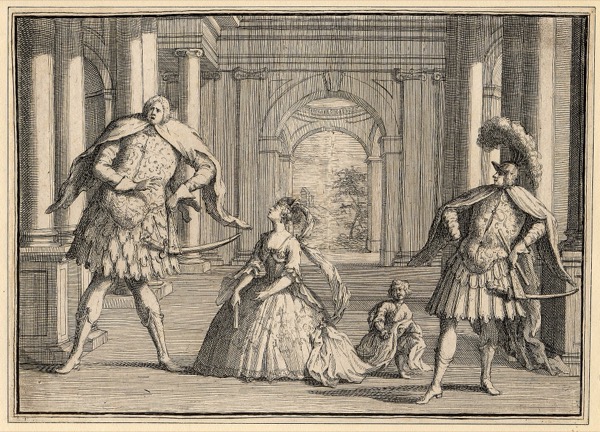
Caricature of Handel’s Flavio; Cuzzoni at the centre
Yet Handel’s Caesar is more than merely a victorious general. When Pompey’s severed head is presented to him as a gift, Caesar responds not with satisfaction but with contempt at what he considers barbarity. Standing before Pompey’s remains, he sings the accompanied recitative “Alma del gran Pompeo”, reflecting on how all worldly glory must ultimately return to dust. Here Handel dispenses with the splendour of the virtuoso aria altogether, setting Caesar’s meditation in music of almost extreme simplicity and creating, precisely through that restraint, a remarkable sense of solemnity. It is a masterstroke.
In the second act “Se in fiorito ameno prato”, however, even the great hero proves unable to avoid a certain romantic conventionality: Caesar, now thoroughly in love, spins an ingratiatingly graceful melody while an obbligato violin repeatedly imitates birdsong, the two forming an exquisitely sweet duet. Fortunately, Handel’s craftsmanship is so assured that the music never sinks into mere sentimentality.
Musically, however, the opera’s most glamorous star is unquestionably Cleopatra. Whether in Shakespeare’s Antony and Cleopatra or in Handel’s opera, the seductive Queen of Egypt can hardly fail to steal the theatrical spotlight. In Act II, Cleopatra disguises herself as the goddess Lydia and conjures before Caesar a vision of Mount Parnassus, carrying her display of seductive charm to its extravagant extreme. Handel even deploys an additional ensemble onstage as a band of “celestial musicians”. Among its instruments are the theorbo and viola da gamba, both already beginning to seem somewhat outdated by Handel’s time; their unusual timbres help create an archaic, almost otherworldly soundscape.
Giulio Cesare: ‘V’adoro, pupille’ – Glyndebourne
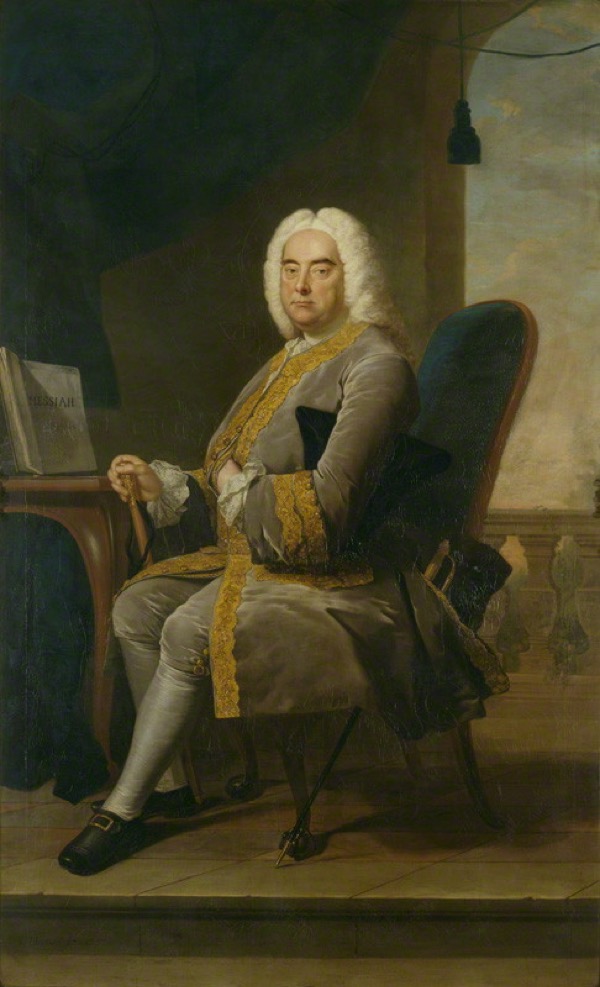
George Frideric Handel
Shakespeare’s Cleopatra is an extraordinarily complex creation. Handel’s may not possess quite the same psychological intricacy, but she is nevertheless strikingly multifaceted. At first, Cleopatra approaches Caesar to exploit him politically, only to succumb in turn to his masculine charisma, a plot development that is, admittedly, a little melodramatic. Yet Handel’s music gives the character genuine depth and warmth. Her prayer for Caesar’s victory, “Se pietà di me non senti”, is dark-hued and deeply affecting. Still more dramatically charged is “Piangerò la sorte mia”, sung after Cleopatra has been defeated and imprisoned and believes Caesar to be dead. She begins by lamenting her fate in a broad, slow-moving major-key melody; then, quite suddenly, grief turns to fury, as she declares that even after death her ghost will return to torment those who have persecuted her. Later, when Caesar escapes death and Cleopatra regains her freedom, “Da tempeste il legno infranto” sweeps away all the preceding heaviness. In its place comes an exuberant display of brilliant coloratura, the sheer buoyancy of the writing forming a vivid contrast with her earlier introspection.
Giulio Cesare: ‘Da tempeste il legno infranto’ | Glyndebourne
Cleopatra is consequently a role of formidable difficulty. Handel created it for the great soprano Francesca Cuzzoni. Cuzzoni had made her London debut in 1723 in another Handel opera, Ottone. Although relations between singer and composer were reportedly somewhat tempestuous at first, Handel soon came to recognise the exceptional gifts of this notoriously eccentric Italian soprano, ultimately creating nine roles for her. During one of their quarrels, Handel is said to have called Cuzzoni a “devil”, while declaring himself to be “Beelzebub, the chief of devils”, and therefore not afraid of her. Perhaps characters such as Cleopatra, simultaneously alluring and dangerous, vulnerable and calculating, could neither have been written nor sung quite so convincingly without personalities of similarly contradictory temperaments behind them.
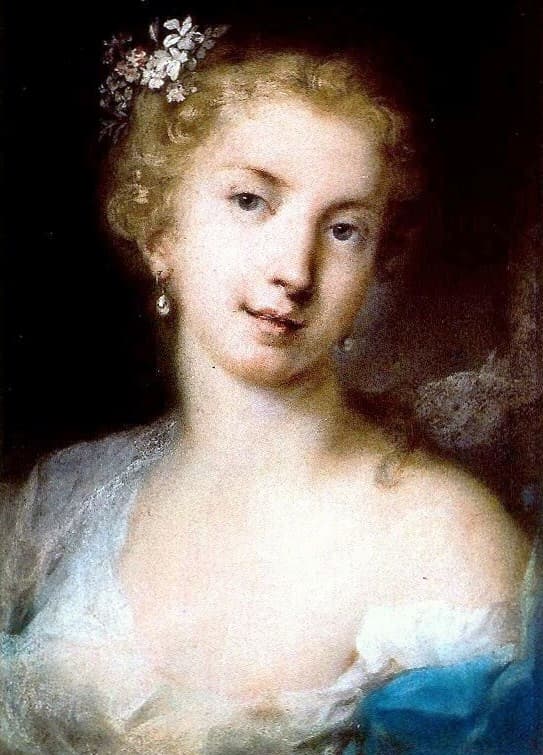
Francesca Cuzzoni
For more of the best in classical music, sign up for our E-Newsletter